
Sets and Properties of Equality 1 1 B
Sets and Properties of Equality 1. 1 -B
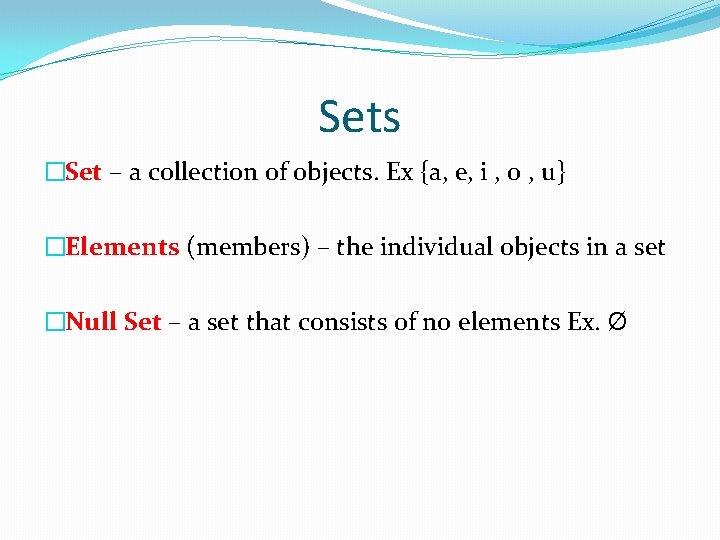
Sets �Set – a collection of objects. Ex {a, e, i , o , u} �Elements (members) – the individual objects in a set �Null Set – a set that consists of no elements Ex. Ø
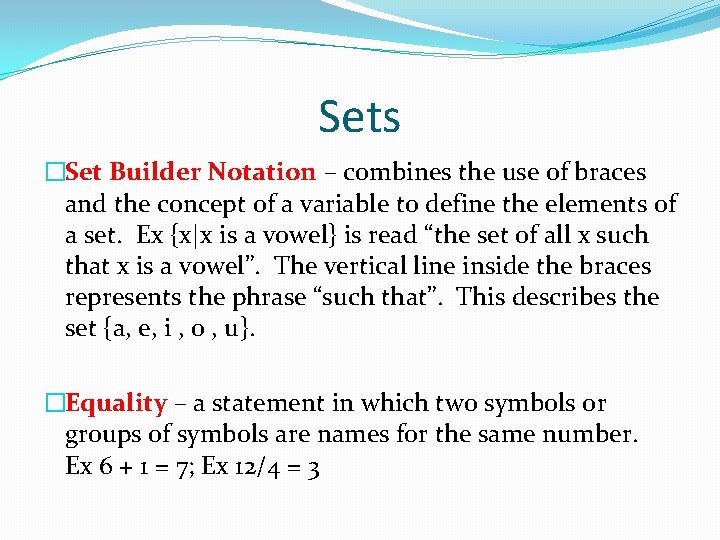
Sets �Set Builder Notation – combines the use of braces and the concept of a variable to define the elements of a set. Ex {x|x is a vowel} is read “the set of all x such that x is a vowel”. The vertical line inside the braces represents the phrase “such that”. This describes the set {a, e, i , o , u}. �Equality – a statement in which two symbols or groups of symbols are names for the same number. Ex 6 + 1 = 7; Ex 12/4 = 3
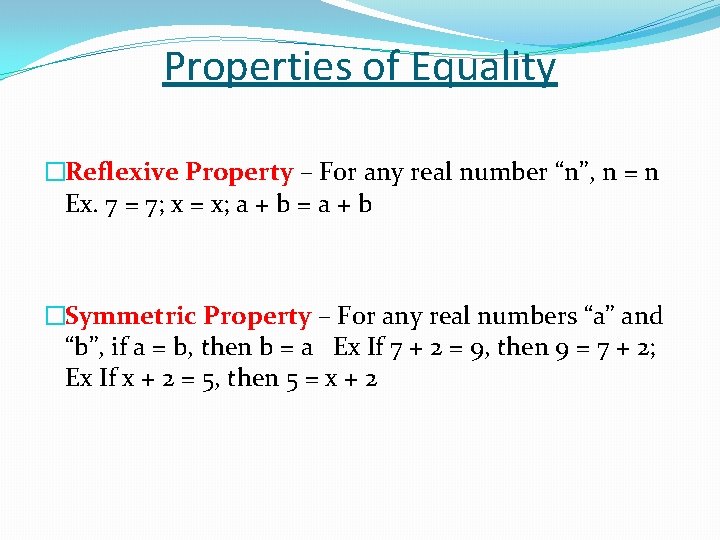
Properties of Equality �Reflexive Property – For any real number “n”, n = n Ex. 7 = 7; x = x; a + b = a + b �Symmetric Property – For any real numbers “a” and “b”, if a = b, then b = a Ex If 7 + 2 = 9, then 9 = 7 + 2; Ex If x + 2 = 5, then 5 = x + 2
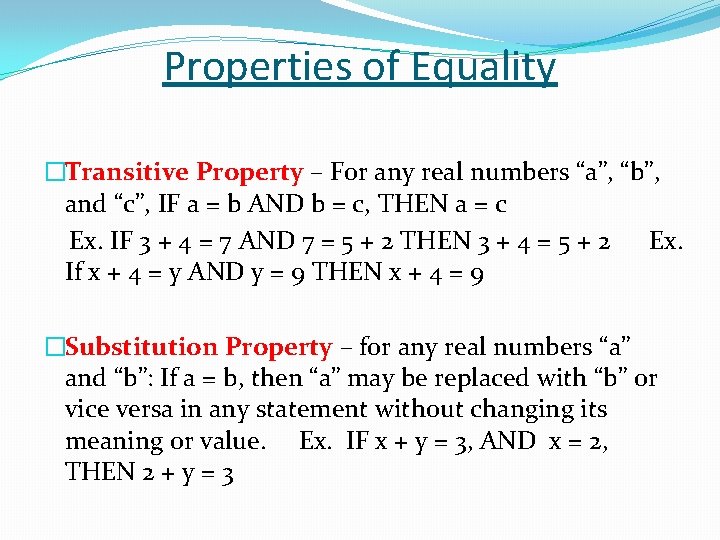
Properties of Equality �Transitive Property – For any real numbers “a”, “b”, and “c”, IF a = b AND b = c, THEN a = c Ex. IF 3 + 4 = 7 AND 7 = 5 + 2 THEN 3 + 4 = 5 + 2 Ex. If x + 4 = y AND y = 9 THEN x + 4 = 9 �Substitution Property – for any real numbers “a” and “b”: If a = b, then “a” may be replaced with “b” or vice versa in any statement without changing its meaning or value. Ex. IF x + y = 3, AND x = 2, THEN 2 + y = 3
- Slides: 5