
Set Products COMPONENT 1 Kiss of the Vampire
- Slides: 19
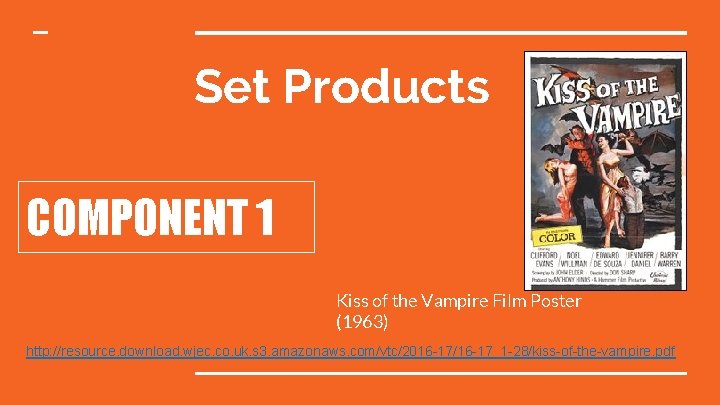
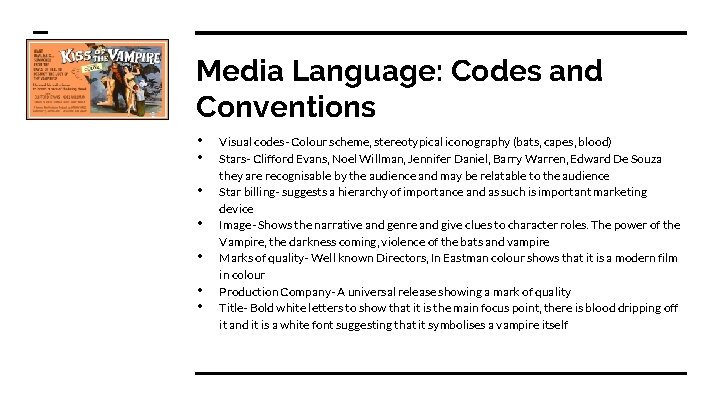
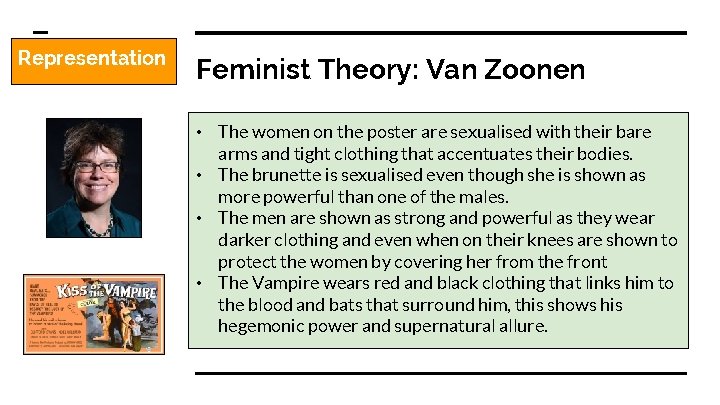
Set Products COMPONENT 1 Kiss of the Vampire Film Poster (1963) http: //resource. download. wjec. co. uk. s 3. amazonaws. com/vtc/2016 -17/16 -17_1 -28/kiss-of-the-vampire. pdf
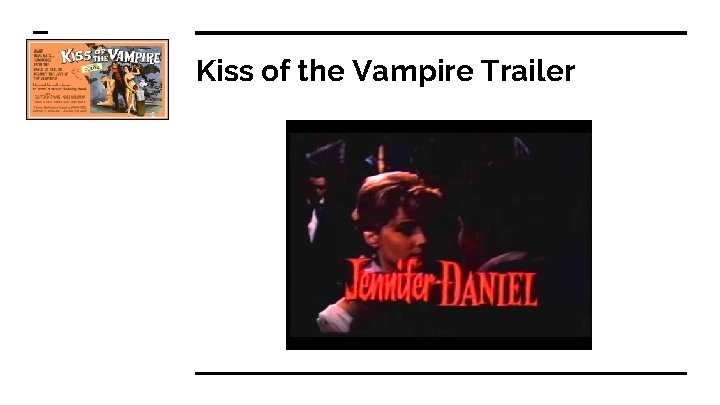
Kiss of the Vampire Trailer
Product Context Produced by Hammer film Production and distributed by J. Arthur Rank and Universal, Kiss of the Vampire was intended to be the second sequel to 1958 s Dracula, although the film's script actually makes no reference to Stoker's character. This is perhaps to distance itself from unfavorable comparisons to the superior Christopher Lee who starred in the original film.
Media Language: Cultural Context The 1960 s audience for this advert could be assumed to be familiar with the codes and conventions of a 'monster movie' films posters- such as its composition, fonts and representations of 'the monster' and its (usually female) victims. Interesting texts for comparative study might include: The Evil of Frankenstein (1964) and Blood from the Mummy's Tomb (1971).
Media Language: Codes and Conventions • • Visual codes- Colour scheme, stereotypical iconography (bats, capes, blood) Stars- Clifford Evans, Noel Willman, Jennifer Daniel, Barry Warren, Edward De Souza they are recognisable by the audience and may be relatable to the audience Star billing- suggests a hierarchy of importance and as such is important marketing device Image- Shows the narrative and genre and give clues to character roles. The power of the Vampire, the darkness coming, violence of the bats and vampire Marks of quality- Well known Directors, In Eastman colour shows that it is a modern film in colour Production Company- A universal release showing a mark of quality Title- Bold white letters to show that it is the main focus point, there is blood dripping off it and it is a white font suggesting that it symbolises a vampire itself
Media Language Semiotics: Roland Barthes ● the idea that texts communicate their meanings through a process of signification ● the idea that signs can function at the level of denotation, which involves the ‘literal’ or common-sense meaning of the sign, and at the level of connotation, which involves the meanings associated with or suggested by the sign ● the idea that constructed meanings can come to seem self -evident, achieving the status of myth through a process of naturalisation.
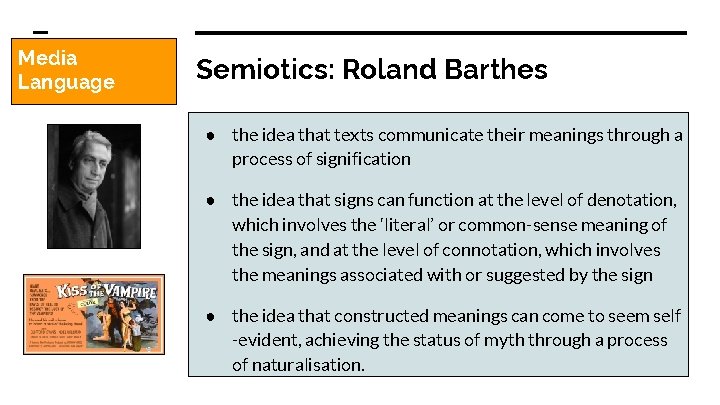
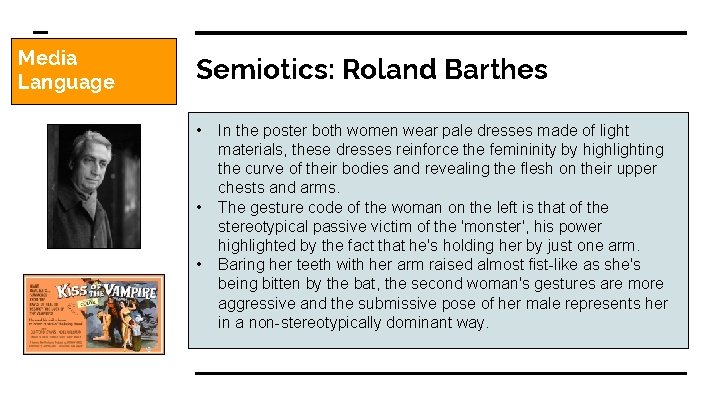
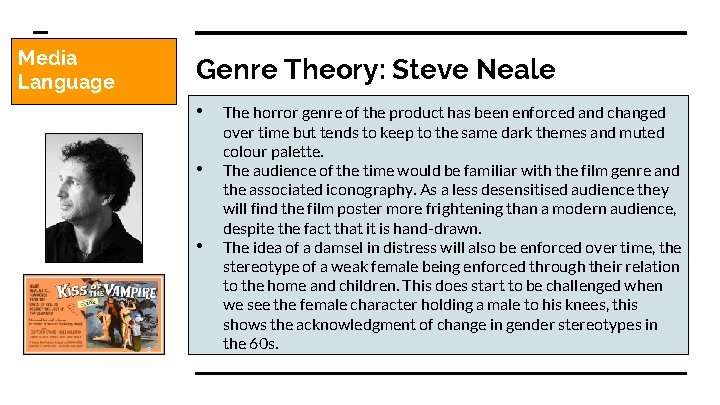
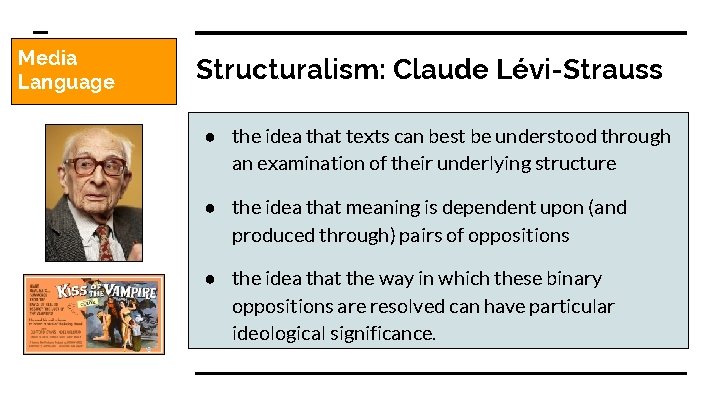
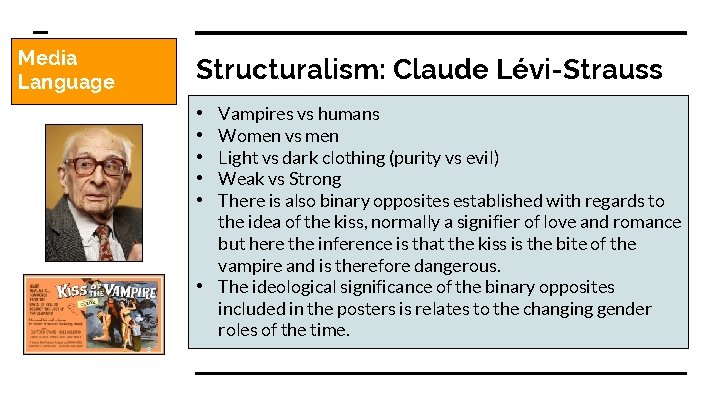
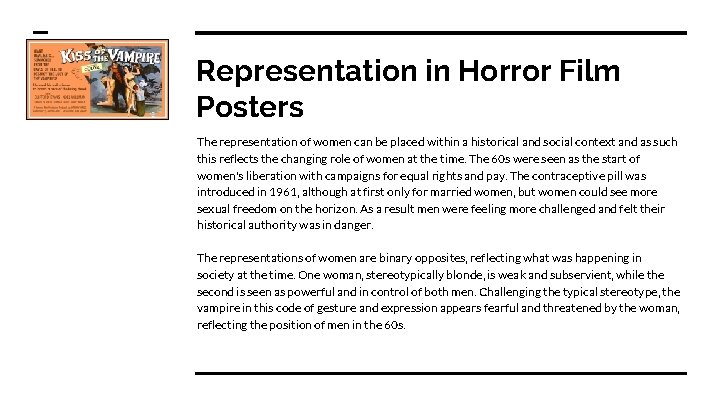
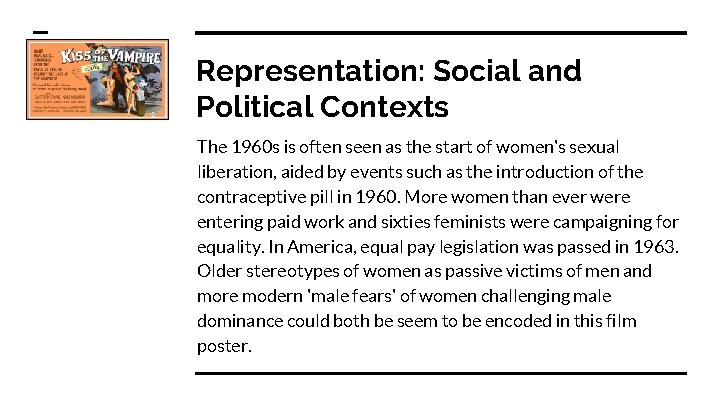
Media Language Semiotics: Roland Barthes • • • In the poster both women wear pale dresses made of light materials, these dresses reinforce the femininity by highlighting the curve of their bodies and revealing the flesh on their upper chests and arms. The gesture code of the woman on the left is that of the stereotypical passive victim of the 'monster', his power highlighted by the fact that he's holding her by just one arm. Baring her teeth with her arm raised almost fist-like as she's being bitten by the bat, the second woman's gestures are more aggressive and the submissive pose of her male represents her in a non-stereotypically dominant way.
Media Language Genre Theory: Steve Neale ● the idea that genres may be dominated by repetition, but are also marked by difference, variation, and change ● the idea that genres change, develop, and vary, as they borrow from and overlap with one another ● the idea that genres exist within specific economic, institutional and industrial contexts
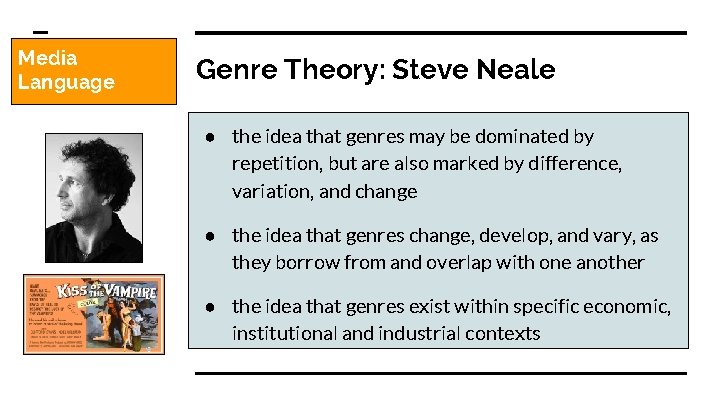
Media Language Genre Theory: Steve Neale • • • The horror genre of the product has been enforced and changed over time but tends to keep to the same dark themes and muted colour palette. The audience of the time would be familiar with the film genre and the associated iconography. As a less desensitised audience they will find the film poster more frightening than a modern audience, despite the fact that it is hand-drawn. The idea of a damsel in distress will also be enforced over time, the stereotype of a weak female being enforced through their relation to the home and children. This does start to be challenged when we see the female character holding a male to his knees, this shows the acknowledgment of change in gender stereotypes in the 60 s.
Media Language Structuralism: Claude Lévi-Strauss ● the idea that texts can best be understood through an examination of their underlying structure ● the idea that meaning is dependent upon (and produced through) pairs of oppositions ● the idea that the way in which these binary oppositions are resolved can have particular ideological significance.
Media Language Structuralism: Claude Lévi-Strauss • • • Vampires vs humans Women vs men Light vs dark clothing (purity vs evil) Weak vs Strong There is also binary opposites established with regards to the idea of the kiss, normally a signifier of love and romance but here the inference is that the kiss is the bite of the vampire and is therefore dangerous. • The ideological significance of the binary opposites included in the posters is relates to the changing gender roles of the time.
Representation in Horror Film Posters The representation of women can be placed within a historical and social context and as such this reflects the changing role of women at the time. The 60 s were seen as the start of women's liberation with campaigns for equal rights and pay. The contraceptive pill was introduced in 1961, although at first only for married women, but women could see more sexual freedom on the horizon. As a result men were feeling more challenged and felt their historical authority was in danger. The representations of women are binary opposites, reflecting what was happening in society at the time. One woman, stereotypically blonde, is weak and subservient, while the second is seen as powerful and in control of both men. Challenging the typical stereotype, the vampire in this code of gesture and expression appears fearful and threatened by the woman, reflecting the position of men in the 60 s.
Representation: Social and Political Contexts The 1960 s is often seen as the start of women's sexual liberation, aided by events such as the introduction of the contraceptive pill in 1960. More women than ever were entering paid work and sixties feminists were campaigning for equality. In America, equal pay legislation was passed in 1963. Older stereotypes of women as passive victims of men and more modern 'male fears' of women challenging male dominance could both be seem to be encoded in this film poster.
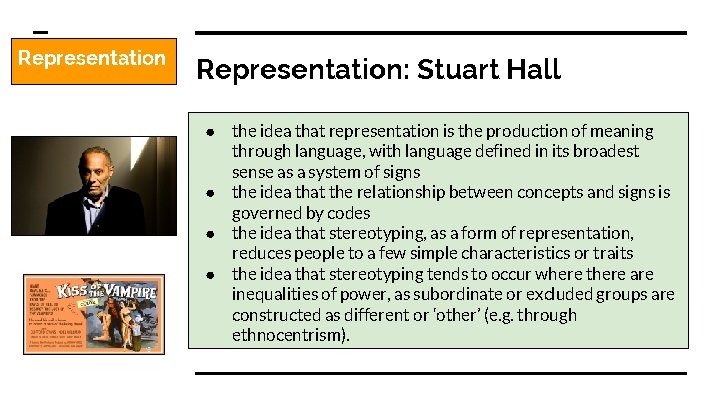
Representation: Stuart Hall ● the idea that representation is the production of meaning through language, with language defined in its broadest sense as a system of signs ● the idea that the relationship between concepts and signs is governed by codes ● the idea that stereotyping, as a form of representation, reduces people to a few simple characteristics or traits ● the idea that stereotyping tends to occur where there are inequalities of power, as subordinate or excluded groups are constructed as different or ‘other’ (e. g. through ethnocentrism).
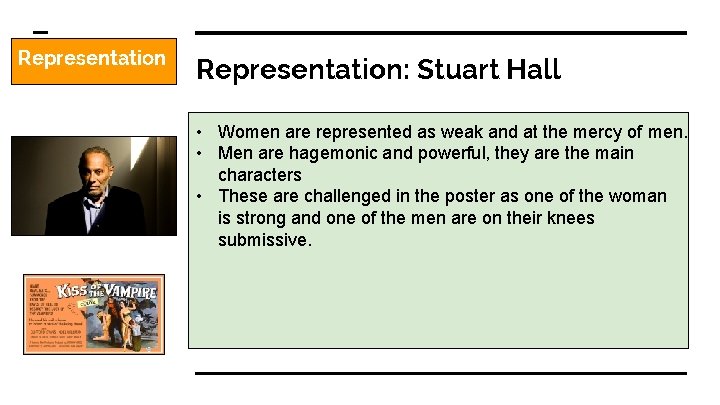
Representation: Stuart Hall • Women are represented as weak and at the mercy of men. • Men are hagemonic and powerful, they are the main characters • These are challenged in the poster as one of the woman is strong and one of the men are on their knees submissive.
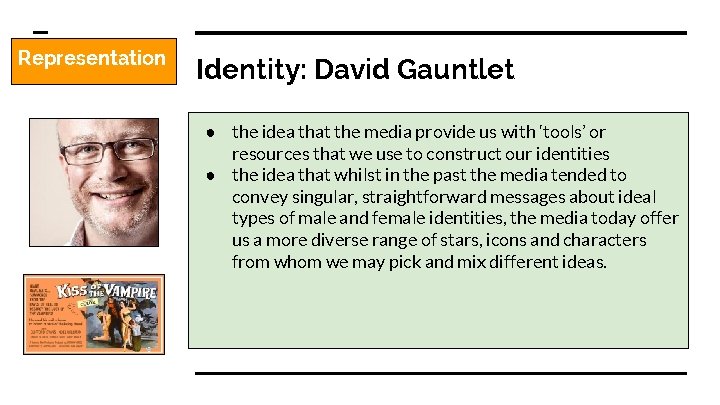
Representation Identity: David Gauntlet ● the idea that the media provide us with ‘tools’ or resources that we use to construct our identities ● the idea that whilst in the past the media tended to convey singular, straightforward messages about ideal types of male and female identities, the media today offer us a more diverse range of stars, icons and characters from whom we may pick and mix different ideas.
Representation Identity: David Gauntlet In the 60's there would have been limited representations in the media as the characters were usually white or at least all the "good" characters were, this is due to the fact that people were still racist on the whole and segregation continued until the 70 s. Negative stereotypes are portrayed in the poster and I assume in the movie too, this is where men are controlling and violent and women are submissive and at the mercy of men.
Representation Feminist Theory: Van Zoonen ● the idea that gender is constructed through discourse, and that its meaning varies according to cultural and historical context ● the idea that the display of women’s bodies as objects to be looked at is a core element of western patriarchal culture ● the idea that in mainstream culture the visual and narrative codes that are used to construct the male body as spectacle differ from those used to objectify the female body.
Representation Feminist Theory: Van Zoonen • The women on the poster are sexualised with their bare arms and tight clothing that accentuates their bodies. • The brunette is sexualised even though she is shown as more powerful than one of the males. • The men are shown as strong and powerful as they wear darker clothing and even when on their knees are shown to protect the women by covering her from the front • The Vampire wears red and black clothing that links him to the blood and bats that surround him, this shows his hegemonic power and supernatural allure.