
Set Design Techniques An overview of Curtains Rigging

- Slides: 39
Set Design Techniques An overview of Curtains, Rigging, and Scenery Construction
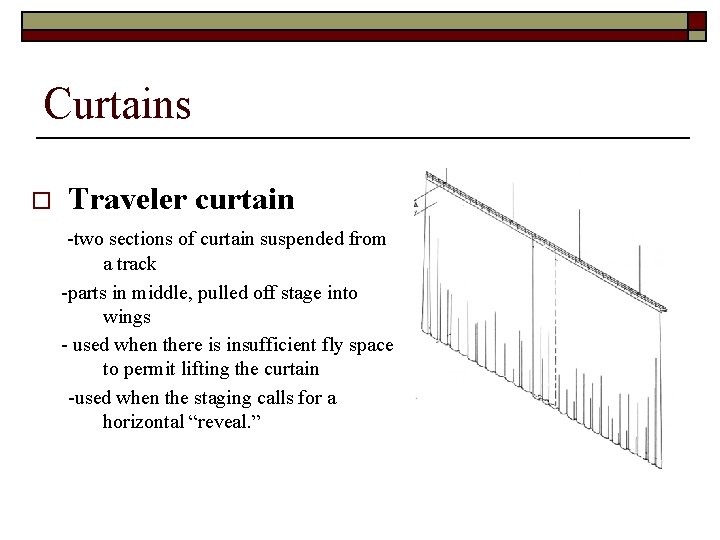
Curtains o Traveler curtain -two sections of curtain suspended from a track -parts in middle, pulled off stage into wings - used when there is insufficient fly space to permit lifting the curtain -used when the staging calls for a horizontal “reveal. ”
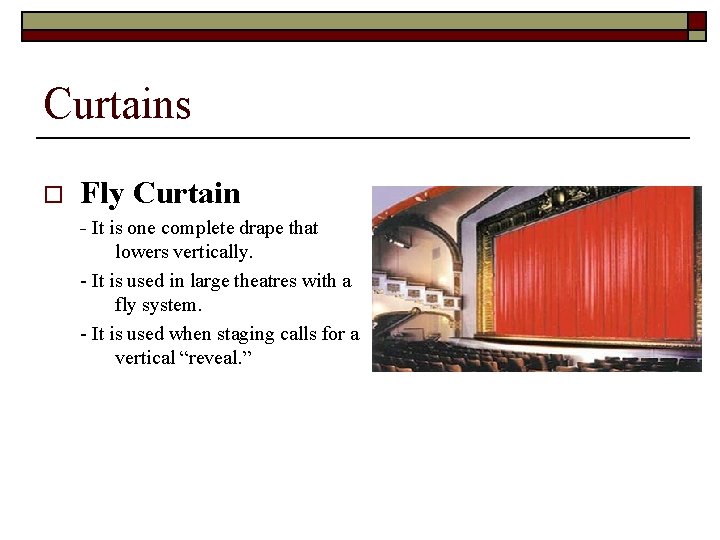
Curtains o Fly Curtain - It is one complete drape that lowers vertically. - It is used in large theatres with a fly system. - It is used when staging calls for a vertical “reveal. ”
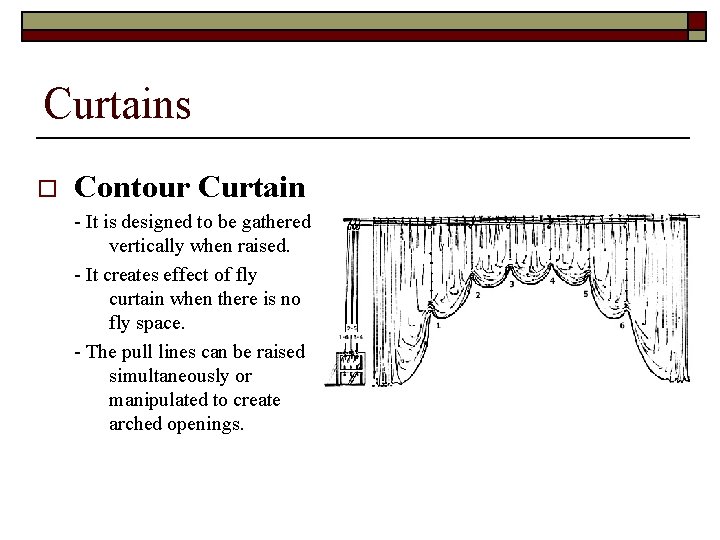
Curtains o Contour Curtain - It is designed to be gathered vertically when raised. - It creates effect of fly curtain when there is no fly space. - The pull lines can be raised simultaneously or manipulated to create arched openings.
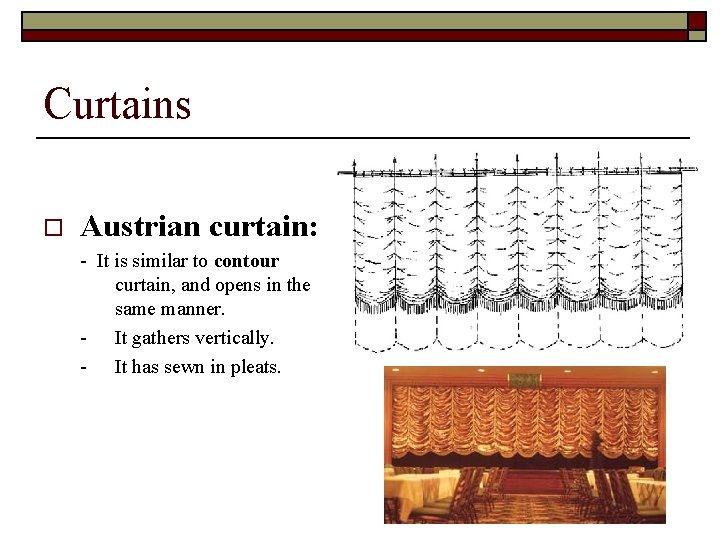
Curtains o Austrian curtain: - It is similar to contour curtain, and opens in the same manner. - It gathers vertically. - It has sewn in pleats.
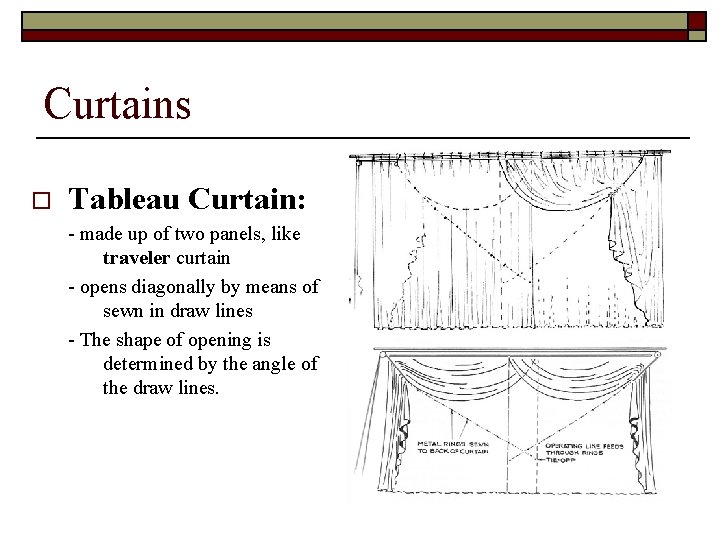
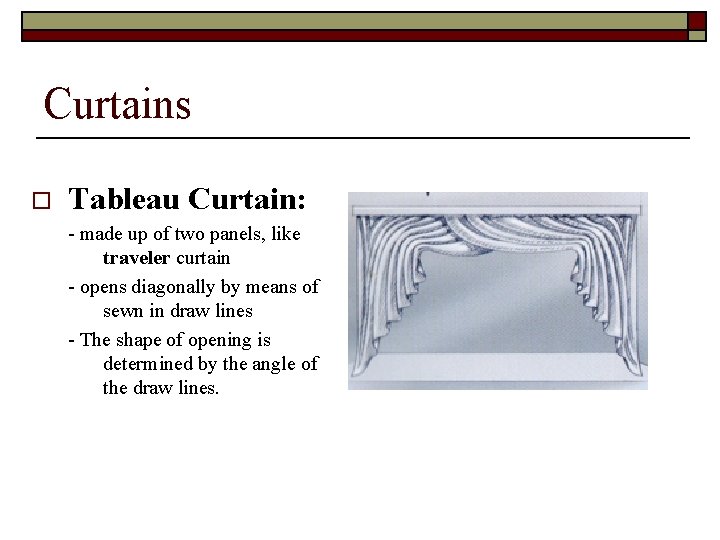
Curtains o Tableau Curtain: - made up of two panels, like traveler curtain - opens diagonally by means of sewn in draw lines - The shape of opening is determined by the angle of the draw lines.
Curtains o Tableau Curtain: - made up of two panels, like traveler curtain - opens diagonally by means of sewn in draw lines - The shape of opening is determined by the angle of the draw lines.
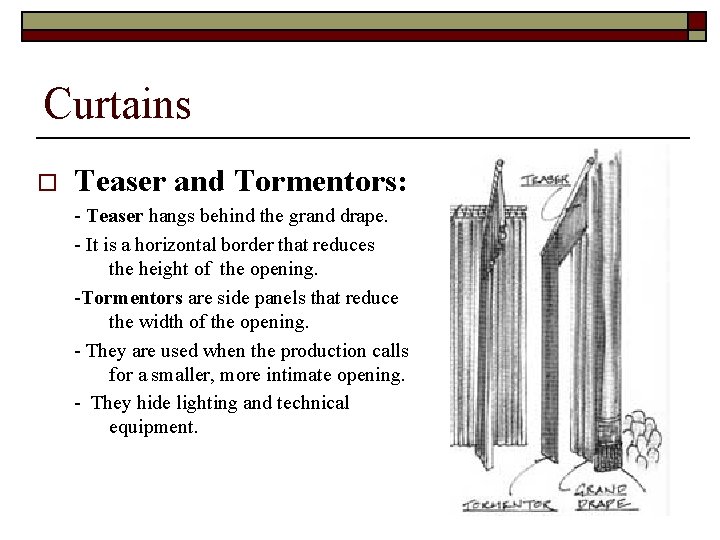
Curtains o Teaser and Tormentors: - Teaser hangs behind the grand drape. - It is a horizontal border that reduces the height of the opening. -Tormentors are side panels that reduce the width of the opening. - They are used when the production calls for a smaller, more intimate opening. - They hide lighting and technical equipment.
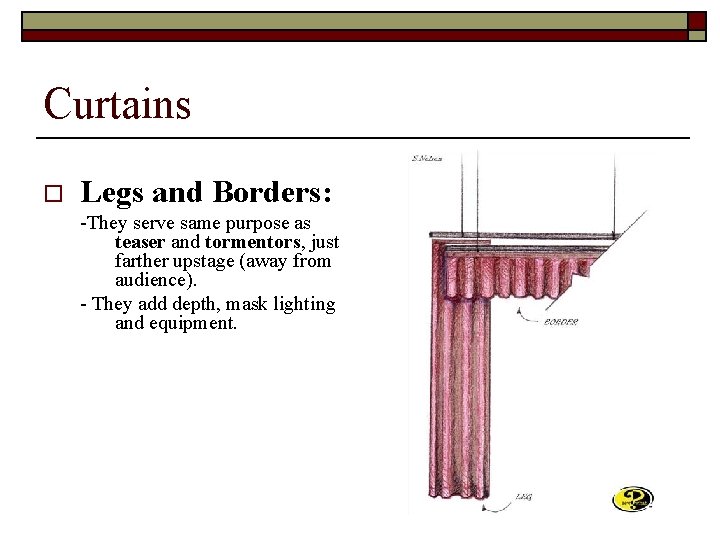
Curtains o Legs and Borders: -They serve same purpose as teaser and tormentors, just farther upstage (away from audience). - They add depth, mask lighting and equipment.
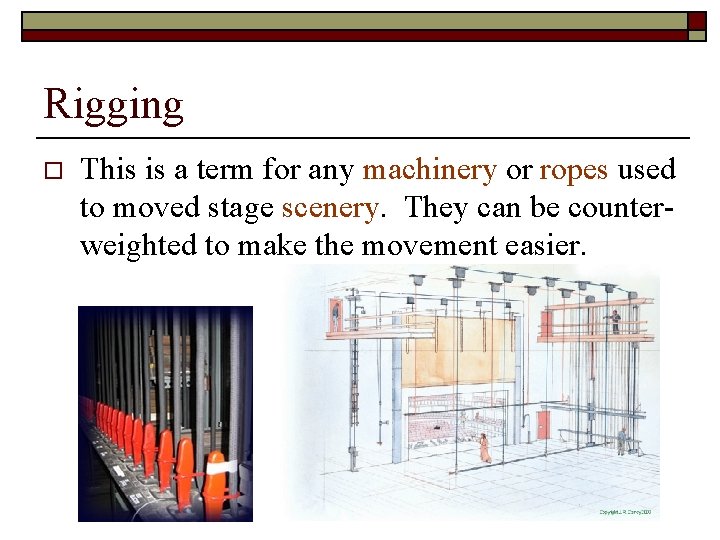
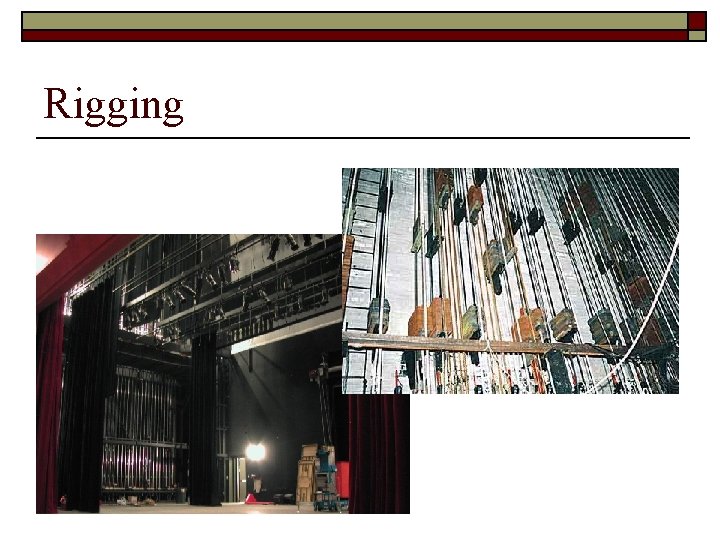
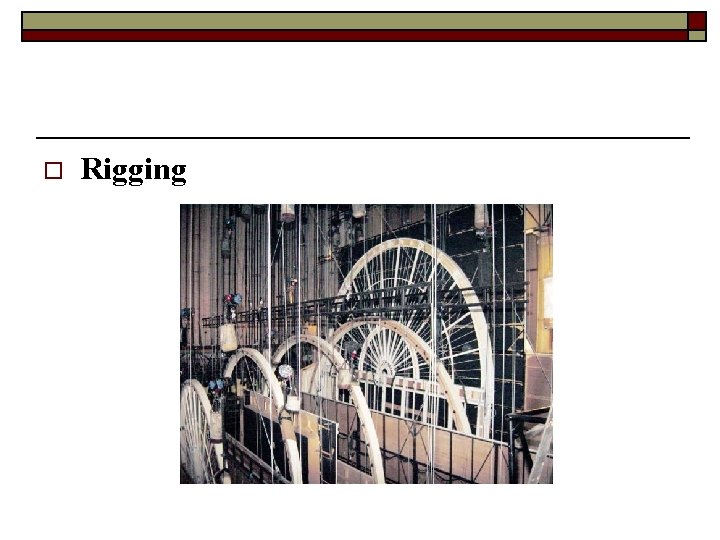
Rigging o This is a term for any machinery or ropes used to moved stage scenery. They can be counterweighted to make the movement easier.
Rigging
o Rigging
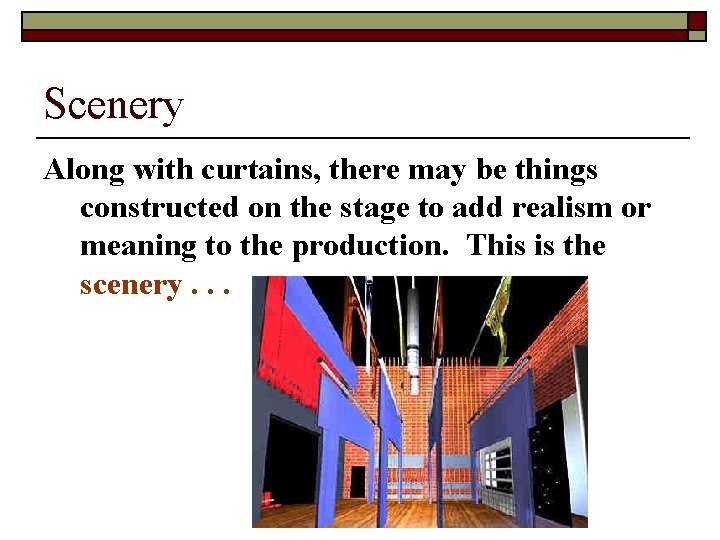
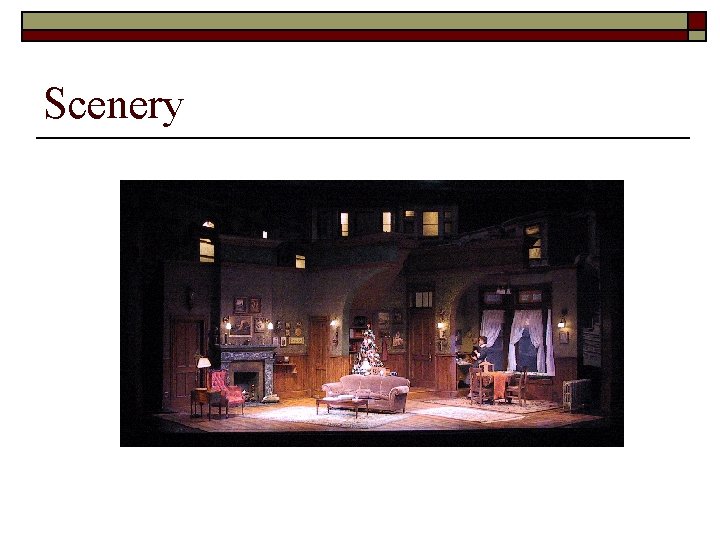
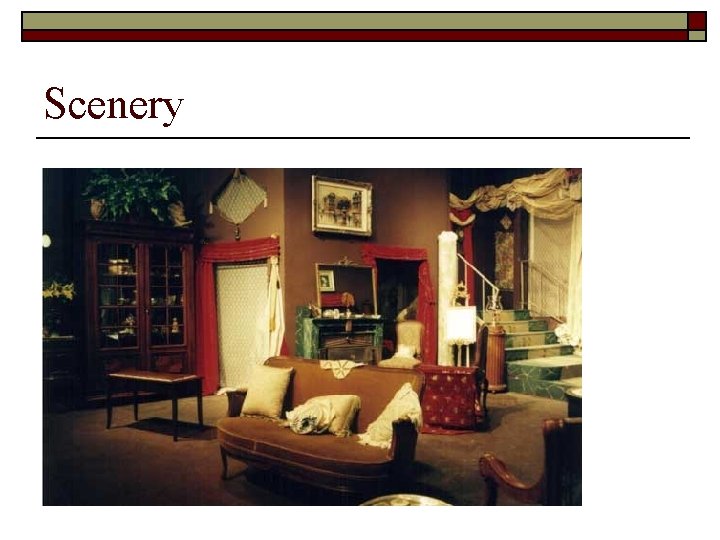
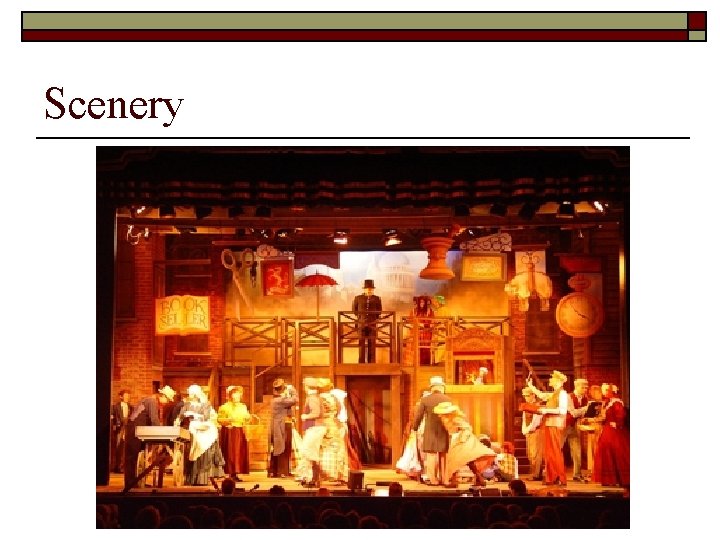
Scenery Along with curtains, there may be things constructed on the stage to add realism or meaning to the production. This is the scenery. . .
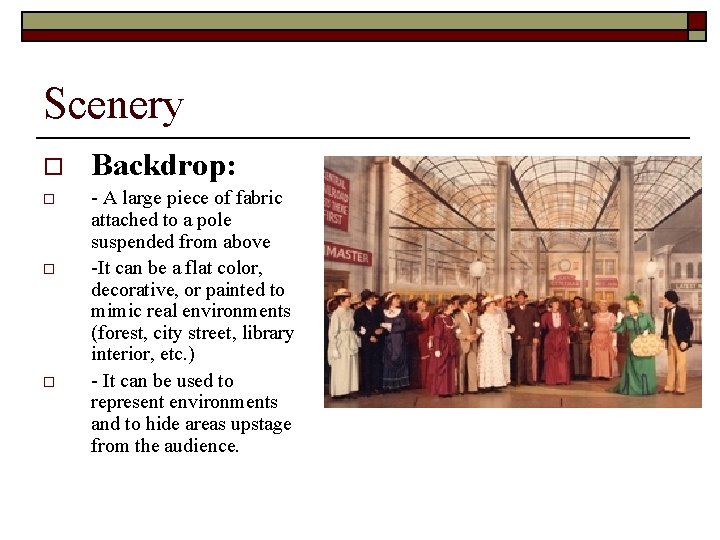
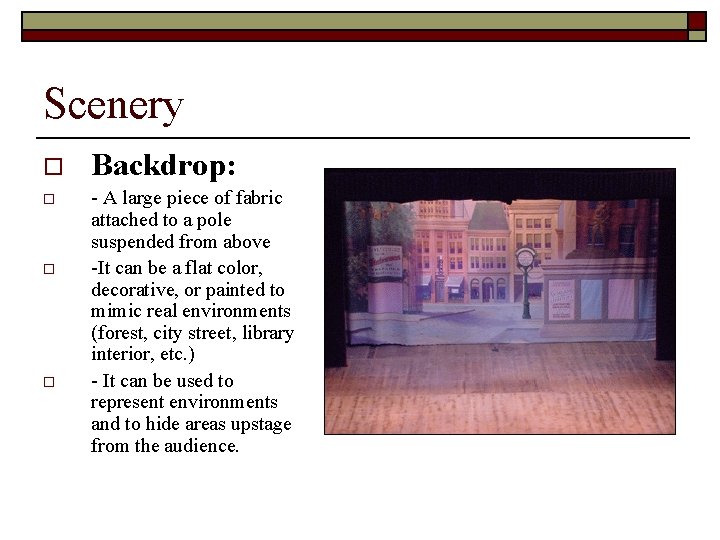
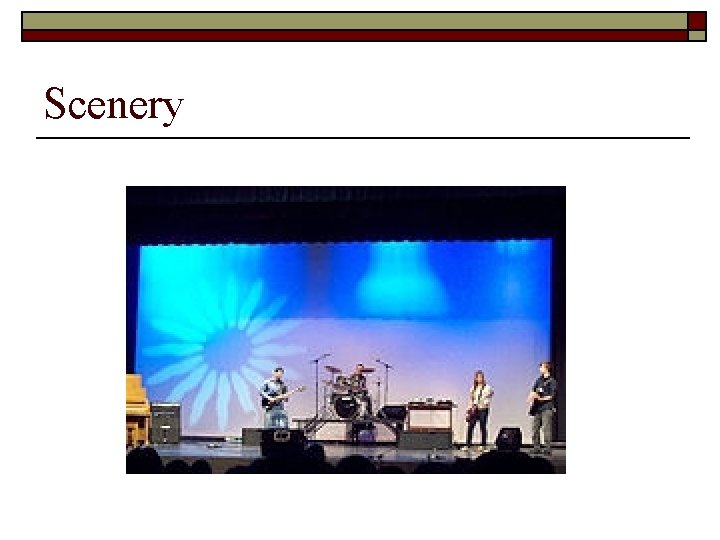
Scenery o o Backdrop: - A large piece of fabric attached to a pole suspended from above -It can be a flat color, decorative, or painted to mimic real environments (forest, city street, library interior, etc. ) - It can be used to represent environments and to hide areas upstage from the audience.
Scenery o o Backdrop: - A large piece of fabric attached to a pole suspended from above -It can be a flat color, decorative, or painted to mimic real environments (forest, city street, library interior, etc. ) - It can be used to represent environments and to hide areas upstage from the audience.
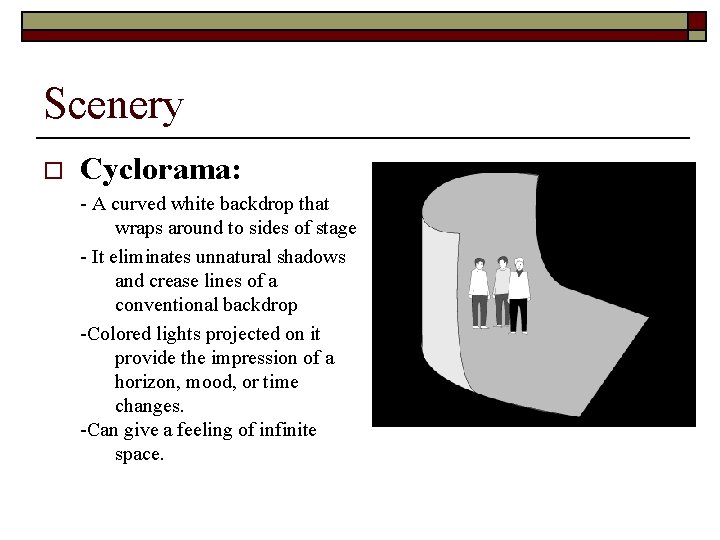
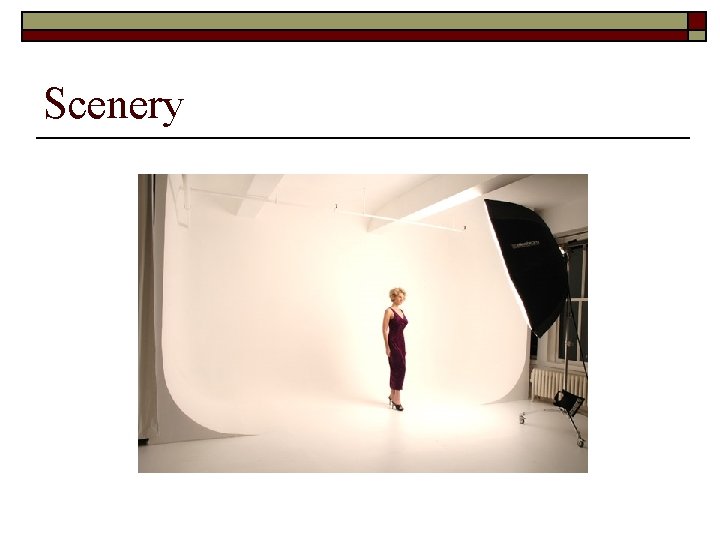
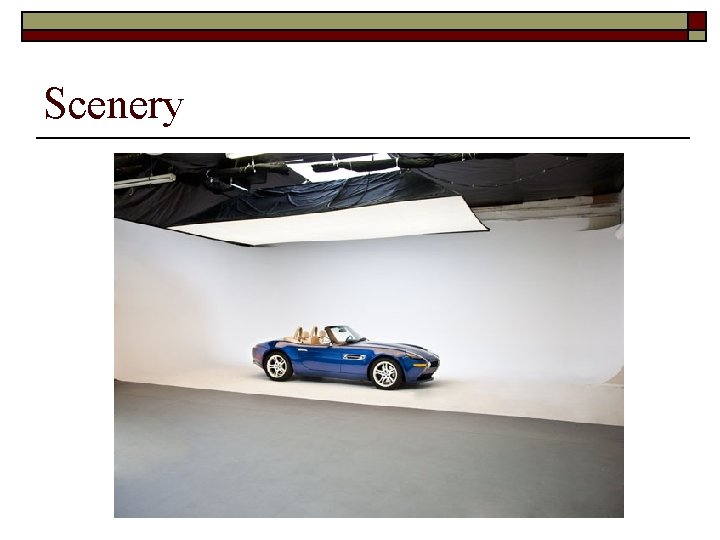
Scenery o Cyclorama: - A curved white backdrop that wraps around to sides of stage - It eliminates unnatural shadows and crease lines of a conventional backdrop -Colored lights projected on it provide the impression of a horizon, mood, or time changes. -Can give a feeling of infinite space.
Scenery
Scenery
Scenery
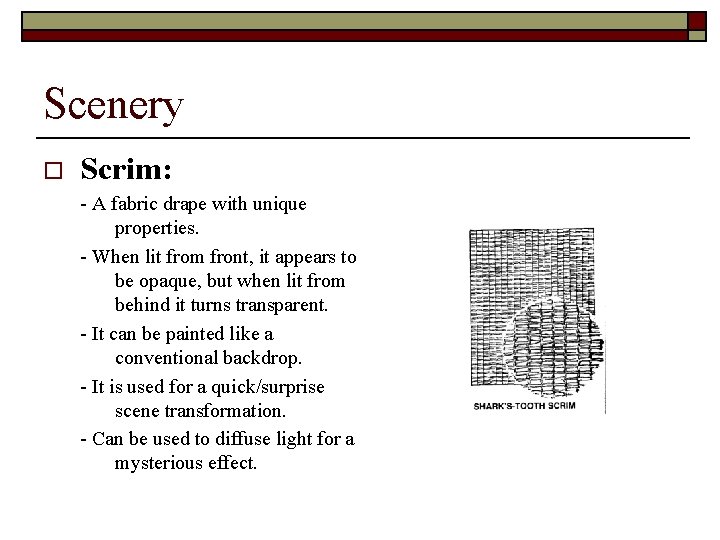
Scenery o Scrim: - A fabric drape with unique properties. - When lit from front, it appears to be opaque, but when lit from behind it turns transparent. - It can be painted like a conventional backdrop. - It is used for a quick/surprise scene transformation. - Can be used to diffuse light for a mysterious effect.
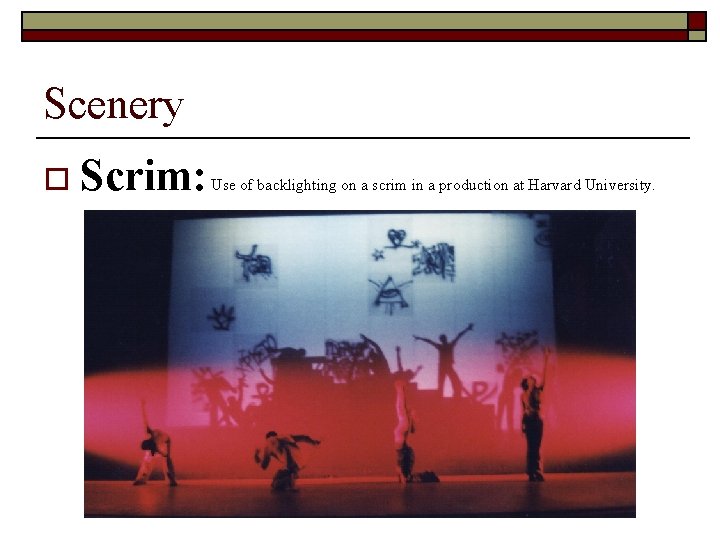
Scenery o Scrim: Use of backlighting on a scrim in a production at Harvard University.
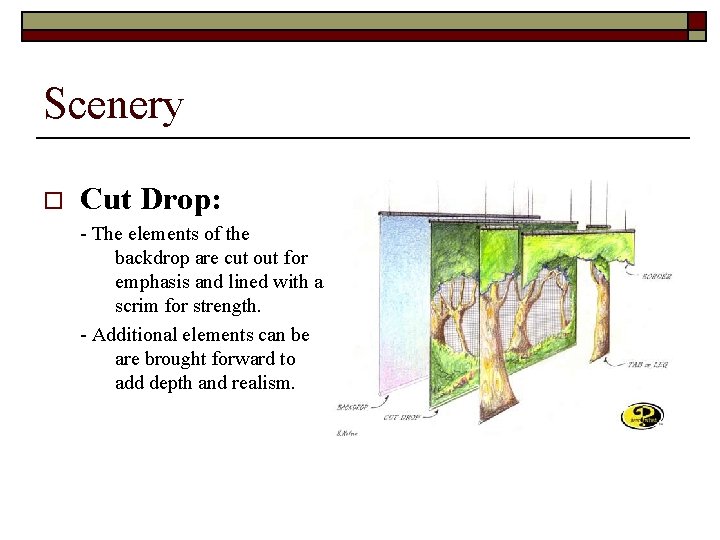
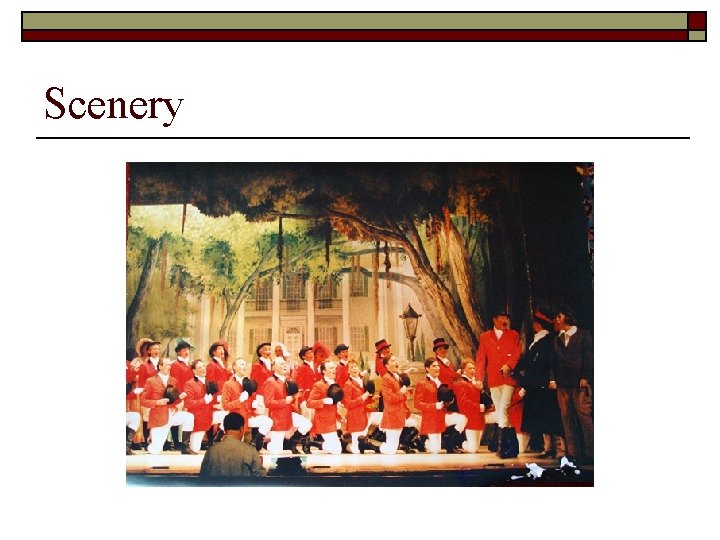
Scenery o Cut Drop: - The elements of the backdrop are cut out for emphasis and lined with a scrim for strength. - Additional elements can be are brought forward to add depth and realism.
Scenery
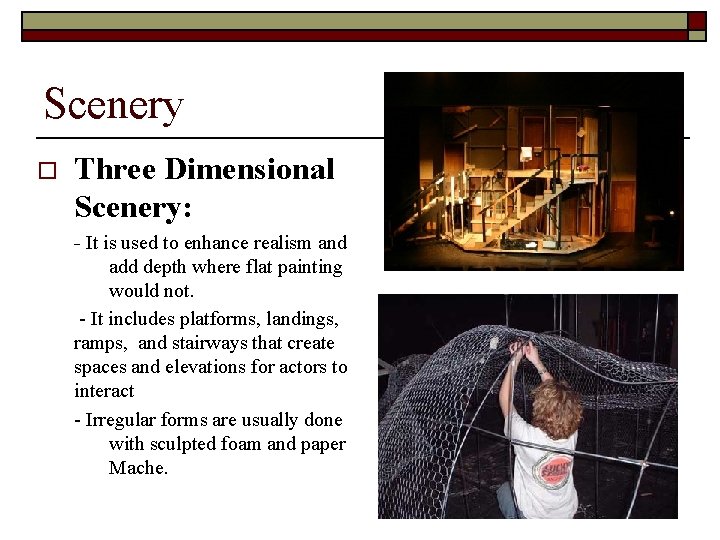
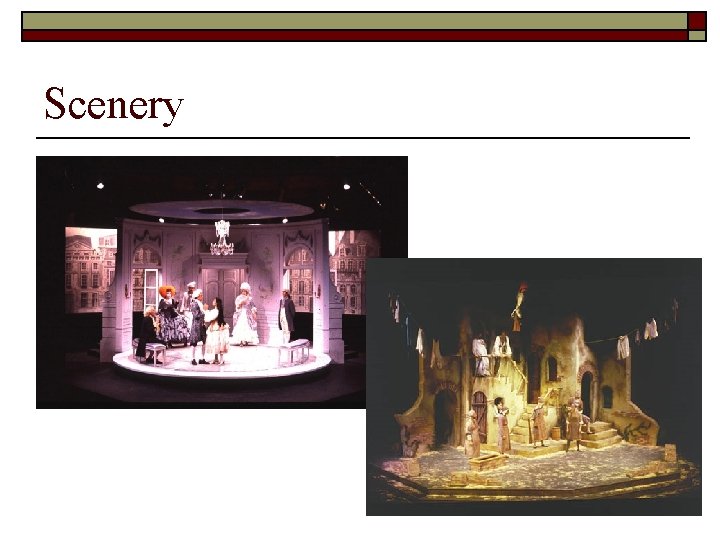
Scenery o Three Dimensional Scenery: - It is used to enhance realism and add depth where flat painting would not. - It includes platforms, landings, ramps, and stairways that create spaces and elevations for actors to interact - Irregular forms are usually done with sculpted foam and paper Mache.
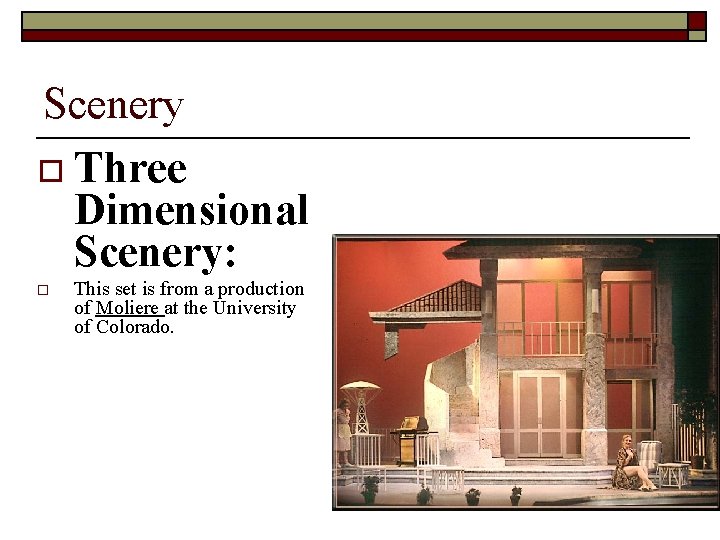
Scenery o Three Dimensional Scenery: o This set is from a production of Moliere at the University of Colorado.
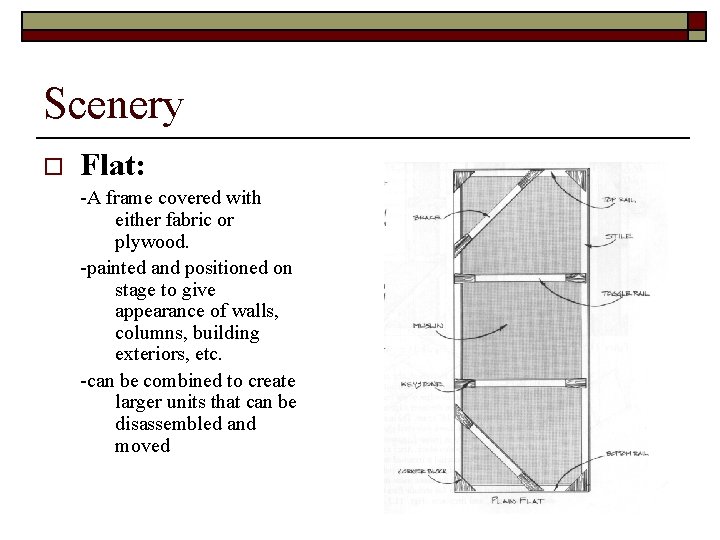
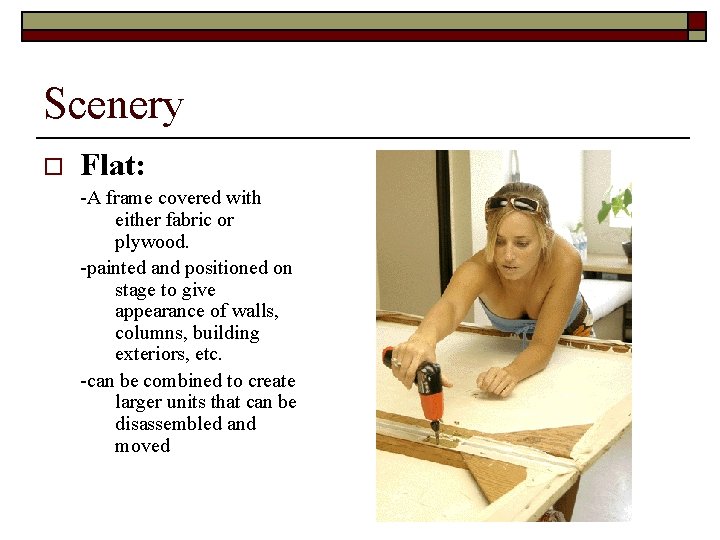
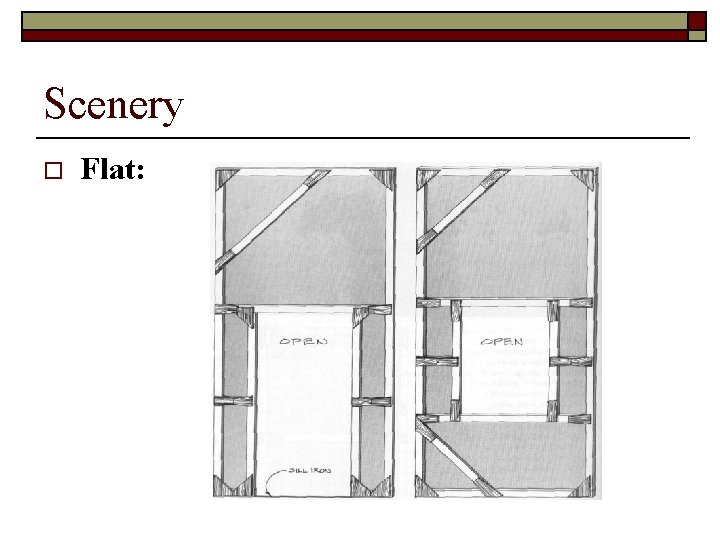
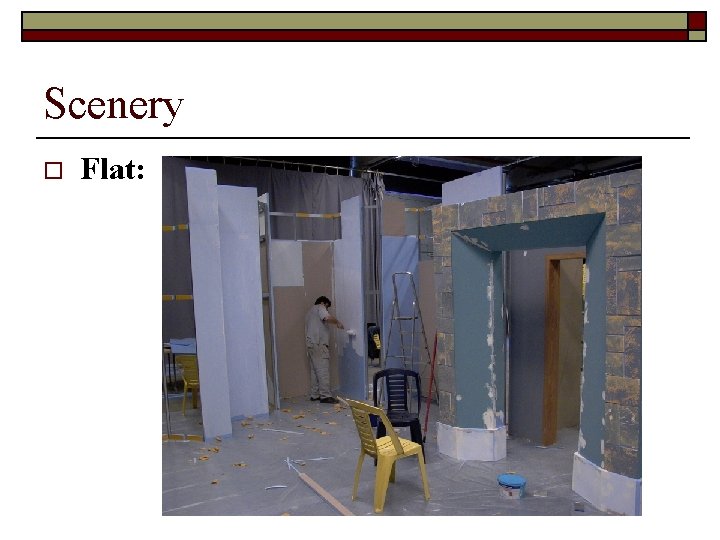
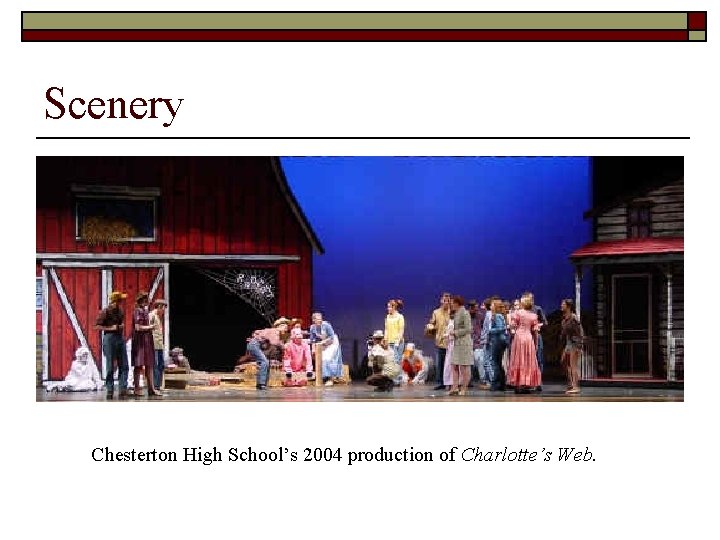
Scenery o Flat: -A frame covered with either fabric or plywood. -painted and positioned on stage to give appearance of walls, columns, building exteriors, etc. -can be combined to create larger units that can be disassembled and moved
Scenery o Flat: -A frame covered with either fabric or plywood. -painted and positioned on stage to give appearance of walls, columns, building exteriors, etc. -can be combined to create larger units that can be disassembled and moved
Scenery o Flat:
Scenery o Flat:
Scenery
Scenery
Scenery Chesterton High School’s 2004 production of Charlotte’s Web.
Scenery
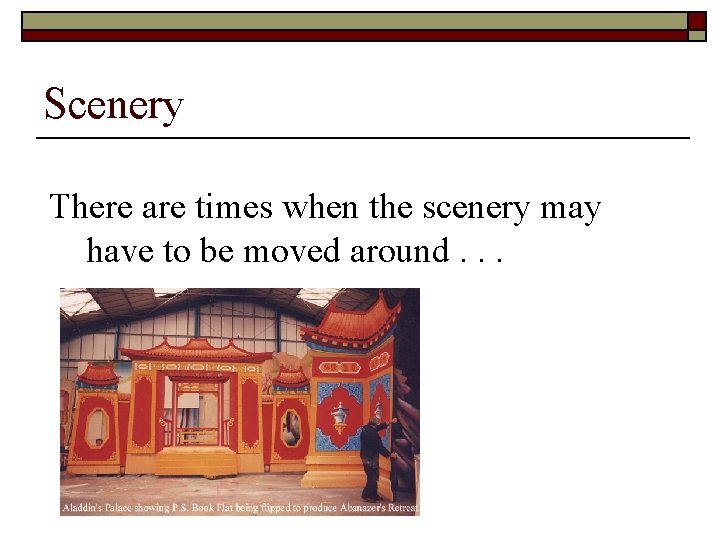
Scenery There are times when the scenery may have to be moved around. . .
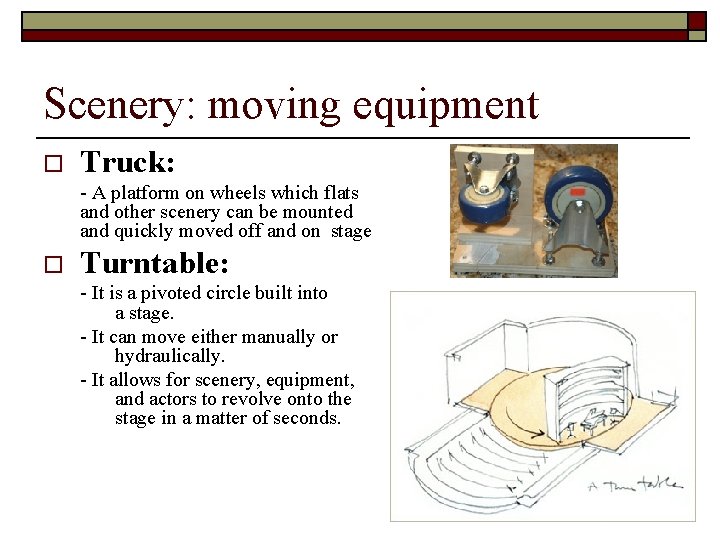
Scenery: moving equipment o Truck: - A platform on wheels which flats and other scenery can be mounted and quickly moved off and on stage o Turntable: - It is a pivoted circle built into a stage. - It can move either manually or hydraulically. - It allows for scenery, equipment, and actors to revolve onto the stage in a matter of seconds.
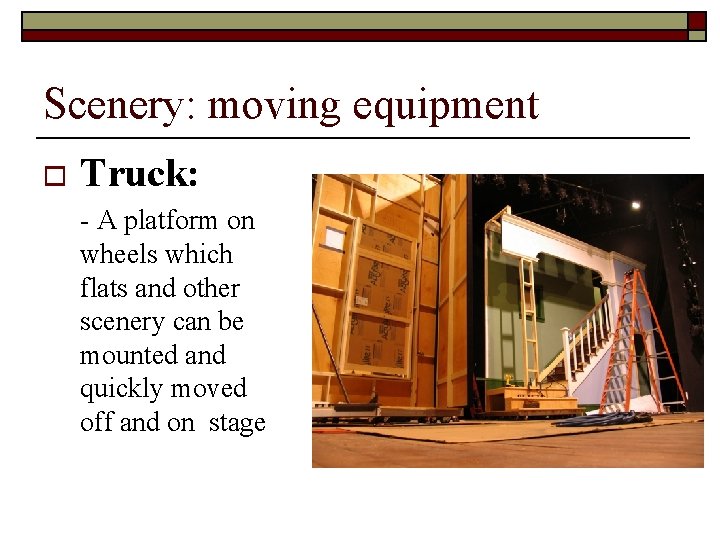
Scenery: moving equipment o Truck: - A platform on wheels which flats and other scenery can be mounted and quickly moved off and on stage
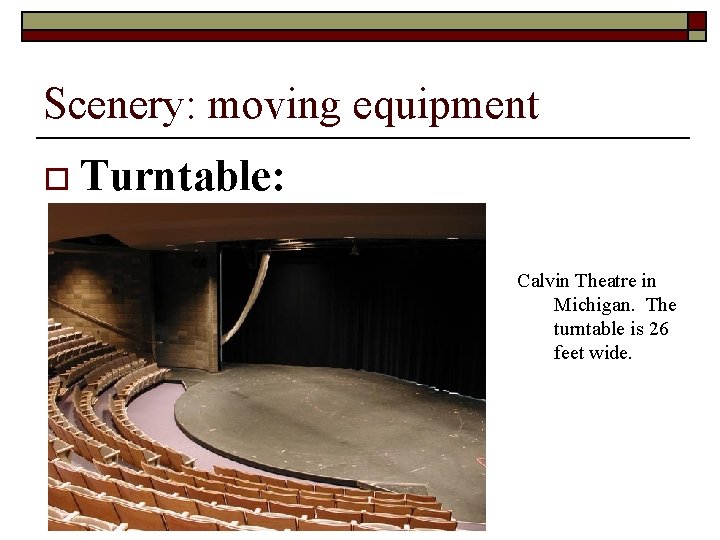
Scenery: moving equipment o Turntable: Calvin Theatre in Michigan. The turntable is 26 feet wide.
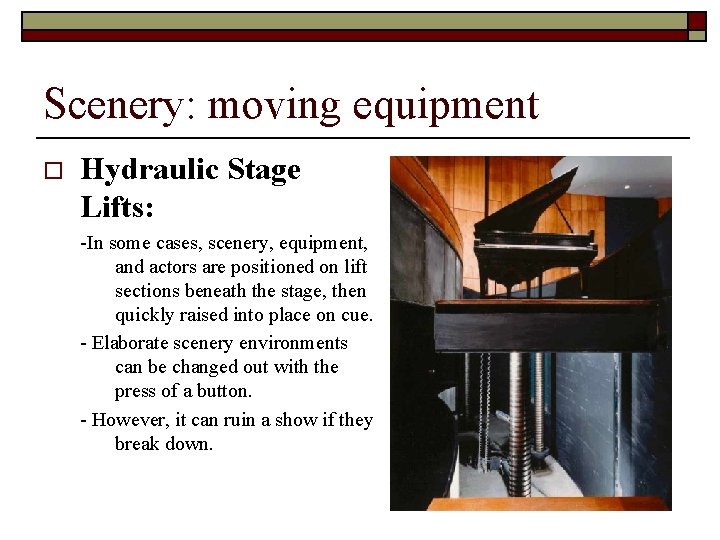
Scenery: moving equipment o Hydraulic Stage Lifts: -In some cases, scenery, equipment, and actors are positioned on lift sections beneath the stage, then quickly raised into place on cue. - Elaborate scenery environments can be changed out with the press of a button. - However, it can ruin a show if they break down.
Scenery