
SET 2 Chapter 4 Probability 4 1 Definitions
SET 2 Chapter 4 Probability ﺍﻹﺣﺘﻤـﺎﻝ
4 - 1 Definitions ﺗﻌﺎﺭﻳﻒ • The probability ( ) ﺍﻹﺣﺘﻤﺎﻝ of something happening is the likelihood or chance of it happening. • An experiment ( )ﺍﻟﺘﺠﺮﺑﺔ is a process that, when performed, results in exactly one of two or more expected results. • These expected results are called the outcomes ( )ﺍﻟﻤﺨﺮﺟﺎﺕ of the experiment. • The set of all possible outcomes for an experiment is called the sample space ( )ﻓﻀﺎﺀ ﺍﻟﻌﻴﻨﺔ , and is denoted by S. • An Event ( )ﺍﻟﺤﺪﺙ is one or more of the experiment’s outcomes. • Values of probability lie between 0 and 1, where 0 represents an absolute impossibility and 1 represents an absolute certainty. • For example, in the case of a die, the event of getting a face of 7 has a probability of 0, because this event cannot occur. The event of getting a face of (1 or 2 or 3 or 4 or 5 or 6) has a probability of 1. 0. SET 2 - Chapter 4 2 GFP - Sohar University

4 - 2 Sample Space ﻓﻀﺎﺀ ﺍﻟﻌﻴﻨﺔ • Examples Tossing a Coin Twice (or Tossing 2 Coins) SET 2 - Chapter 4 3 GFP - Sohar University
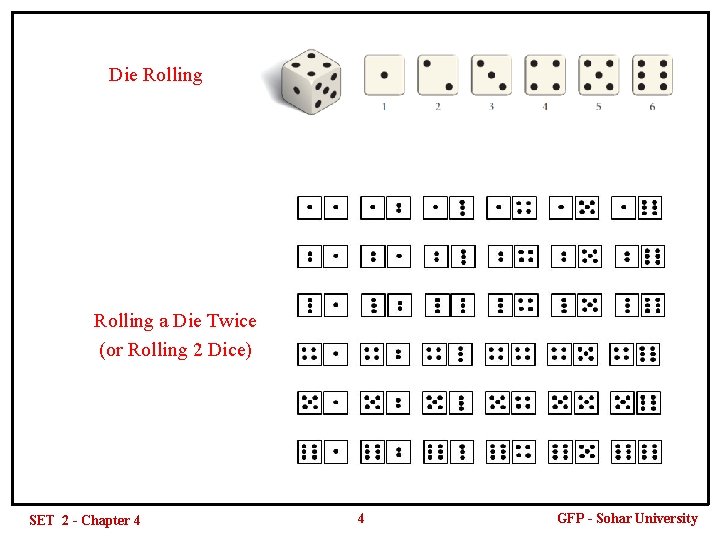
Die Rolling a Die Twice (or Rolling 2 Dice) SET 2 - Chapter 4 4 GFP - Sohar University
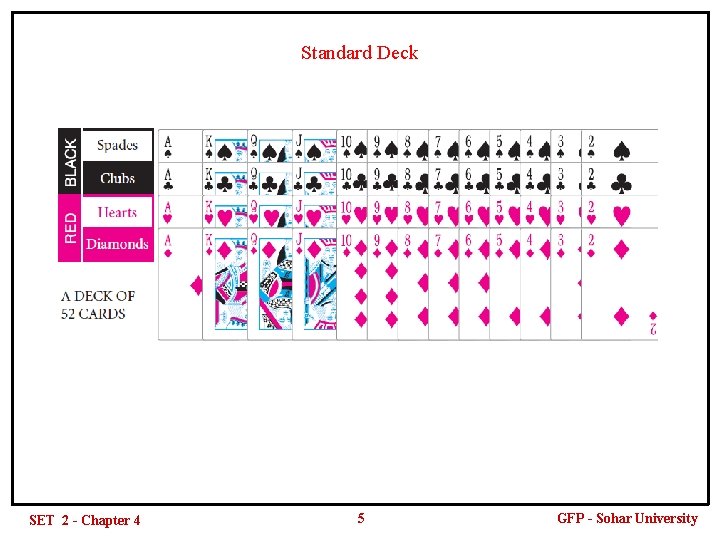
Standard Deck SET 2 - Chapter 4 5 GFP - Sohar University
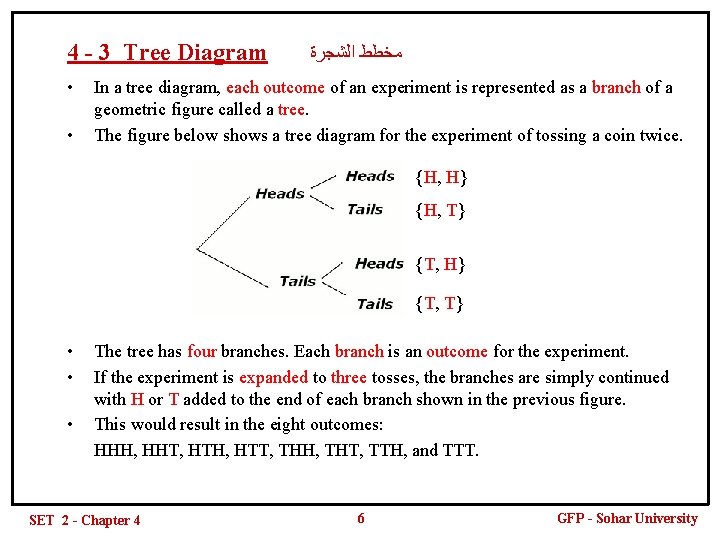
4 - 3 Tree Diagram • • ﻣﺨﻄﻂ ﺍﻟﺸﺠﺮﺓ In a tree diagram, each outcome of an experiment is represented as a branch of a geometric figure called a tree. The figure below shows a tree diagram for the experiment of tossing a coin twice. {H, H} {H, T} {T, H} {T, T} • • • The tree has four branches. Each branch is an outcome for the experiment. If the experiment is expanded to three tosses, the branches are simply continued with H or T added to the end of each branch shown in the previous figure. This would result in the eight outcomes: HHH, HHT, HTH, HTT, THH, THT, TTH, and TTT. SET 2 - Chapter 4 6 GFP - Sohar University
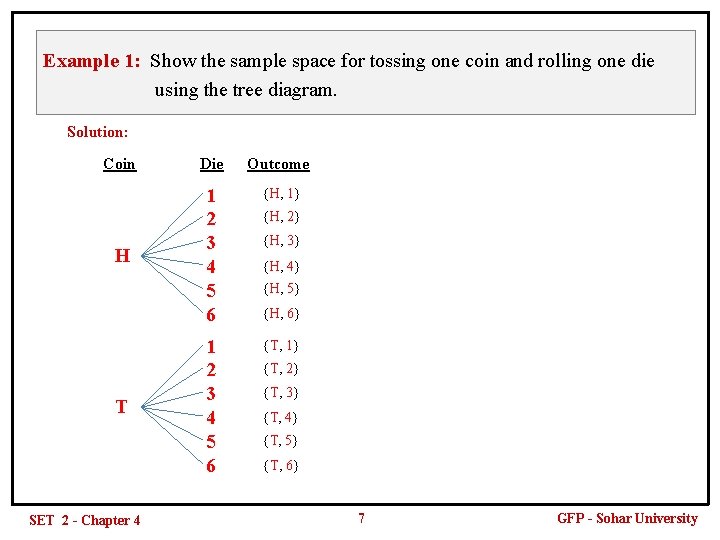
Example 1: Show the sample space for tossing one coin and rolling one die using the tree diagram. Solution: Coin Die Outcome {H, 1} H 1 2 3 4 5 6 T SET 2 - Chapter 4 1 2 3 4 5 6 {H, 2} {H, 3} {H, 4} {H, 5} {H, 6} {T, 1} {T, 2} {T, 3} {T, 4} {T, 5} {T, 6} 7 GFP - Sohar University
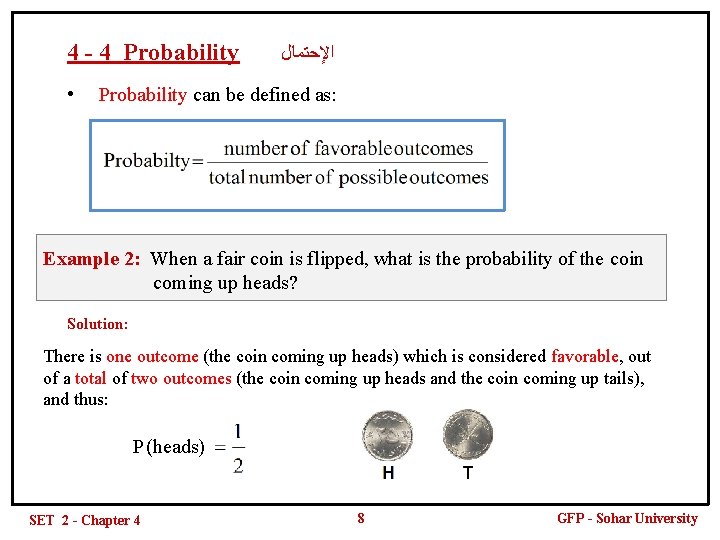
4 - 4 Probability • ﺍﻹﺣﺘﻤﺎﻝ Probability can be defined as: Example 2: When a fair coin is flipped, what is the probability of the coin coming up heads? Solution: There is one outcome (the coin coming up heads) which is considered favorable, out of a total of two outcomes (the coin coming up heads and the coin coming up tails), and thus: P (heads) SET 2 - Chapter 4 8 GFP - Sohar University
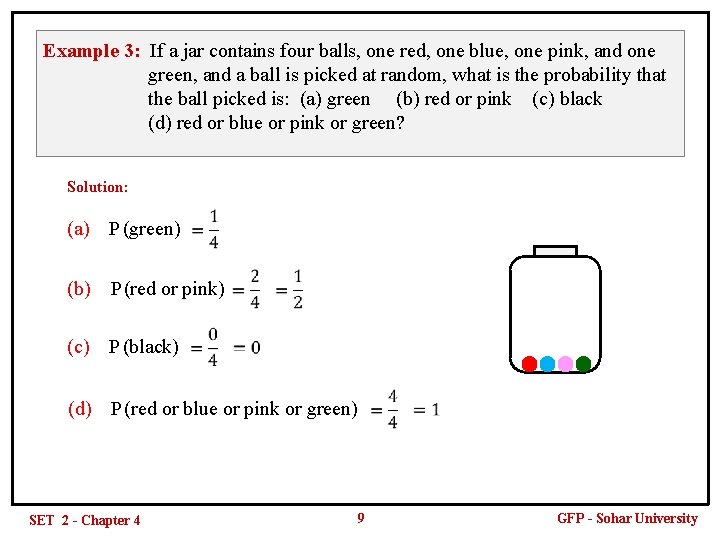
Example 3: If a jar contains four balls, one red, one blue, one pink, and one green, and a ball is picked at random, what is the probability that the ball picked is: (a) green (b) red or pink (c) black (d) red or blue or pink or green? Solution: (a) P (green) (b) P (red or pink) (c) P (black) (d) P (red or blue or pink or green) SET 2 - Chapter 4 9 GFP - Sohar University
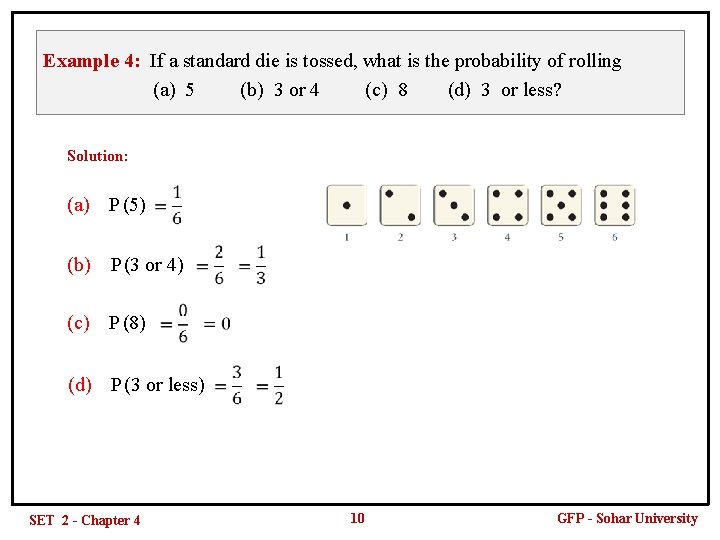
Example 4: If a standard die is tossed, what is the probability of rolling (a) 5 (b) 3 or 4 (c) 8 (d) 3 or less? Solution: (a) P (5) (b) P (3 or 4) (c) P (8) (d) P (3 or less) SET 2 - Chapter 4 10 GFP - Sohar University
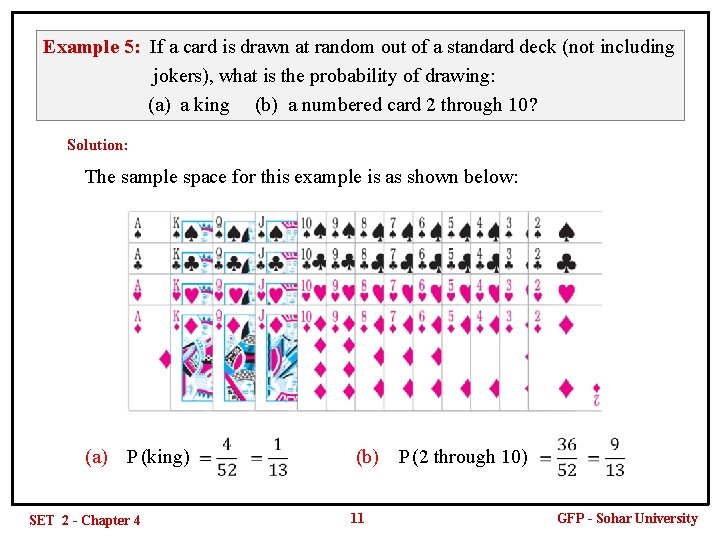
Example 5: If a card is drawn at random out of a standard deck (not including jokers), what is the probability of drawing: (a) a king (b) a numbered card 2 through 10? Solution: The sample space for this example is as shown below: (a) P (king) SET 2 - Chapter 4 (b) 11 P (2 through 10) GFP - Sohar University
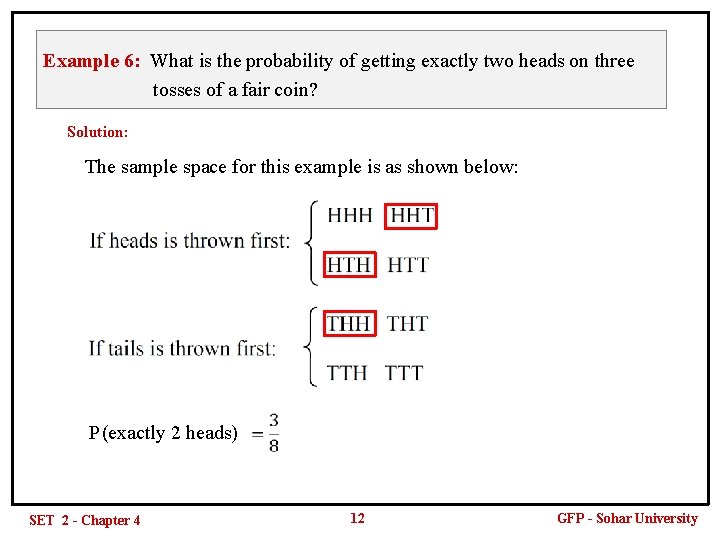
Example 6: What is the probability of getting exactly two heads on three tosses of a fair coin? Solution: The sample space for this example is as shown below: P (exactly 2 heads) SET 2 - Chapter 4 12 GFP - Sohar University
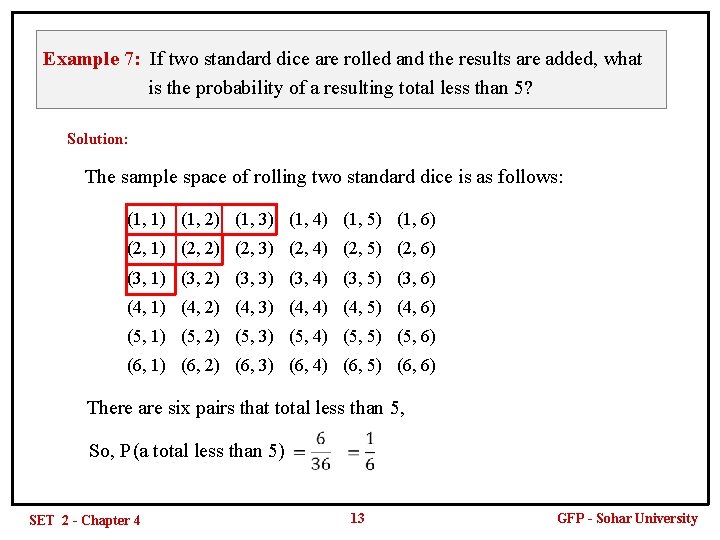
Example 7: If two standard dice are rolled and the results are added, what is the probability of a resulting total less than 5? Solution: The sample space of rolling two standard dice is as follows: (1, 1) (1, 2) (1, 3) (1, 4) (1, 5) (1, 6) (2, 1) (2, 2) (2, 3) (2, 4) (2, 5) (2, 6) (3, 1) (3, 2) (3, 3) (3, 4) (3, 5) (3, 6) (4, 1) (4, 2) (4, 3) (4, 4) (4, 5) (4, 6) (5, 1) (5, 2) (5, 3) (5, 4) (5, 5) (5, 6) (6, 1) (6, 2) (6, 3) (6, 4) (6, 5) (6, 6) There are six pairs that total less than 5, So, P (a total less than 5) SET 2 - Chapter 4 13 GFP - Sohar University
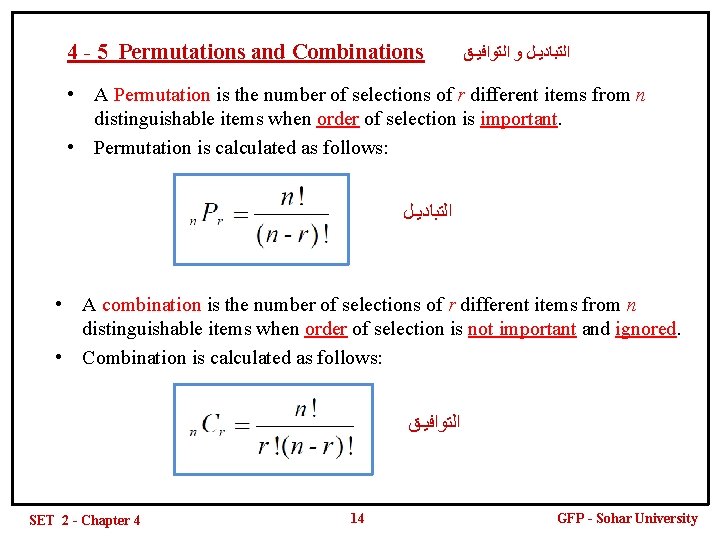
4 - 5 Permutations and Combinations ﺍﻟﺘﺒﺎﺩﻳـﻞ ﻭ ﺍﻟﺘﻮﺍﻓﻴـﻖ • A Permutation is the number of selections of r different items from n distinguishable items when order of selection is important. • Permutation is calculated as follows: ﺍﻟﺘﺒﺎﺩﻳـﻞ • A combination is the number of selections of r different items from n distinguishable items when order of selection is not important and ignored. • Combination is calculated as follows: ﺍﻟﺘﻮﺍﻓﻴـﻖ SET 2 - Chapter 4 14 GFP - Sohar University
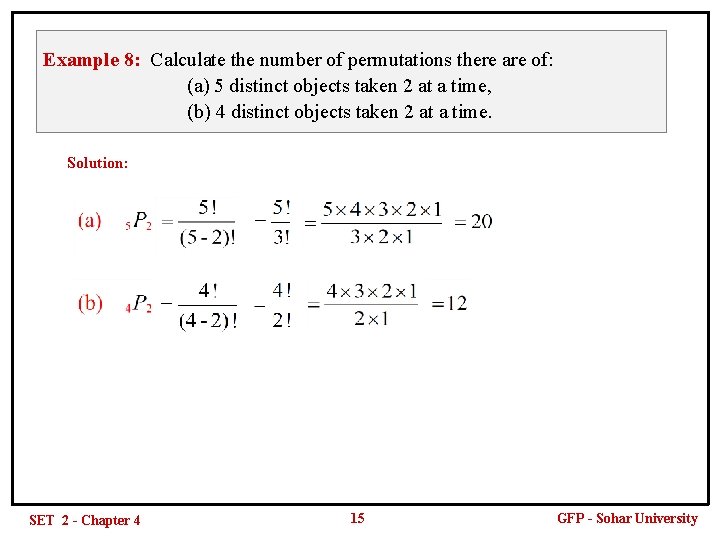
Example 8: Calculate the number of permutations there are of: (a) 5 distinct objects taken 2 at a time, (b) 4 distinct objects taken 2 at a time. Solution: SET 2 - Chapter 4 15 GFP - Sohar University
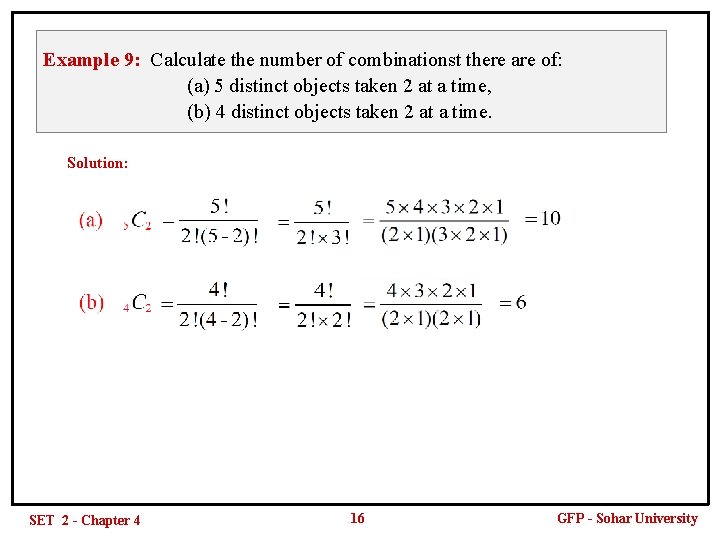
Example 9: Calculate the number of combinationst there are of: (a) 5 distinct objects taken 2 at a time, (b) 4 distinct objects taken 2 at a time. Solution: SET 2 - Chapter 4 16 GFP - Sohar University
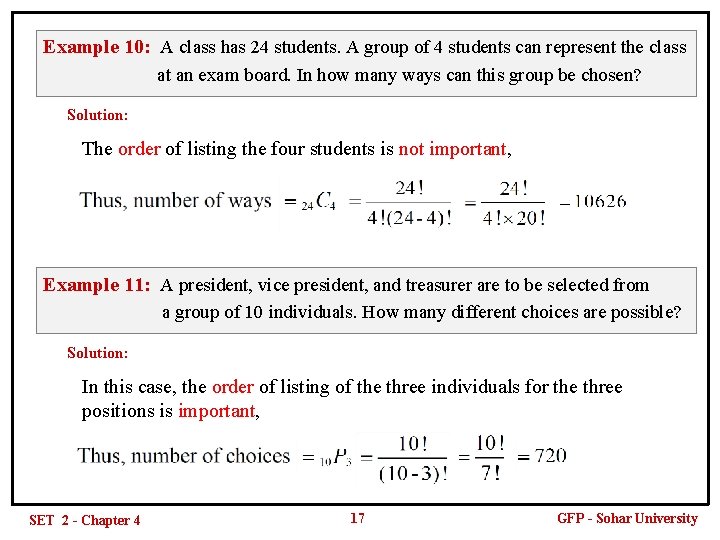
Example 10: A class has 24 students. A group of 4 students can represent the class at an exam board. In how many ways can this group be chosen? Solution: The order of listing the four students is not important, Example 11: A president, vice president, and treasurer are to be selected from a group of 10 individuals. How many different choices are possible? Solution: In this case, the order of listing of the three individuals for the three positions is important, SET 2 - Chapter 4 17 GFP - Sohar University
- Slides: 17