
Session Outline Background What is phonics Structure of
Session Outline � Background � What is phonics? � Structure of phonics teaching � Progression � Ideas and importance of phonics through the phases for supporting phonics
Background to Phonics Following Government guidance called Letters and Sounds � The Intention is to “…equip children who are 5 with the phonic knowledge and skills they need to become fluent readers by the age of 7. ” � By the end of Year Two children should have completed phase 6. � Phonics is crucial, as it aids the early reading development of children. �
Blending � Blending is the process of saying the individual sounds in a word and then running them together to read the word. E. g d- o- g and making dog. � Some sounds (digraphs) are represented by two letters, such as sh. � Some words in English have an irregular spelling and cannot be read by blending, such as said, was and one. These are called the ‘tricky words’.
Segmenting � The easiest way to know how to spell a word is to listen for the sounds in that word. � Take care with digraphs. The word fish, for example, has four letters but only three sounds, f-i-sh. � Rhyming games and poems help here.
Structure of Phonics � Daily 1. 2. 3. 4. for 20 to 25 minutes. Revisiting and revising previous sounds and tricky words. Teaching a new sound or spelling. Practise reading and spelling the new sound. Apply the new sound by reading and writing sentences using words containing the new sound.
Progression � End of year 1 the children will complete a Phonics Screening test. � Results of the screening check help to inform the teachers of any gaps in their phonics knowledge that need to be addressed. � However, all children progress through the 6 stages.
Phase One � Children develop their ability to explore, recognise and create sounds in the world around them. � Children begin to understand the importance of sounds and how to distinguish between them.
Phase Two � At this point the children are introduced to the majority of the sounds in the alphabet. � Children learn sounds not in alphabetical order. � The children begin to learn a small selection of sounds which they begin to apply.
Phase Three � Children are taught one grapheme for each of the 44 phonemes. � Children continue to learn to link sounds to letters, naming and sounding the letters of the alphabet. � Recognise common digraphs such as ‘th’ and trigraphs ‘igh’.
Phase Four � Children are taught to read and spell words containing consonant clusters. � Children will be able to blend and segment consonant clusters in words and apply this skill when reading and spelling. � Children will move from CVC words such as ‘pot’, to more complex words such as ‘crunch’.
Phase Five � Children learn to recognise and use alternative ways of pronouncing the graphemes and spelling the phonemes already taught. � Children will learn to use these alternative ways of pronouncing the graphemes (e. g. the ‘c’ in coat and city). � Children begin to recognise an increasing number of high frequency words automatically.
Phase Six Children develop their skill and ability to read words automatically in reading and spelling. � They will apply phonic knowledge to recognise and spell an increasing number of complex words. � Children will be able to read an increasing number of high and medium frequency words independently and automatically. � At this stage we move onto other areas including suffixes and syllables. �
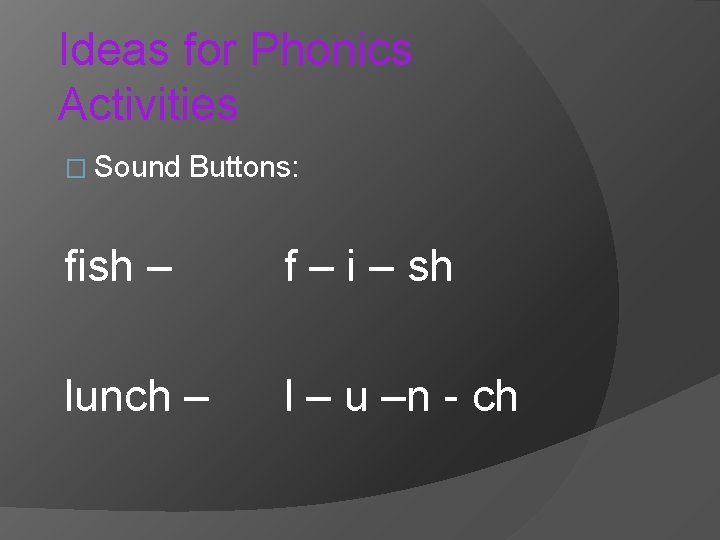
Ideas for Phonics Activities � Sound Buttons: fish – f – i – sh lunch – l – u –n - ch
Your turn… � Can you add the sound buttons to the following words… � chip � church � scream � paintbrush
Ideas for Phonics Activities � Phonics Play: http: //www. phonicsplay. co. uk/ Let’s have a go at the Obb and Bob game!
Thank you for coming! Please take time to explore the resources and to ask any questions.
- Slides: 17