
Session One Leading Governance www nga org ukleadinggovernance





- Slides: 51
Session One – Leading Governance www. nga. org. uk/leadinggovernance
Welcome © National Governance Association 2018 www. nga. org. uk/leadinggovernance
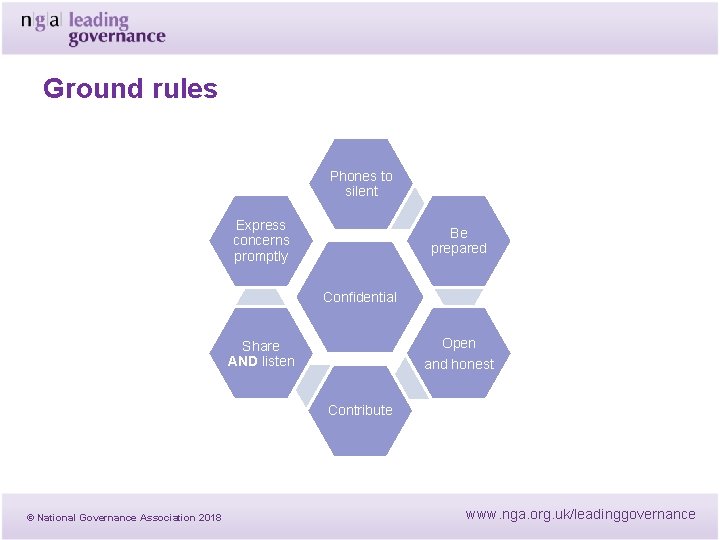
Ground rules Phones to silent Express concerns promptly Be prepared © National Governance Association 2018 Confidential Open Share AND listen and honest Contribute © National Governance Association 2018 www. nga. org. uk/leadinggovernance
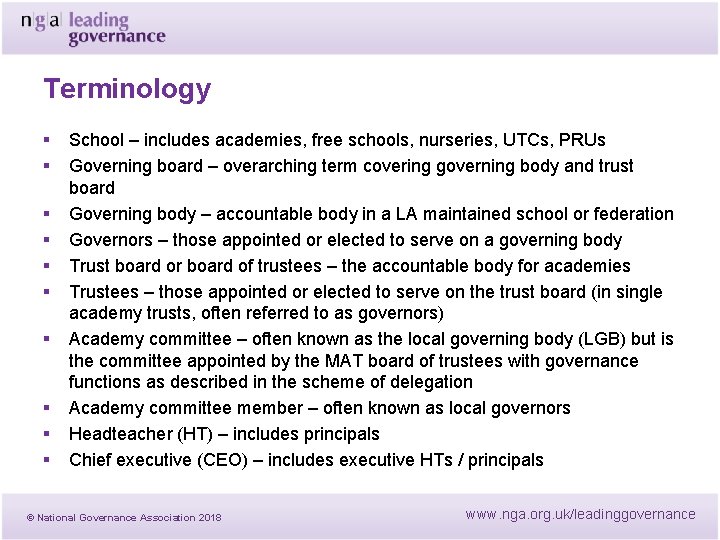
Terminology § § § § § School – includes academies, free schools, nurseries, UTCs, PRUs Governing board – overarching term covering governing body and trust board Governing body – accountable body in a LA maintained school or federation Governors – those appointed or elected to serve on a governing body Trust board or board of trustees – the accountable body for academies © National Governance Association 2018 Trustees – those appointed or elected to serve on the trust board (in single academy trusts, often referred to as governors) Academy committee – often known as the local governing body (LGB) but is the committee appointed by the MAT board of trustees with governance functions as described in the scheme of delegation Academy committee member – often known as local governors Headteacher (HT) – includes principals Chief executive (CEO) – includes executive HTs / principals © National Governance Association 2018 www. nga. org. uk/leadinggovernance
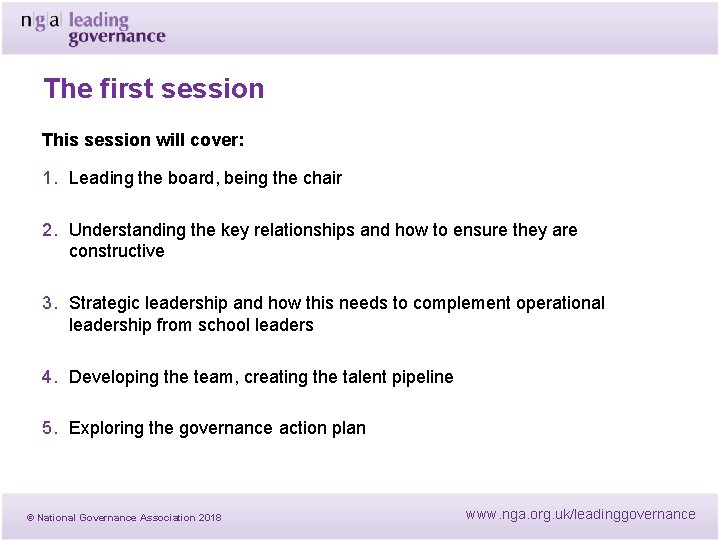
The first session This session will cover: 1. Leading the board, being the chair 2. Understanding the key relationships and how to ensure they are constructive © National Governance Association 2018 3. Strategic leadership and how this needs to complement operational leadership from school leaders 4. Developing the team, creating the talent pipeline 5. Exploring the governance action plan © National Governance Association 2018 www. nga. org. uk/leadinggovernance
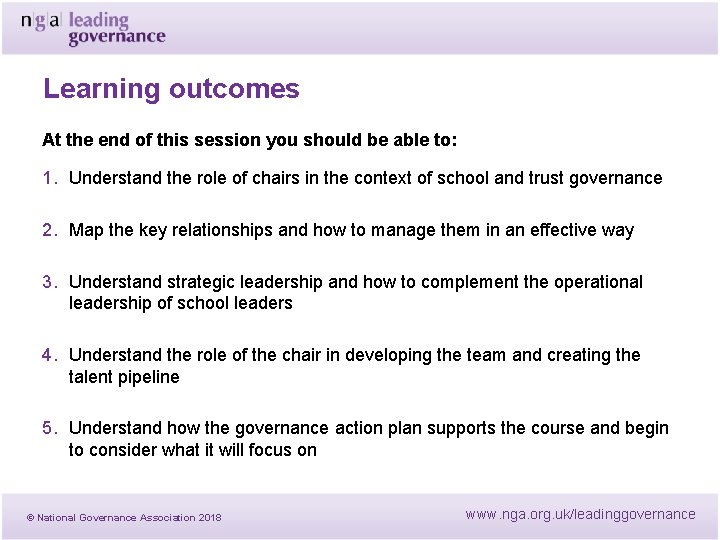
Learning outcomes At the end of this session you should be able to: 1. Understand the role of chairs in the context of school and trust governance 2. Map the key relationships and how to manage them in an effective way © National Governance Association 2018 3. Understand strategic leadership and how to complement the operational leadership of school leaders 4. Understand the role of the chair in developing the team and creating the talent pipeline 5. Understand how the governance action plan supports the course and begin to consider what it will focus on © National Governance Association 2018 www. nga. org. uk/leadinggovernance
1. Leading the board © National Governance Association 2018 www. nga. org. uk/leadinggovernance
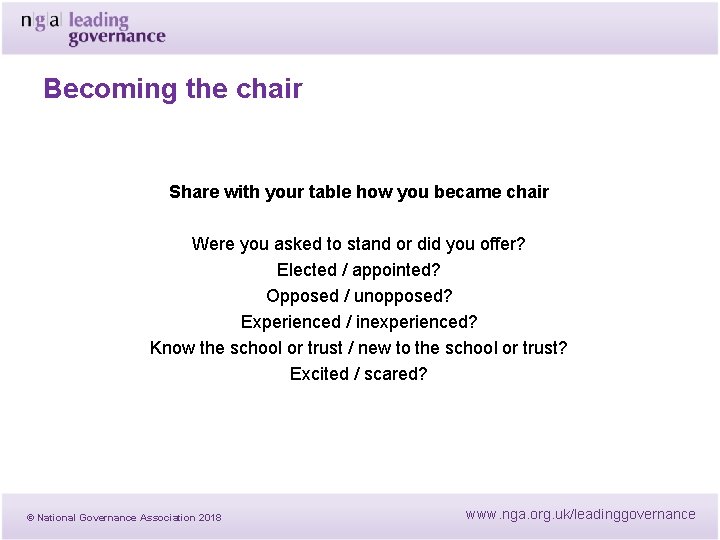
Becoming the chair Share with your table how you became chair Were you asked to stand or did you offer? © National Governance Association 2018 Elected / appointed? Opposed / unopposed? Experienced / inexperienced? Know the school or trust / new to the school or trust? Excited / scared? © National Governance Association 2018 www. nga. org. uk/leadinggovernance
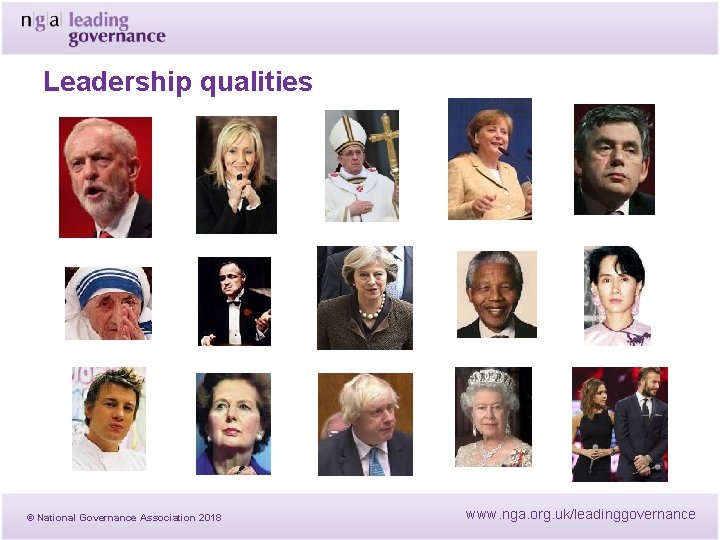
Leadership qualities © National Governance Association 2018 www. nga. org. uk/leadinggovernance
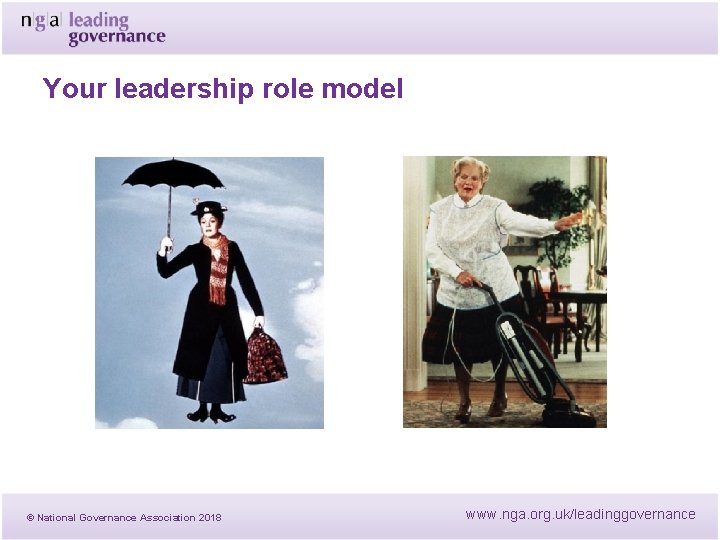
Your leadership role model © National Governance Association 2018 www. nga. org. uk/leadinggovernance
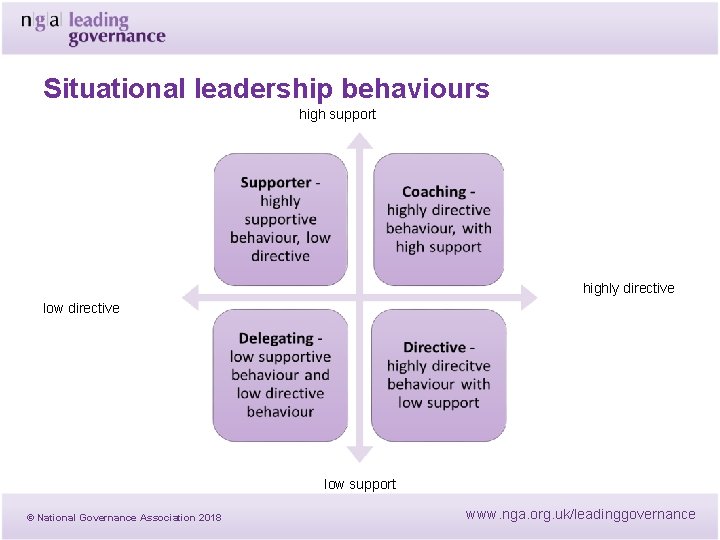
Situational leadership behaviours high support © National Governance Association 2018 highly directive low support © National Governance Association 2018 www. nga. org. uk/leadinggovernance
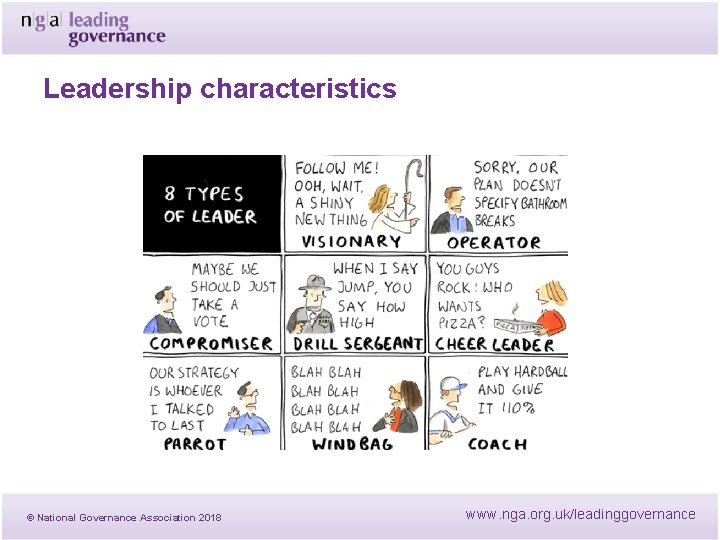
Leadership characteristics © National Governance Association 2018 www. nga. org. uk/leadinggovernance
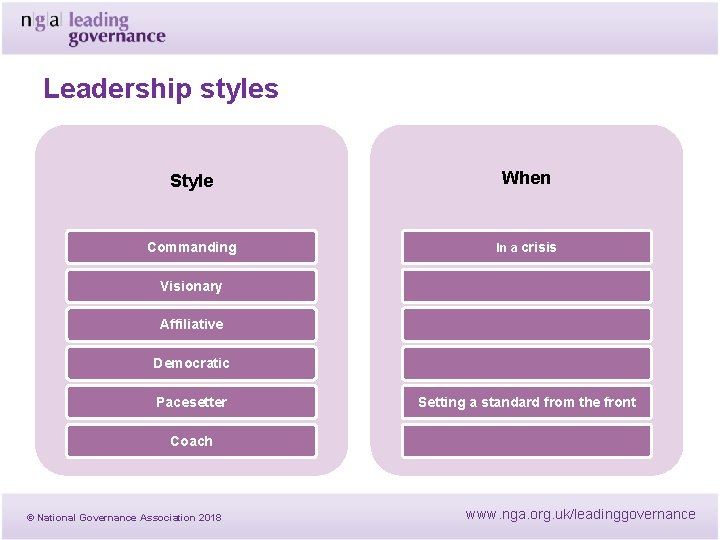
Leadership styles Style When Commanding In a crisis © National Governance Association 2018 Visionary Affiliative Democratic Pacesetter Setting a standard from the front Coach © National Governance Association 2018 www. nga. org. uk/leadinggovernance
Your 360° appraisal On your own Using the handout ‘Six leadership styles’ and your 360° appraisal: © National Governance Association 2018 1. What is your style 2. What areas do you need to develop? © National Governance Association 2018 www. nga. org. uk/leadinggovernance
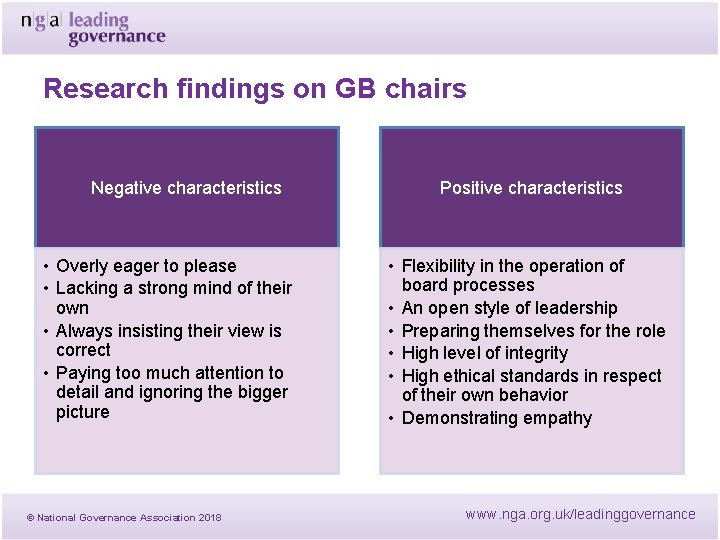
Research findings on GB chairs Negative characteristics Positive characteristics • Overly eager to please © National Governance Association 2018 • Flexibility in the operation of board processes • Lacking a strong mind of their own • An open style of leadership • Always insisting their view is • Preparing themselves for the role correct • High level of integrity • Paying too much attention to • High ethical standards in respect detail and ignoring the bigger of their own behavior picture • Demonstrating empathy © National Governance Association 2018 www. nga. org. uk/leadinggovernance
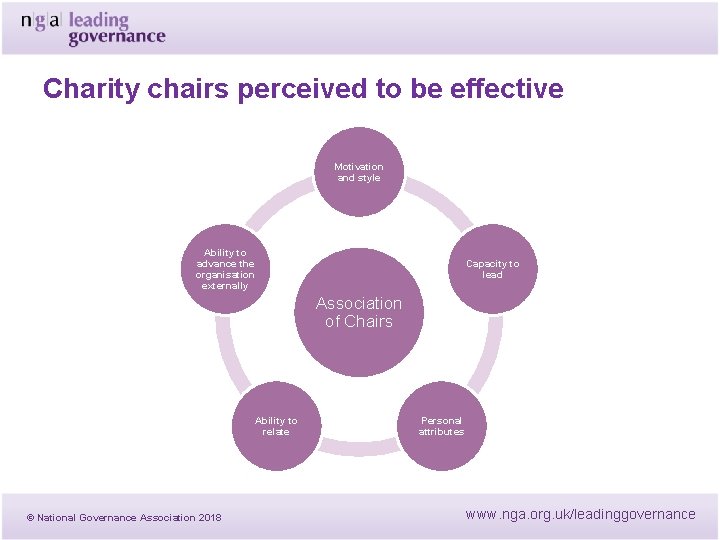
Charity chairs perceived to be effective Motivation and style Ability to advance the organisation © National Governance Association 2018 externally Capacity to lead Association of Chairs Ability to relate © National Governance Association 2018 Personal attributes www. nga. org. uk/leadinggovernance
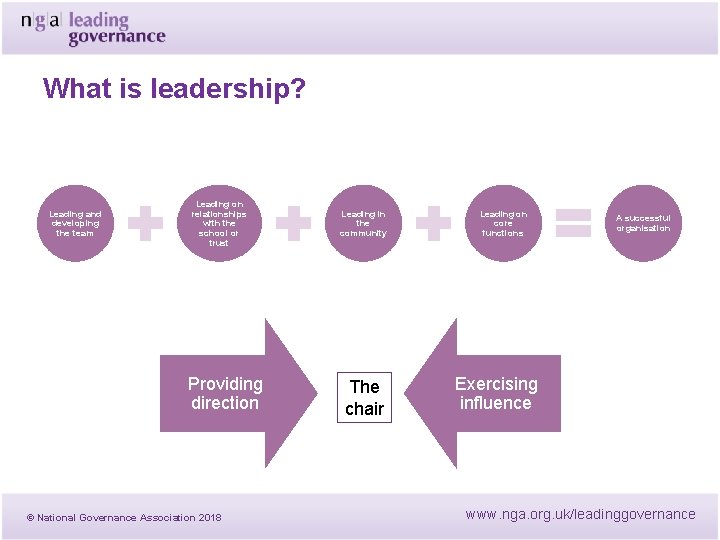
What is leadership? Leading and developing the team Leading on relationships with the school or trust Leading in the community Leading on core functions A successful organisation © National Governance Association 2018 Providing direction © National Governance Association 2018 The chair Exercising influence www. nga. org. uk/leadinggovernance
2. Understanding key relationships © National Governance Association 2018 www. nga. org. uk/leadinggovernance
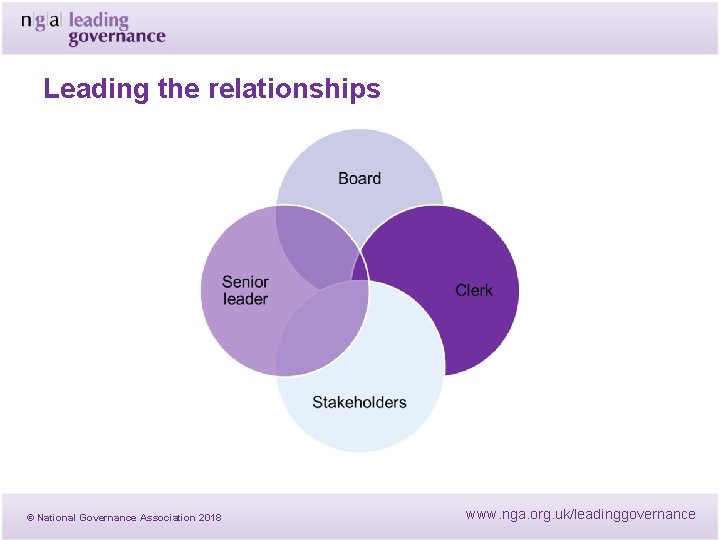
Leading the relationships © National Governance Association 2018 www. nga. org. uk/leadinggovernance
The role of the vice chair and committee chairs Should be: § Opportunity for genuine leadership (especially the chair delegating to the vice chair tasks e. g. the annual review of colleagues contributions) § Built on the basis of partnership § Open to the possibilities for coaching and mentoring (both ways) © National Governance Association 2018 Reflection § What is the nature of the relationship with those with other leadership roles? § Do you / they have any opportunities for coaching and mentoring? § Do you know each other’s strengths … and areas for development? § Do your styles, knowledge and experience complement each other? § Do you delegate enough … to the right people? § Should you delegate more? © National Governance Association 2018 www. nga. org. uk/leadinggovernance
Using your clerk Your clerk should be able to: § Administer all your meetings, including panels § Give legal advice and guidance relating to governance § Induct new governors and trustees § Organise training and development Reflection © National Governance Association 2018 You are your clerk’s line manager – what are the challenges? § Creating and using positive channels for communication § Finding time for face-to-face meetings § Performance management – Are you aware of the clerks’ competency framework? – Does their JD / PS need reviewing? And their pay scale? § Investing in their development § Making them part of the team © National Governance Association 2018 www. nga. org. uk/leadinggovernance
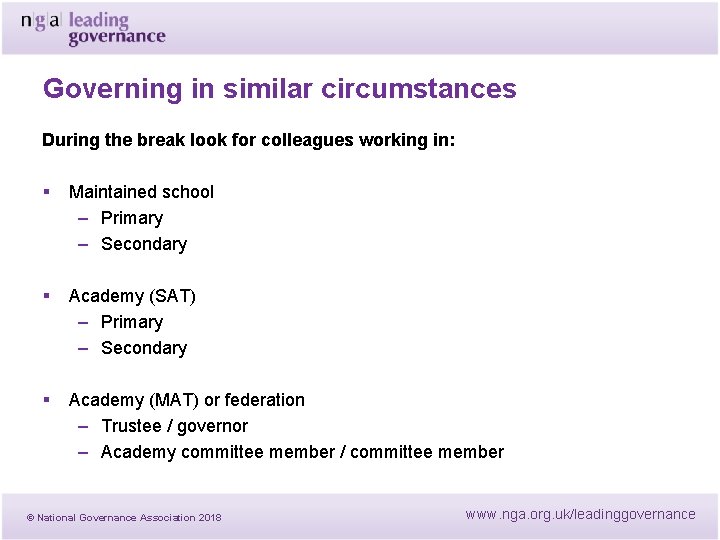
Governing in similar circumstances During the break look for colleagues working in: § Maintained school – Primary – Secondary © National Governance Association 2018 § Academy (SAT) – Primary – Secondary § Academy (MAT) or federation – Trustee / governor – Academy committee member / committee member © National Governance Association 2018 www. nga. org. uk/leadinggovernance
Break © National Governance Association 2018 www. nga. org. uk/leadinggovernance
3. Strategic leadership © National Governance Association 2018 www. nga. org. uk/leadinggovernance
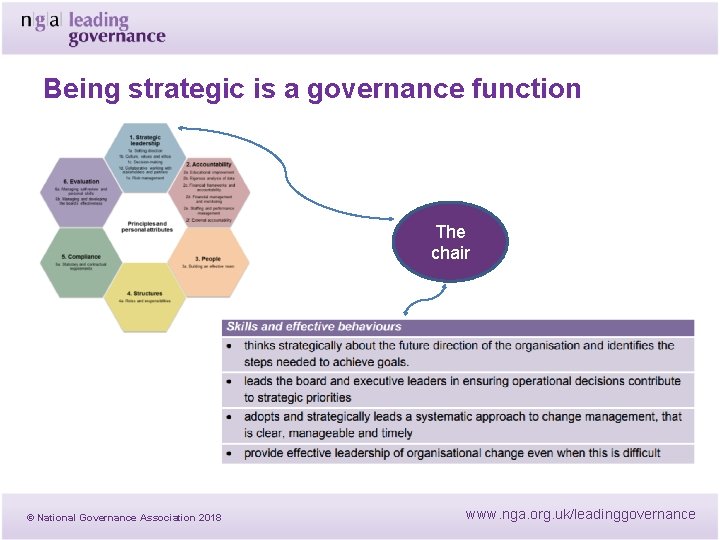
Being strategic is a governance function The chair © National Governance Association 2018 www. nga. org. uk/leadinggovernance
The three core functions In order for … § Governing bodies of maintained schools to direct the conduct of their schools with a view to promoting high standards of education or § Governing boards of academy trusts to fulfil their charitable object of advancing education for the public benefit … … the Df. E identifies three core functions for governing boards: © National Governance Association 2018 1. Ensuring clarity of vision, ethos and strategic direction 2. Holding executive leaders to account for the performance of the organisation and its pupils and for the performance management of staff 3. Overseeing the financial performance of the organisation and making sure its money is well spent © National Governance Association 2018 www. nga. org. uk/leadinggovernance
Discussion Governors and trustees are always being told to ‘be strategic’ 1. 2. What does ‘being strategic’ mean to you? © National Governance Association 2018 How do you lead strategically in your school or trust? © National Governance Association 2018 www. nga. org. uk/leadinggovernance
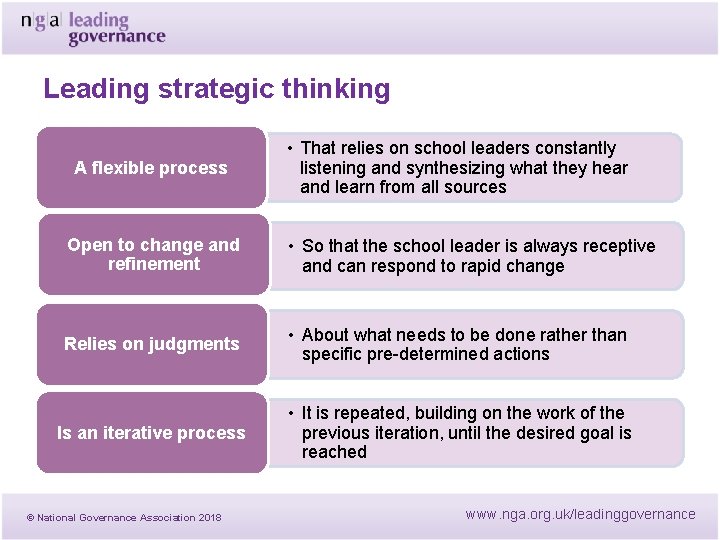
Leading strategic thinking A flexible process • That relies on school leaders constantly listening and synthesizing what they hear and learn from all sources Open to change and refinement • So that the school leader is always receptive and can respond to rapid change © National Governance Association 2018 Relies on judgments • About what needs to be done rather than specific pre-determined actions Is an iterative process • It is repeated, building on the work of the previous iteration, until the desired goal is reached © National Governance Association 2018 www. nga. org. uk/leadinggovernance
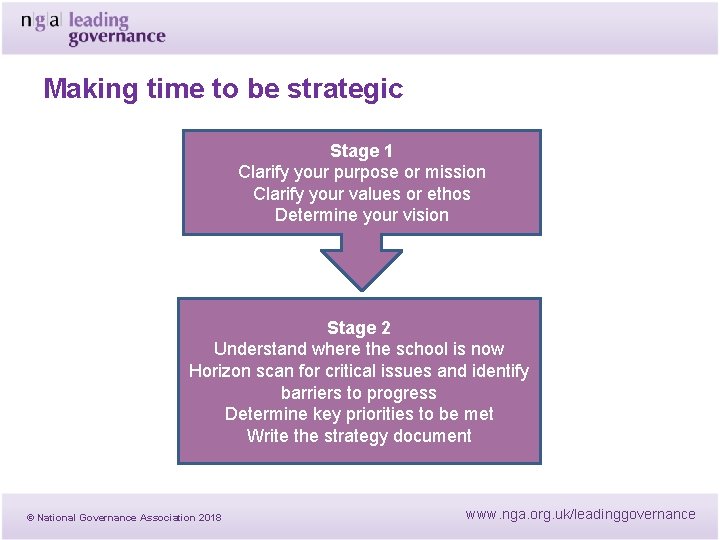
Making time to be strategic Stage 1 Clarify your purpose or mission Clarify your values or ethos Determine your vision © National Governance Association 2018 Stage 2 Understand where the school is now Horizon scan for critical issues and identify barriers to progress Determine key priorities to be met Write the strategy document © National Governance Association 2018 www. nga. org. uk/leadinggovernance
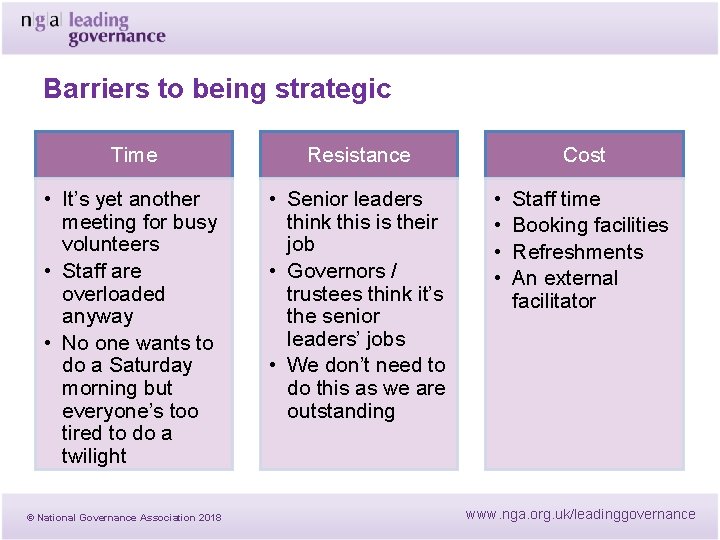
Barriers to being strategic Time • It’s yet another meeting for busy volunteers • Staff are overloaded anyway • No one wants to do a Saturday morning but everyone’s too tired to do a twilight © National Governance Association 2018 Resistance • Senior leaders think this is their job © National Governance Association 2018 • Governors / trustees think it’s the senior leaders’ jobs • We don’t need to do this as we are outstanding Cost • • Staff time Booking facilities Refreshments An external facilitator www. nga. org. uk/leadinggovernance
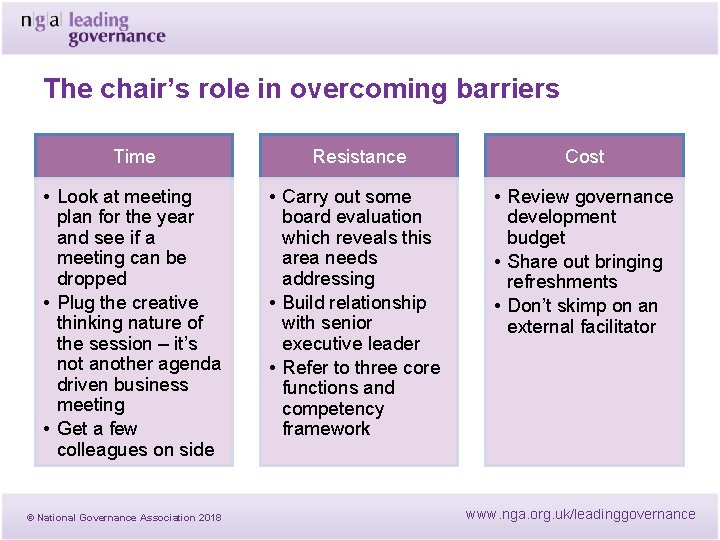
The chair’s role in overcoming barriers Time • Look at meeting plan for the year and see if a meeting can be dropped • Plug the creative thinking nature of the session – it’s not another agenda driven business meeting • Get a few colleagues on side © National Governance Association 2018 Resistance • Carry out some board evaluation which reveals this area needs © National Governance Association 2018 addressing • Build relationship with senior executive leader • Refer to three core functions and competency framework Cost • Review governance development budget • Share out bringing refreshments • Don’t skimp on an external facilitator www. nga. org. uk/leadinggovernance
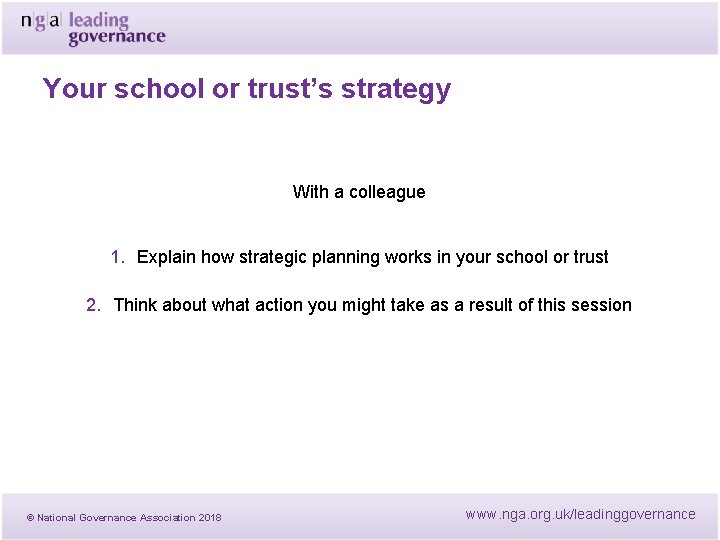
Your school or trust’s strategy With a colleague 1. Explain how strategic planning works in your school or trust © National Governance Association 2018 2. Think about what action you might take as a result of this session © National Governance Association 2018 www. nga. org. uk/leadinggovernance
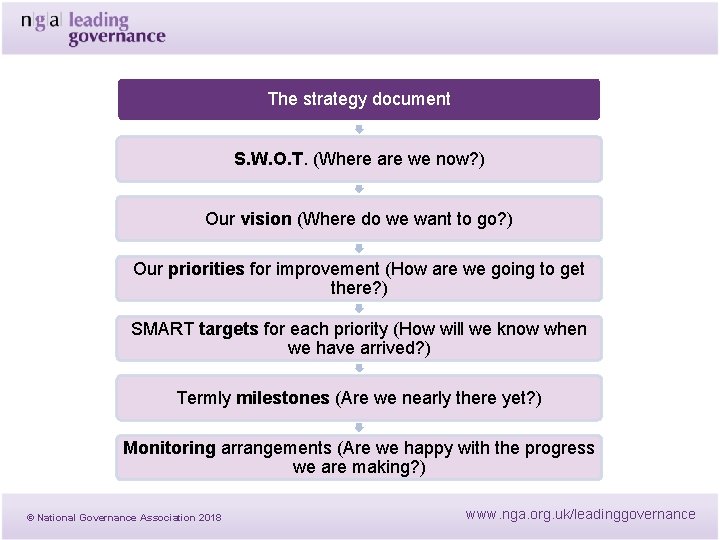
The strategy document S. W. O. T. (Where are we now? ) Our vision (Where do we want to go? ) © National Governance Association 2018 Our priorities for improvement (How are we going to get there? ) SMART targets for each priority (How will we know when we have arrived? ) Termly milestones (Are we nearly there yet? ) Monitoring arrangements (Are we happy with the progress we are making? ) © National Governance Association 2018 www. nga. org. uk/leadinggovernance
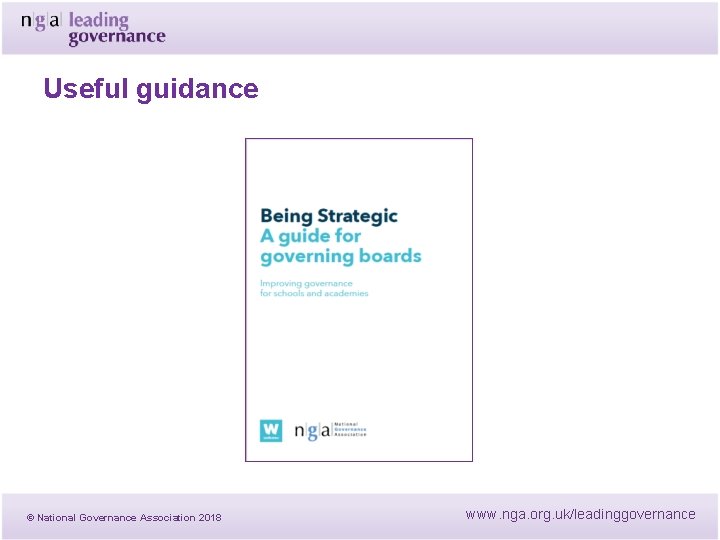
Useful guidance © National Governance Association 2018 www. nga. org. uk/leadinggovernance
e-learning © National Governance Association 2018 www. nga. org. uk/leadinggovernance
4. Developing the team © National Governance Association 2018 www. nga. org. uk/leadinggovernance
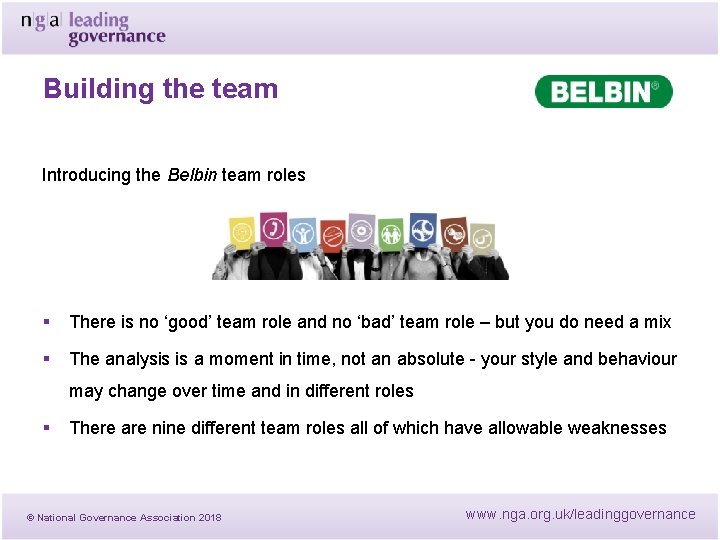
Building the team Introducing the Belbin team roles © National Governance Association 2018 § There is no ‘good’ team role and no ‘bad’ team role – but you do need a mix § The analysis is a moment in time, not an absolute - your style and behaviour may change over time and in different roles § There are nine different team roles all of which have allowable weaknesses © National Governance Association 2018 www. nga. org. uk/leadinggovernance
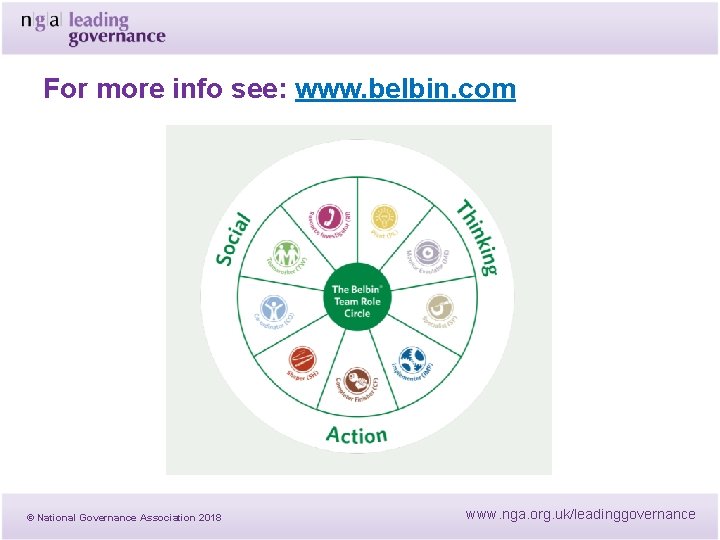
For more info see: www. belbin. com © National Governance Association 2018 www. nga. org. uk/leadinggovernance
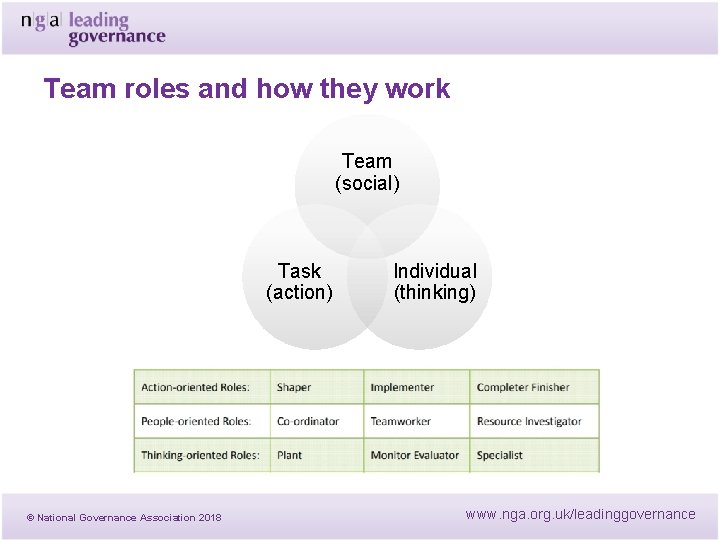
Team roles and how they work Team (social) Task (action) Individual (thinking) © National Governance Association 2018 www. nga. org. uk/leadinggovernance
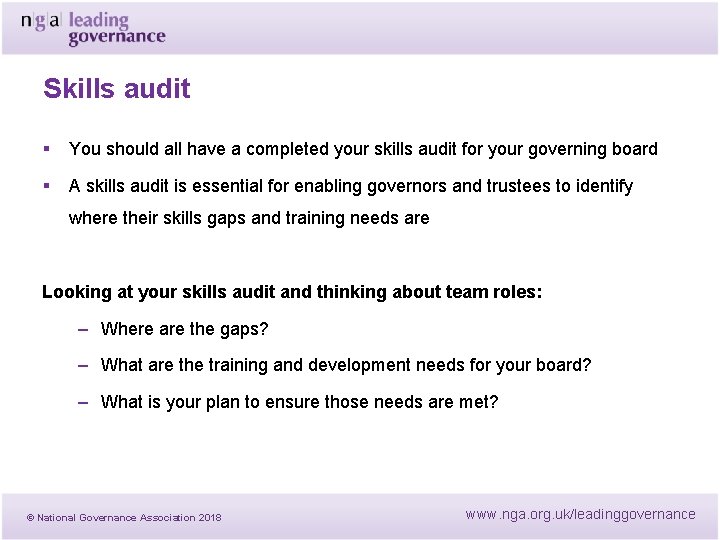
Skills audit § You should all have a completed your skills audit for your governing board § A skills audit is essential for enabling governors and trustees to identify where their skills gaps and training needs are © National Governance Association 2018 Looking at your skills audit and thinking about team roles: – Where are the gaps? – What are the training and development needs for your board? – What is your plan to ensure those needs are met? © National Governance Association 2018 www. nga. org. uk/leadinggovernance
Creating a healthy culture © National Governance Association 2018 Good chairs: ü Actively set the culture of the board, building a skilled governance team ü Make time for bigger thinking - plan occasional away (half) day type events ü Are inclusive, welcoming of all contributions, ideas and other points of view ü Must be open and transparent ü Listen © National Governance Association 2018 www. nga. org. uk/leadinggovernance
5. Your governance action plan © National Governance Association 2018 www. nga. org. uk/leadinggovernance
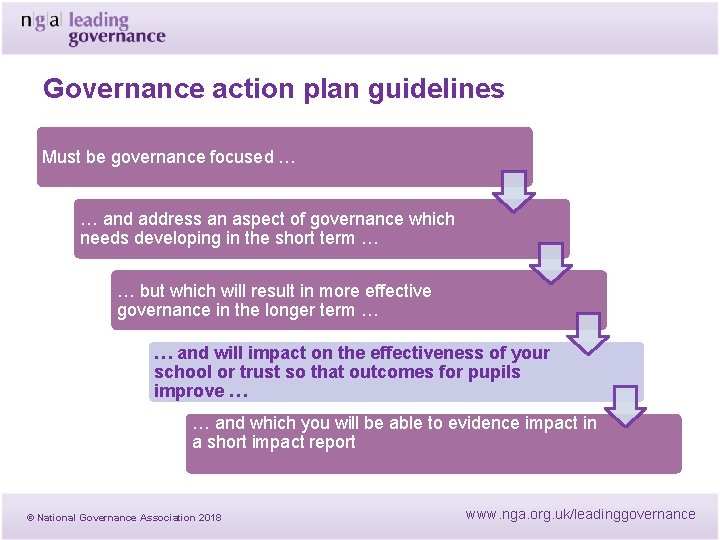
Governance action plan guidelines Must be governance focused … … and address an aspect of governance which needs developing in the short term … © National Governance Association 2018 … but which will result in more effective governance in the longer term … … and will impact on the effectiveness of your school or trust so that outcomes for pupils improve … … and which you will be able to evidence impact in a short impact report © National Governance Association 2018 www. nga. org. uk/leadinggovernance
Planning your governance action plan 5 © National Governance Association 2018 www. nga. org. uk/leadinggovernance
6. Session review and next steps © National Governance Association 2018 www. nga. org. uk/leadinggovernance
Reviewing the session Have we met the learning outcomes for this session? These were: 1. Understand the role of chairs in the context of school and trust governance 2. Map the key relationships and how to manage them in an effective way © National Governance Association 2018 3. Understand strategic leadership and how to complement the operational leadership of school leaders 4. Understand the role of the chair in developing the team and creating the talent pipeline 5. Understand how the governance action plan supports the course and begin to consider what it will focus on © National Governance Association 2018 www. nga. org. uk/leadinggovernance
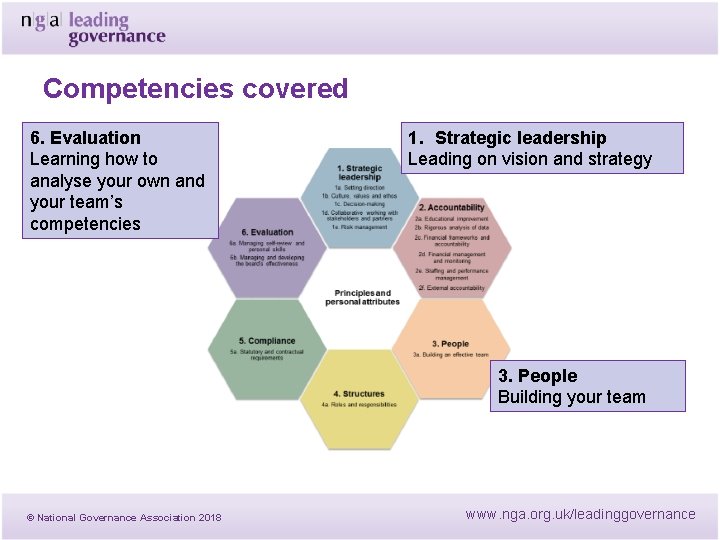
Competencies covered 6. Evaluation Learning how to analyse your own and your team’s competencies 1. Strategic leadership Leading on vision and strategy © National Governance Association 2018 3. People Building your team © National Governance Association 2018 www. nga. org. uk/leadinggovernance
Next steps 1. Your mentor call which will: – Review the responses to and your analysis of your 360° appraisal – Advise on your personal development plan – Advise on your governance action plan © National Governance Association 2018 2. Complete any e-learning you need to 3. Finalise your personal development plan 4. Agree your governance action plan with school based colleagues 5. Complete pre-work for session 2 see next slide and the handbook 6. Get going! © National Governance Association 2018 www. nga. org. uk/leadinggovernance
Pre-work to be completed for face-to-face session 2 1 The Chair’s Handbook Read chapters 3 and 6 Answer the questions on the Leading Governance portal © National Governance Association 2018 2 Your school’s data Complete the data exercise on the handout Challenging school performance - you will need to bring this completed handout to session 2 © National Governance Association 2018 www. nga. org. uk/leadinggovernance
Evaluation – we value your feedback Later Now Please tell us … © National Governance Association 2018 What went well After your first mentor call, complete the online evaluation Even better it Thank you © National Governance Association 2018 www. nga. org. uk/leadinggovernance
www. nga. org. uk/leadinggovernance