
SESSION IV Legal Framework of Land Management Unlocking
- Slides: 5
SESSION IV Legal Framework of Land Management
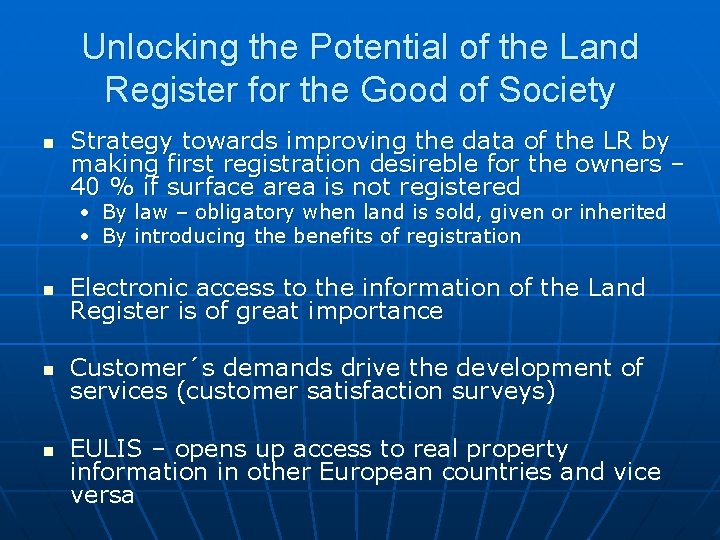
Unlocking the Potential of the Land Register for the Good of Society n Strategy towards improving the data of the LR by making first registration desireble for the owners – 40 % if surface area is not registered • • By By law – obligatory when land is sold, given or inherited introducing the benefits of registration n Electronic access to the information of the Land Register is of great importance n Customer´s demands drive the development of services (customer satisfaction surveys) n EULIS – opens up access to real property information in other European countries and vice versa
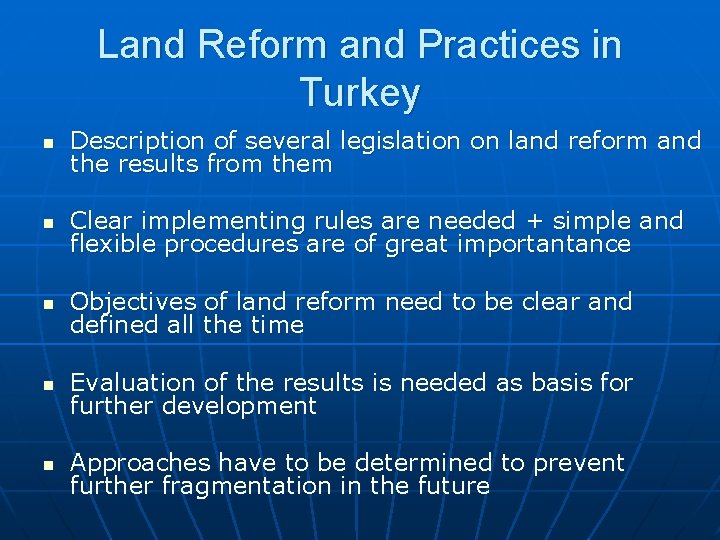
Land Reform and Practices in Turkey n Description of several legislation on land reform and the results from them n Clear implementing rules are needed + simple and flexible procedures are of great importantance n Objectives of land reform need to be clear and defined all the time n Evaluation of the results is needed as basis for further development n Approaches have to be determined to prevent further fragmentation in the future
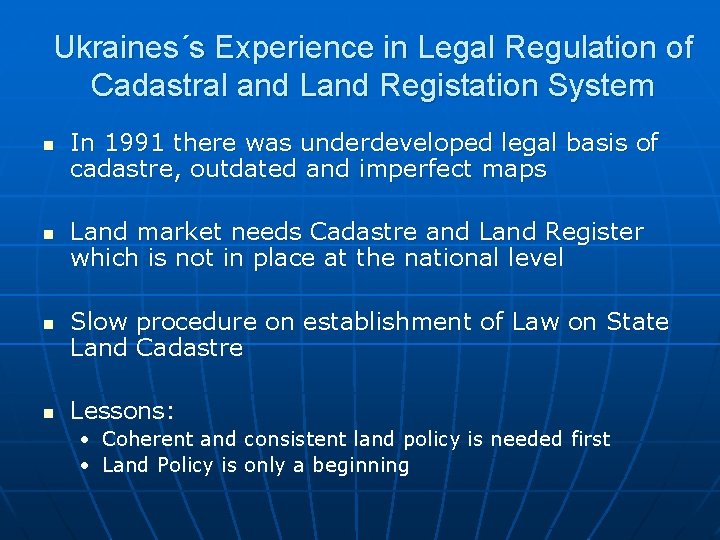
Ukraines´s Experience in Legal Regulation of Cadastral and Land Registation System n n In 1991 there was underdeveloped legal basis of cadastre, outdated and imperfect maps Land market needs Cadastre and Land Register which is not in place at the national level Slow procedure on establishment of Law on State Land Cadastre Lessons: • Coherent and consistent land policy is needed first • Land Policy is only a beginning
Legal framework of Land Management in Lithuania after 1990 n Restitution of land ownership is still very high on the polictical agenda in Lithuania n Land reforms have taken longer time than expected n Weaknesses and lessons to learn were pointed out • Weak institutional structure could been seen as the main obstacle for successful implementation of the present land reform and changes of the government´s policy and legislation n Most countries see reforms in Lithuania as a great success bearing in mind the need in 1990 for building up the economic and legal basis, setting up the organisational structure when looking at the results in land administration