
Session 5 Supporting the development of National Social

- Slides: 20
Session 5 – Supporting the development of National Social Protection Strategies: the ABND methodology Enhancing employers’ involvement in Social Protection policy debates Turin, 1 -4 September 2015
Key questions • What are the objectives & methodology of the ABND exercise? • What are the main steps of the ABND process? • How do we ensure that all stakeholders are involved from the outset? • How do we move from a technical validation of the report to a political endorsement? • How can the ABND exercise contribute to a country’s national strategy on social protection?
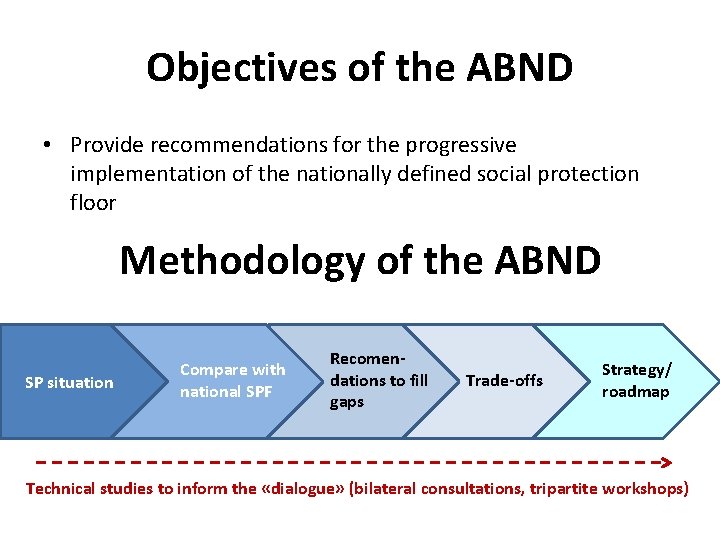
Objectives of the ABND • Provide recommendations for the progressive implementation of the nationally defined social protection floor Methodology of the ABND SP situation Compare with national SPF Recomendations to fill gaps Trade-offs Strategy/ roadmap Technical studies to inform the «dialogue» (bilateral consultations, tripartite workshops)
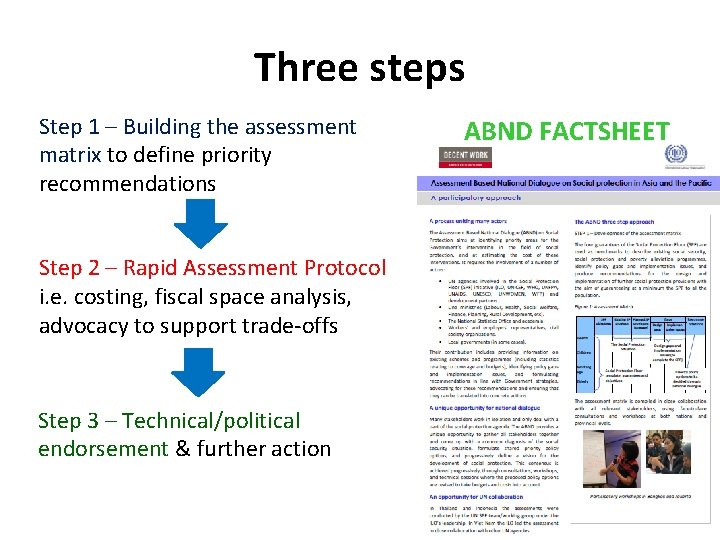
Three steps Step 1 – Building the assessment matrix to define priority recommendations Step 2 – Rapid Assessment Protocol i. e. costing, fiscal space analysis, advocacy to support trade-offs Step 3 – Technical/political endorsement & further action ABND FACTSHEET
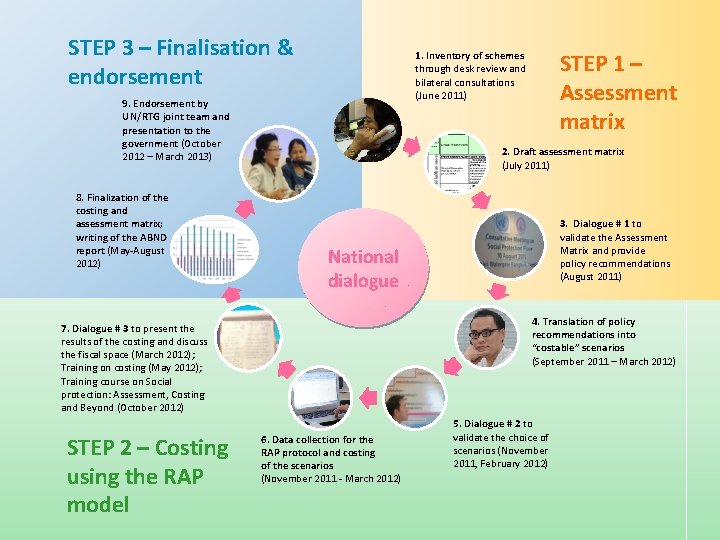
STEP 3 – Finalisation & endorsement 9. Endorsement by UN/RTG joint team and presentation to the government (October 2012 – March 2013) 8. Finalization of the costing and assessment matrix; writing of the ABND report (May-August 2012) 2. Draft assessment matrix (July 2011) 3. Dialogue # 1 to validate the Assessment Matrix and provide policy recommendations (August 2011) National dialogue 4. Translation of policy recommendations into “costable” scenarios (September 2011 – March 2012) 7. Dialogue # 3 to present the results of the costing and discuss the fiscal space (March 2012); Training on costing (May 2012); Training course on Social protection: Assessment, Costing and Beyond (October 2012) STEP 2 – Costing using the RAP model STEP 1 – Assessment matrix 1. Inventory of schemes through desk review and bilateral consultations (June 2011) 6. Data collection for the RAP protocol and costing of the scenarios (November 2011 - March 2012) 5. Dialogue # 2 to validate the choice of scenarios (November 2011, February 2012)
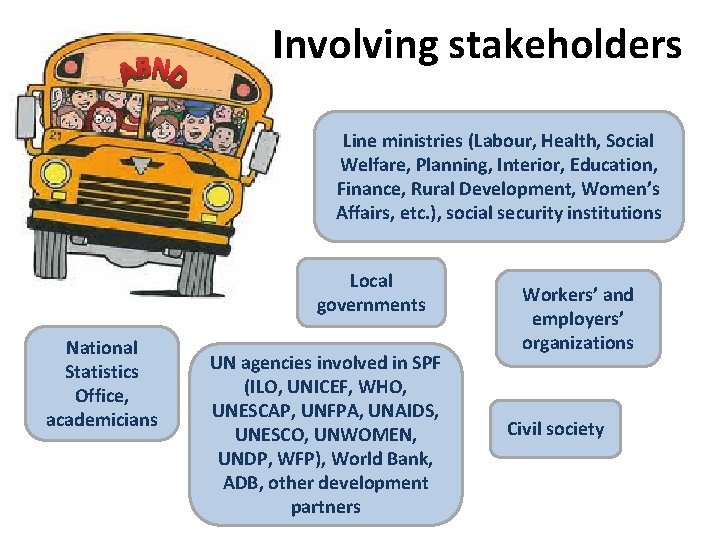
Involving stakeholders Line ministries (Labour, Health, Social Welfare, Planning, Interior, Education, Finance, Rural Development, Women’s Affairs, etc. ), social security institutions Local governments National Statistics Office, academicians UN agencies involved in SPF (ILO, UNICEF, WHO, UNESCAP, UNFPA, UNAIDS, UNESCO, UNWOMEN, UNDP, WFP), World Bank, ADB, other development partners Workers’ and employers’ organizations Civil society
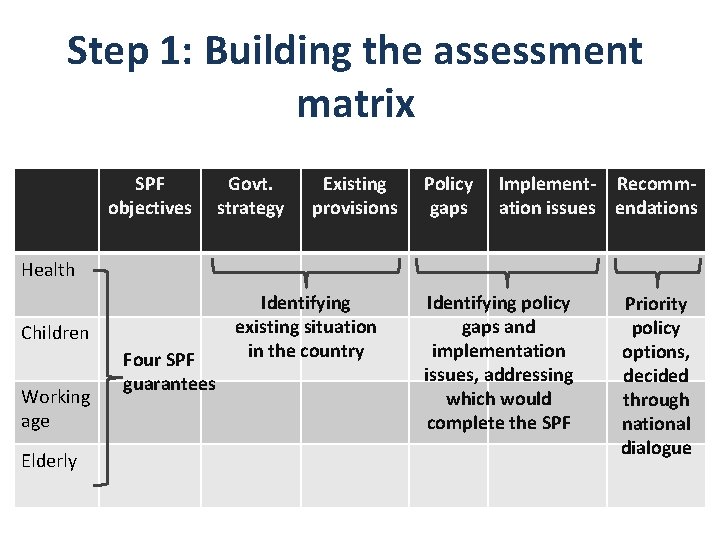
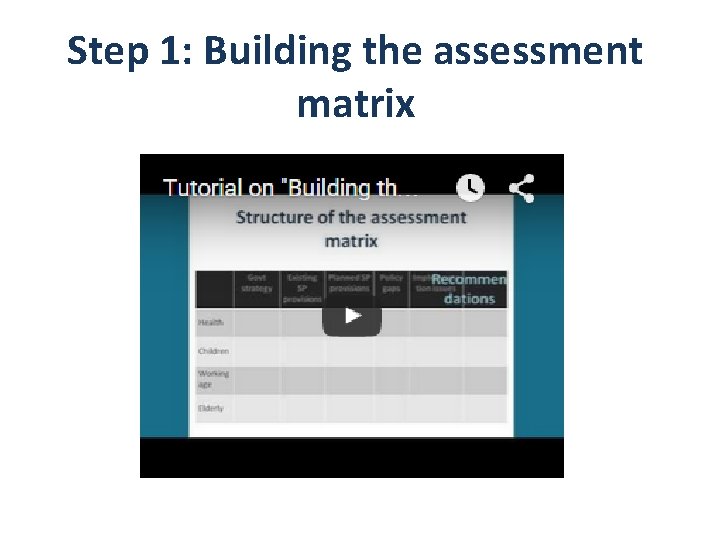
Step 1: Building the assessment matrix SPF objectives Govt. strategy Existing provisions Policy gaps Implement- Recommation issues endations Health Children Working age Elderly Four SPF guarantees Identifying existing situation in the country Identifying policy gaps and implementation issues, addressing which would complete the SPF Priority policy options, decided through national dialogue
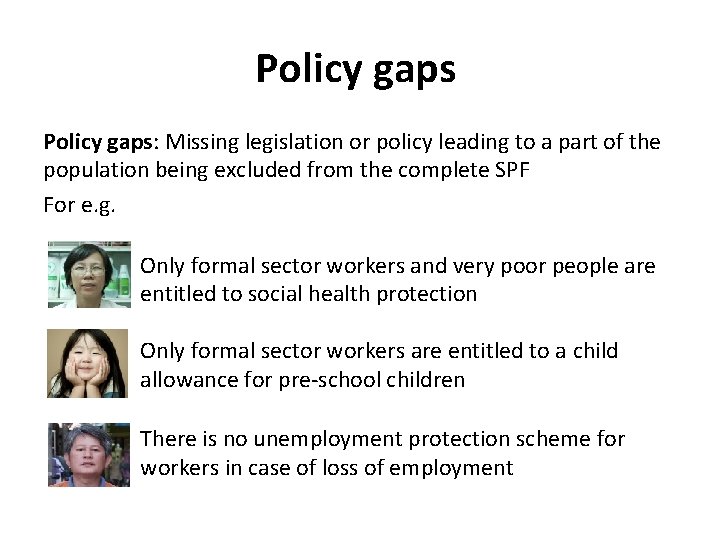
Policy gaps: Missing legislation or policy leading to a part of the population being excluded from the complete SPF For e. g. Only formal sector workers and very poor people are entitled to social health protection Only formal sector workers are entitled to a child allowance for pre-school children There is no unemployment protection scheme for workers in case of loss of employment
Implementation issues: Despite existing policies or legislation, people do not have effective access to entitlements For e. g. Despite universal access to social health protection, people from rural areas have limited protection due to poor health care infrastructure Enforcement of the Social Security Act is low, due to employers not registering their staff and a lack of resources to reach out to informal sector workers
Step 1: Building the assessment matrix
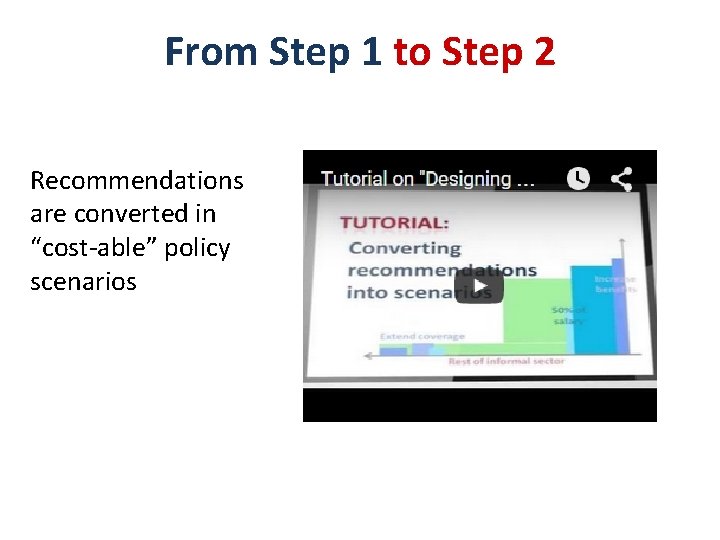
From Step 1 to Step 2 Recommendations are converted in “cost-able” policy scenarios
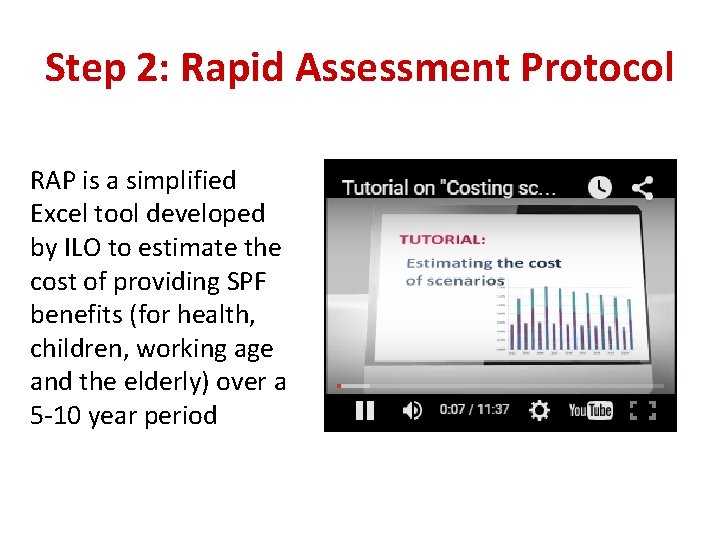
Step 2: Rapid Assessment Protocol RAP is a simplified Excel tool developed by ILO to estimate the cost of providing SPF benefits (for health, children, working age and the elderly) over a 5 -10 year period
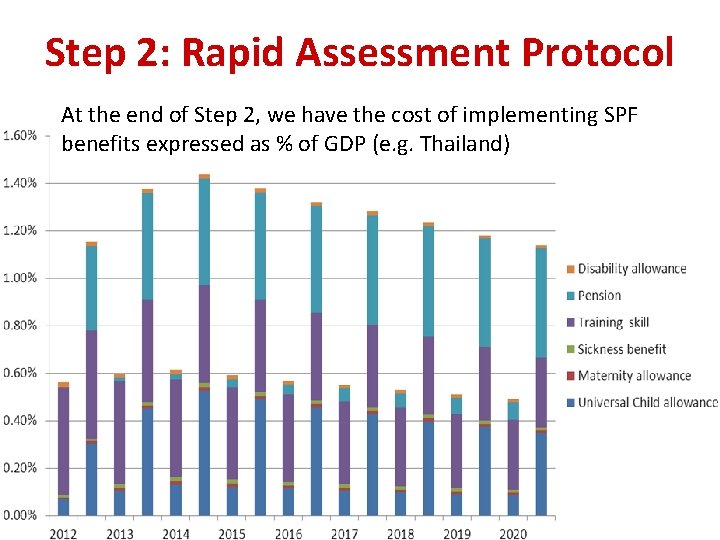
Step 2: Rapid Assessment Protocol At the end of Step 2, we have the cost of implementing SPF benefits expressed as % of GDP (e. g. Thailand)
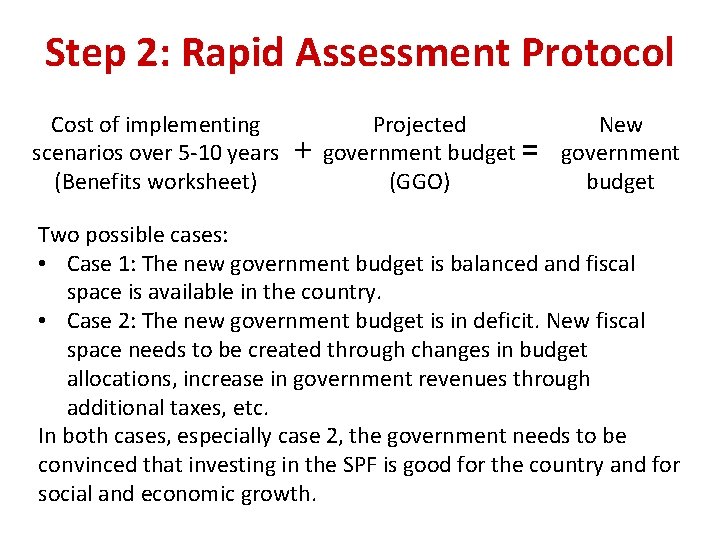
Step 2: Rapid Assessment Protocol Cost of implementing scenarios over 5 -10 years (Benefits worksheet) + Projected New government budget = government (GGO) budget Two possible cases: • Case 1: The new government budget is balanced and fiscal space is available in the country. • Case 2: The new government budget is in deficit. New fiscal space needs to be created through changes in budget allocations, increase in government revenues through additional taxes, etc. In both cases, especially case 2, the government needs to be convinced that investing in the SPF is good for the country and for social and economic growth.
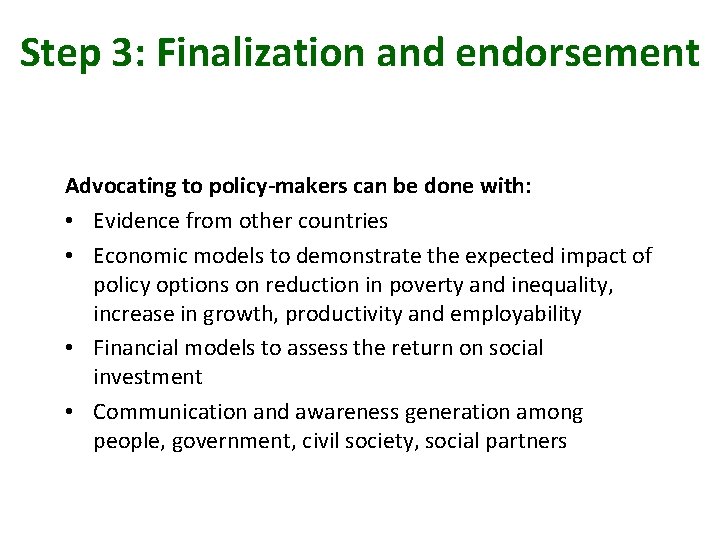
Step 3: Finalization and endorsement Advocating to policy-makers can be done with: • Evidence from other countries • Economic models to demonstrate the expected impact of policy options on reduction in poverty and inequality, increase in growth, productivity and employability • Financial models to assess the return on social investment • Communication and awareness generation among people, government, civil society, social partners
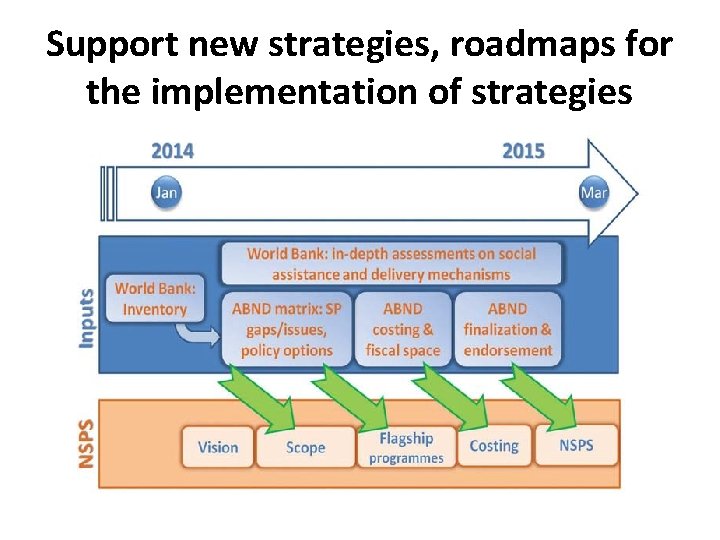
Support new strategies, roadmaps for the implementation of strategies
Strengths of ABND • It provides a coordinated, holistic and coherent approach to the development of social protection in a country • It initiates national dialogue on social security strategy, SPF, priority policy options, problems in providing social protection to all and ways to address the issues • It provides evidence on the feasibility of different policy options • It can serve as a baseline for monitoring of SPF implementation (within the national framework)
Limitations of ABND • The analysis conducted under Step 1 is simplistic and does not go into details on operations and institutional capacities • The social dialogue usually takes place at the technical level and higher-level policy makers or “champions” may need to be involved during Step 3 • The RAP is based on some assumptions leading to rough estimates of future costs; additional actuarial studies are needed for the finalisation of the design of proposed schemes
Exercise 1 - Case study – conducting the ABND in Coresia