
Session 5 MARKET ASSESSMENT 1 Scale of success




- Slides: 33
Session 5 MARKET ASSESSMENT
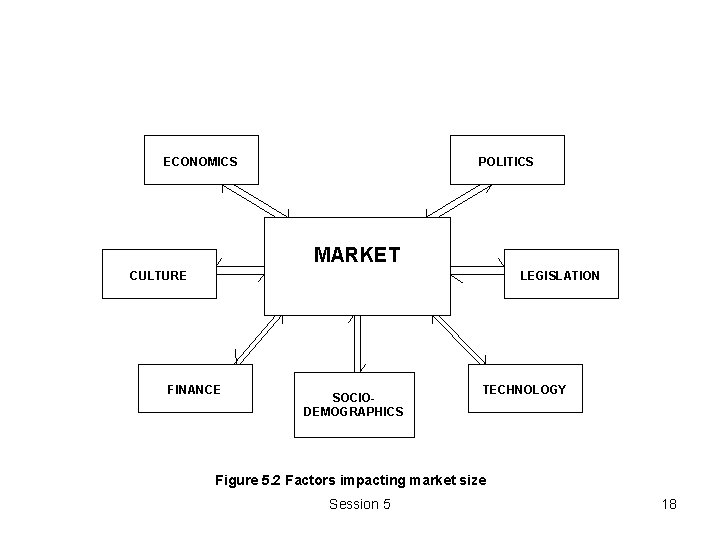
1. Scale of success for an entrepreneurial proposition will depend on the market demand. 2. Accurate market size estimates are more difficult for new-to-the-world propositions. 3. Sector experts may be unable to accurately forecast ultimate market size for a totally new product. 4. Market size is influenced by macroenvironmental factors beyond the control of the entrepreneur. 5. Variables which can influence market size include economics, politics, legislation, finance, technology, socio-demographics and culture. Session 5 2
Market Potential • Revenue is determined by current and future market size. • Larger markets offer greater potential but only where further growth is expected and competition is not intense. • Mature or declining markets will usually mean a firm’s future sales will fall. • Need to recognise existence of market at two levels. Session 5 3
• ‘Actual market’ of customers already purchasing. • ‘Potential market’ containing both actual market and customers who have yet to start purchasing. • Small firms tend to focus on actual market because it is much easier to measure. • Over the long term, the potential market is more important because shift can radically alter total demand. Session 5 4
• Example of number of households consisting of young couples. • Decline in this group will reduce the number of children born and hence reduce the sale of children’s products. • Customer demand is divisible into: – Economic preference in terms of affordability – Benefit preference in terms of benefit desired – Practicality preference in relation to desire for practicality Session 5 5
Unexpected Success • For over 40 years, Mattel’s Barbie Doll has dominated the toy market with $2 billion annual sales. • Isaac Larian was shown a doll design he thought was ugly but which fascinated his daughter. • He perceived an opportunity to challenge the Barbie product proposition by offering doll closer to young girls’ future image of themselves. • He developed a range of curvier, shorter multiethnic dolls under brand name ‘Bratz’. Session 5 6
• Product could be dressed in very modern clothes as currently be worn by teenagers. • Initial reaction of retailers was that Bratz would never compete successfully against the Barbie brand heritage. • Year 1 sales were only $100, 000 but 12 months later had reached over $1 million. • Overtook Barbie as top selling doll and, in 2004, achieved annual sales of $3 billion. Session 5 7
Market Size • Determined by number of customers entering/departing market and per capita purchasing rate. • For major brands, forecasting is often a matter of extrapolating sales history. • For entrepreneurs in new or emerging markets, such techniques have limited application. • This reflects lack of knowledge of: – Eventual total number of customers – Ultimate per capita purchase rate Session 5 8
Errors • One approach to evaluating forecasting errors is to compare expert opinion with subsequent events. • Professor Young in the USA predicted in 1988: – Exploitation of superconductivity would be important – Computers would dominate commercial growth with hardware/software sales being 80/20 • Ten years later: – Superconductivity did not become a commercial reality – Computer market did grow – Ratio of hardware/software actually 20/80 due to impact of PCs and role of standardised platforms such as Microsoft products Session 5 9
No Market Forecast • Entrepreneurs often start a venture without any understanding of potential market size. • Steve and Julia Pankhurst decided to use the Internet to help people find old friends in UK. • Launched Friends. Reunited in 1999 from a spare bedroom. • Initially, the site survived by word-of-mouth recommendations to locate old school friends. • Featured on radio as ‘Website of the Day’, the server was overwhelmed by new visitors. • No idea of market size, but in 3 years became most popular social networking site in the UK. • Business was sold to UK television channel ITV in 2006 when registered membership level was 12 million. Session 5 10
Experts • Firms often rely on industry experts to develop forecasts for new products. • Research study of 69 high-tech grant proposals evaluated by experts to qualify for funding. • Post-project evaluation revealed low accuracy. • Higher accuracy obtained by using multiple regression based on background and experience of applicant firms. • Forecasting difficult when product is based on a new application or new technology. • Forecasting much easier for a new technology which creates product substitute (e. g. market potential for digital cameras). Session 5 11
Expert Error • There is a risk that experts are biased or myopic when evaluating new opportunities. • The videodisc player (VDP) used videodisc to play films/entertainment via home television. • Laser technology provides high quality reproduction. • Competitor was videocassette recorder (VCR) which provided much lower quality playback but could be used to record TV programmes. • Experts predicted VDP would be more successful. • US/EU firms priced VCR at cost (£ 1, 000+) but Japanese priced at £ 500 on assumption costs would fall. • VDP was a failure and VCR was huge success and provided the basis for another Japanese success story. Session 5 12
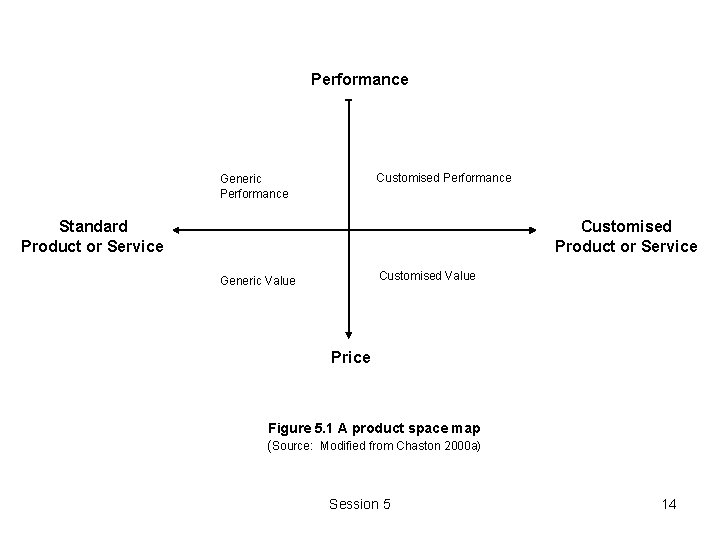
Competition • The capability and intensity of market activity of competition must be included in any market forecast. • One approach to assessing competition is to analyse their strategy and market positioning. • Another approach is to develop a product space map with dimensions ‘standard versus customised product’ and ‘product performance versus price’. • Seek to avoid areas of space map already crowded by presence of competition. Session 5 13
Performance Customised Performance Generic Performance Standard Product or Service Customised Value Generic Value Price Figure 5. 1 A product space map (Source: Modified from Chaston 2000 a) Session 5 14
Browser War • Entrepreneurs can often build a business by outinnovating large firms. • However, large firms have the potential to use resource superiority to demolish the new upstart. • In 1994 Jim Clark and Marc Andreesen launched the first commercial Internet browser – Netscape. • They provided a client application programme so Web developers could incorporate Netscape into their development. • Potential users could download Netscape for a free 90 day trial. Session 5 15
• Netscape became the market leader and the company went public in 1995, making its founders millionaires overnight. • Initially, Microsoft ignored Netscape’s success, but then Bill Gates announced his intention of entering browser market. • Early Microsoft products were poor but Internet Explorer 3. 0 was a major improvement. • Microsoft’s strategy was to give away Internet Explorer free with Windows 95. • Microsoft then set up agreements with ISPs such as AOL and MCT. • Netscape eventually sold to another US company at fraction of original launch share price. Session 5 16
Macro-Environment • Entrepreneurs tend to focus on the core market. • The reality is that other factors, such as economic conditions, can have major impact on market size and trends. • The advent of the Internet has increased the ability of entrepreneurs to gain an understanding of macro-environmental variables. • This is important because, although macroenvironment has influence, most variables are beyond the control or influence of a small firm. Session 5 17
ECONOMICS POLITICS MARKET CULTURE LEGISLATION FINANCE SOCIODEMOGRAPHICS TECHNOLOGY Figure 5. 2 Factors impacting market size Session 5 18
Economics • As economies grow, consumers’ income and confidence rises, leading to further market growth. • The opposite is a downturn, when confidence and income declines, leading to a decline in market size as customer spending falls. • The current 2008 recession was triggered by the 2007 failure of the US sub-prime mortgage and growing evidence of financial institutions holding toxic debts. • Concurrently, consumer spending over the previous decade was fuelled by borrowing based on assumptions about house values’ increasing net worth. Session 5 19
• As the financial crisis worsened, the house price bubble burst, triggering decline in consumer spending and confidence. • The global credit crisis then triggered a downturn with rising business failures and global unemployment. • The scale of recession is greater than initially forecast by economists. • Length and depth of the recession is an issue because its continuation will impact consumer markets and limit scale of success of new entrepreneurial initiatives. Session 5 20
Politics • Prevailing political philosophy of government will influence economic policy. • After the Second World War, many Western governments introduced a ‘welfare state’ offering free or subsidised services and benefit payments. • An ageing population and declining economic success is creating funding problems for these welfare states. • The outcome will probably be fewer services and higher tax, reducing consumers’ disposable income. • A new unknown is the scale of inflation that may result from governments’ attempts to solve the global credit crisis/recession. Session 5 21
Legislation • Governments tend to introduce new legislation in cases where voluntary co-operation has not been achieved. • Governments usually provide indications of their intention to introduce new laws which may provide time for firms to plan a response. • One problem is that legislation usually adds to administrative burden. • The resulting cost/revenue burden is much higher for smaller firms. • This may reduce their ability to respond flexibly and rapidly to market opportunities. Session 5 22
Winner/Loser • Legislative change often generates losses for some but new opportunities for others. • Example of UK government in 2000 introduced new tax regulations which complicated life for small business contractors and their large firm clients. • Paul Bishop launched Actinium which creates and manages limited companies on behalf of contractors for free. • Revenue is generated from commission on managing contractors’ invoicing. • Over 3 years, sales rose to approximately £ 40 million. Session 5 23
• Another example is the of emergence of on-line gambling firms. • Many were started by entrepreneurs who became millionaires by taking their firms public. • Over 50% of revenue came from gamblers in the USA, even though the risk of the US government legislating against on-line gambling was known. • In 2006, the US Senate did not criminalise online gambling, but prohibited banks and credit cards accepting gambling transactions. • This wiped out a number of firms but, on other hand, provided protection for the US gambling industry in places such as Las Vegas. Session 5 24
Finance • Having borrowed from self or family, SME growth often requires external bank borrowing. • A problem is that the banking sector’s desire to lend to SMEs varies over time. • Hence we have period of aggressive lending (e. g. early years of 21 st century) followed by a massive cutback, as in the current recession. • A problem is that an overdraft is ‘demand lending’, which means a bank can reduce or withdraw it without notice. Session 5 25
• As a firm continues to grow, so does its need for equity finance. • Again, there is the problem of the fluctuating availability of equity capital. • The late 1990 s saw ‘dot-coms’ being hugely popular, with numerous IPOs. • Then came the recognition that many dot-coms would not deliver their forecasted profits, and the lending bubble burst. • Since then, raising venture capital has been more difficult. • It is probable the 2008 credit crunch will mean a further decline in access to equity capital. Session 5 26
Technology • History is littered with cases of firms which ignored the potential impact of new technology. • Usually it is a small band of entrepreneurs who recognise and act to develop new products. • A common explanation is that small firms are more innovative, flexible, proactive and respond rapidly. • In many cases, large firms’ lack of response is due to their innovation being driven by the requirements of key customers. Session 5 27
New Frontier • Large pharmaceuticals firms focused on new ‘wonder drugs’ and ignored biotechnology, gene therapy and stem cell research. • It took them some years to recognise threat and, in many cases, they were forced to acquire entrepreneurial firms. • Another developing area is neurotechnology which, to date, has remained of interest to small entrepreneurial firms. • For many years, it has been known that muscles respond to electrical stimulation. Session 5 28
• In the late 20 th century, neuroscientists exploited IT to understand how biomaterials can be used to treat medical disorders. • An early breakthrough was using implants to restore mobility following spinal injuries. • Implants have now been developed to overcome severe deafness conditions. • Other applications being researched include treatment of Parkinson’s disease and chronic pain management. • Market growth is in excess of 40%/year, but barriers of gaining acceptance by major medical insurance companies and time taken to obtain government approval of treatments remain. Session 5 29
Socio-Demographics • Variables in population such as age, income, employment, education. • Data in many countries is generated by government census to identify change over time. • Governments also often compliment census data with surveys and forecasts of consumer spending patterns. • Entrepreneurs can now access these data via the Internet, which permits more effective identification between spending and variables such as age and income. Session 5 30
Culture • Reflects current attitudes and beliefs within a population. • Identifying an early shift in culture is not easy. • Once a shift has been identified, an entrepreneur may be able to exploit it ahead of large firms. • Small firms can survive in smaller markets and early culture shift is often only reflected by a small proportion of the population changing its buying behaviour. • As culture shift influences more of population, smaller entrepreneurs can often enjoy and exploit their head start over their potential large firm competitors. Session 5 31
Culture Comparison • The success of the Japanese in 1980 s raised the issue of whether Pacific Rim nations exhibit different cultural values in developing new products. • Researchers focused on the view that Pacific Rim nations are more effective as ‘entrepreneurial adaptors’ (i. e. do existing things better). • This was contrasted with the Western nation culture of disruptive innovation. • This reflected Western national culture’s support for personal freedom and creativity. • Japanese innovation is reflective of need for conformity, common good, fulfilling needs of community and team. Session 5 32
• View supported by approach to science and technology differences. • Western national values are based upon support for individual making a leap of imagination, but grounded in scientific reality. • Japanese academic research is more embedded in progressive development of knowledge based upon careful research. • Technological entrepreneurs are curious, comfortable with radical solutions and taking risks. • Culture constraint in Japan of preference to work with making improvements based on existing technologies. Session 5 33