
Session 5 Intersectionality The law Crenshaw Concept of

- Slides: 6
Session 5 Intersectionality
The law
Crenshaw • Concept of intersectionality • Structural intersectionality • Political intersectionality • Identity politics vs diversity - intersectionality
Challenges coming from intersectionality Questioning the universality of violence against women: • common experiences of battered women vs different experiences along class, race etc. • universality: token attempt to include diverse experiences Questioning traditional definitions of violence against women • • Assumptions of homogeneity: stereotypes of victimhood - (in)appropriate victims VAW definitions: Incomplete if specific forms of abuse not included (as perceived culturally, locally etc) Does it mean relativism? Does it mean individualism? Questioning the primacy of gender equality explanations: • VAW takes place in the context of other oppressions (homophobia, racism etc). • Fear from racism and homophobia leads to silencing. • Poverty, economic dependency: strong determinant. Need to redefine VAW! GBV?
Tensions between VAW and intersectionality • Sokoloff & Dupont • Attributing blame for VAW to other cultures. Relativizing (Dasgupta 1998) – belief that minority ethnic communities, lower socio economic status, and race defines it. Simplistic analysis of the role of culture – only as a negative factor • Culture used to justify violence: moral relativism. Looking at it in terms of group stereotype rather than individual behavior. Culture in devalued groups seen as more deterministic than in majority groups
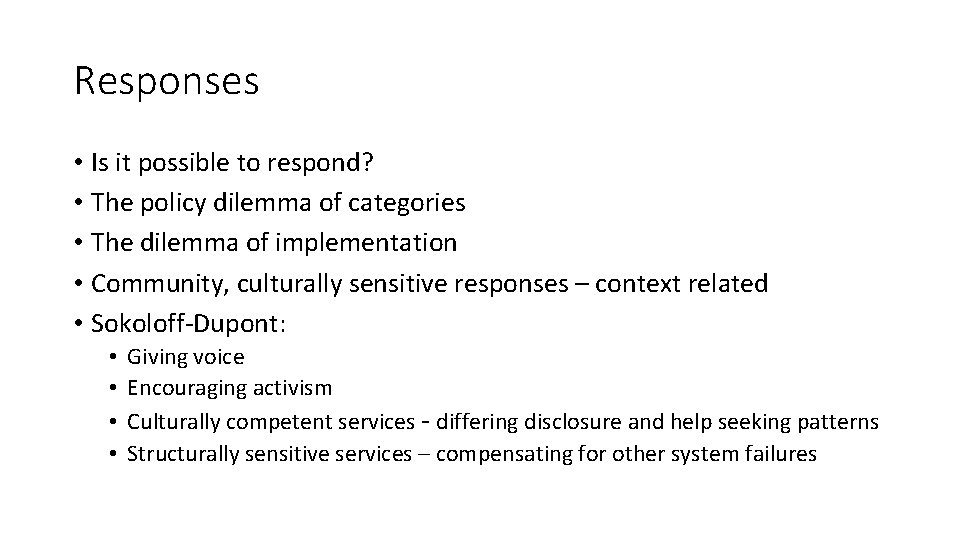
Responses • Is it possible to respond? • The policy dilemma of categories • The dilemma of implementation • Community, culturally sensitive responses – context related • Sokoloff-Dupont: • • Giving voice Encouraging activism Culturally competent services - differing disclosure and help seeking patterns Structurally sensitive services – compensating for other system failures