
Session 5 How do you do it PROCESS

- Slides: 28
Session 5
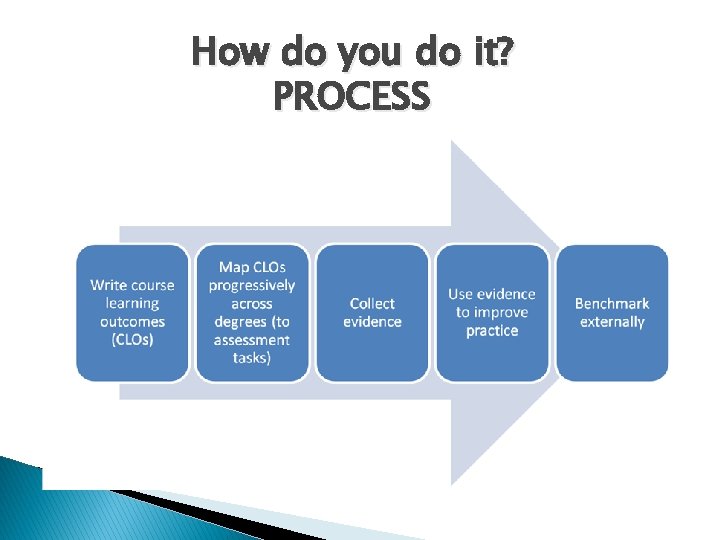
How do you do it? PROCESS
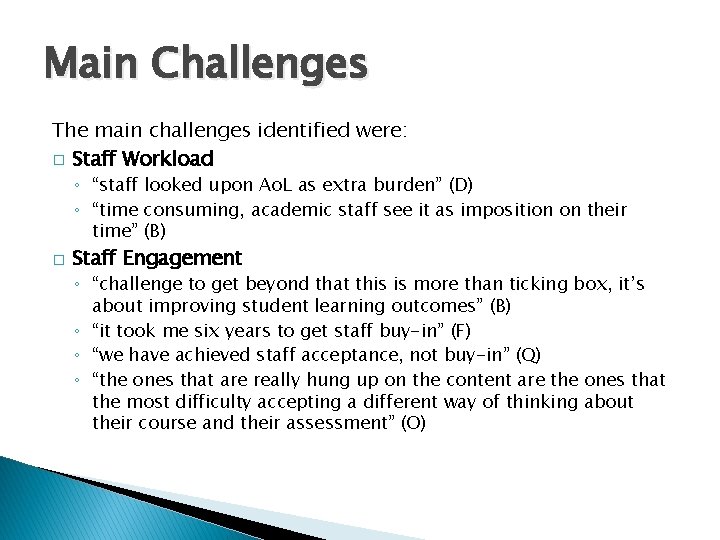
Main Challenges The main challenges identified were: � Staff Workload ◦ “staff looked upon Ao. L as extra burden” (D) ◦ “time consuming, academic staff see it as imposition on their time” (B) � Staff Engagement ◦ “challenge to get beyond that this is more than ticking box, it’s about improving student learning outcomes” (B) ◦ “it took me six years to get staff buy-in” (F) ◦ “we have achieved staff acceptance, not buy-in” (Q) ◦ “the ones that are really hung up on the content are the ones that the most difficulty accepting a different way of thinking about their course and their assessment” (O)
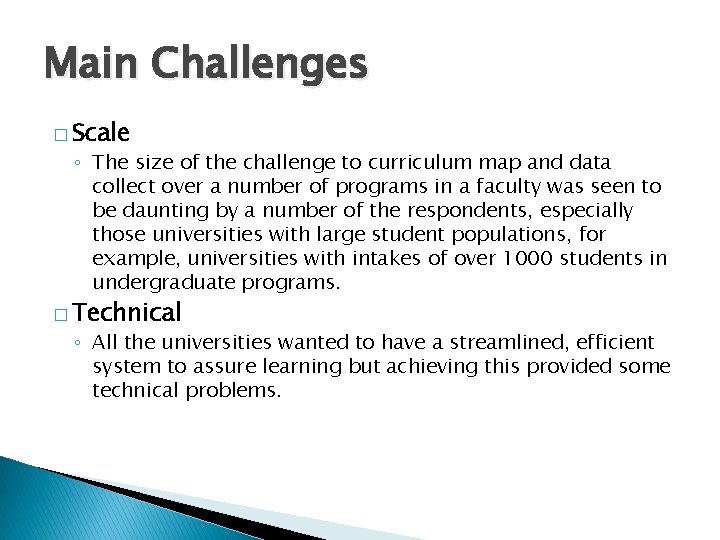
Main Challenges � Scale ◦ The size of the challenge to curriculum map and data collect over a number of programs in a faculty was seen to be daunting by a number of the respondents, especially those universities with large student populations, for example, universities with intakes of over 1000 students in undergraduate programs. � Technical ◦ All the universities wanted to have a streamlined, efficient system to assure learning but achieving this provided some technical problems.
What are the main challenges in implementing AOL in your context?
Bridging the gap between strategy/ process, and implementation? Staff Buy-in/ Engagement
Shared Understanding – What? �A prime aspect of leading the change is the creation of a shared understanding, which is a precursor to a shared commitment. � Shared understanding is defined as the stakeholders understanding each other’s positions well enough to have an intelligent dialogue about their different interpretations, and to exercise collective intelligence for necessary actions (Conklin, 2006).
Shared Understanding – Why? � Developing a shared understanding requires robust conversation in order to expose where understanding may be unclear. � The three structural components that create shared understanding in an organisation are: ◦ vision ◦ mission ◦ values � These should be well defined and articulated, and authentic. � Different organisations accomplish it differently, but the best way is to use the collective wisdom through inclusive activities (Wertsch, 1991).
Focus Group � 4 universities recognised as demonstrating “good practice” in Ao. L � 2 focus groups at each institution – “Leaders” and “Academics” What did they say?
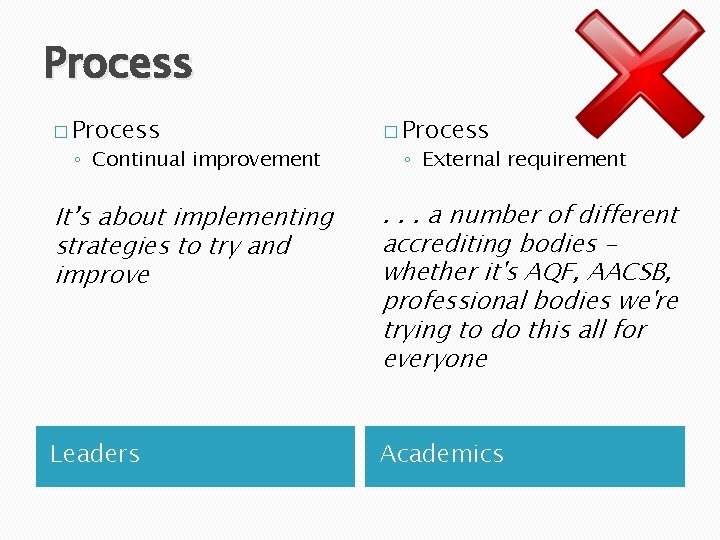
Process � Process It’s about implementing strategies to try and improve . . . a number of different accrediting bodies whether it's AQF, AACSB, professional bodies we're trying to do this all for everyone Leaders Academics ◦ Continual improvement ◦ External requirement
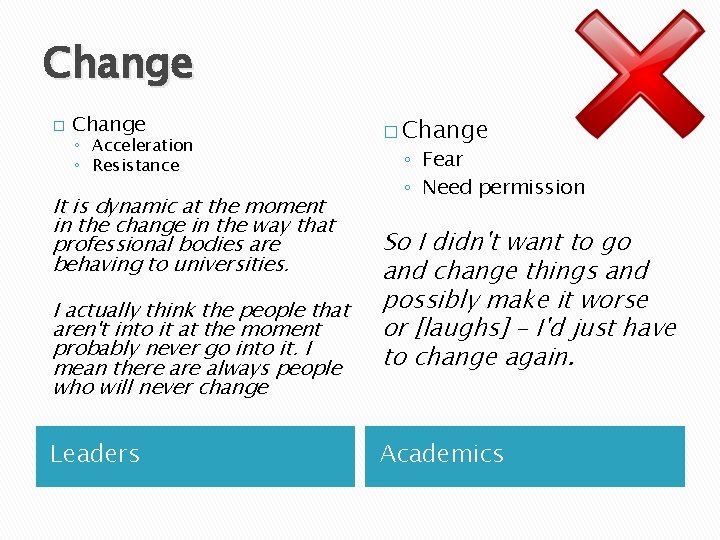
Change � Change ◦ Acceleration ◦ Resistance It is dynamic at the moment in the change in the way that professional bodies are behaving to universities. I actually think the people that aren't into it at the moment probably never go into it. I mean there always people who will never change Leaders � Change ◦ Fear ◦ Need permission So I didn't want to go and change things and possibly make it worse or [laughs] - I'd just have to change again. Academics
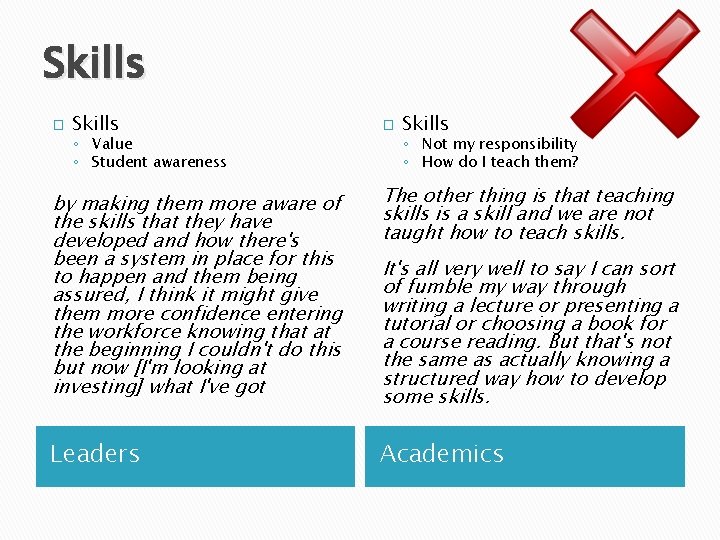
Skills � Skills ◦ Value ◦ Student awareness � Skills ◦ Not my responsibility ◦ How do I teach them? by making them more aware of the skills that they have developed and how there's been a system in place for this to happen and them being assured, I think it might give them more confidence entering the workforce knowing that at the beginning I couldn't do this but now [I'm looking at investing] what I've got The other thing is that teaching skills is a skill and we are not taught how to teach skills. Leaders Academics It's all very well to say I can sort of fumble my way through writing a lecture or presenting a tutorial or choosing a book for a course reading. But that's not the same as actually knowing a structured way how to develop some skills.
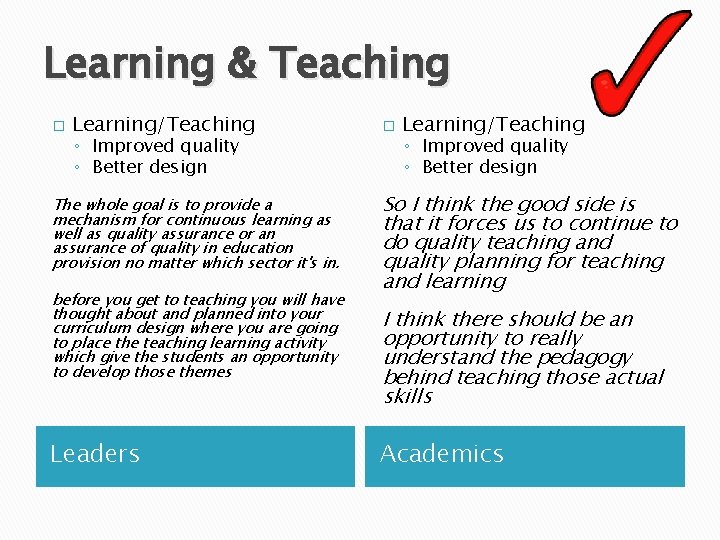
Learning & Teaching � Learning/Teaching ◦ Improved quality ◦ Better design The whole goal is to provide a mechanism for continuous learning as well as quality assurance or an assurance of quality in education provision no matter which sector it's in. before you get to teaching you will have thought about and planned into your curriculum design where you are going to place the teaching learning activity which give the students an opportunity to develop those themes Leaders � Learning/Teaching ◦ Improved quality ◦ Better design So I think the good side is that it forces us to continue to do quality teaching and quality planning for teaching and learning I think there should be an opportunity to really understand the pedagogy behind teaching those actual skills Academics
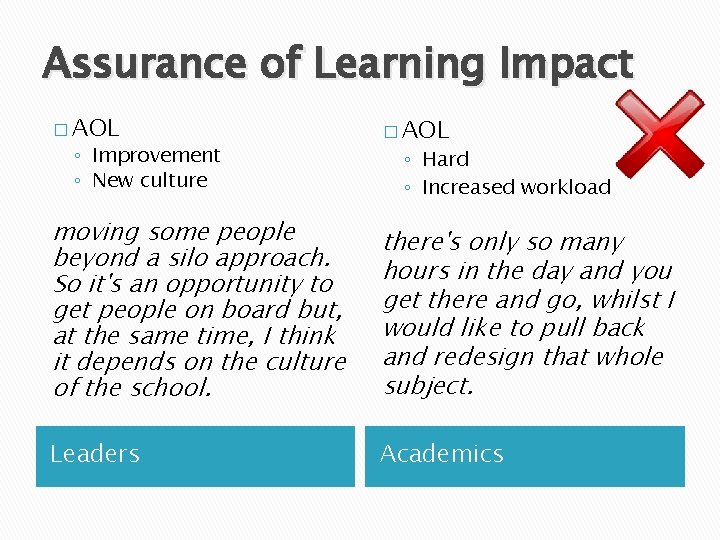
Assurance of Learning Impact � AOL moving some people beyond a silo approach. So it's an opportunity to get people on board but, at the same time, I think it depends on the culture of the school. there's only so many hours in the day and you get there and go, whilst I would like to pull back and redesign that whole subject. Leaders Academics ◦ Improvement ◦ New culture ◦ Hard ◦ Increased workload
Bridging the gap between strategy/ process, and implementation? How do you achieve “shared understanding” / change/ engagement ? ? ?
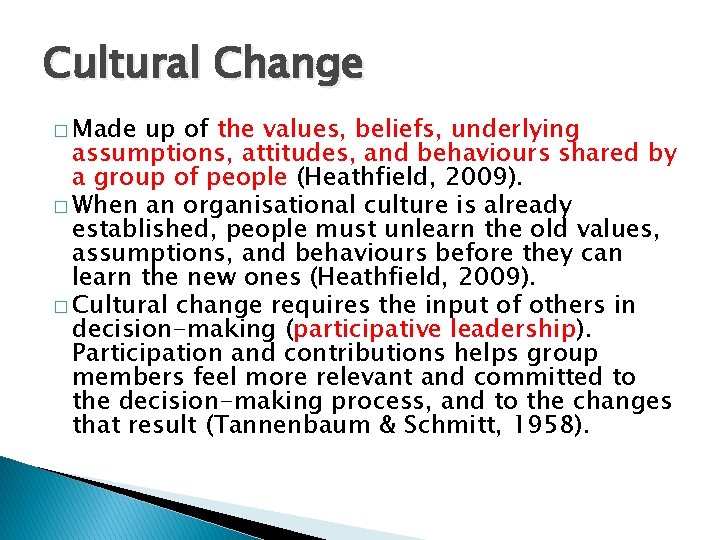
Cultural Change � Made up of the values, beliefs, underlying assumptions, attitudes, and behaviours shared by a group of people (Heathfield, 2009). � When an organisational culture is already established, people must unlearn the old values, assumptions, and behaviours before they can learn the new ones (Heathfield, 2009). � Cultural change requires the input of others in decision-making (participative leadership). Participation and contributions helps group members feel more relevant and committed to the decision-making process, and to the changes that result (Tannenbaum & Schmitt, 1958).
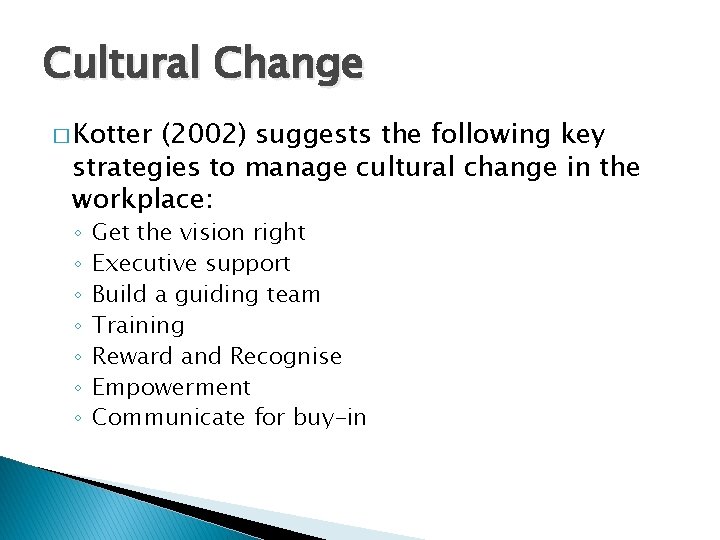
Cultural Change � Kotter (2002) suggests the following key strategies to manage cultural change in the workplace: ◦ ◦ ◦ ◦ Get the vision right Executive support Build a guiding team Training Reward and Recognise Empowerment Communicate for buy-in
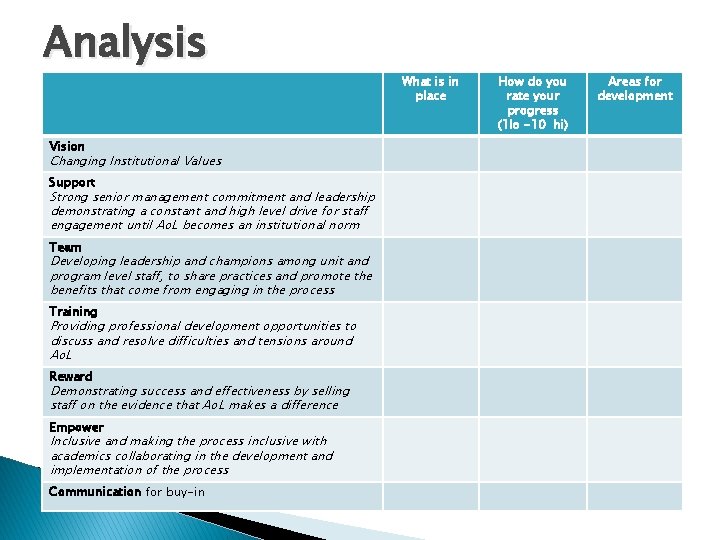
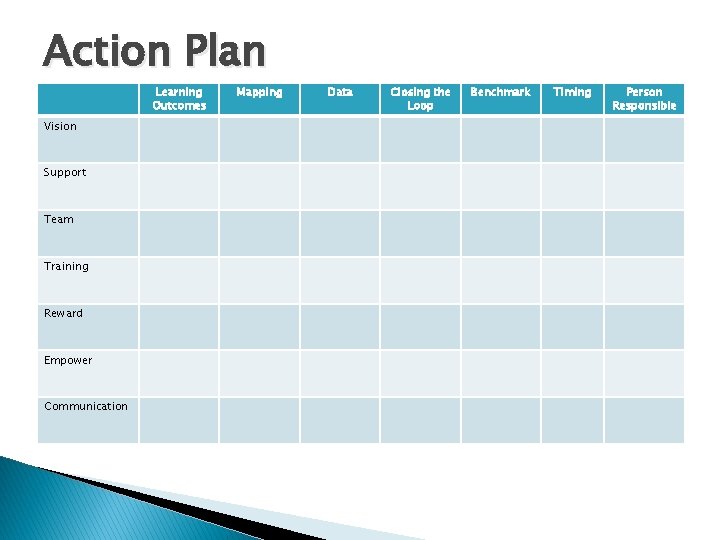
Analysis Vision Changing Institutional Values Support Strong senior management commitment and leadership demonstrating a constant and high level drive for staff engagement until Ao. L becomes an institutional norm Team Developing leadership and champions among unit and program level staff, to share practices and promote the benefits that come from engaging in the process Training Providing professional development opportunities to discuss and resolve difficulties and tensions around Ao. L Reward Demonstrating success and effectiveness by selling staff on the evidence that Ao. L makes a difference Empower Inclusive and making the process inclusive with academics collaborating in the development and implementation of the process Communication for buy-in What is in place How do you rate your progress (1 lo -10 hi) Areas for development
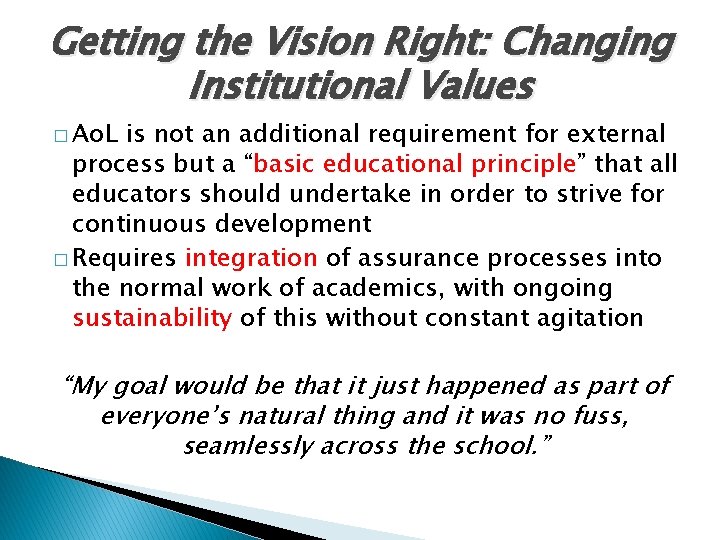
Getting the Vision Right: Changing Institutional Values � Ao. L is not an additional requirement for external process but a “basic educational principle” that all educators should undertake in order to strive for continuous development � Requires integration of assurance processes into the normal work of academics, with ongoing sustainability of this without constant agitation “My goal would be that it just happened as part of everyone’s natural thing and it was no fuss, seamlessly across the school. ”
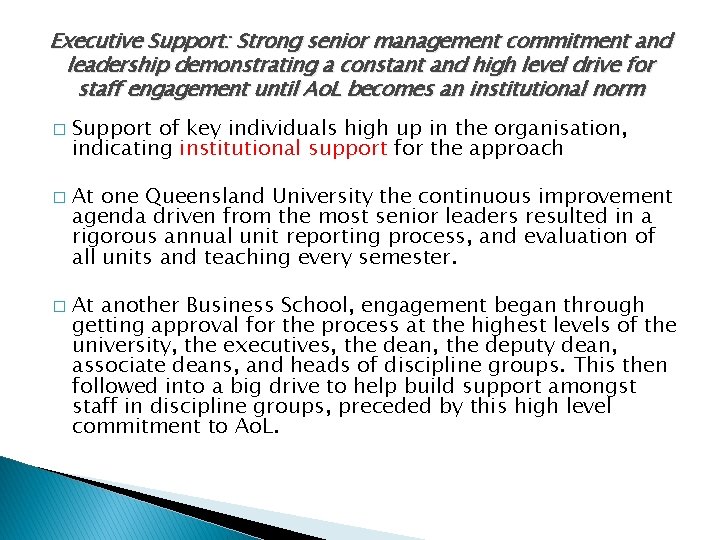
Executive Support: Strong senior management commitment and leadership demonstrating a constant and high level drive for staff engagement until Ao. L becomes an institutional norm � � � Support of key individuals high up in the organisation, indicating institutional support for the approach At one Queensland University the continuous improvement agenda driven from the most senior leaders resulted in a rigorous annual unit reporting process, and evaluation of all units and teaching every semester. At another Business School, engagement began through getting approval for the process at the highest levels of the university, the executives, the dean, the deputy dean, associate deans, and heads of discipline groups. This then followed into a big drive to help build support amongst staff in discipline groups, preceded by this high level commitment to Ao. L.
Building a Guiding Team: Developing leadership and champions among unit and program level staff, to share practices and promote the benefits that come from engaging in the process � Using participative leadership was an important element of successfully integrating Ao. L in institutions. “. . . needing a distributed leadership model to be able to make it to work, so it doesn’t just rely on one person to be a champion. Let them sow a few seeds, and get a few other leaders around to help them spread it a bit further”. � One example was an assurance of learning committee that drew on a representative from each of the disciplines involved. This served to not only have staff members responsible for interpreting the results, but to have key staff members enmeshed in the process. These leaders then fostered engagement through interaction with peers, as well as ensuring the process reflected the experiences of the staff involved.
Training - Providing professional development opportunities to discuss and resolve difficulties and tensions around Ao. L � � Participants emphasised the importance of setting up workshops/professional development as opposed to lectures, and setting up activities as opportunities to develop skills as well as raise concerns. At one school workshops were held featuring staff that had implemented Ao. L processes well within their programs/units; presenting the experience of someone who shared the perspective of staff was effective means of fostering support. One Business School established a Teaching and Learning Team of four teaching and learning consultants and learning designers. They provided one -on-one support to individual academics to explore and improve practice. Key resources created in order to improve staff engagement in Ao. L: ◦ ◦ ◦ web based resources, tools to support and streamline the Ao. L process, development of generic rubrics for undergraduate and postgraduate learning goals, inductions for new staff (including tutors and casual staff) and sponsorship for staff to attend external Ao. L conferences.
Reward and Recognise - Demonstrating success and effectiveness by selling staff on the evidence that Ao. L makes a difference � Selling staff on the usefulness and effectiveness of Ao. L was central to getting engagement, staff need to be able to directly see the benefits in order for them to be invested in the process. “. . . what I’ll do now is I’ll take the behaviour changer and I’ll say let’s find someone doing this really well and then let’s promote it”. � � One university used an online program that made it possible for staff to engage with the Ao. L data directly. Presenting the data as a resource as well as the basis for change and decision-making was important for staff engagement. One fairly innovative measure was using program and unit coordinators who had done Ao. L well, and having them present at seminars and engage in mentoring and peer support. By recognising these staff, anxiety levels about the process were reduced amongst other academics.
Empowerment - Inclusive and making the process inclusive with academics collaborating in the development and implementation of the process � One institution developed a mapping tool so that subject coordinators collaborated in not only the mapping of attributes across the program, but identifying and resolving issues around the distribution and gaps in the curriculum. � At another School of Business, initial work on mapping was done through workshops where coordinators where using Post-it notes, they were asked to map out the distribution of the attributes across assessment tasks through a program, from which a number of gaps and overlaps were identified and discussed.
Communicate for Buy-in � Communications about Ao. L went hand in hand with professional development activities. � Acknowledging the degree of apprehension around Ao. L processes was important in order to make it less daunting. � Important to provide reference material and regular updates on the Ao. L process � Academics were also canvassed for their feedback on the Ao. L process.
The magic words. . . � Embedded � Progressive � Inclusive � Sustainable
Action Plan Learning Outcomes Vision Support Team Training Reward Empower Communication Mapping Data Closing the Loop Benchmark Timing Person Responsible
Resources � Website: ◦ http: //assuringlearning. com/ ◦ Leadership