
Session 5 Consumer preferences utility and budget constraints
Session 5: Consumer preferences, utility and budget constraints Ø How do consumers with limited income decide what to buy? Ø How can we determine the nature of consumer preferences for observations of consumer behaviour?
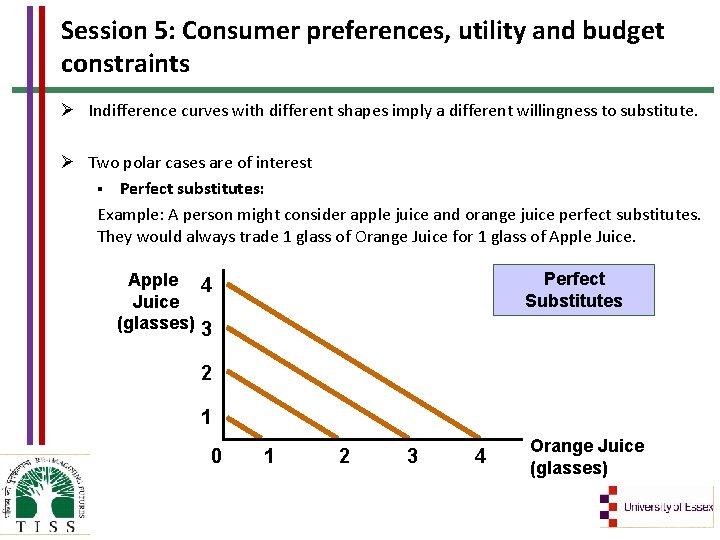
Session 5: Consumer preferences, utility and budget constraints Ø Indifference curves with different shapes imply a different willingness to substitute. Ø Two polar cases are of interest § Perfect substitutes: Example: A person might consider apple juice and orange juice perfect substitutes. They would always trade 1 glass of Orange Juice for 1 glass of Apple Juice. Perfect Substitutes Apple 4 Juice (glasses) 3 2 1 0 1 2 3 4 Orange Juice (glasses)
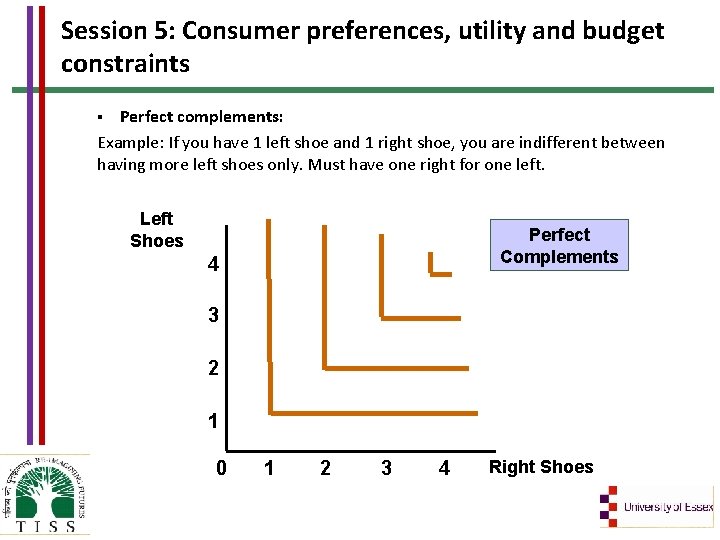
Session 5: Consumer preferences, utility and budget constraints Perfect complements: Example: If you have 1 left shoe and 1 right shoe, you are indifferent between having more left shoes only. Must have one right for one left. § Left Shoes Perfect Complements 4 3 2 1 0 1 2 3 4 Right Shoes
Session 5: Consumer preferences, utility and budget constraints Consumer Preferences • The theory of consumer behaviour does not required assigning a numerical value to the level of satisfaction • Although ranking of market baskets is good, sometimes numerical value is useful
Session 5: Consumer preferences, utility and budget constraints Utility – A numerical score representing the satisfaction that a consumer gets from a given market basket – If buying 3 copies of Microeconomics makes you happier than buying one shirt, then we say that the books give you more utility than the shirt
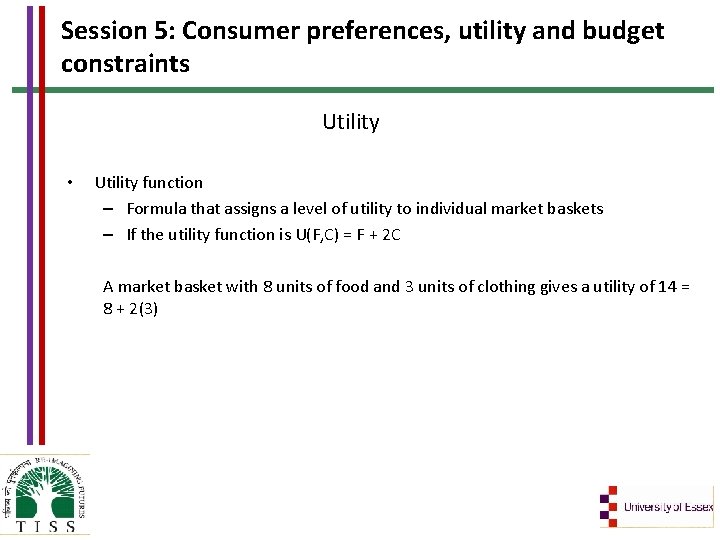
Session 5: Consumer preferences, utility and budget constraints Utility • Utility function – Formula that assigns a level of utility to individual market baskets – If the utility function is U(F, C) = F + 2 C A market basket with 8 units of food and 3 units of clothing gives a utility of 14 = 8 + 2(3)
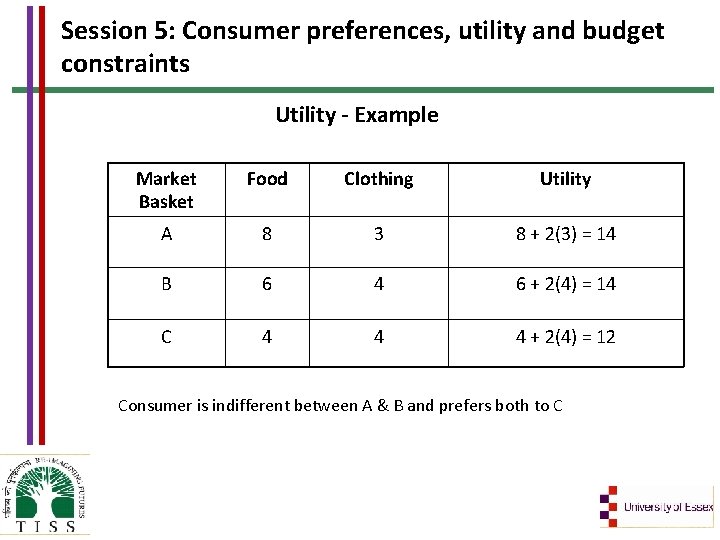
Session 5: Consumer preferences, utility and budget constraints Utility - Example Market Basket Food Clothing Utility A 8 3 8 + 2(3) = 14 B 6 4 6 + 2(4) = 14 C 4 4 4 + 2(4) = 12 Consumer is indifferent between A & B and prefers both to C
Session 5: Consumer preferences, utility and budget constraints Utility - Example Baskets for each level of utility can be plotted to get an indifference curve – To find the indifference curve for a utility of 14, we can change the combinations of food and clothing that give us a utility of 14
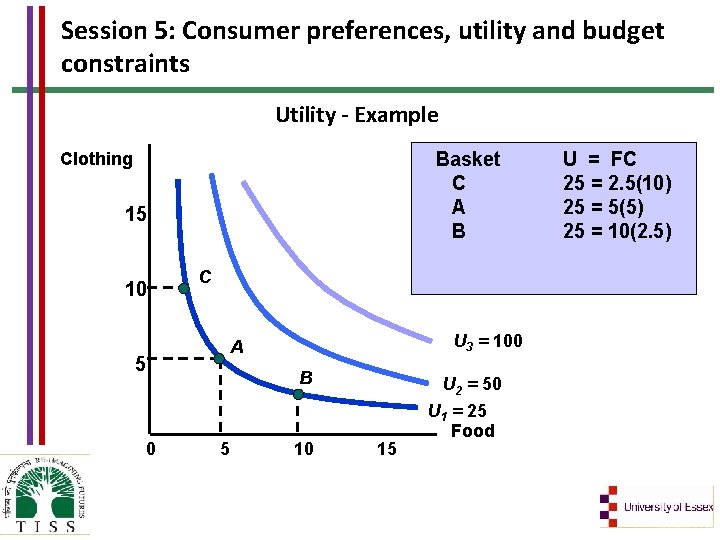
Session 5: Consumer preferences, utility and budget constraints Utility - Example Basket C A B Clothing 15 10 C U 3 = 100 A 5 B 0 5 10 15 U 2 = 50 U 1 = 25 Food U = FC 25 = 2. 5(10) 25 = 5(5) 25 = 10(2. 5)
Session 5: Consumer preferences, utility and budget constraints • Although we numerically rank baskets and indifference curves, numbers are ONLY for ranking • A utility of 4 is not necessarily twice as good as a utility of 2 • There are two types of rankings – Ordinal ranking – Cardinal ranking
Session 5: Consumer preferences, utility and budget constraints Ø Ordinal Utility Function – Places market baskets in the order of most preferred to least preferred, but it does not indicate how much one market basket is preferred to another Ø Cardinal Utility Function – Utility function describing the extent to which one market basket is preferred to another Chapter 3 11 © 2005 Pearson Education, Inc.
Session 5: Consumer preferences, utility and budget constraints • The actual unit of measurement for utility is not important • An ordinal ranking is sufficient to explain how most individual decisions are made
Session 5: Consumer preferences, utility and budget constraints Budget Constraints • Preferences do not explain all of consumer behaviour • Budget constraints also limit an individual’s ability to consume in light of the prices they must pay for various goods and services
Session 5: Consumer preferences, utility and budget constraints The Budget Line – Indicates all combinations of two commodities for which total money spent equals total income – We assume only 2 goods are consumed, so we do not consider savings
Session 5: Consumer preferences, utility and budget constraints The Budget Line • Let F equal the amount of food purchased, and C is the amount of clothing • Price of food = PF and price of clothing = PC • Then PFF is the amount of money spent on food, and PCC is the amount of money spent on clothing
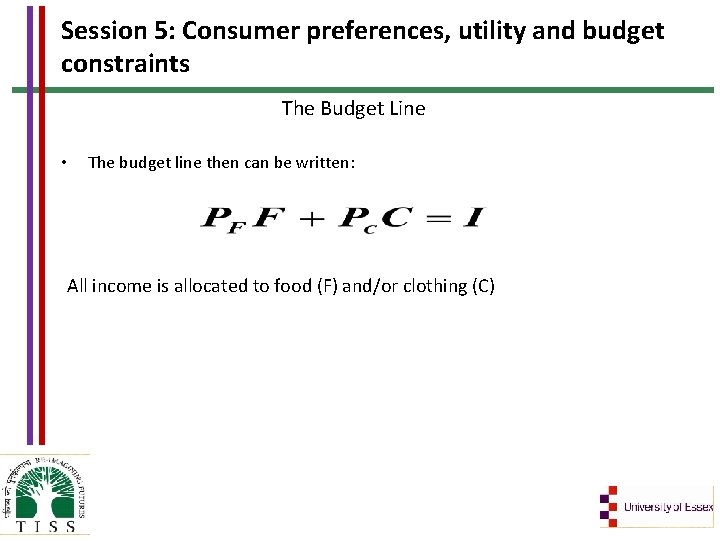
Session 5: Consumer preferences, utility and budget constraints The Budget Line • The budget line then can be written: All income is allocated to food (F) and/or clothing (C)
Session 5: Consumer preferences, utility and budget constraints The Budget Line • Different choices of food and clothing can be calculated that use all income – These choices can be graphed as the budget line • Example: – Assume income of $80/week, PF = $1 and PC = $2
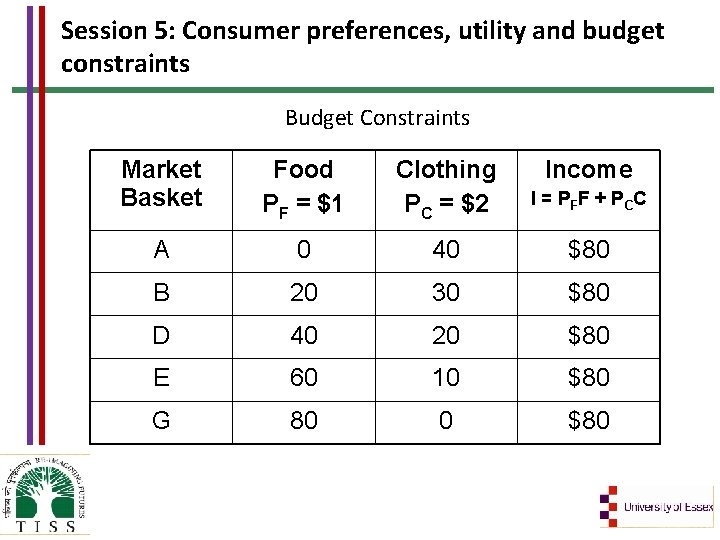
Session 5: Consumer preferences, utility and budget constraints Budget Constraints Market Basket Food PF = $1 Clothing PC = $2 Income I = PFF + PCC A 0 40 $80 B 20 30 $80 D 40 20 $80 E 60 10 $80 G 80 0 $80
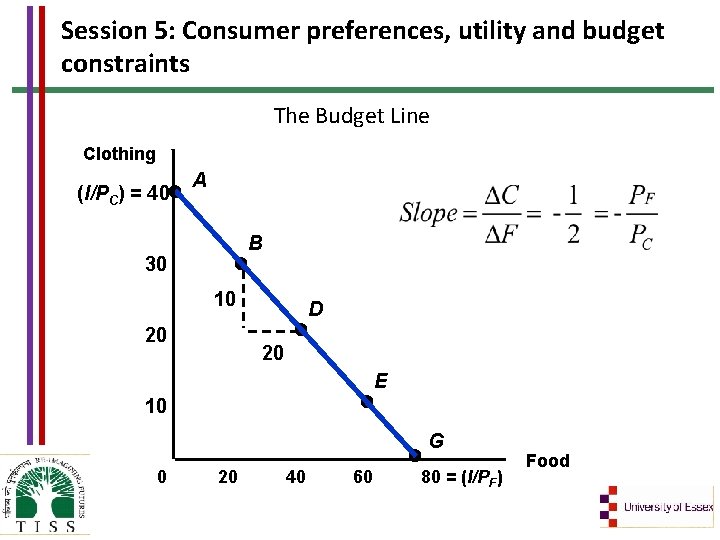
Session 5: Consumer preferences, utility and budget constraints The Budget Line Clothing (I/PC) = 40 A B 30 10 20 D 20 E 10 G 0 20 40 60 80 = (I/PF) Food
Session 5: Consumer preferences, utility and budget constraints The Budget Line • As consumption moves along a budget line from the intercept, the consumer spends less on one item and more on the other • The slope of the line measures the relative cost of food and clothing • The slope is the negative of the ratio of the prices of the two goods • The slope indicates the rate at which the two goods can be substituted without changing the amount of money spent • We can rearrange the budget line equation to make this more clear
Session 5: Consumer preferences, utility and budget constraints The Budget Line
Session 5: Consumer preferences, utility and budget constraints • The Budget Line – The vertical intercept, I/PC, illustrates the maximum amount of C that can be purchased with income I – The horizontal intercept, I/PF, illustrates the maximum amount of F that can be purchased with income I
Session 5: Consumer preferences, utility and budget constraints • As we know, income and prices can change • As incomes and prices change, there are changes in budget lines • We can show the effects of these changes on budget lines and consumer choices
Session 5: Consumer preferences, utility and budget constraints The Budget Line - Changes • The Effects of Changes in Income – An increase in income causes the budget line to shift outward, parallel to the original line (holding prices constant). – Can buy more of both goods with more income
Session 5: Consumer preferences, utility and budget constraints The Budget Line - Changes • The Effects of Changes in Income – A decrease in income causes the budget line to shift inward, parallel to the original line (holding prices constant) – Can buy less of both goods with less income
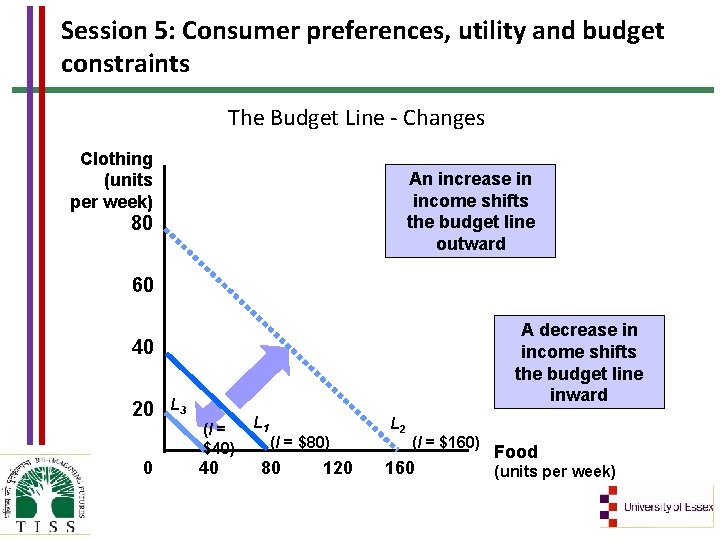
Session 5: Consumer preferences, utility and budget constraints The Budget Line - Changes Clothing (units per week) An increase in income shifts the budget line outward 80 60 A decrease in income shifts the budget line inward 40 20 0 L 3 (I = $40) 40 L 1 (I = $80) 80 120 L 2 (I = $160) 160 Food (units per week)
Session 5: Consumer preferences, utility and budget constraints References: § § Chapter 3 and 4 Microeconomics, R. S. Pyndick, D. L. Rubinfeld and Prem L. Mehta, Peason Publishing House. Consumer Behaviour: faculty. arts. ubc. ca/dqirjo/Teaching/PPLAM/ch 03_08_31_08. ppt
- Slides: 27