
Session 5 Clinical Teaching Skills Basics of Clinical
Session 5: Clinical Teaching Skills Basics of Clinical Mentoring
Learning Objectives By the end of this session, participants will be able to: § Define a teaching moment § Use bedside teaching, side-by-side teaching, and case presentations as teaching strategies Session 5: Clinical Teaching Moments Slide 2
Teaching Moment § An opportunity to share a piece of information, demonstrate a technique, or expand on the implications of a clinical observation Examples: § Demonstration of a physical exam § Allowing mentee to feel/hear/observe something abnormal upon patient examination that you, as mentor, have experienced § Ask a mentee to stage the patient according to WHO stages Session 5: Clinical Teaching Moments Slide 3
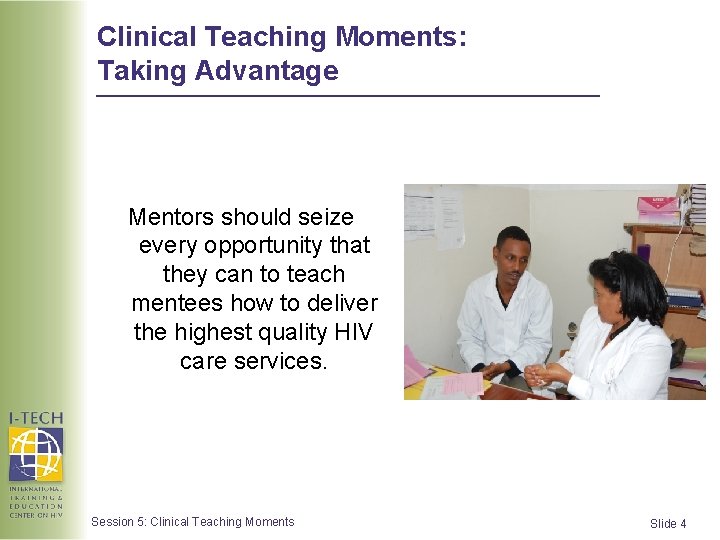
Clinical Teaching Moments: Taking Advantage Mentors should seize every opportunity that they can to teach mentees how to deliver the highest quality HIV care services. Session 5: Clinical Teaching Moments Slide 4
Clinical Teaching Moments: Missed Opportunities § Mentor notes mistakes but does not communicate about them to the health care worker (HCW). § Mentor informs an HCW that errors are being made, but does not provide effective teaching to correct the error. § Mentor is impatient/unapproachable so that HCW is scared to ask questions regarding his/her work performance. Session 5: Clinical Teaching Moments Slide 5
When and Where Do Teaching Moments Occur? § In a variety of settings: § ART clinics, inpatient medical wards, labor and delivery wards, sessions on voluntary counseling and testing, etc. § Anytime: § While a patient is present in the room § Following a client visit § Planned for the future Session 5: Clinical Teaching Moments Slide 6
Content of a Teaching Moment Can be about any aspect of service provision within the clinical setting: § Methodology or process of a counseling session or procedure § § Background on disease pathophysiology § Suggesting appropriate treatment options Patient rapport/interpersonal communication patterns Building confidence Strategies for maintaining patient confidentiality within the clinic setting Session 5: Clinical Teaching Moments Slide 7
Three Basic Learning Styles § Visual: Learning through watching, observing, and reading § Demonstrations, visual examples § Auditory: Learning through listening § Case discussions, lectures § Kinesthetic: Learning through doing, practicing, and touching § Role plays, practice techniques (e. g. , blood draws) Session 5: Clinical Teaching Moments Slide 8
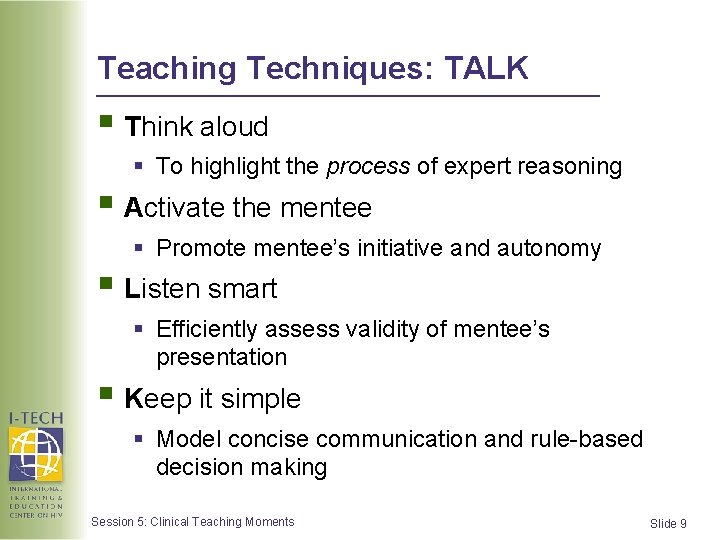
Teaching Techniques: TALK § Think aloud § To highlight the process of expert reasoning § Activate the mentee § Promote mentee’s initiative and autonomy § Listen smart § Efficiently assess validity of mentee’s presentation § Keep it simple § Model concise communication and rule-based decision making Session 5: Clinical Teaching Moments Slide 9
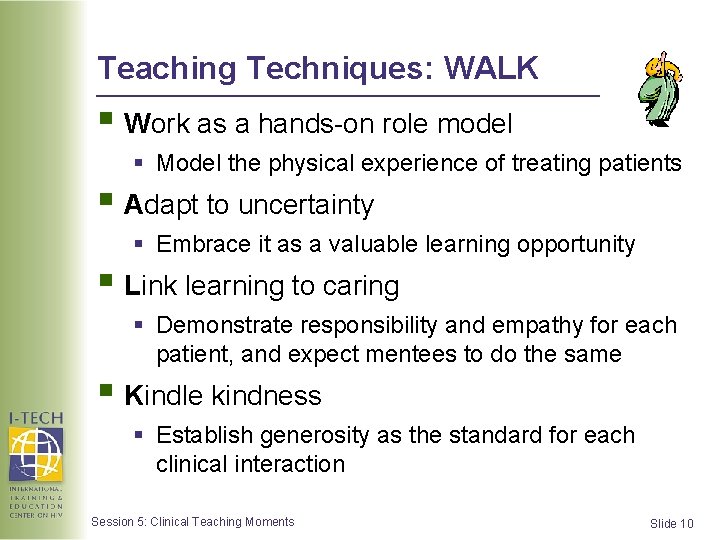
Teaching Techniques: WALK § Work as a hands-on role model § Model the physical experience of treating patients § Adapt to uncertainty § Embrace it as a valuable learning opportunity § Link learning to caring § Demonstrate responsibility and empathy for each patient, and expect mentees to do the same § Kindle kindness § Establish generosity as the standard for each clinical interaction Session 5: Clinical Teaching Moments Slide 10
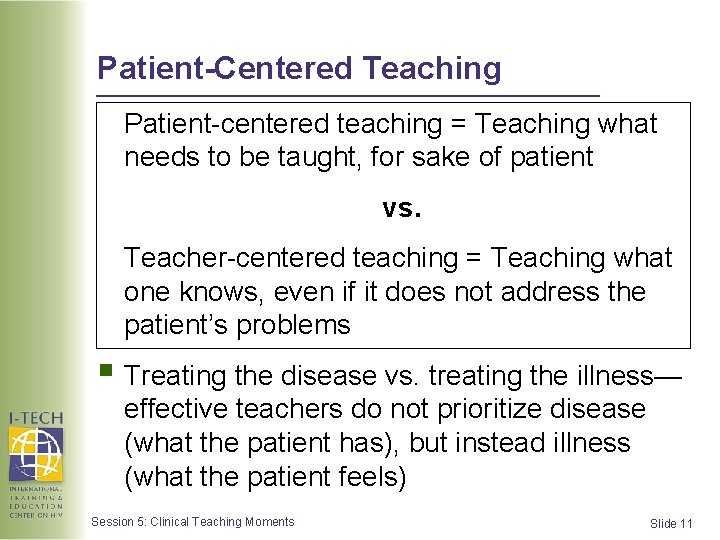
Patient-Centered Teaching Patient-centered teaching = Teaching what needs to be taught, for sake of patient vs. Teacher-centered teaching = Teaching what one knows, even if it does not address the patient’s problems § Treating the disease vs. treating the illness— effective teachers do not prioritize disease (what the patient has), but instead illness (what the patient feels) Session 5: Clinical Teaching Moments Slide 11
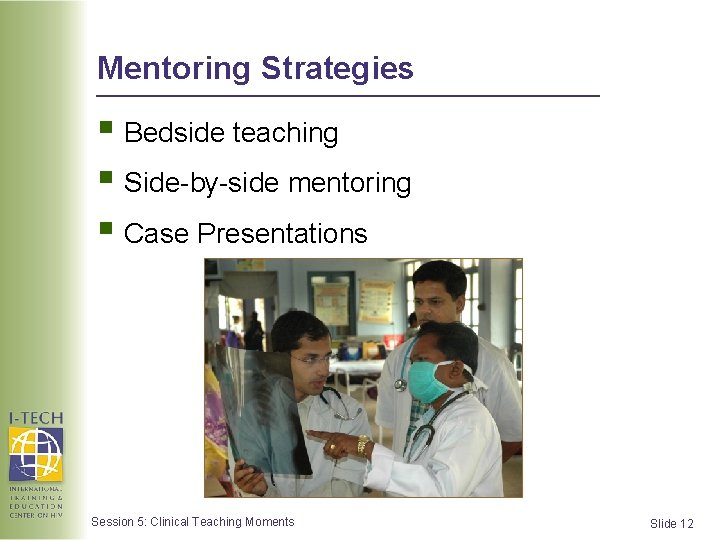
Mentoring Strategies § Bedside teaching § Side-by-side mentoring § Case Presentations Session 5: Clinical Teaching Moments Slide 12
Bedside Teaching (1) § Defined as teaching and reinforcing skills at patient’s bedside: § A common approach in medical education § Reinforces classroom learning § Allows mentor to model important clinical skills, attitudes, and communication in the context of patient care, as well as observe mentee’s skills § Strengths and weaknesses of mentees become very clear at the bedside Session 5: Clinical Teaching Moments Slide 13
Bedside Teaching (2) Before meeting with the patient: Mentor and mentee should discuss the purpose and structure of the session: § Identify appropriate patients § Set goals for the session § Agree on roles and expectations § Discuss expected time frame Session 5: Clinical Teaching Moments Slide 14
Bedside Teaching (3) Five steps: 1. Get a commitment 2. Probe for supporting evidence 3. Reinforce what was done well 4. Give guidance about errors and omissions 5. Summarize encounter with a general principle Session 5: Clinical Teaching Moments Slide 15
Demonstration: Bedside Teaching Approach Session 5: Clinical Teaching Moments Slide 16
Bedside Teaching (5) After consultation: § § Review and summarize key points. § Offer specific positive and constructive feedback. § Agree on an area of improvement and formulate a plan for how to improve. Solicit questions from mentee, and discuss any identified problems. Session 5: Clinical Teaching Moments Slide 17
Side-by-Side Teaching § As the name implies, this technique involves working alongside the mentee in clinic. § Mentor and mentee alternate duties of seeing and examining the patients, writing relevant information in patient’s health record and ART file, and checking lab results. Session 5: Clinical Teaching Moments Slide 18
Side-by-Side Teaching: Benefits § Mentor can observe mentee at work and identify and address challenges § Mentor acts as a role model when he/she is performing physical exam § Patients are seen more quickly than if the mentee sees the patients alone § Visits are more comprehensive and thorough § Mentors do not feel like they are being watched, but rather supported by a colleague Session 5: Clinical Teaching Moments Slide 19
“Example is not the main thing influencing others. It is the only thing. ” -Albert Schweitzer Session 5: Clinical Teaching Moments Slide 20
Case Studies: Defined § A training methodology that provides learners with an opportunity to apply new skills and knowledge to a simulated “real-life” situation § Allows exploration of various strategies to address complex issues § Requires learners to analyze the scenario, problem solve, and apply what they know to work through the case, much like they would in a clinic setting Session 5: Clinical Teaching Moments Slide 21
Case Studies: Rationale § Case studies are one of the most effective ways to train health care workers in the delivery of ART, particularly in multidisciplinary teams. § Case studies can be used to role play best practices and effective health care worker behaviors. § Effective case studies include adequate patient detail and specific decision points. § Discussion of options is central to case studies. Session 5: Clinical Teaching Moments Slide 22
Case Presentations (1) § Invite a staff member to present a difficult or challenging case they have encountered. Presentation should include the following: § Issue patient presented with § Age, gender, relevant social history § Medical history § Current profile: risk, symptoms, medications, HIV status, etc. § What they did in the situation Session 5: Clinical Teaching Moments Slide 23
Case Presentations (2) § Thank the staff person. Discuss the case: § What was good about the way the case was handled? § What recommendations would improve management of the case? § Provide your own feedback/observations on the case. Session 5: Clinical Teaching Moments Slide 24
Key Points § Teaching moments are opportunities to improve clinical skills of a health care worker, can take place in a variety of settings, and mentors should maximize the number of teaching moments at a site visit. § Bedside and side-by-side teaching reinforce classroom learning, and allow the mentor to model clinical technique, as well as attitudes and behaviors. § Case studies are an effective tool for clinical teaching. Session 5: Clinical Teaching Moments Slide 25
- Slides: 25