
Session 4 Value Chain for Production Establishing the
Session 4 Value Chain for Production Establishing the Value Chain
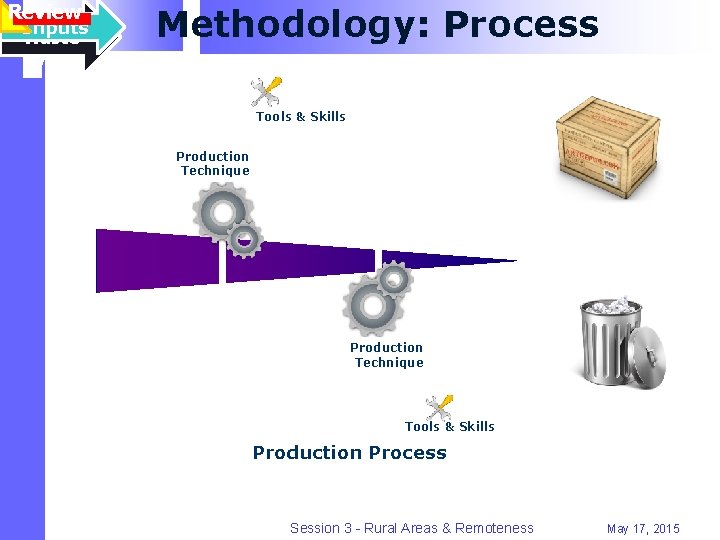
Review Inputs Waste Outputs Methodology: Process Tools & Skills Production Technique Tools & Skills Production Process Session 3 - Rural Areas & Remoteness May 17, 2015
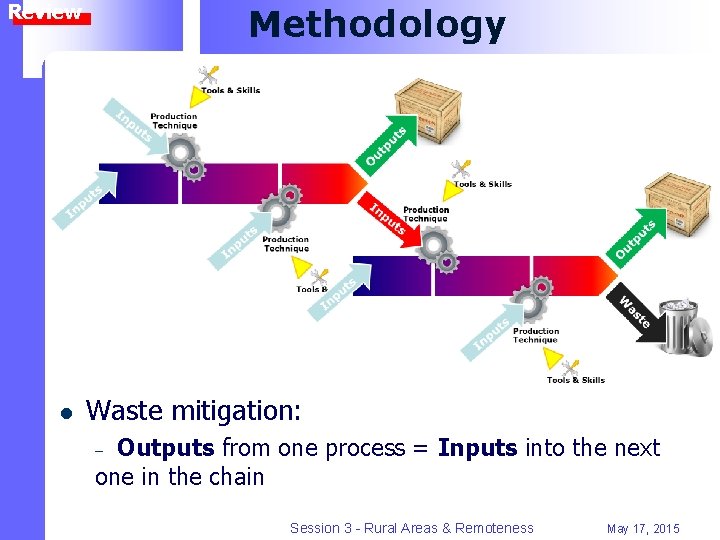
Review l Methodology Waste mitigation: Outputs from one process = Inputs into the next one in the chain – Session 3 - Rural Areas & Remoteness May 17, 2015
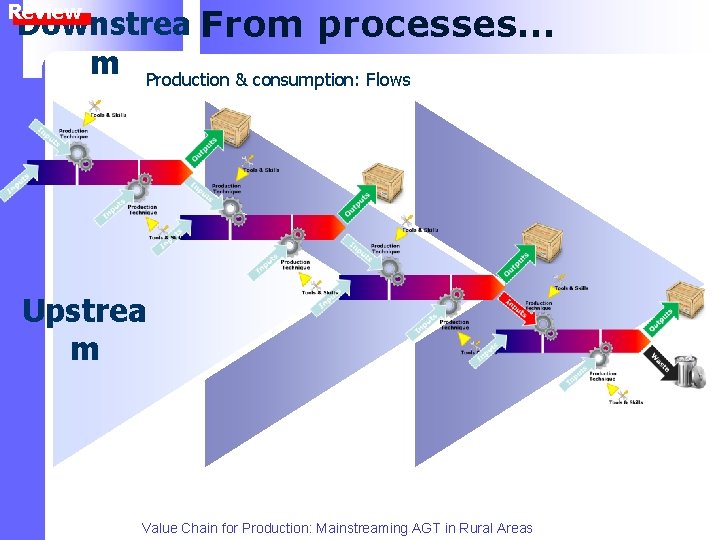
Review Downstrea From processes… m Production & consumption: Flows Upstrea m Value Chain for Production: Mainstreaming AGT in Rural Areas
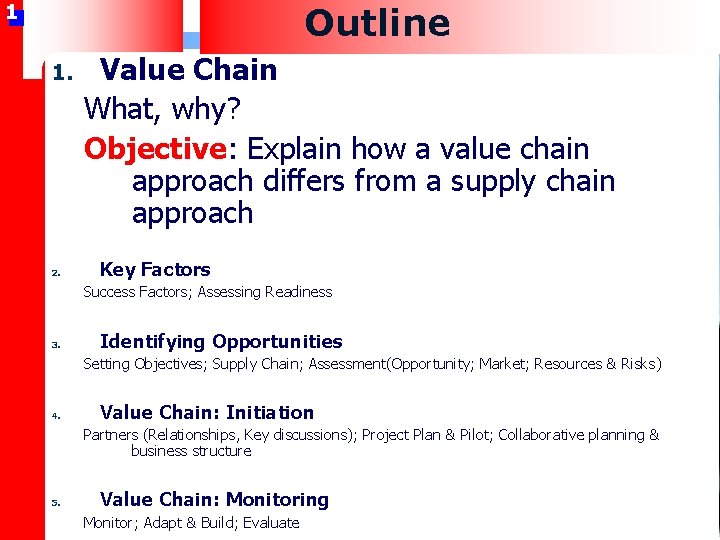
1 Outline 1. 2. Value Chain What, why? Objective: Explain how a value chain approach differs from a supply chain approach Key Factors Success Factors; Assessing Readiness 3. Identifying Opportunities Setting Objectives; Supply Chain; Assessment(Opportunity; Market; Resources & Risks) 4. Value Chain: Initiation Partners (Relationships, Key discussions); Project Plan & Pilot; Collaborative planning & business structure 5. Value Chain: Monitoring Monitor; Adapt & Build; Evaluate
1 What is a Value Chain? “Alliance of enterprises collaborating vertically to achieve a more rewarding position in the market” l Businesses face Intensely competitive world of changing markets and technologies, – Need for sustainability – Value Chain for Production: Mainstreaming AGT in Rural Areas
1 What is a Value Chain? “Alliance of enterprises collaborating vertically to achieve a more rewarding position in the market” l Market-focused collaboration: – Businesses: l l – Different but complementary Work together to: – Produce & market Products and services – Effective and efficient manner. Rapid Response to marketplace changes: Linking production, processing and marketing activities to market demands. l Value Chain for Production: Mainstreaming AGT in Rural Areas
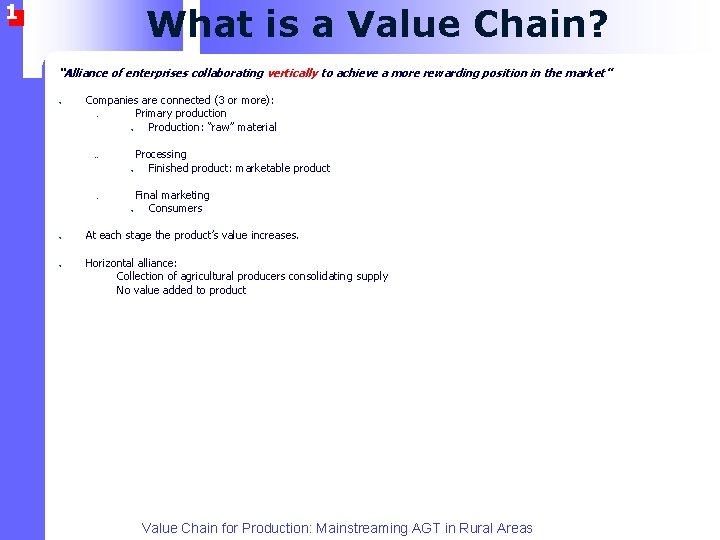
1 What is a Value Chain? “Alliance of enterprises collaborating vertically to achieve a more rewarding position in the market” l Companies are connected (3 or more): Primary production Production: “raw” material 1. l l Processing Finished product: marketable product l Final marketing Consumers 2. 3. l l At each stage the product’s value increases. Horizontal alliance: Collection of agricultural producers consolidating supply No value added to product – – Value Chain for Production: Mainstreaming AGT in Rural Areas
1 What is a Value Chain? “Alliance of enterprises collaborating vertically to achieve a more rewarding position in the market” l Companies in a value chain: – – Legally independent operations, Become interdependent: l l – Common goals, work collaboratively Long term l l Troubleshooting Not long-term contracting. Value Chain for Production: Mainstreaming AGT in Rural Areas
Assess Readiness: External Factors Four main factors that can hinder a Value Chain: The business environment: high risk of doing business for Small and Medium Enterprises (SMEs); l l Access to cross-cutting service markets; Limited local productive assets, and property rights unclear or poorly enforced. l – This is compounded by a lack of formal education; Limited access to external resources, goods and services, or markets. l – “Poverty trap” of high costs and low returns. Session 3 - Rural Areas & Remoteness May 17, 2015
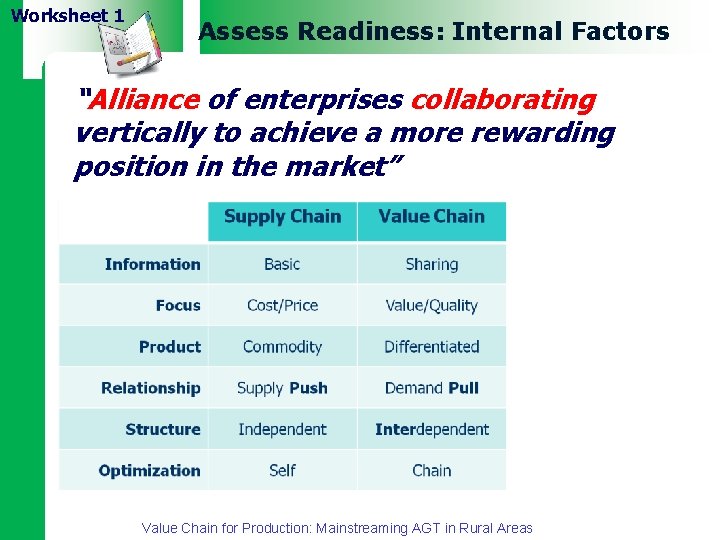
Worksheet 1 Assess Readiness: Internal Factors “Alliance of enterprises collaborating vertically to achieve a more rewarding position in the market” Value Chain for Production: Mainstreaming AGT in Rural Areas
1 Why a Value Chain? l Triggers: 1. 2. 3. Improve Quality: Increase Efficiency Differentiate Products If I want to: 1. Improve efficiencies, quality or differentiate my product 2. Be more competitive or sustainable Can I do it on my own? Or Do I need to work with other businesses in my supply chain? Value Chain for Production: Mainstreaming AGT in Rural Areas
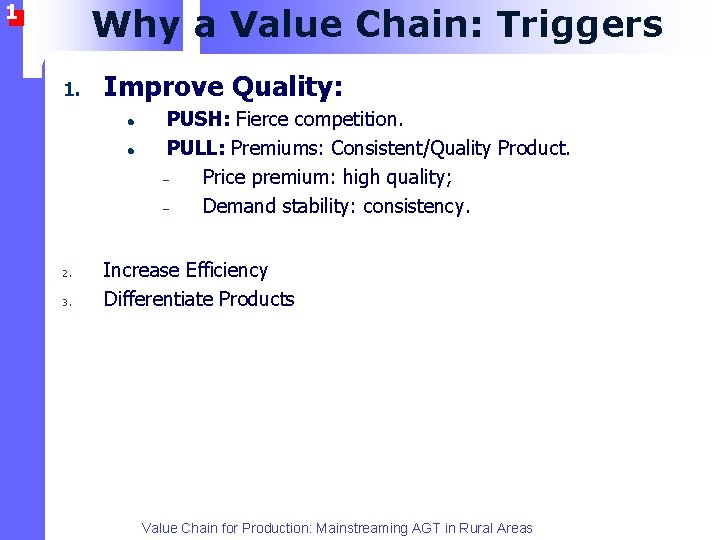
1 Why a Value Chain: Triggers 1. Improve Quality: l l 2. 3. PUSH: Fierce competition. PULL: Premiums: Consistent/Quality Product. – Price premium: high quality; – Demand stability: consistency. Increase Efficiency Differentiate Products Value Chain for Production: Mainstreaming AGT in Rural Areas
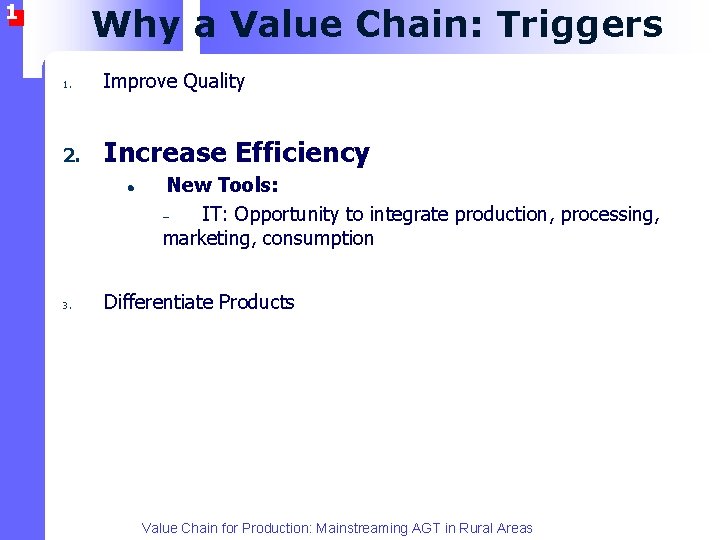
1 Why a Value Chain: Triggers 1. Improve Quality 2. Increase Efficiency l 3. New Tools: – IT: Opportunity to integrate production, processing, marketing, consumption Differentiate Products Value Chain for Production: Mainstreaming AGT in Rural Areas
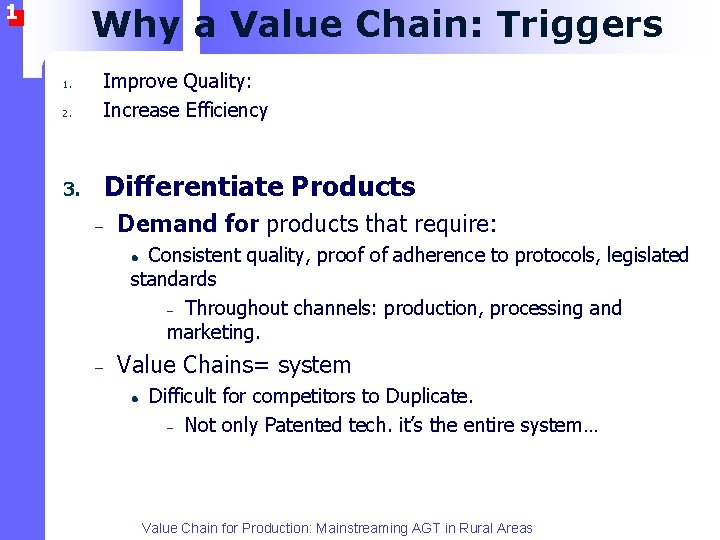
1 Why a Value Chain: Triggers 2. Improve Quality: Increase Efficiency 3. Differentiate Products 1. – Demand for products that require: Consistent quality, proof of adherence to protocols, legislated standards – Throughout channels: production, processing and marketing. l – Value Chains= system l Difficult for competitors to Duplicate. – Not only Patented tech. it’s the entire system… Value Chain for Production: Mainstreaming AGT in Rural Areas
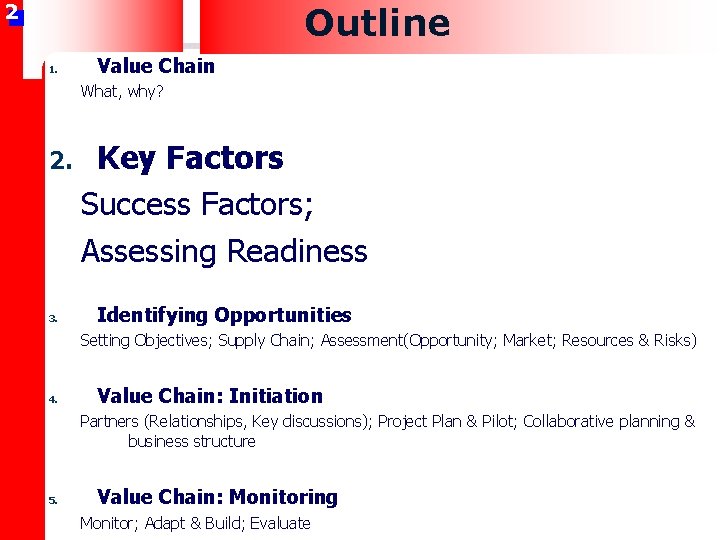
2 Outline 1. Value Chain What, why? 2. 3. Key Factors Success Factors; Assessing Readiness Identifying Opportunities Setting Objectives; Supply Chain; Assessment(Opportunity; Market; Resources & Risks) 4. Value Chain: Initiation Partners (Relationships, Key discussions); Project Plan & Pilot; Collaborative planning & business structure 5. Value Chain: Monitoring Monitor; Adapt & Build; Evaluate
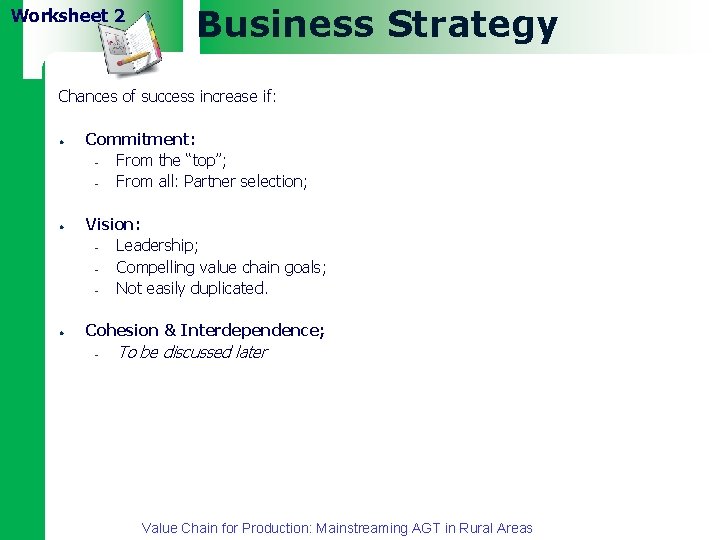
2 Worksheet 2 Business Strategy Chances of success increase if: l l l Commitment: – From the “top”; – From all: Partner selection; Vision: – Leadership; – Compelling value chain goals; – Not easily duplicated. Cohesion & Interdependence; – To be discussed later Value Chain for Production: Mainstreaming AGT in Rural Areas
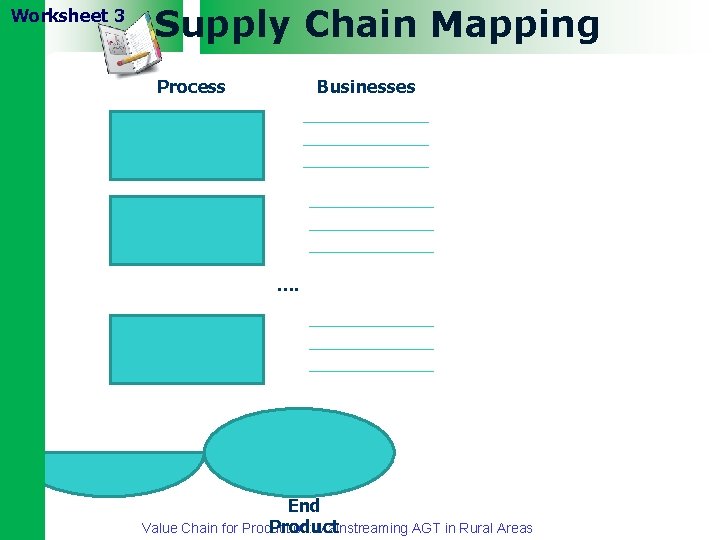
3 Worksheet 3 Supply Chain Mapping Process Businesses …. End Value Chain for Production: Mainstreaming AGT in Rural Areas Product
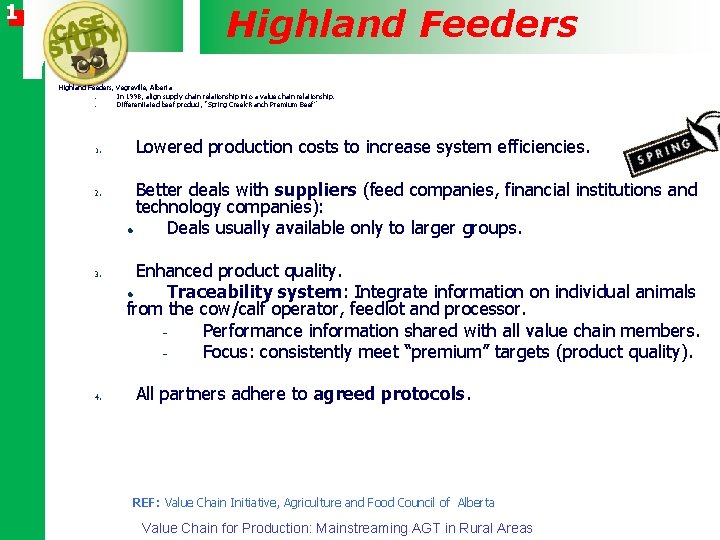
1 Highland Feeders, Vegreville, Alberta In 1998, align supply chain relationship into a value chain relationship. Differentiated beef product, “Spring Creek Ranch Premium Beef” – – 1. 2. 3. 4. Lowered production costs to increase system efficiencies. Better deals with suppliers (feed companies, financial institutions and technology companies): l Deals usually available only to larger groups. Enhanced product quality. l Traceability system: Integrate information on individual animals from the cow/calf operator, feedlot and processor. – Performance information shared with all value chain members. – Focus: consistently meet “premium” targets (product quality). All partners adhere to agreed protocols. REF: Value Chain Initiative, Agriculture and Food Council of Alberta Value Chain for Production: Mainstreaming AGT in Rural Areas
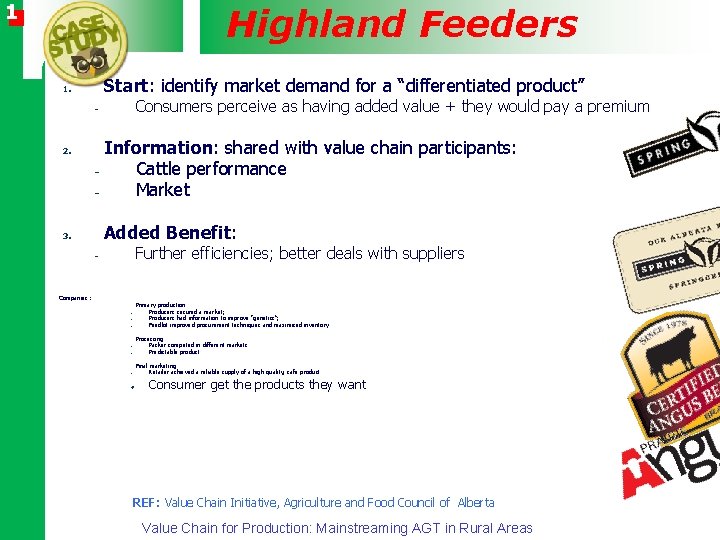
1 Highland Feeders Start: identify market demand for a “differentiated product” 1. Consumers perceive as having added value + they would pay a premium – 2. Information: shared with value chain participants: – Cattle performance – Market Added Benefit: 3. Further efficiencies; better deals with suppliers – Companies : Primary production Producers secured a market; Producers had information to improve “genetics”; Feedlot improved procurement techniques and maximized inventory 1. l l l Processing Packer competed in different markets Predictable product 2. l l Final marketing Retailer achieved a reliable supply of a high quality, safe product 3. l l Consumer get the products they want REF: Value Chain Initiative, Agriculture and Food Council of Alberta Value Chain for Production: Mainstreaming AGT in Rural Areas
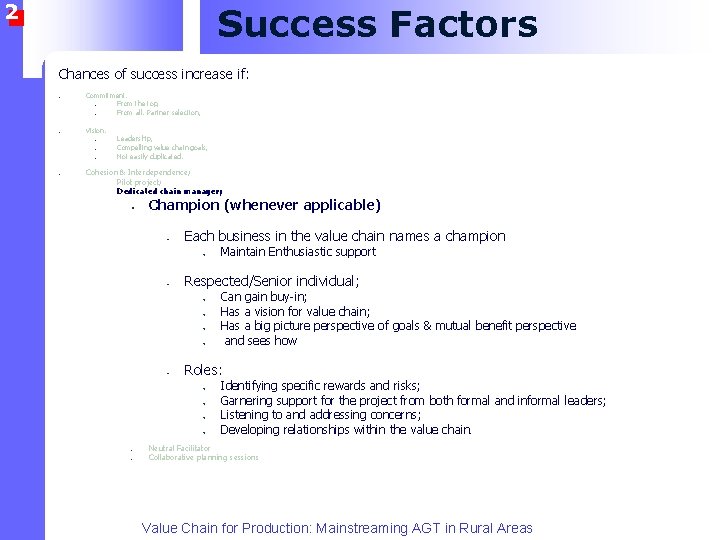
2 Success Factors Chances of success increase if: l Commitment: From the top; From all: Partner selection; – – l Vision: – – – l Leadership; Compelling value chain goals; Not easily duplicated. Cohesion & Interdependence; Pilot project; Dedicated chain manager; – – l Champion (whenever applicable) – Each business in the value chain names a champion l – Respected/Senior individual; l l – l l Can gain buy-in; Has a vision for value chain; Has a big picture perspective of goals & mutual benefit perspective and sees how Roles: l l Maintain Enthusiastic support Identifying specific rewards and risks; Garnering support for the project from both formal and informal leaders; Listening to and addressing concerns; Developing relationships within the value chain. Neutral Facilitator Collaborative planning sessions Value Chain for Production: Mainstreaming AGT in Rural Areas
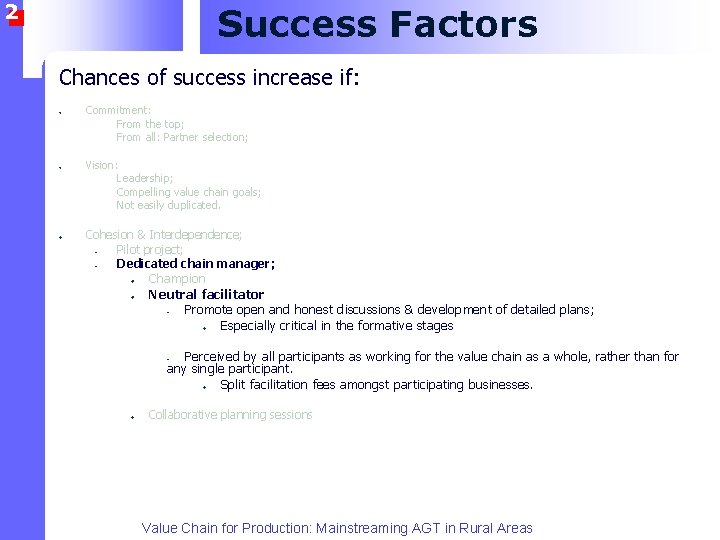
2 Success Factors Chances of success increase if: l Commitment: From the top; From all: Partner selection; – – l Vision: Leadership; Compelling value chain goals; Not easily duplicated. – – – l Cohesion & Interdependence; Pilot project; Dedicated chain manager; – – l l Champion Neutral facilitator Promote open and honest discussions & development of detailed plans; Especially critical in the formative stages – l Perceived by all participants as working for the value chain as a whole, rather than for any single participant. Split facilitation fees amongst participating businesses. – l l Collaborative planning sessions Value Chain for Production: Mainstreaming AGT in Rural Areas
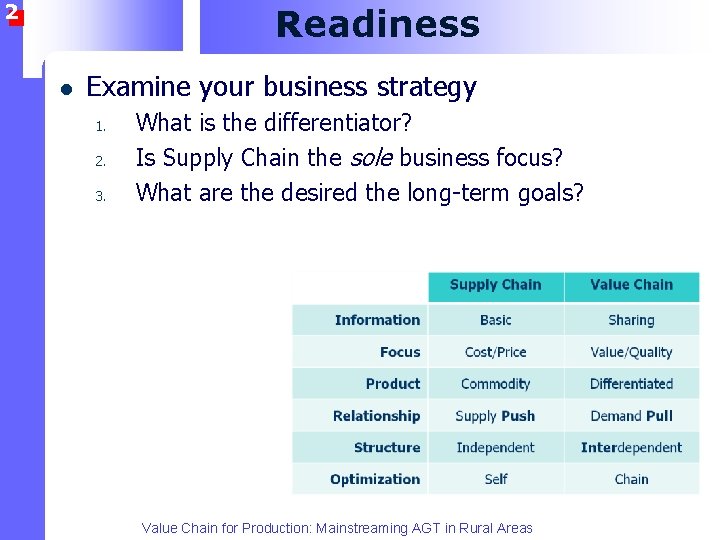
2 Readiness l Examine your business strategy 1. 2. 3. What is the differentiator? Is Supply Chain the sole business focus? What are the desired the long-term goals? Value Chain for Production: Mainstreaming AGT in Rural Areas
3 Outline 1. Value Chain What, why? 2. Key Factors Success Factors; Assessing Readiness 3. 4. Identifying Opportunities Setting Objectives; Supply Chain; Assessment (Opportunity; Market; Resources & Risks) Value Chain: Initiation Partners (Relationships, Key discussions); Project Plan & Pilot; Collaborative planning & business structure 5. Value Chain: Monitoring Monitor; Adapt & Build; Evaluate
3 Objective: l Map & evaluate the supply chain l Outline the opportunity by: – – l Developing a project summary Evaluating the market Assess a Project’s: – – – Resources; Risks; Capabilities. Value Chain for Production: Mainstreaming AGT in Rural Areas
3 Supply Chain Mapping l The first step to identifying opportunities. Suppliers Customers, – – l Understand how the product moves through the market channel l Identify who should be involved in the value chain project l Carry out the mapping with some of the existing chain partners: Help create buy-in for the project; Gain valuable perspectives on; Strengths; Limitations; Opportunities. – – l l l Value Chain for Production: Mainstreaming AGT in Rural Areas
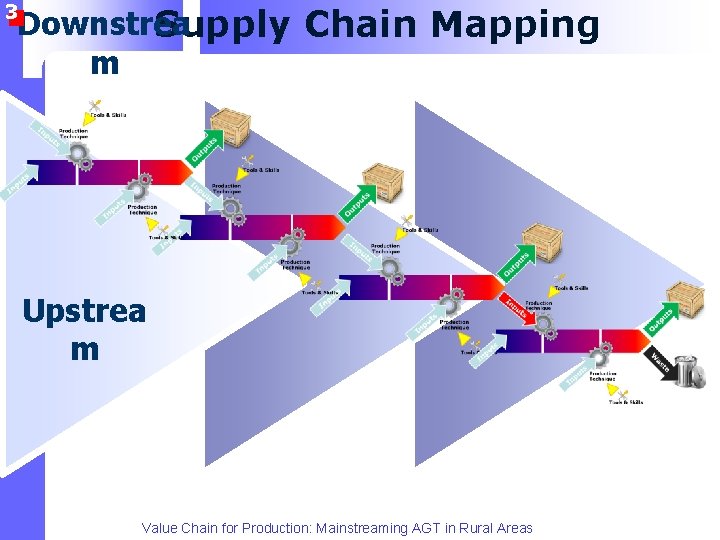
3 Downstrea Supply Chain Mapping m Upstrea m Value Chain for Production: Mainstreaming AGT in Rural Areas
4 Outline 1. Value Chain What, why? 2. Key Factors Success Factors; Assessing Readiness 3. Identifying Opportunities Setting Objectives; Supply Chain; Assessment(Opportunity; Market; Resources & Risks) 4. 5. Value Chain: Initiation Partners / Relationships, Key discussions: Risks and Rewards Project Plan & Pilot; Value Chain: Monitoring Monitor; Adapt & Build; Evaluate
1 Worksheet 5 l Rewards Competitive edge: Products and processes = difficult to duplicate; – – Business relationships: Collaborative versus adversarial. l • Integrated systems from production to retail; – A unique way to manage risk Buyers are assured product quality, supply and safety; Suppliers are more assured of a market; Economies of scale. l l l – Fast-response to changing customer demand – Improved access to markets Value Chain for Production: Mainstreaming AGT in Rural Areas
1 Worksheet 5 Risks inherent to a collaborative approach l Shared Business Activities: – – – l Less control and independence; Longer decision making time; Less flexibility; Loss of proprietary information or expertise Time, effort and money spent to achieve a wellfunctioning value chain. l Value Chain for Production: Mainstreaming AGT in Rural Areas
4 Business Strategy Chances of success increase if: l Commitment: From the “top”; From all: Partner selection; – – l Vision: Leadership; Compelling value chain goals; Not easily duplicated. – – – l Cohesion & Interdependence; Pilot project; Dedicated chain manager; Neutral facilitator Collaborative planning sessions – – l l Value Chain for Production: Mainstreaming AGT in Rural Areas
Pilot Project A pilot would be a small, trial-size version of a commercial-scale value chain; l l Designed to clearly add and share value. – Minimizes some risk by allowing: Value chain’s stakeholders and partners to commit themselves and work out any bugs while they proceed on a small scale. l Stage where one identifies suitable partners for the value chain, selects a manager, and achieves some form commitment from all partners. l Session 3 - Rural Areas & Remoteness May 17, 2015
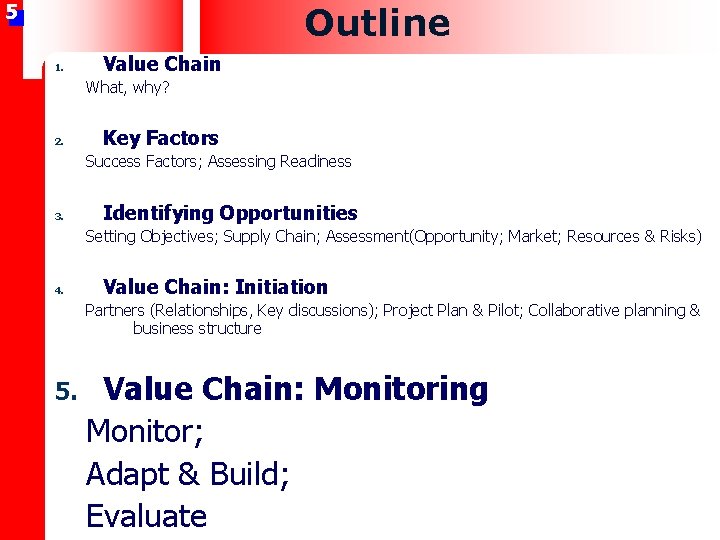
5 Outline 1. Value Chain What, why? 2. Key Factors Success Factors; Assessing Readiness 3. Identifying Opportunities Setting Objectives; Supply Chain; Assessment(Opportunity; Market; Resources & Risks) 4. Value Chain: Initiation Partners (Relationships, Key discussions); Project Plan & Pilot; Collaborative planning & business structure 5. Value Chain: Monitoring Monitor; Adapt & Build; Evaluate
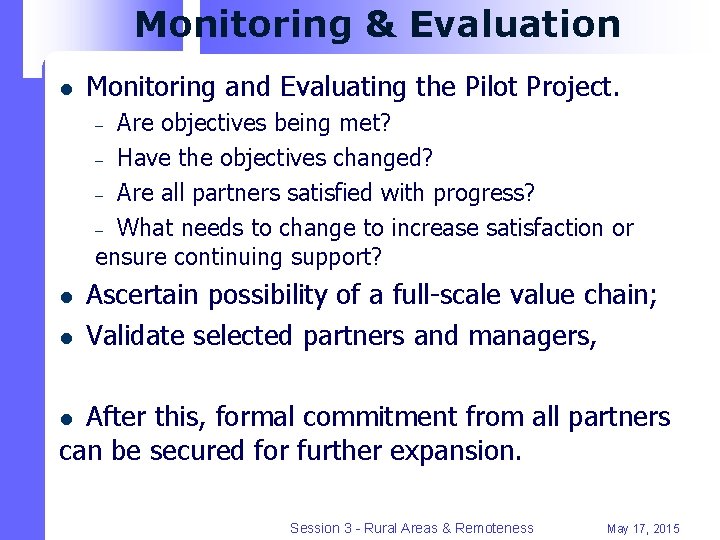
Monitoring & Evaluation l Monitoring and Evaluating the Pilot Project. Are objectives being met? – Have the objectives changed? – Are all partners satisfied with progress? – What needs to change to increase satisfaction or ensure continuing support? – l l Ascertain possibility of a full-scale value chain; Validate selected partners and managers, After this, formal commitment from all partners can be secured for further expansion. l Session 3 - Rural Areas & Remoteness May 17, 2015
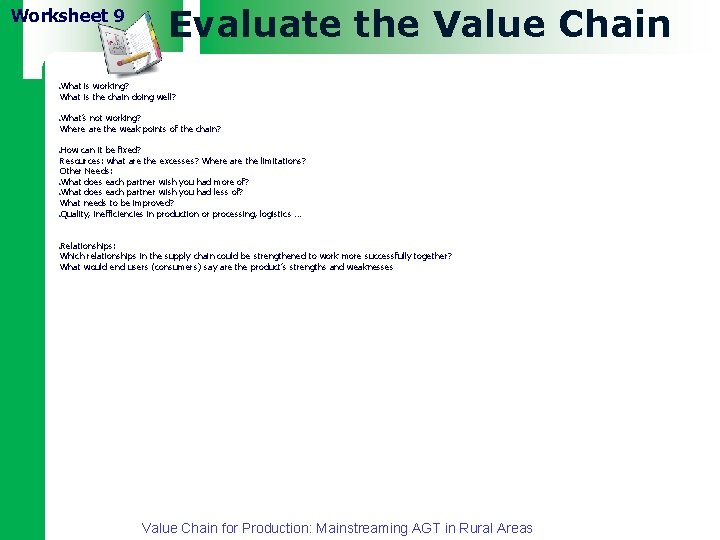
1 Worksheet 9 Evaluate the Value Chain What is working? What is the chain doing well? l – What’s not working? Where are the weak points of the chain? l – How can it be fixed? Resources: what are the excesses? Where are the limitations? Other Needs: What does each partner wish you had more of? What does each partner wish you had less of? What needs to be improved? Quality, inefficiencies in production or processing, logistics … l – – l l – l Relationships: Which relationships in the supply chain could be strengthened to work more successfully together? What would end users (consumers) say are the product’s strengths and weaknesses l – – Value Chain for Production: Mainstreaming AGT in Rural Areas

questions ? …comments … Session 3 - Rural Areas & Remoteness May 17, 2015
- Slides: 36