
Session 4 The humanenvironment system A conceptual framework
- Slides: 10
Session 4 The human-environment system: A conceptual framework Presenter: B. L. Turner; Moderator: Elizabeth King Cambridge Discussants: Matthew Aruch, Alicia Harley, David Parker, Amar Patnaik, Todd Schenk, Berit Ullrich, Elizabeth Walker October 4, 2010 DGS in Sustainability Science: Session 4 1
Discussion Topics • How does one choose system boundaries, and how do these choices shape, limit outcomes, and otherwise pose problems? • How do we integrate results produced by distinct disciplines? What do you do when research leads to different outcomes? Are we able to integrate disciplines without producing a hierarchy among them? • Are there effective ways to map CHES? What are the methodological alternatives to the kinds of placebased research we have covered thus far? Examination of System Dynamics as a method which uses CHES. 2
Exploring Boundaries • Several challenges associated with bounding systems – Historical precedent within a discipline or data granularity may drive bounds rather than nature of the problem – Bounding along some dimensions limits uncertainty while introducing new uncertainty, analogous to Heisenberg Uncertainty Principle – “Matching” problem – Movement of boundaries – Depth vs. breadth of research findings • Bounding systems requires judgment, trade-offs, and compromise 3
Managing Boundaries • New research has room to shift boundaries from traditional place-based assessments (spatial boundary) • Examples of ways in which CHES research delineates boundaries – Cross-disciplinary collaboration in defining variables – Pluralism: triangulating data and information sources – Use of the “slow” variable as the limiting factor – Flexibility to use outcomes to inform new boundaries and “robustness” checks varying boundaries 4
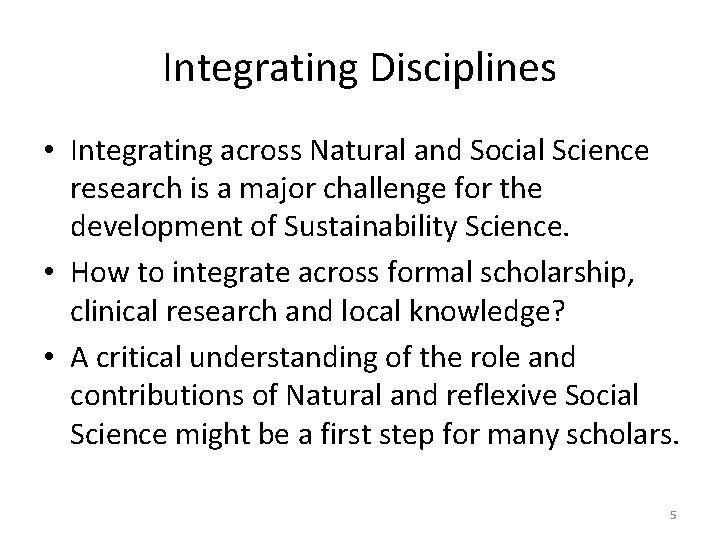
Integrating Disciplines • Integrating across Natural and Social Science research is a major challenge for the development of Sustainability Science. • How to integrate across formal scholarship, clinical research and local knowledge? • A critical understanding of the role and contributions of Natural and reflexive Social Science might be a first step for many scholars. 5
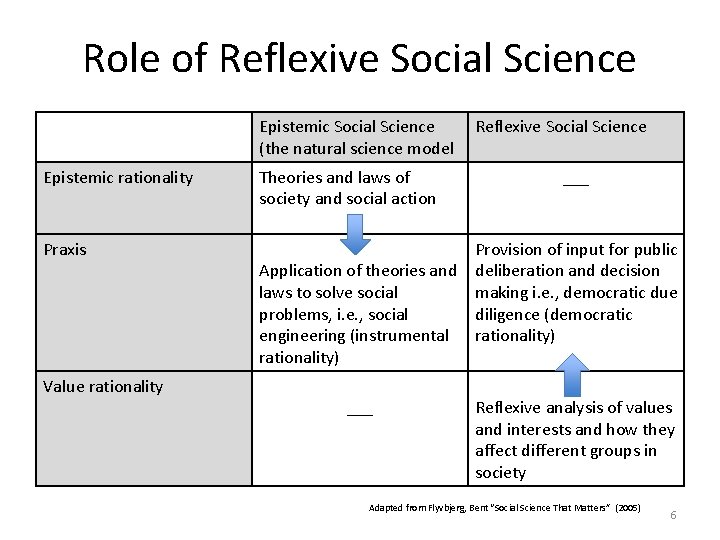
Role of Reflexive Social Science Epistemic Social Science (the natural science model Epistemic rationality Praxis Value rationality Theories and laws of society and social action Application of theories and laws to solve social problems, i. e. , social engineering (instrumental rationality) ___ Reflexive Social Science ___ Provision of input for public deliberation and decision making i. e. , democratic due diligence (democratic rationality) Reflexive analysis of values and interests and how they affect different groups in society Adapted from Flyvbjerg, Bent “Social Science That Matters” (2005) 6
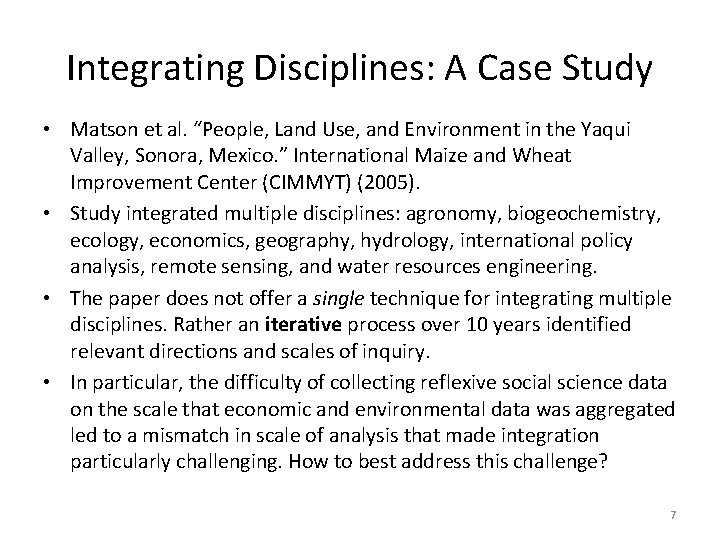
Integrating Disciplines: A Case Study • Matson et al. “People, Land Use, and Environment in the Yaqui Valley, Sonora, Mexico. ” International Maize and Wheat Improvement Center (CIMMYT) (2005). • Study integrated multiple disciplines: agronomy, biogeochemistry, ecology, economics, geography, hydrology, international policy analysis, remote sensing, and water resources engineering. • The paper does not offer a single technique for integrating multiple disciplines. Rather an iterative process over 10 years identified relevant directions and scales of inquiry. • In particular, the difficulty of collecting reflexive social science data on the scale that economic and environmental data was aggregated led to a mismatch in scale of analysis that made integration particularly challenging. How to best address this challenge? 7
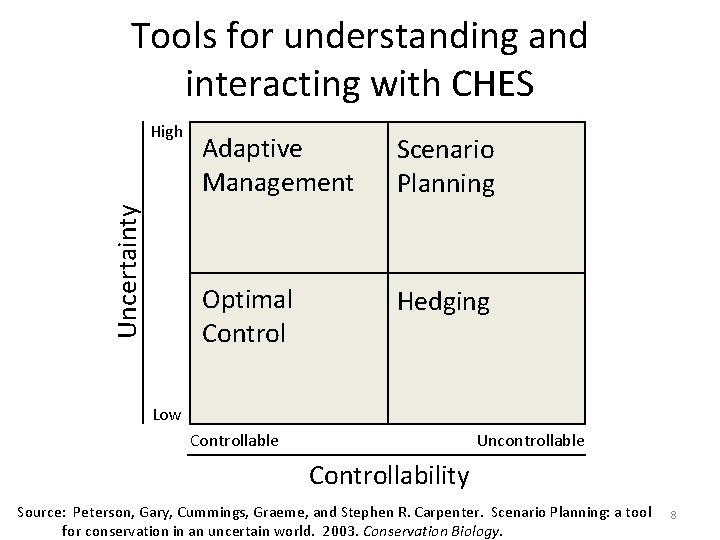
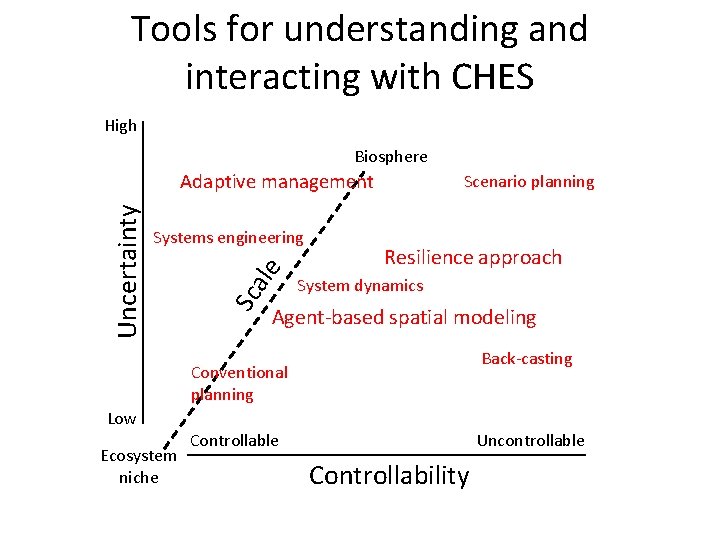
Tools for understanding and interacting with CHES Uncertainty High Adaptive Management Scenario Planning Optimal Control Hedging Low Controllable Uncontrollable Controllability Source: Peterson, Gary, Cummings, Graeme, and Stephen R. Carpenter. Scenario Planning: a tool for conservation in an uncertain world. 2003. Conservation Biology. 8
Tools for understanding and interacting with CHES High Biosphere ale Systems engineering Sc Uncertainty Adaptive management Scenario planning Resilience approach System dynamics Agent-based spatial modeling Back-casting Conventional planning Low Ecosystem niche Controllable Uncontrollable Controllability
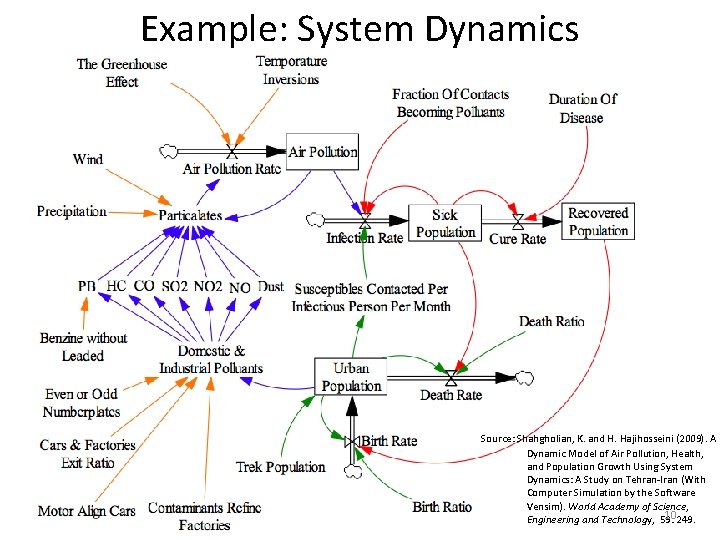
Example: System Dynamics Source: Shahgholian, K. and H. Hajihosseini (2009). A Dynamic Model of Air Pollution, Health, and Population Growth Using System Dynamics: A Study on Tehran-Iran (With Computer Simulation by the Software Vensim). World Academy of Science, 10249. Engineering and Technology, 59: