
Session 4 Structures of Problems OGAPMath LLC 2017
Session 4: Structures of Problems © OGAPMath. LLC 2017 for non-commercial use only 1

Solve each of the problems. Locate handout 4 a-Problem Structures © OGAPMath. LLC 2017 for non-commercial use only 2
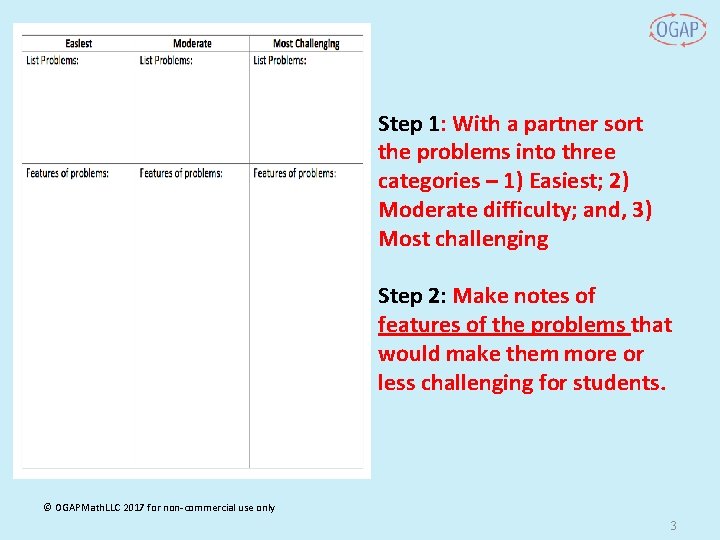
Step 1: With a partner sort the problems into three categories – 1) Easiest; 2) Moderate difficulty; and, 3) Most challenging Step 2: Make notes of features of the problems that would make them more or less challenging for students. © OGAPMath. LLC 2017 for non-commercial use only 3

Mathematics education research distilled and used to: … develop short focused items (and bank) structured to elicit …and interpret student work. © OGAPMath. LLC 2017 for non-commercial use only 4
OGAP questions are engineered based on math education research. © OGAPMath. LLC 2017 for non-commercial use only 5

Structure of the Problems that Students Solve “Structure” refers to how the problems are built. © OGAPMath. LLC 2017 for non-commercial use only 6
Researchers believe that the reliance on “immature” strategies in multiplicative situations can be offset by expanding: • the context and application of multiplication and division • the range of numbers • the language used. © OGAPMath. LLC 2017 for non-commercial use only 7
Teachers can decrease student use of immature strategies if they know: • Differences among problem structures • The difficulties students encounter while solving problems From Cobb, P. , Yackel, E. , and Wood, T. (1988); and, Peterson, P. L. , Carpenter, T. P. , and Fennema, E. (1989) © OGAPMath. LLC 2017 for non-commercial use only 8
Structures of Multiplicative Problems • Multiplicative representations Kaput, J. (1989), Greer, B. , (1992), and Ambrose, Baek, and Carpenter, (1998) • Number and language relationship Greer, B. , Bell, et all (1981) • Complexity of the numbers Kouba and Franklin, (1995), Steffe (1994), Bell, A. , et al (1989) • Meaning of the quantities Silver, E. (2006) Vermont meeting • Multiplicative Contexts Greer, B. (1992) © OGAPMath. LLC 2017 for non-commercial use only 9

Multiplicative Representations Students should encounter a variety of models for multiplication and division situations, and should be able to model and explain the relationships among those representations. (Kaput, J. , 1989) © OGAPMath. LLC 2017 for non-commercial use only 10
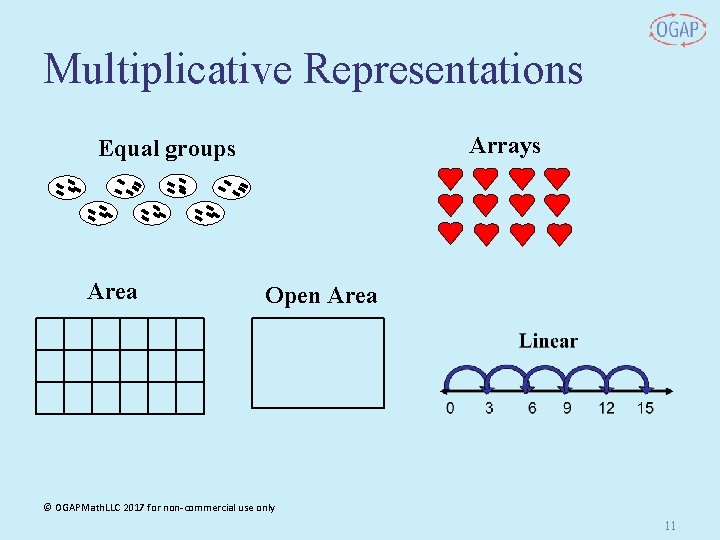
Multiplicative Representations Arrays Equal groups Area Open Area © OGAPMath. LLC 2017 for non-commercial use only 11
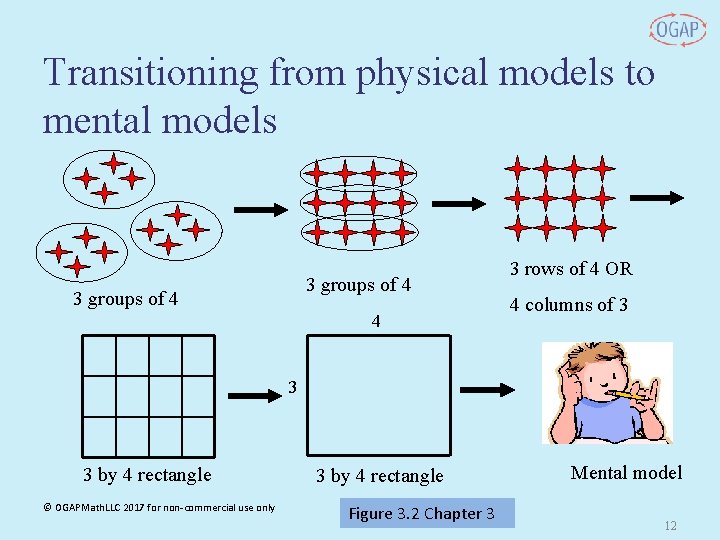
Transitioning from physical models to mental models 3 groups of 4 4 3 rows of 4 OR 4 columns of 3 3 3 by 4 rectangle © OGAPMath. LLC 2017 for non-commercial use only 3 by 4 rectangle Figure 3. 2 Chapter 3 Mental model 12

8 10 2 80 16 I got it – 8 x 12 = (8 x 10) + (8 x 2) = 96 8 x 12 = ? © OGAPMath. LLC 2017 for non-commercial use only 13
Case Study Ms. Ward is a fourth grade teacher. It is the beginning of the school year and she is getting ready to start her first unit on multiplication. The unit focuses on having students use area models to make sense of a variety of important math concepts such as properties of operations and basic fact fluency. © OGAPMath. LLC 2017 for non-commercial use only 14

Before beginning the unit she decides to give her students the following task. Ms. Ward knows that asking them to draw a model when there is no context will reveal their default model (the model they are most comfortable using when not influenced by context). © OGAPMath. LLC 2017 for non-commercial use only 15
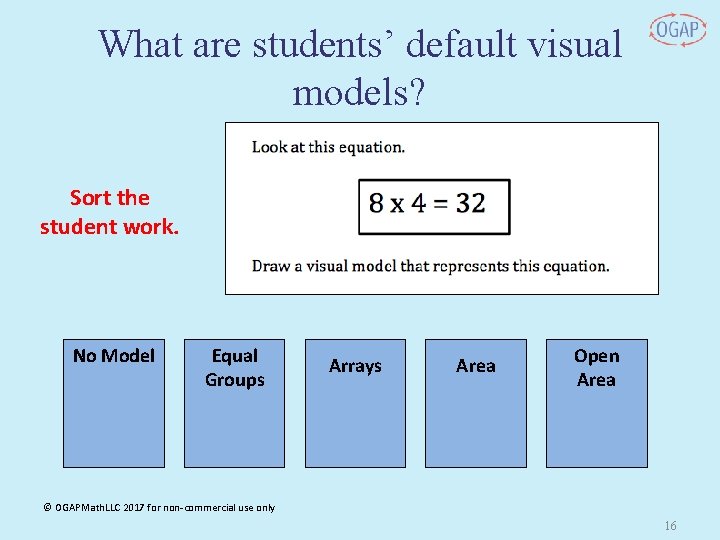
What are students’ default visual models? Sort the student work. No Model Equal Groups Arrays Area Open Area © OGAPMath. LLC 2017 for non-commercial use only 16
© OGAPMath. LLC 2017 for non-commercial use only 17
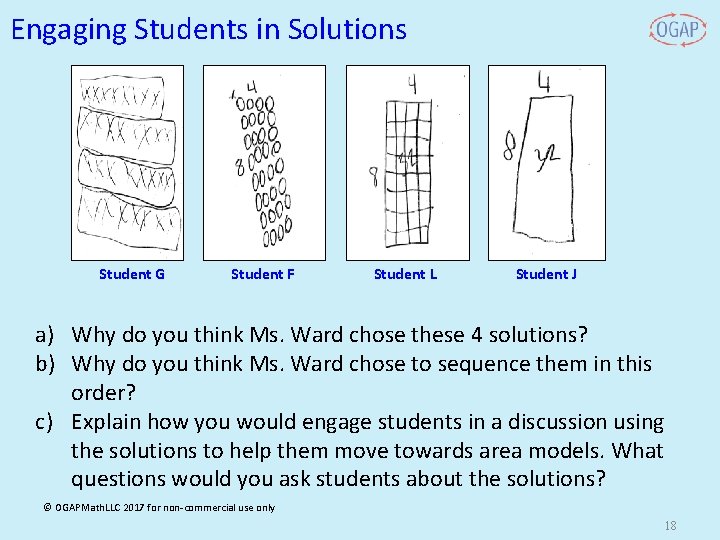
Engaging Students in Solutions Student G Student F Student L Student J a) Why do you think Ms. Ward chose these 4 solutions? b) Why do you think Ms. Ward chose to sequence them in this order? c) Explain how you would engage students in a discussion using the solutions to help them move towards area models. What questions would you ask students about the solutions? © OGAPMath. LLC 2017 for non-commercial use only 18
Multiplicative Representations Students should be able to link symbolic representations to pictorial representations, i. e. link equations to visual models and problem situations. Kouba and Franklin, 1995 Students should have experience with problems that are easily represented as arrays, area models…so that they are comfortable with the commutativity of multiplication. Ambrose, Baek, & Carpenter, 1998 © OGAPMath. LLC 2017 for non-commercial use only 19
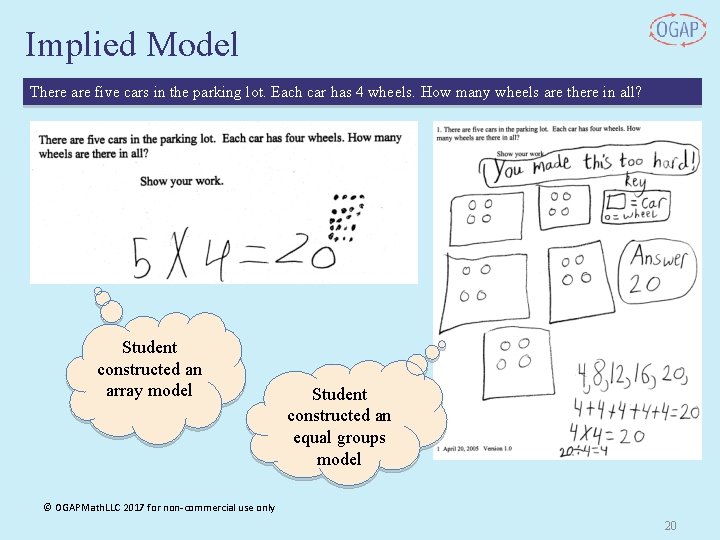
Implied Model There are five cars in the parking lot. Each car has 4 wheels. How many wheels are there in all? Student constructed an array model Student constructed an equal groups model © OGAPMath. LLC 2017 for non-commercial use only 20
Explicit and Implied Models Multiplication and division problems can have a particular associated visual model which may be explicit or implied. Examine the four problems in Chapter 6 Looking Back Question 1 – page 123 -124. a) Identify the model associated with each problem. b) Explain whether the model is explicit or implied. © OGAPMath. LLC 2017 for non-commercial use only 21
Structures of Multiplicative Problems • Multiplicative representations Kaput, J. (1989), Greer, B. , (1992), and Ambrose, Baek, and Carpenter, (1998) • Number and language relationship Greer, B. , Bell, et all (1981) • Complexity of the numbers Kouba and Franklin, (1995), Steffe (1994), Bell, A. , et al (1989) • Meaning of the quantities Silver, E. (2006) Vermont meeting • Multiplicative Situations (context) Greer, B. (1992) © OGAPMath. LLC 2017 for non-commercial use only 22
Complexity of the Numbers • • • Single digit Multiple digits Powers of ten (e. g. , 100, 1000) Multiples of powers of ten (e. g. , 60) Fractions/decimals (Kouba and Franklin, (1995), Steffe (1994), Bell, A. , et al) © OGAPMath. LLC 2017 for non-commercial use only 23
Powers of Ten and Multiples of Powers of Ten Mary knows 8 x 9 = 72. How can Mary use this fact to find the answer to 800 x 90? Generalizing the concept of multiplication to powers of ten is an essential understanding for manipulating, imagining, estimating, and calculating with large numbers. (Fosnot 1991) © OGAPMath. LLC 2017 for non-commercial use only 24
Decimals The average turtle can walk about 3. 5 miles per hour. About how far will a turtle walk in 5 hours? The ease with which students recognize multiplication as the appropriate operation when solving a problem depends on whether the multiplier is an integer, a decimal greater than 1, or a decimal less than one. (Bell, Greer, et al, 1986) © OGAPMath. LLC 2017 for non-commercial use only 25
From easy to complex numbers Beginning with easier numbers … One tricycle has three wheels. A. How many wheels do 5 tricycles have? Show your work. B. How many wheels do 29 tricycles have? Show your work. …then moving to more complex numbers in the same context gives insight into the student’s facility with multiplicative reasoning (Nesher, Greer, and Bell (1981)) © OGAPMath. LLC 2017 for non-commercial use only 26
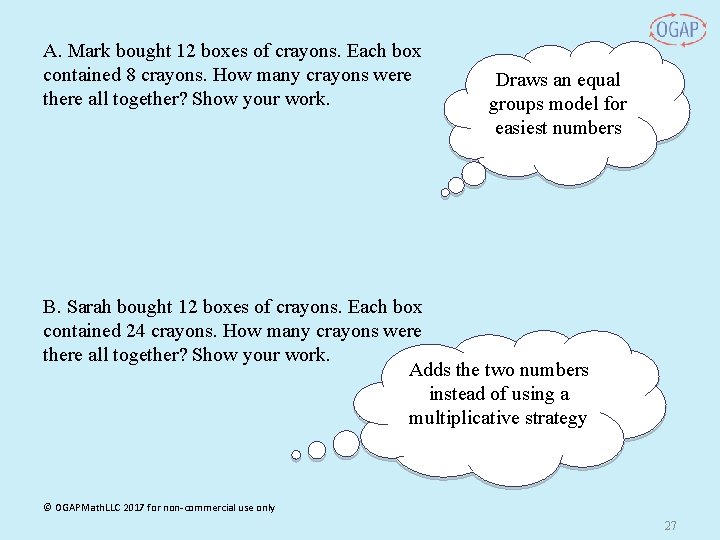
A. Mark bought 12 boxes of crayons. Each box contained 8 crayons. How many crayons were there all together? Show your work. Draws an equal groups model for easiest numbers B. Sarah bought 12 boxes of crayons. Each box contained 24 crayons. How many crayons were there all together? Show your work. Adds the two numbers instead of using a multiplicative strategy © OGAPMath. LLC 2017 for non-commercial use only 27
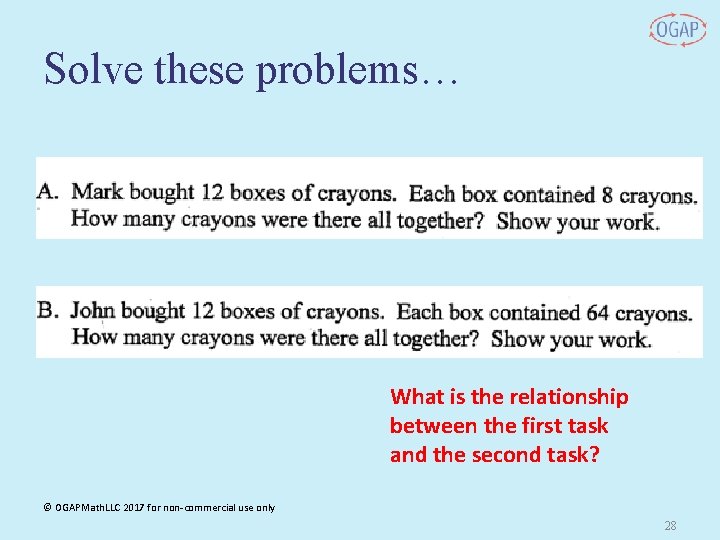
Solve these problems… What is the relationship between the first task and the second task? © OGAPMath. LLC 2017 for non-commercial use only 28
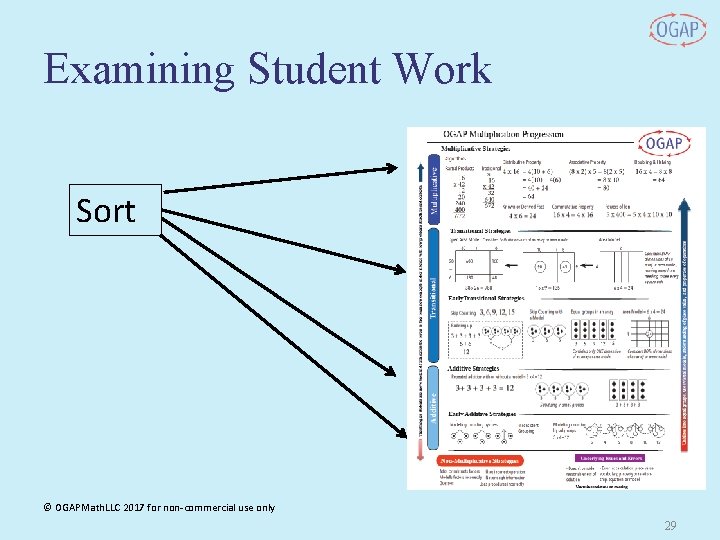
Examining Student Work Sort © OGAPMath. LLC 2017 for non-commercial use only 29
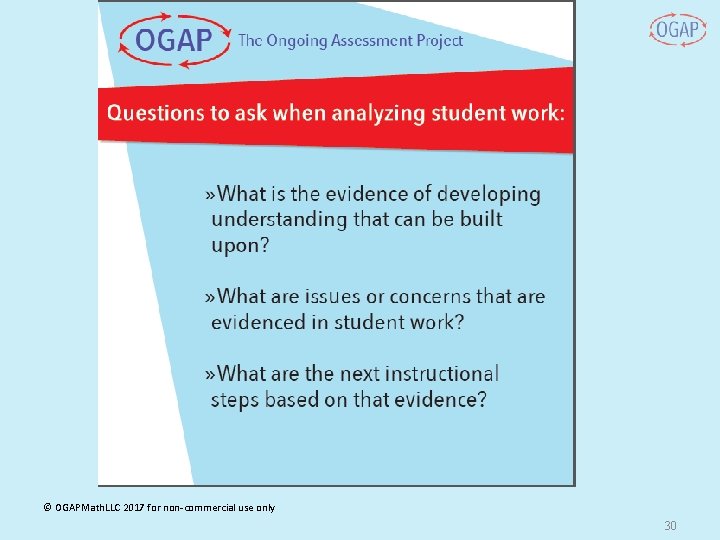
© OGAPMath. LLC 2017 for non-commercial use only 30
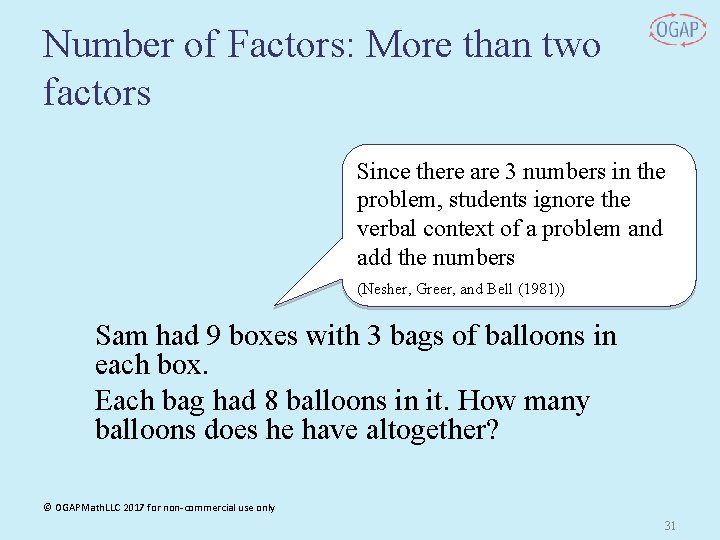
Number of Factors: More than two factors Since there are 3 numbers in the problem, students ignore the verbal context of a problem and add the numbers (Nesher, Greer, and Bell (1981)) Sam had 9 boxes with 3 bags of balloons in each box. Each bag had 8 balloons in it. How many balloons does he have altogether? © OGAPMath. LLC 2017 for non-commercial use only 31
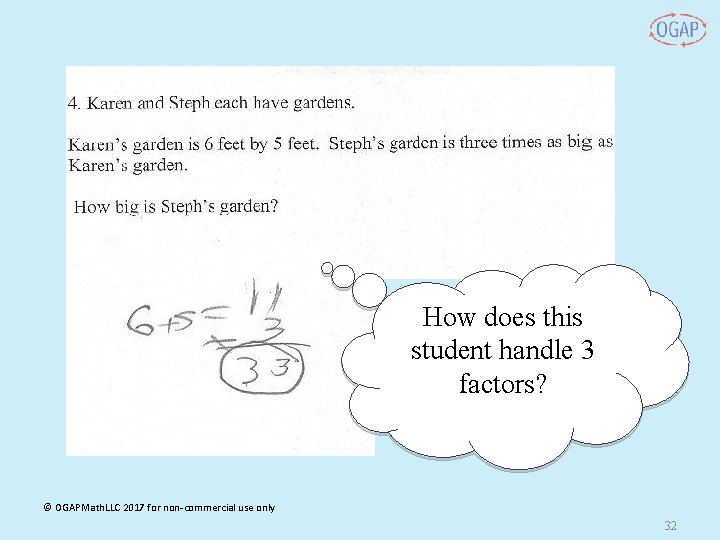
How does this student handle 3 factors? © OGAPMath. LLC 2017 for non-commercial use only 32
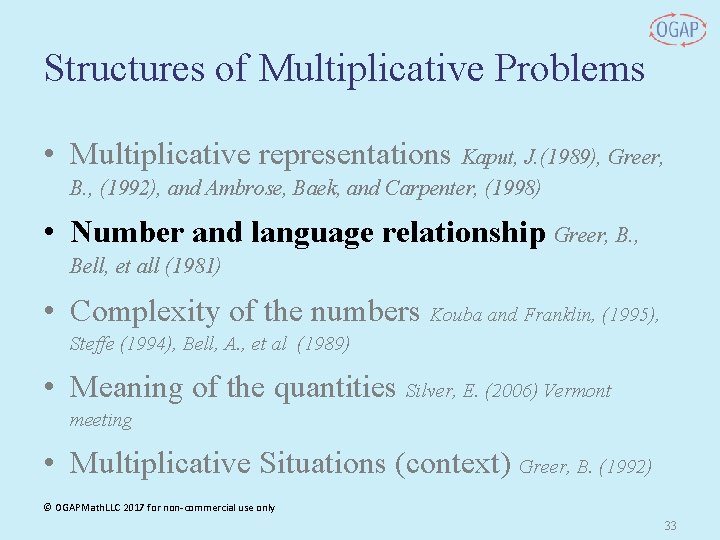
Structures of Multiplicative Problems • Multiplicative representations Kaput, J. (1989), Greer, B. , (1992), and Ambrose, Baek, and Carpenter, (1998) • Number and language relationship Greer, B. , Bell, et all (1981) • Complexity of the numbers Kouba and Franklin, (1995), Steffe (1994), Bell, A. , et al (1989) • Meaning of the quantities Silver, E. (2006) Vermont meeting • Multiplicative Situations (context) Greer, B. (1992) © OGAPMath. LLC 2017 for non-commercial use only 33
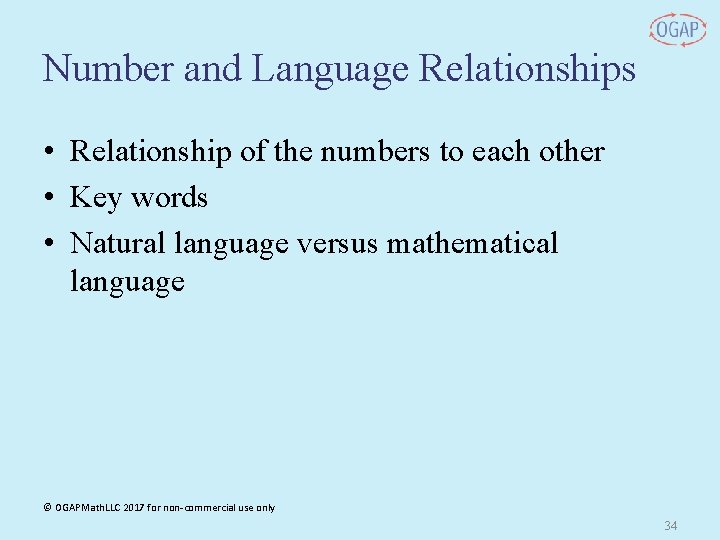
Number and Language Relationships • Relationship of the numbers to each other • Key words • Natural language versus mathematical language © OGAPMath. LLC 2017 for non-commercial use only 34
Relationship of the Numbers to Each Other There are 12 cans of tennis balls in a case. There are 3 tennis balls per can. How many tennis balls per case? … the types of numbers exert a very strong influence on the ease with which students decide on the appropriate operation to use. Nesher, Greer, Bell, 1981 © OGAPMath. LLC 2017 for non-commercial use only 35
Natural versus Mathematical Language Students who can understand… Sally had 64 crayons in one box. She had 12 boxes of crayons. How many crayons did she have in all? …may not understand (Zweng, 1984) Sally had 64 crayons per box. She had 12 boxes of crayons. How many crayons did she have in all? © OGAPMath. LLC 2017 for non-commercial use only 36
Keywords Sam had 9 boxes with 3 balloons in each. He got 8 more balloons. How many balloons does he have altogether? The word altogether is often taught as a “key word” to add. Teaching the use of key words is “a limiting, detrimental strategy. ” (Souder and Nesher, 1988) © OGAPMath. LLC 2017 for non-commercial use only 37
Read The Limitations of a Keywords Approach (Chapter 5 page 107) Highlight the 3 main reasons teaching a keywords approach is a “limiting, detrimental strategy”. © OGAPMath. LLC 2017 for non-commercial use only 38
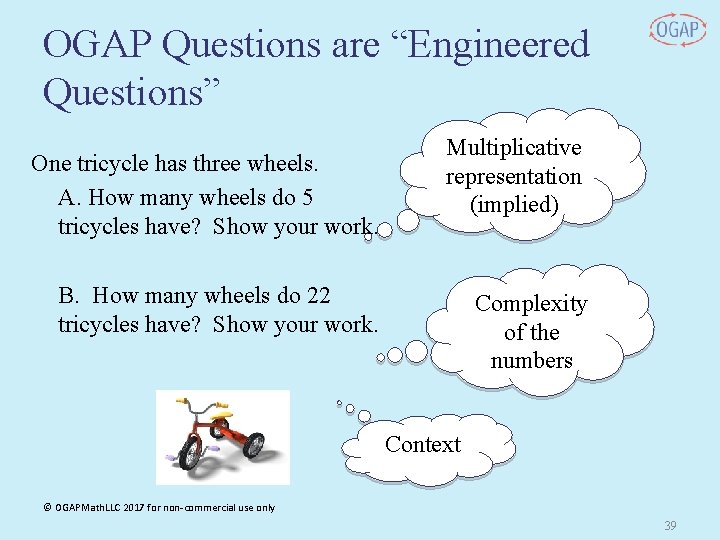
OGAP Questions are “Engineered Questions” One tricycle has three wheels. A. How many wheels do 5 tricycles have? Show your work. Multiplicative representation (implied) B. How many wheels do 22 tricycles have? Show your work. Complexity of the numbers Context © OGAPMath. LLC 2017 for non-commercial use only 39
- Slides: 39