
Session 4 Identifying Problems LB 160 Book 1
Session 4 Identifying Problems LB 160 – Book 1 Analyzing Business Cases 1
Session 4 Identifying Problems 4. 1. Introduction 4. 2. What is a problem? 4. 3. Problems and perception 4. 4. The problem-solution pattern in business texts 4. 5. Noticing problem language 4. 6. Problems, influences and impacts 4. 7. Analyzing the problems in a case study text Reflection Session 4. Identifying problems
4. 1 Introduction One of the key purposes of doing business case study analysis is to identify the problems that a person, organization (company) or the industry faces. Session 4. Identifying problems 3
4. 2 What is a Problem? A problem is a “negative situation” which “threatens” or “challenges” an individual or a group (Book 1 - p. 109). For e. g. , a fast food delivery service gets the food to its customers both late and cold. This is a problem that the business needs to fix if it wants to survive in a competitive market. Session 4. Identifying problems 4
4. 3 Problems and perception Some problems apply to all (in the delivery example, both business and customers are unhappy); Other problems are a matter of perception (i. e. the way one sees it from his/her point of view). Session 4. Identifying problems 5
4. 3 Problems and perception (cont’d) For example, a middle manager (1) who has spent years in the same job with no promotion may feel de-motivated and become less productive. - This poses a problem to the company. But only in the case of this particular person; - Another middle manager (2) stuck in the same position may feel completely satisfied with his/her safe job and wouldn’t want to take on new and unpredictable challenges. Session 4. Identifying problems 6
4. 3 Problems and perception (cont’d) - Another example is the “US Airlines” case study. While from the point of view of the traditional or major carriers, the competition created by low cost carriers is a problem, From the point of the view of the customers, there are now more options and cheaper options to choose from. Therefore, whether a situation is considered a problem depends on how it is interpreted. A problem only exists if a person or group of people views it as such. Session 4. Identifying problems 7
4. 3 Problems and perception (cont’d) In any case study, the case will often be presented from an “insider’s” “insider’s point of view—that is, as it relates to a specific business. You as an analyst need to ALSO think about the outside view: how does this “problem” affect other people outside the company. Ultimately, the point of thinking about problems is to find solutions for them and optimize a company’s performance and profit. Session 4. Identifying problems 8
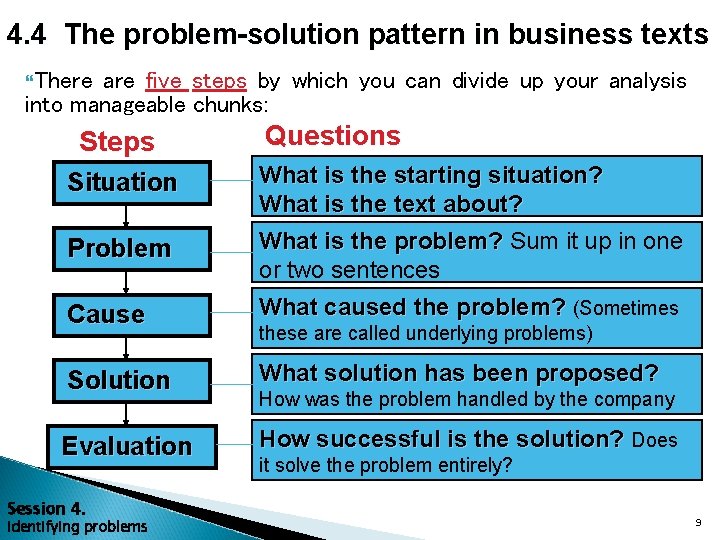
4. 4 The problem-solution pattern in business texts There are five steps by which you can divide up your analysis into manageable chunks: Steps Questions Situation What is the starting situation? What is the text about? Problem What is the problem? Sum it up in one or two sentences Cause What caused the problem? (Sometimes Solution What solution has been proposed? Evaluation How successful is the solution? Does Session 4. Identifying problems these are called underlying problems) How was the problem handled by the company it solve the problem entirely? 9
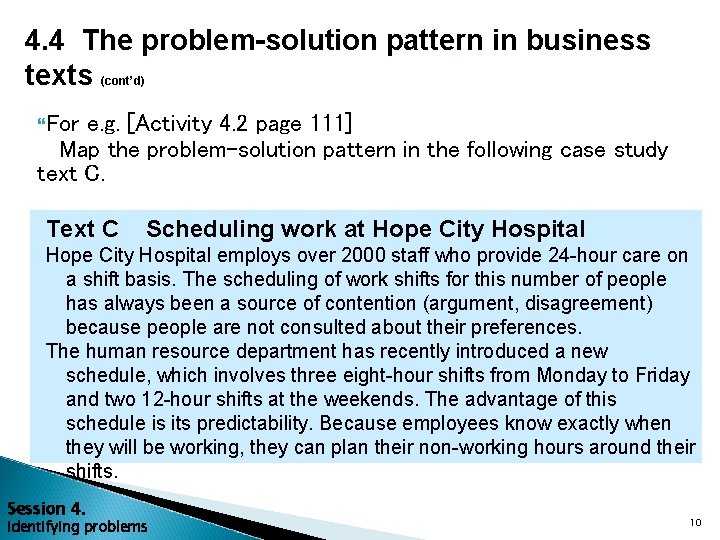
4. 4 The problem-solution pattern in business texts (cont’d) For e. g. [Activity 4. 2 page 111] Map the problem-solution pattern in the following case study text C. Text C Scheduling work at Hope City Hospital employs over 2000 staff who provide 24 -hour care on a shift basis. The scheduling of work shifts for this number of people has always been a source of contention (argument, disagreement) because people are not consulted about their preferences. The human resource department has recently introduced a new schedule, which involves three eight-hour shifts from Monday to Friday and two 12 -hour shifts at the weekends. The advantage of this schedule is its predictability. Because employees know exactly when they will be working, they can plan their non-working hours around their shifts. Session 4. Identifying problems 10
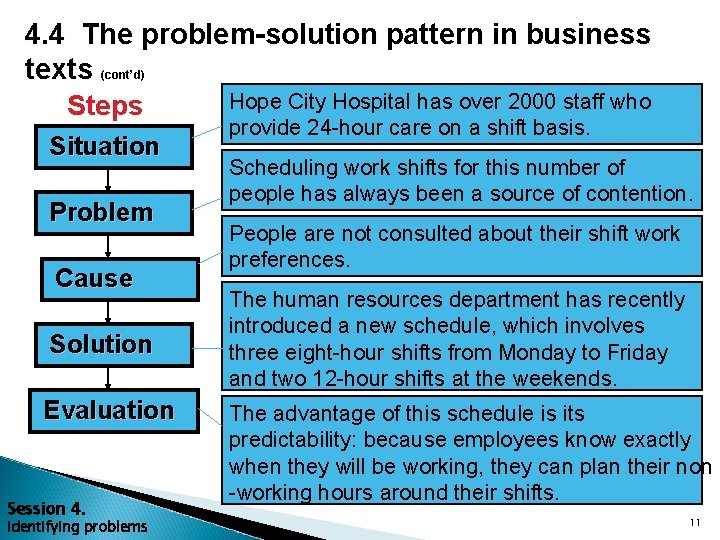
4. 4 The problem-solution pattern in business texts (cont’d) Hope City Hospital has over 2000 staff who Steps Situation Problem Cause Solution Evaluation Session 4. Identifying problems provide 24 -hour care on a shift basis. Scheduling work shifts for this number of people has always been a source of contention. People are not consulted about their shift work preferences. The human resources department has recently introduced a new schedule, which involves three eight-hour shifts from Monday to Friday and two 12 -hour shifts at the weekends. The advantage of this schedule is its predictability: because employees know exactly when they will be working, they can plan their non -working hours around their shifts. 11
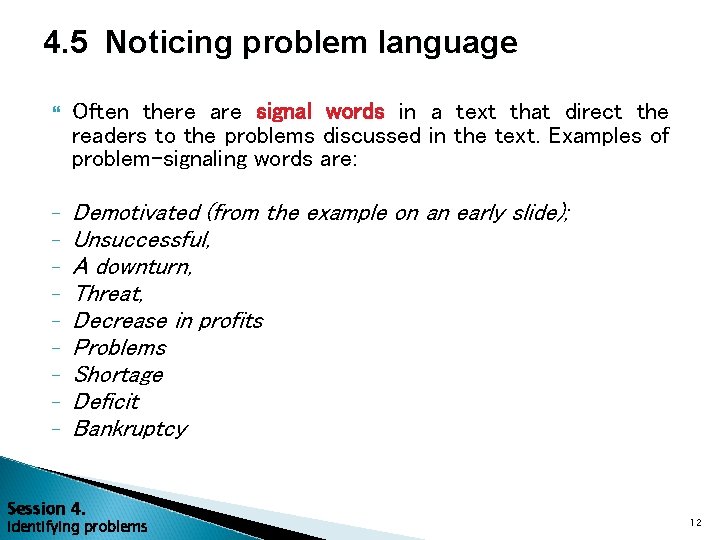
4. 5 Noticing problem language Often there are signal words in a text that direct the readers to the problems discussed in the text. Examples of problem-signaling words are: Demotivated (from the example on an early slide); Unsuccessful, A downturn, Threat, Decrease in profits Problems Shortage Deficit Bankruptcy Session 4. Identifying problems 12
4. 6 Problems, Influences and Impacts Problems that remain unsolved lead to negative influences or effects on a company or organization. Sometimes, there may be many problems that are interrelated, so we look at the “problem area” area as a whole, and try to sort out which problem causes what effect and has what kind of a larger impact on the organization. Session 4. Identifying problems 13
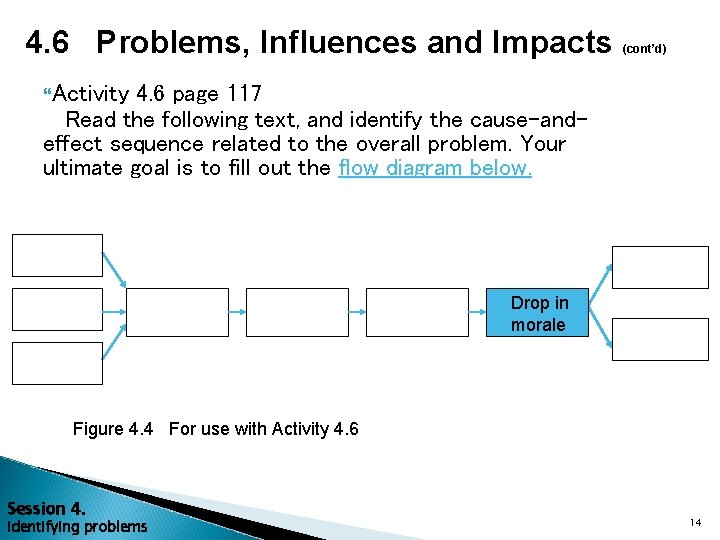
4. 6 Problems, Influences and Impacts (cont’d) Activity 4. 6 page 117 Read the following text, and identify the cause-andeffect sequence related to the overall problem. Your ultimate goal is to fill out the flow diagram below. Drop in morale Figure 4. 4 For use with Activity 4. 6 Session 4. Identifying problems 14
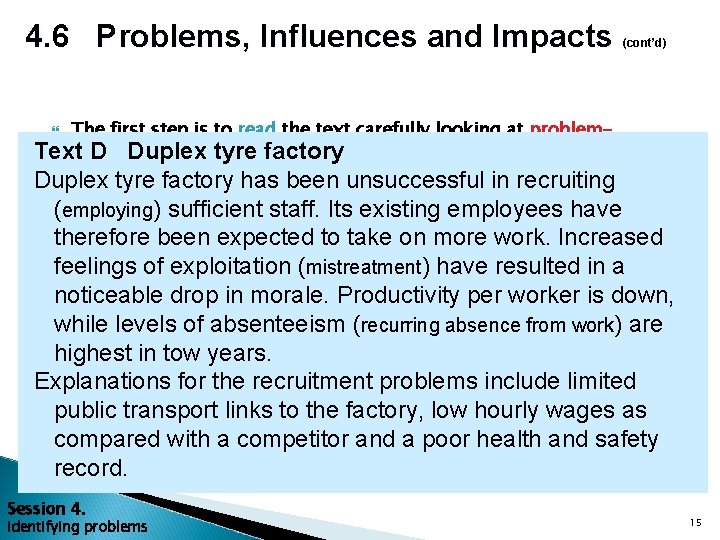
4. 6 Problems, Influences and Impacts (cont’d) The first step is to read the text carefully looking at problemwords tyre factory Textsignaling D Duplex tyre factory has been unsuccessful in recruiting (employing) sufficient staff. Its existing employees have therefore been expected to take on more work. Increased feelings of exploitation (mistreatment) have resulted in a noticeable drop in morale. Productivity per worker is down, while levels of absenteeism (recurring absence from work) are highest in tow years. Explanations for the recruitment problems include limited public transport links to the factory, low hourly wages as compared with a competitor and a poor health and safety record. Session 4. Identifying problems 15
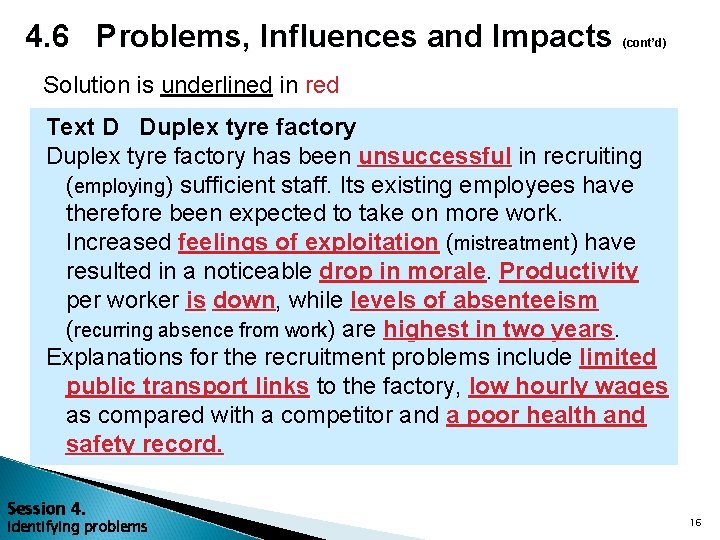
4. 6 Problems, Influences and Impacts (cont’d) Solution is underlined in red Text D Duplex tyre factory has been unsuccessful in recruiting (employing) sufficient staff. Its existing employees have therefore been expected to take on more work. Increased feelings of exploitation (mistreatment) have resulted in a noticeable drop in morale. Productivity per worker is down, while levels of absenteeism (recurring absence from work) are highest in two years. Explanations for the recruitment problems include limited public transport links to the factory, low hourly wages as compared with a competitor and a poor health and safety record. Session 4. Identifying problems 16
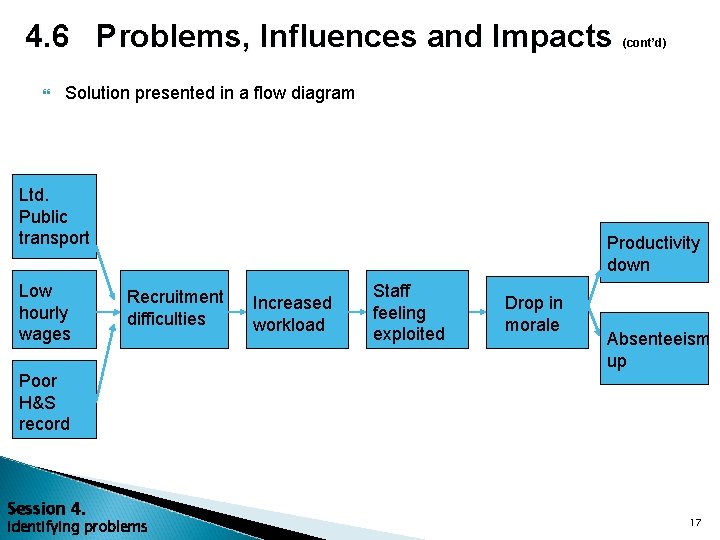
4. 6 Problems, Influences and Impacts (cont’d) Solution presented in a flow diagram Ltd. Public transport Low hourly wages Productivity down Recruitment difficulties Increased workload Staff feeling exploited Dropinin morale Absenteeism up Poor H&S record Session 4. Identifying problems 17
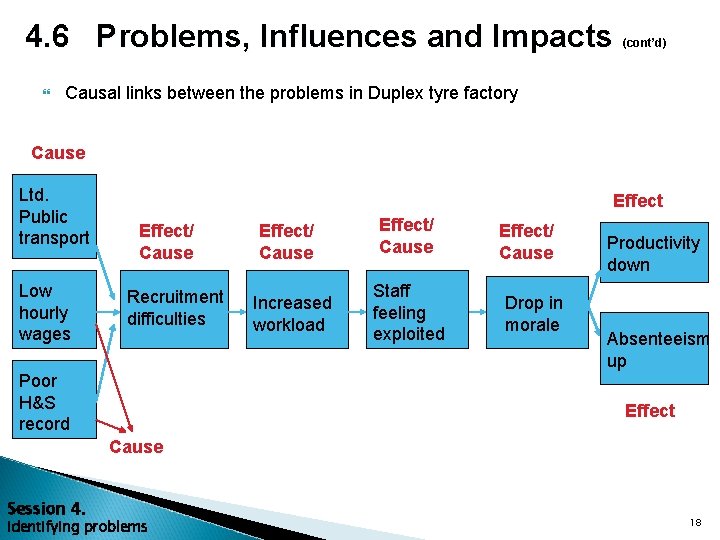
4. 6 Problems, Influences and Impacts (cont’d) Causal links between the problems in Duplex tyre factory Cause Ltd. Public transport Low hourly wages Effect/ Cause Recruitment difficulties Poor H&S record Effect/ Cause Increased workload Effect/ Cause Staff feeling exploited Dropinin morale Productivity down Absenteeism up Effect Cause Session 4. Identifying problems 18
4. 7 Analyzing the problems in a case study text The SWOT Framework SWOT is another business concept used to frame a case study. S is for Strength; trength W, weaknesses; eaknesses O, opportunities; and T, threats Session 4. Identifying problems 19
4. 7 Analyzing the problems in a case study text (cont’d) 1. Strengths are the distinctive and positive qualities, reputation, and resources a company has. 2. Weaknesses are the required competences, capabilities, and qualities that a company lacks (does not have). They are the negatives of a company. 3. Opportunities are openings in the market and in new regions that allow the company to expand, as well as the chances available to develop products and services to keep up with the customers’ needs and desires. (positive). 4. Threats are things that can harm the company, like fierce competition, changing markets, changes in tastes and inflation. (negative). Session 4. Identifying problems 20
4. 7 Analyzing the problems in a case study text (cont’d) 1. Strengths & 2. Weaknesses are related to the company. They are internal to the business 3. Opportunities & 4. Threats are part of the external environment Session 4. Identifying problems 21
4. 7 Analyzing the problems in a case study text (cont’d) Activity 4. 7 page 119 Try to fill in the blanks of this extract In general, in order to succeed, an organization needs to aim to be better than its competitors when it comes to possessing _________and exploring __________, while at the same time minimizing the effect of its __________ and __________ to a greater extent than its competitors. Session 4. Identifying problems 22
4. 7 Analyzing the problems in a case study text (cont’d) Solution In general, in order to succeed, an organization needs to aim to be better than its competitors when it comes to possessing strengths and exploring opportunities, opportunities while at the same time minimizing the effect of its weaknesses and threats to a greater extent than its competitors. Session 4. Identifying problems 23
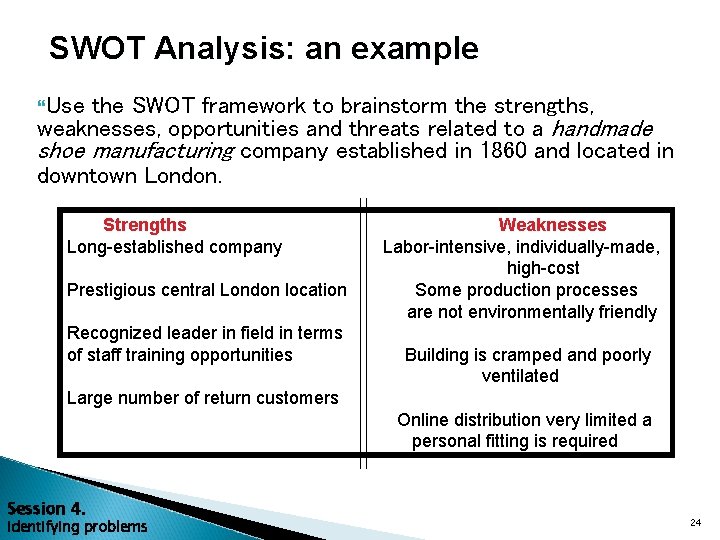
SWOT Analysis: an example Use the SWOT framework to brainstorm the strengths, weaknesses, opportunities and threats related to a handmade shoe manufacturing company established in 1860 and located in downtown London. Strengths Long-established company Prestigious central London location Recognized leader in field in terms of staff training opportunities Weaknesses Labor-intensive, individually-made, high-cost Some production processes are not environmentally friendly Building is cramped and poorly ventilated Large number of return customers Online distribution very limited a personal fitting is required Session 4. Identifying problems 24
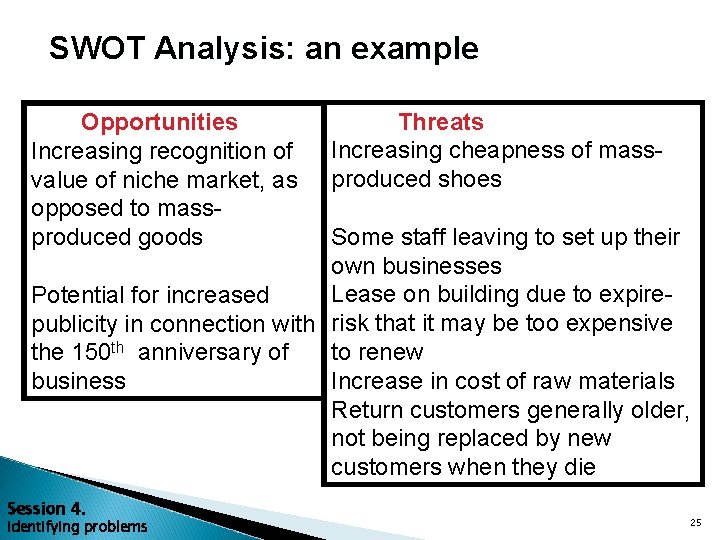
SWOT Analysis: an example Opportunities Increasing recognition of value of niche market, as opposed to massproduced goods Threats Increasing cheapness of massproduced shoes Some staff leaving to set up their own businesses Lease on building due to expire. Potential for increased publicity in connection with risk that it may be too expensive to renew the 150 th anniversary of Increase in cost of raw materials business Return customers generally older, not being replaced by new customers when they die Session 4. Identifying problems 25
SWOT Analysis: an example Do Session 4. activity 4. 9 page 122 Identifying problems 26
- Slides: 26