
Session 4 Framing the Issue Case study examples

- Slides: 13
Session 4: Framing the Issue; Case study examples using the TEEB Approach ©TEEB Training
PUTTING THE TIERED APPROACH INTO PRACTICE • Recognizing Value - IDENTIFY and ASSESS the full range of →ecosystem services affected and the implications for different groups in society • Demonstrating Value – estimate and demonstrate the value of ecosystem services, using appropriate methods. • Capturing Value – capture the value of ecosystem services and seek solutions to overcome their undervaluation, using economically informed policy instruments TEEB Training
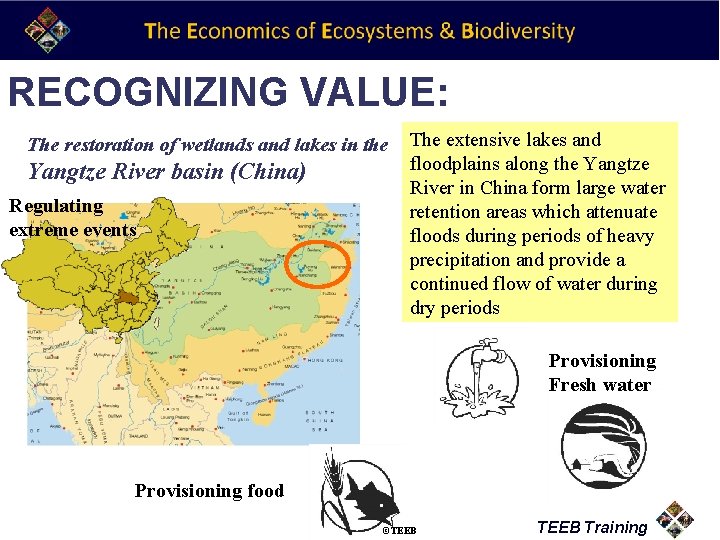
RECOGNIZING VALUE: The restoration of wetlands and lakes in the Yangtze River basin (China) Regulating extreme events The extensive lakes and floodplains along the Yangtze River in China form large water retention areas which attenuate floods during periods of heavy precipitation and provide a continued flow of water during dry periods Provisioning Fresh water Provisioning food ©TEEB Training
RECOGNIZING VALUE: The restoration of wetlands and lakes in the Yangtze River basin (China) Adaptation outcomes: reducing vulnerability to flooding in the central Yangtze region, Pollution fell at Lake Hong from national pollution level IV (fit for agricultural use only) to II (drinkable) Restoration: In 2002 WWF commenced a program to reconnect lakes in Hubei Province to the Yangtze River Cessation of unsustainable aquaculture, better agricultural practices Livelihood outcomes: Income from wild fisheries increased by 15 -25% after restoration. Access to cleaner water supplies is another benefit ©UNEP/GRID-Arendal ©TEEB Training
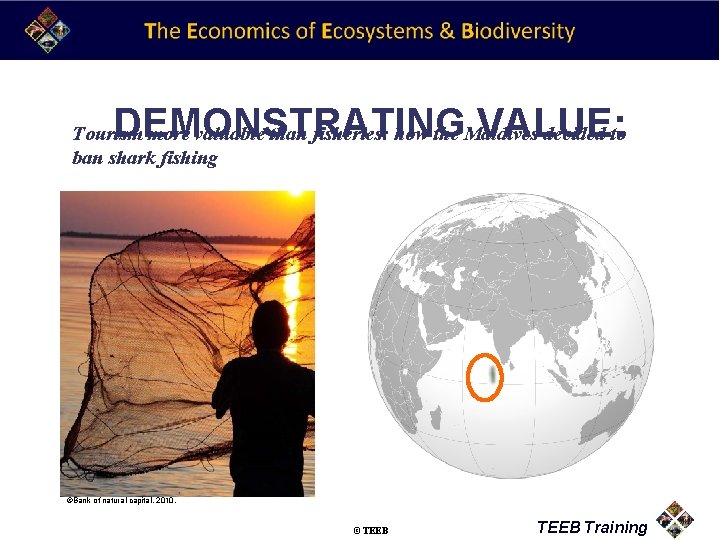
DEMONSTRATING VALUE: Tourism more valuable than fisheries: how the Maldives decided to ban shark fishing ©Bank of natural capital, 2010. ©TEEB Training
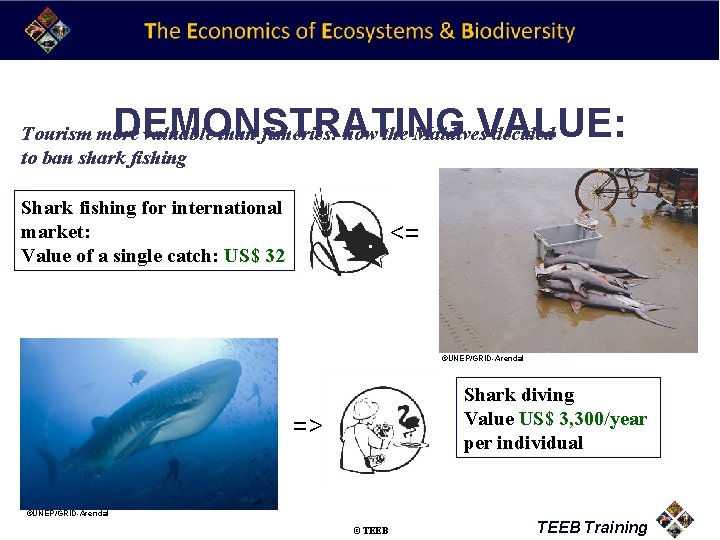
DEMONSTRATING VALUE: Tourism more valuable than fisheries: how the Maldives decided to ban shark fishing Shark fishing for international market: Value of a single catch: US$ 32 <= ©UNEP/GRID-Arendal Shark diving Value US$ 3, 300/year per individual => ©UNEP/GRID-Arendal ©TEEB Training
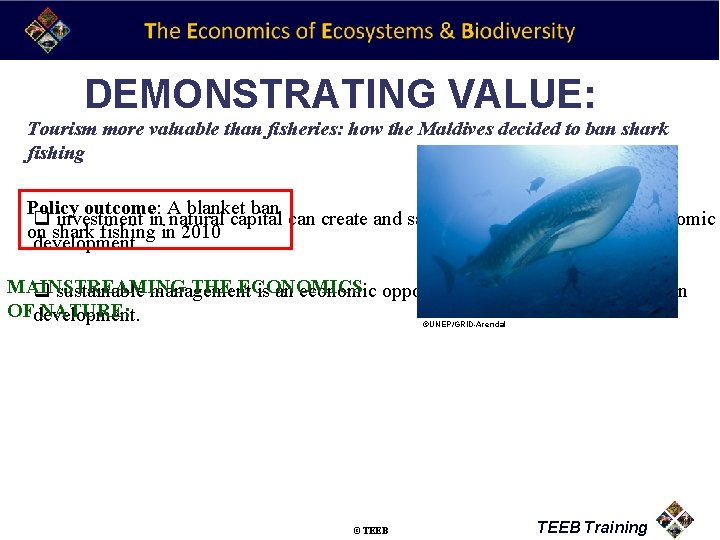
DEMONSTRATING VALUE: Tourism more valuable than fisheries: how the Maldives decided to ban shark fishing Policy outcome: A blanket ban q investment in natural capital can create and safeguard jobs and underpin economic on shark fishing in 2010 development MAINSTREAMING THE ECONOMICS q sustainable management is an economic opportunity rather than a constraint on OFdevelopment. NATURE: ©UNEP/GRID-Arendal ©TEEB Training
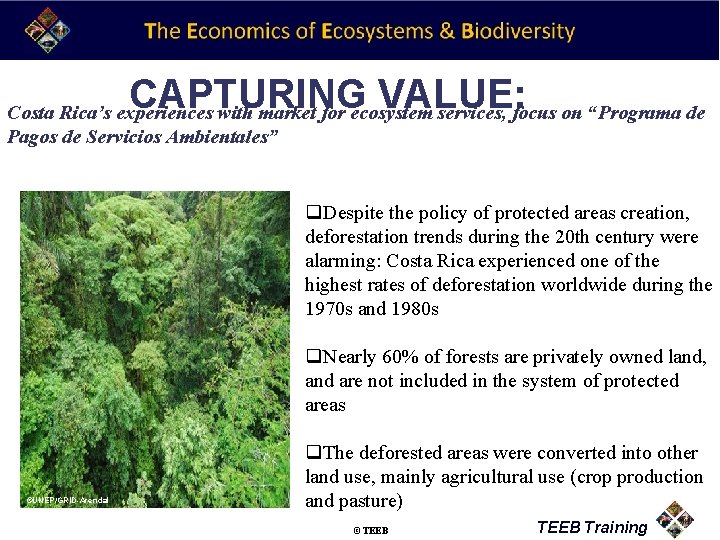
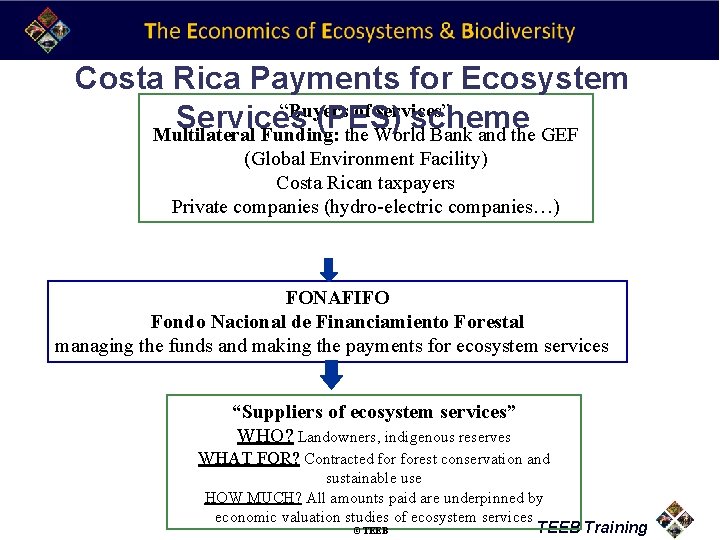
CAPTURING VALUE: Costa Rica’s experiences with market for ecosystem services, focus on “Programa de Pagos de Servicios Ambientales” q. Despite the policy of protected areas creation, deforestation trends during the 20 th century were alarming: Costa Rica experienced one of the highest rates of deforestation worldwide during the 1970 s and 1980 s q. Nearly 60% of forests are privately owned land, and are not included in the system of protected areas ©UNEP/GRID-Arendal q. The deforested areas were converted into other land use, mainly agricultural use (crop production and pasture) ©TEEB Training
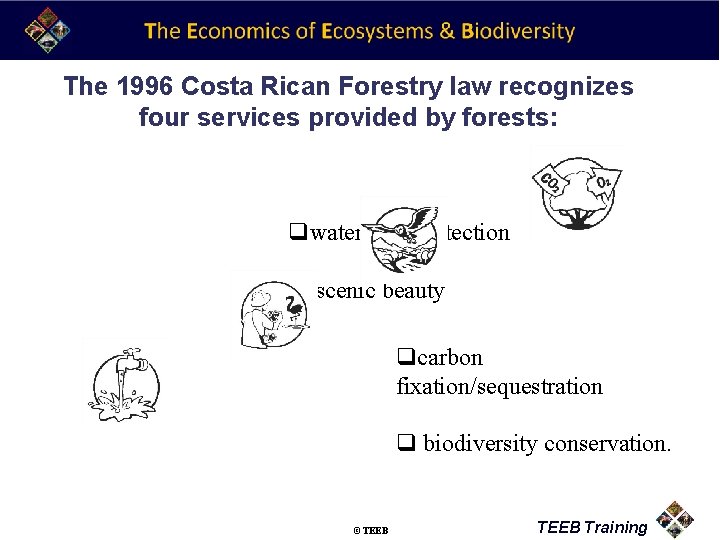
The 1996 Costa Rican Forestry law recognizes four services provided by forests: qwatershed protection q scenic beauty qcarbon fixation/sequestration q biodiversity conservation. ©TEEB Training
Costa Rica Payments for Ecosystem “Buyers of services” Services (PES) scheme Multilateral Funding: the World Bank and the GEF (Global Environment Facility) Costa Rican taxpayers Private companies (hydro-electric companies…) FONAFIFO Fondo Nacional de Financiamiento Forestal managing the funds and making the payments for ecosystem services “Suppliers of ecosystem services” WHO? Landowners, indigenous reserves WHAT FOR? Contracted forest conservation and sustainable use HOW MUCH? All amounts paid are underpinned by economic valuation studies of ecosystem services TEEB Training ©TEEB
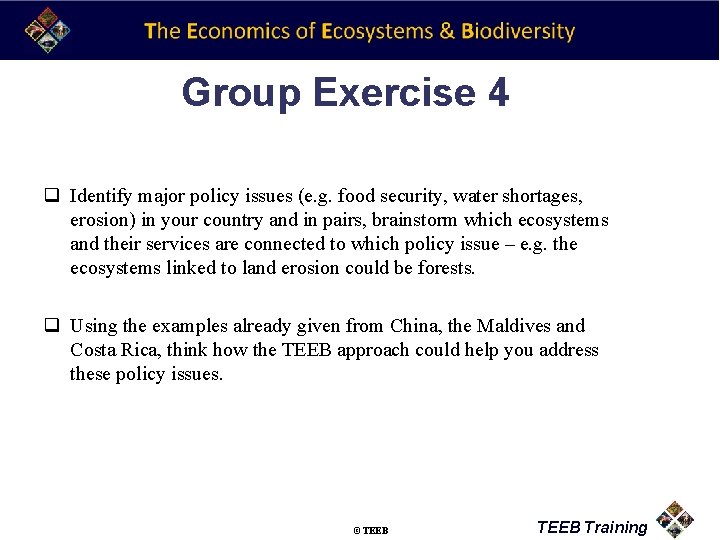
Group Exercise 4 q Identify major policy issues (e. g. food security, water shortages, erosion) in your country and in pairs, brainstorm which ecosystems and their services are connected to which policy issue – e. g. the ecosystems linked to land erosion could be forests. q Using the examples already given from China, the Maldives and Costa Rica, think how the TEEB approach could help you address these policy issues. ©TEEB Training
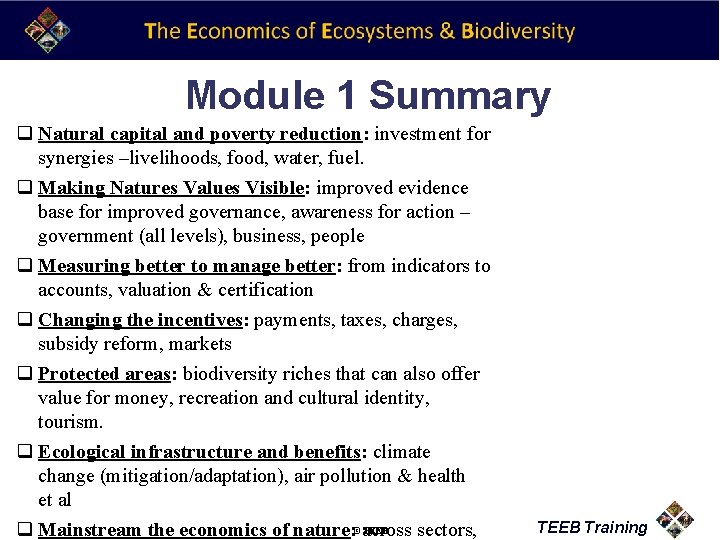
Module 1 Summary q Natural capital and poverty reduction: investment for synergies –livelihoods, food, water, fuel. q Making Natures Values Visible: improved evidence base for improved governance, awareness for action – government (all levels), business, people q Measuring better to manage better: from indicators to accounts, valuation & certification q Changing the incentives: payments, taxes, charges, subsidy reform, markets q Protected areas: biodiversity riches that can also offer value for money, recreation and cultural identity, tourism. q Ecological infrastructure and benefits: climate change (mitigation/adaptation), air pollution & health et al q Mainstream the economics of nature: ©TEEB across sectors, TEEB Training
“Little Things Matter” Video ©TEEB. “Little Things - Mofilm winner 1 st prize”Youtube ©TEEB Training