
Session 4 Email Communication in the Workplace LB
Session 4: Email Communication in the Workplace LB 160 – Book 3 Producing Influential Documents Copyright Material © Arab Open University, Lebanon Branch LB 160_Book 3_Spring 2010_A joint effort between the Business and Language Faculties 1 1
Email Communication in the Workplace 4. 1. - 4. 2. Introduction: Communication in the Workplace 4. 3. Workplace email communication 4. 4. Other forms of online communication Review Session 4. Email Communication
4. 1. - 4. 2. Introduction: email communication in the workplace People communicate in the workplace both internally and externally. There are many ways in which they communicate: through having meetings (face to face), by letters, faxes, phone calls, and of course emails. The best way is to use a combination of methods based on what the situation calls for. Emails have become one of the most depended on and effective methods of communication in the workplace. Let us look at the benefits and problems of email communication. Session 4. Email Communication Copyright Material © Arab Open University, Lebanon Branch LB 160_Book 3_Spring 2010_A joint effort between the Business and Language Faculties 3
4. 3. Workplace email communication Activity 4. 2. p. 88 Purpose: to raise awareness of the advantages and disadvantages of using emails for workplace communication. Task: Think about the various benefits of using emails in the workplace. Then think about the potential disadvantages of this form of communication. Complete the table on the next slide with a list of your ideas. An example is given in each column to get you started. Session 4. Email Communication Copyright Material © Arab Open University, Lebanon Branch LB 160_Book 3_Spring 2010_A joint effort between the Business and Language Faculties 4
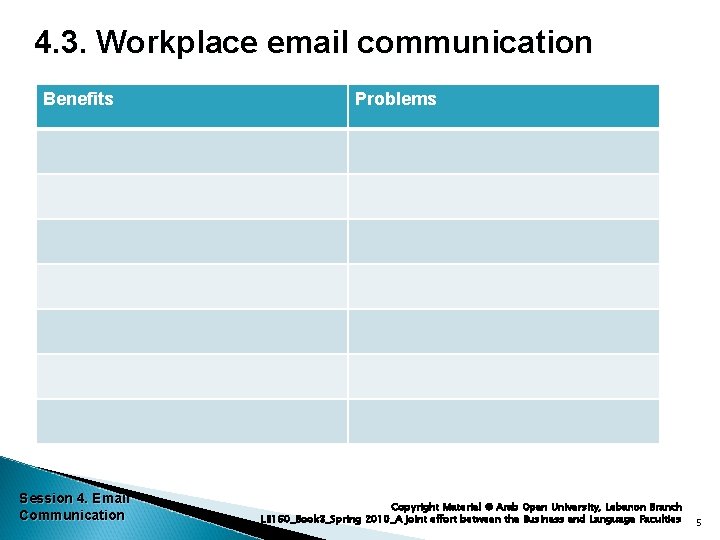
4. 3. Workplace email communication Benefits Session 4. Email Communication Problems Copyright Material © Arab Open University, Lebanon Branch LB 160_Book 3_Spring 2010_A joint effort between the Business and Language Faculties 5
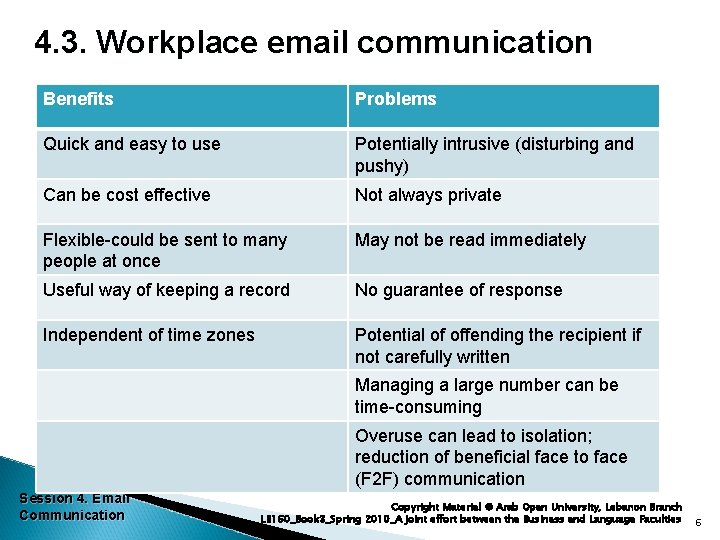
4. 3. Workplace email communication Benefits Problems Quick and easy to use Potentially intrusive (disturbing and pushy) Can be cost effective Not always private Flexible-could be sent to many people at once May not be read immediately Useful way of keeping a record No guarantee of response Independent of time zones Potential of offending the recipient if not carefully written Managing a large number can be time-consuming Overuse can lead to isolation; reduction of beneficial face to face (F 2 F) communication Session 4. Email Communication Copyright Material © Arab Open University, Lebanon Branch LB 160_Book 3_Spring 2010_A joint effort between the Business and Language Faculties 6
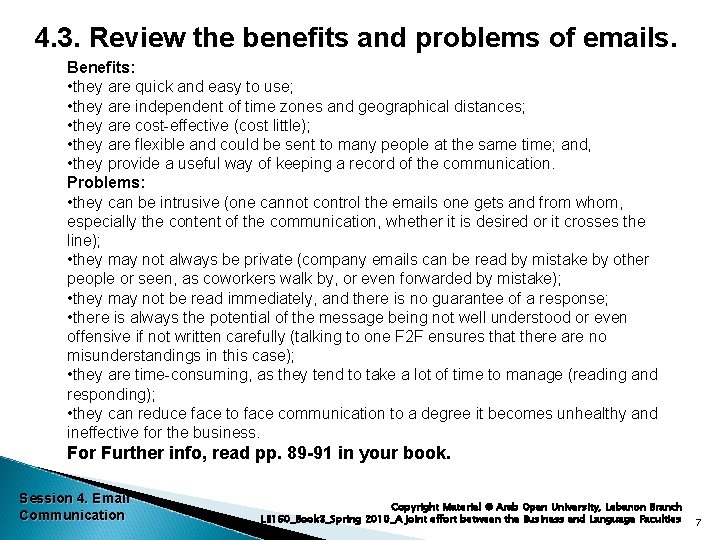
4. 3. Review the benefits and problems of emails. Benefits: • they are quick and easy to use; • they are independent of time zones and geographical distances; • they are cost-effective (cost little); • they are flexible and could be sent to many people at the same time; and, • they provide a useful way of keeping a record of the communication. Problems: • they can be intrusive (one cannot control the emails one gets and from whom, especially the content of the communication, whether it is desired or it crosses the line); • they may not always be private (company emails can be read by mistake by other people or seen, as coworkers walk by, or even forwarded by mistake); • they may not be read immediately, and there is no guarantee of a response; • there is always the potential of the message being not well understood or even offensive if not written carefully (talking to one F 2 F ensures that there are no misunderstandings in this case); • they are time-consuming, as they tend to take a lot of time to manage (reading and responding); • they can reduce face to face communication to a degree it becomes unhealthy and ineffective for the business. For Further info, read pp. 89 -91 in your book. Session 4. Email Communication Copyright Material © Arab Open University, Lebanon Branch LB 160_Book 3_Spring 2010_A joint effort between the Business and Language Faculties 7
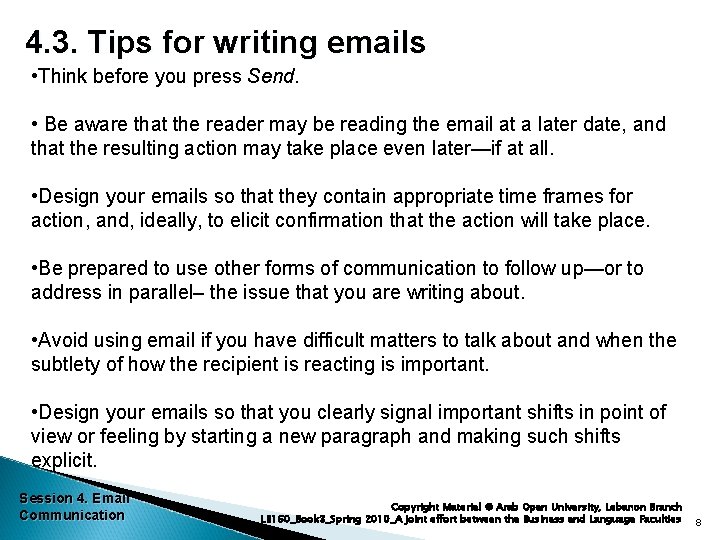
4. 3. Tips for writing emails • Think before you press Send. • Be aware that the reader may be reading the email at a later date, and that the resulting action may take place even later—if at all. • Design your emails so that they contain appropriate time frames for action, and, ideally, to elicit confirmation that the action will take place. • Be prepared to use other forms of communication to follow up—or to address in parallel– the issue that you are writing about. • Avoid using email if you have difficult matters to talk about and when the subtlety of how the recipient is reacting is important. • Design your emails so that you clearly signal important shifts in point of view or feeling by starting a new paragraph and making such shifts explicit. Session 4. Email Communication Copyright Material © Arab Open University, Lebanon Branch LB 160_Book 3_Spring 2010_A joint effort between the Business and Language Faculties 8
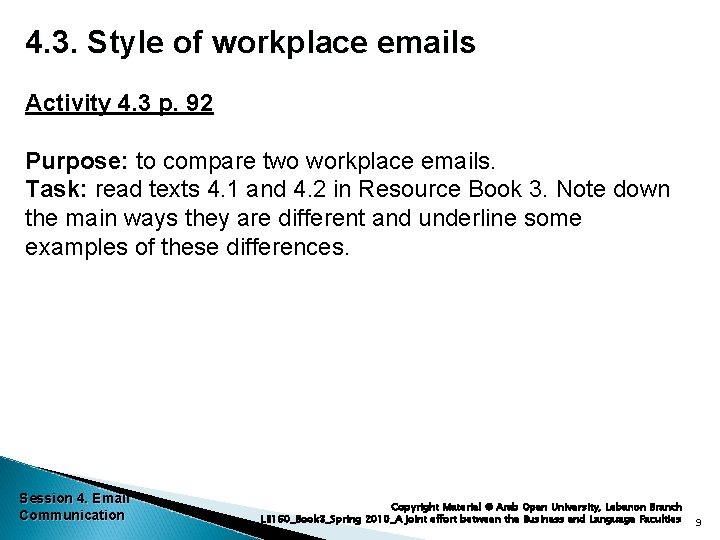
4. 3. Style of workplace emails Activity 4. 3 p. 92 Purpose: to compare two workplace emails. Task: read texts 4. 1 and 4. 2 in Resource Book 3. Note down the main ways they are different and underline some examples of these differences. Session 4. Email Communication Copyright Material © Arab Open University, Lebanon Branch LB 160_Book 3_Spring 2010_A joint effort between the Business and Language Faculties 9

4. 3. Style of workplace emails (comment) Although both emails have a similar basic structure, each one has a distinctive style. This reflects the relationship between sender and recipient. Text 4. 1 is more like a personal email, since it is informal in style. This is evident in its opening line (Hi Pete), and the fact that the sender signs off with his first name only. The text also includes incomplete sentences (e. g. Just heard about your promotion), which are a feature of personal messages. In contrast, text 4. 2 is more formal and impersonal. This is exemplified by the greeting and sign off (Dear Peter; Best wishes) and the full name of the sender at the end. Not only is the text longer but its sentences are complex; I am pleased to inform you that…; In view of this…; Should this not be necessary…; I would like to take this opportunity to offer you my congratulations; I look forward to hearing from you… Session 4. Email Communication Copyright Material © Arab Open University, Lebanon Branch LB 160_Book 3_Spring 2010_A joint effort between the Business and Language Faculties 10
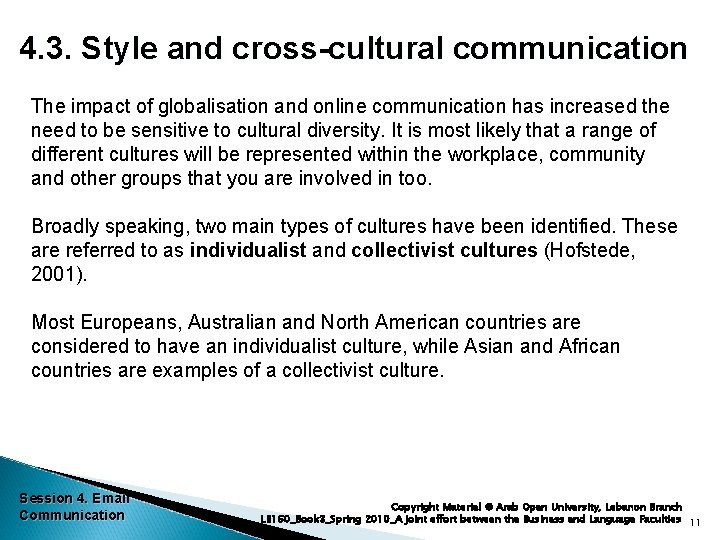
4. 3. Style and cross-cultural communication The impact of globalisation and online communication has increased the need to be sensitive to cultural diversity. It is most likely that a range of different cultures will be represented within the workplace, community and other groups that you are involved in too. Broadly speaking, two main types of cultures have been identified. These are referred to as individualist and collectivist cultures (Hofstede, 2001). Most Europeans, Australian and North American countries are considered to have an individualist culture, while Asian and African countries are examples of a collectivist culture. Session 4. Email Communication Copyright Material © Arab Open University, Lebanon Branch LB 160_Book 3_Spring 2010_A joint effort between the Business and Language Faculties 11
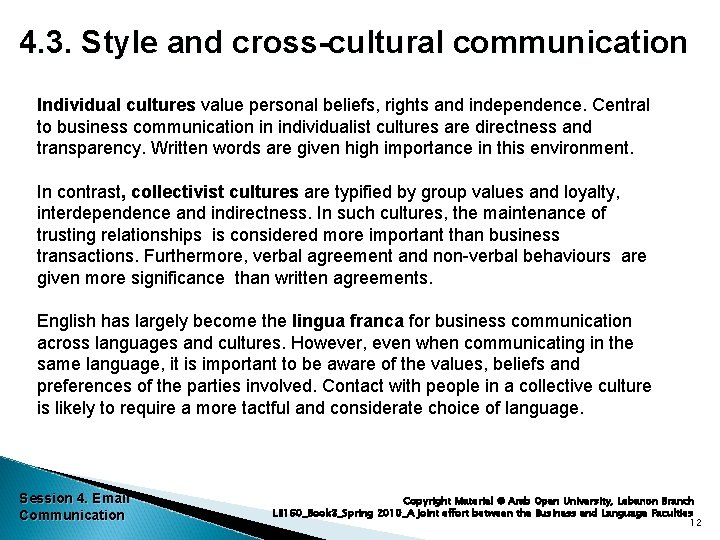
4. 3. Style and cross-cultural communication Individual cultures value personal beliefs, rights and independence. Central to business communication in individualist cultures are directness and transparency. Written words are given high importance in this environment. In contrast, collectivist cultures are typified by group values and loyalty, interdependence and indirectness. In such cultures, the maintenance of trusting relationships is considered more important than business transactions. Furthermore, verbal agreement and non-verbal behaviours are given more significance than written agreements. English has largely become the lingua franca for business communication across languages and cultures. However, even when communicating in the same language, it is important to be aware of the values, beliefs and preferences of the parties involved. Contact with people in a collective culture is likely to require a more tactful and considerate choice of language. Session 4. Email Communication Copyright Material © Arab Open University, Lebanon Branch LB 160_Book 3_Spring 2010_A joint effort between the Business and Language Faculties 12

4. 3. The organisation of workplace emails Apart from determining whether one should be direct or indirect in the email-- i. e. thinking about the audience and whether the message itself is appropriate to send-- one should include the following elements in every email: 1. A clear subject line: if there is more than one topic, mention both briefly in the subject heading. Never leave it empty, and update it if the communication purpose or topic is modified at any point. (e. g. Meeting on Sat 5/1 and FINAL) 2. A salutation: Be courteous, and address the person with the correct ad proper title. (Dear Mr. Salim) 3. An Introduction: in the first couple of lines, say what is the topic in the message, its purpose, and how it relates to previous messages between you and the recipient or their company. 4. Main message: Make sure that you separate the issues you will be discussing in the email. Indicate clearly using numbers and paragraph breaks where old ideas/issues end and new ones begin. Session 4. Email Communication Copyright Material © Arab Open University, Lebanon Branch LB 160_Book 3_Spring 2010_A joint effort between the Business and Language Faculties 13
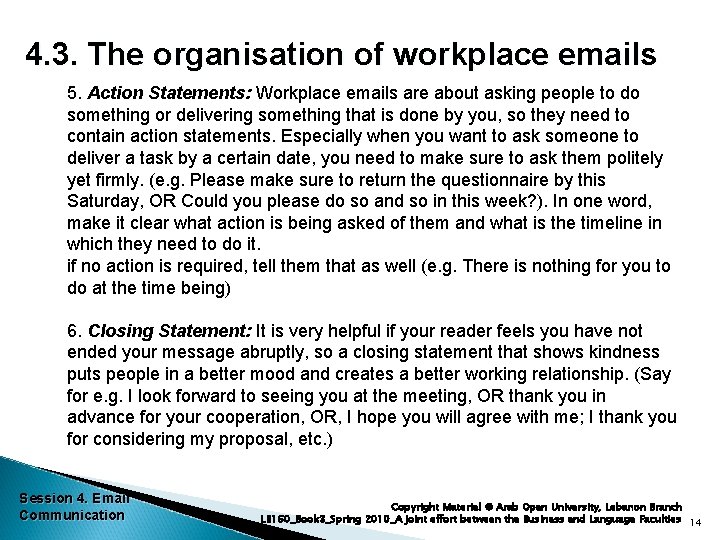
4. 3. The organisation of workplace emails 5. Action Statements: Workplace emails are about asking people to do something or delivering something that is done by you, so they need to contain action statements. Especially when you want to ask someone to deliver a task by a certain date, you need to make sure to ask them politely yet firmly. (e. g. Please make sure to return the questionnaire by this Saturday, OR Could you please do so and so in this week? ). In one word, make it clear what action is being asked of them and what is the timeline in which they need to do it. if no action is required, tell them that as well (e. g. There is nothing for you to do at the time being) 6. Closing Statement: It is very helpful if your reader feels you have not ended your message abruptly, so a closing statement that shows kindness puts people in a better mood and creates a better working relationship. (Say for e. g. I look forward to seeing you at the meeting, OR thank you in advance for your cooperation, OR, I hope you will agree with me; I thank you for considering my proposal, etc. ) Session 4. Email Communication Copyright Material © Arab Open University, Lebanon Branch LB 160_Book 3_Spring 2010_A joint effort between the Business and Language Faculties 14
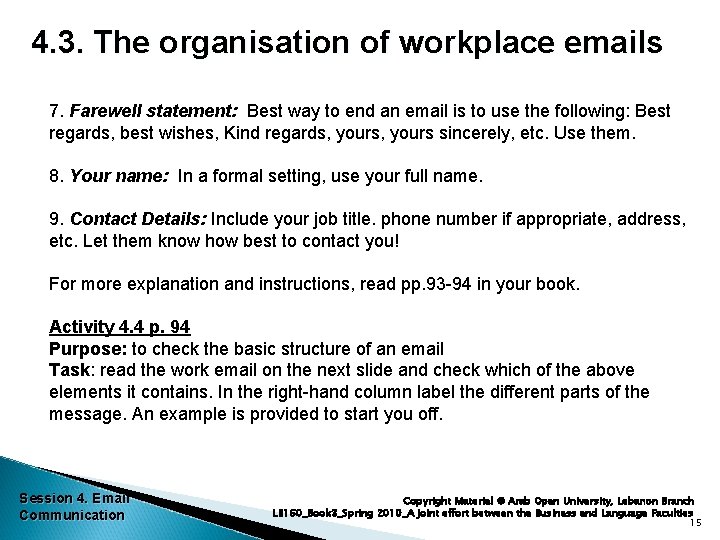
4. 3. The organisation of workplace emails 7. Farewell statement: Best way to end an email is to use the following: Best regards, best wishes, Kind regards, yours sincerely, etc. Use them. 8. Your name: In a formal setting, use your full name. 9. Contact Details: Include your job title. phone number if appropriate, address, etc. Let them know how best to contact you! For more explanation and instructions, read pp. 93 -94 in your book. Activity 4. 4 p. 94 Purpose: to check the basic structure of an email Task: read the work email on the next slide and check which of the above elements it contains. In the right-hand column label the different parts of the message. An example is provided to start you off. Session 4. Email Communication Copyright Material © Arab Open University, Lebanon Branch LB 160_Book 3_Spring 2010_A joint effort between the Business and Language Faculties 15
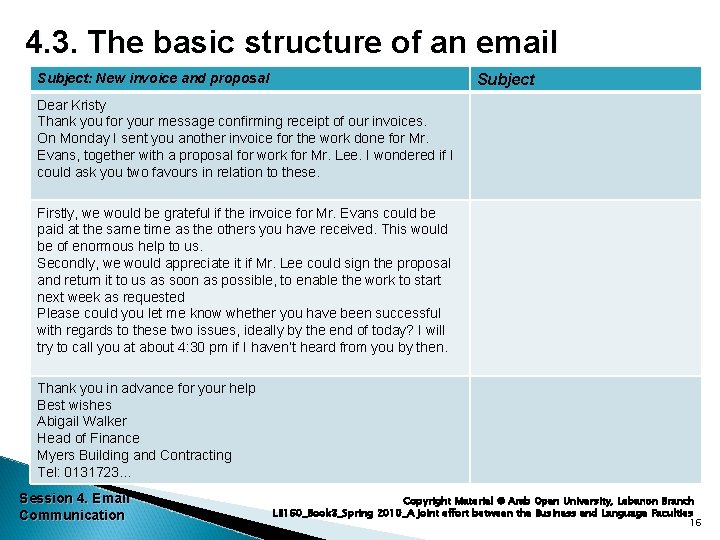
4. 3. The basic structure of an email Subject: New invoice and proposal Subject Dear Kristy Thank you for your message confirming receipt of our invoices. On Monday I sent you another invoice for the work done for Mr. Evans, together with a proposal for work for Mr. Lee. I wondered if I could ask you two favours in relation to these. Firstly, we would be grateful if the invoice for Mr. Evans could be paid at the same time as the others you have received. This would be of enormous help to us. Secondly, we would appreciate it if Mr. Lee could sign the proposal and return it to us as soon as possible, to enable the work to start next week as requested Please could you let me know whether you have been successful with regards to these two issues, ideally by the end of today? I will try to call you at about 4: 30 pm if I haven’t heard from you by then. Thank you in advance for your help Best wishes Abigail Walker Head of Finance Myers Building and Contracting Tel: 0131723… Session 4. Email Communication Copyright Material © Arab Open University, Lebanon Branch LB 160_Book 3_Spring 2010_A joint effort between the Business and Language Faculties 16
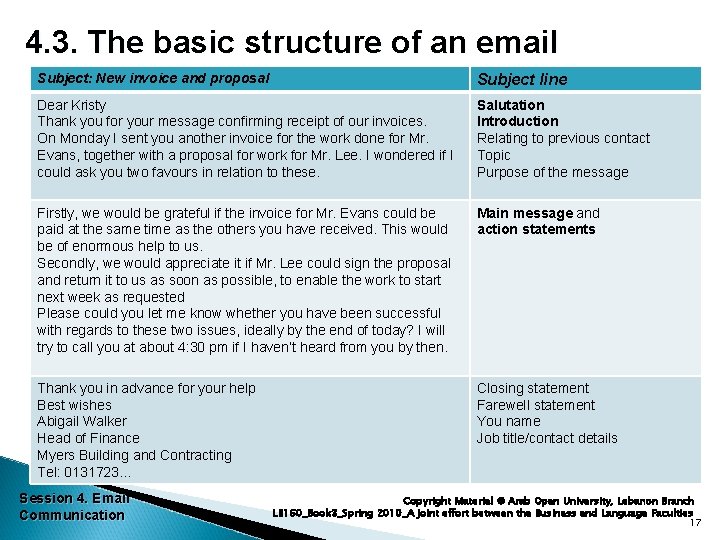
4. 3. The basic structure of an email Subject: New invoice and proposal Subject line Dear Kristy Thank you for your message confirming receipt of our invoices. On Monday I sent you another invoice for the work done for Mr. Evans, together with a proposal for work for Mr. Lee. I wondered if I could ask you two favours in relation to these. Salutation Introduction Relating to previous contact Topic Purpose of the message Firstly, we would be grateful if the invoice for Mr. Evans could be paid at the same time as the others you have received. This would be of enormous help to us. Secondly, we would appreciate it if Mr. Lee could sign the proposal and return it to us as soon as possible, to enable the work to start next week as requested Please could you let me know whether you have been successful with regards to these two issues, ideally by the end of today? I will try to call you at about 4: 30 pm if I haven’t heard from you by then. Main message and action statements Thank you in advance for your help Best wishes Abigail Walker Head of Finance Myers Building and Contracting Tel: 0131723… Closing statement Farewell statement You name Job title/contact details Session 4. Email Communication Copyright Material © Arab Open University, Lebanon Branch LB 160_Book 3_Spring 2010_A joint effort between the Business and Language Faculties 17
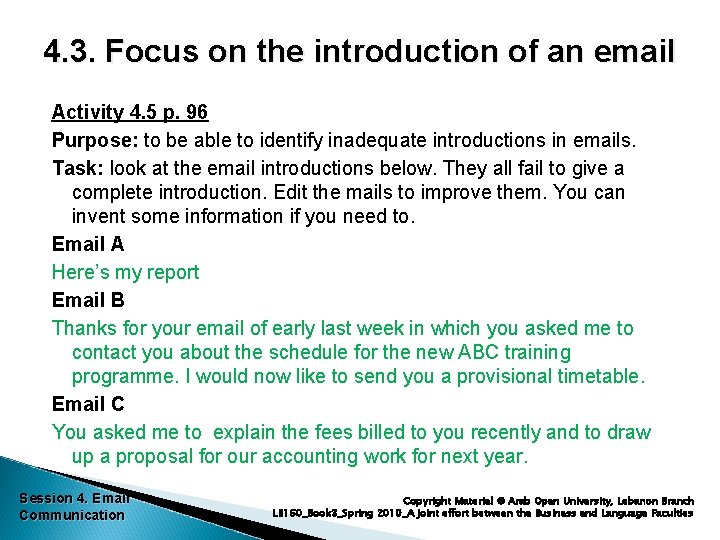
4. 3. Focus on the introduction of an email Activity 4. 5 p. 96 Purpose: to be able to identify inadequate introductions in emails. Task: look at the email introductions below. They all fail to give a complete introduction. Edit the mails to improve them. You can invent some information if you need to. Email A Here’s my report Email B Thanks for your email of early last week in which you asked me to contact you about the schedule for the new ABC training programme. I would now like to send you a provisional timetable. Email C You asked me to explain the fees billed to you recently and to draw up a proposal for our accounting work for next year. Session 4. Email Communication Copyright Material © Arab Open University, Lebanon Branch LB 160_Book 3_Spring 2010_A joint effort between the Business and Language Faculties
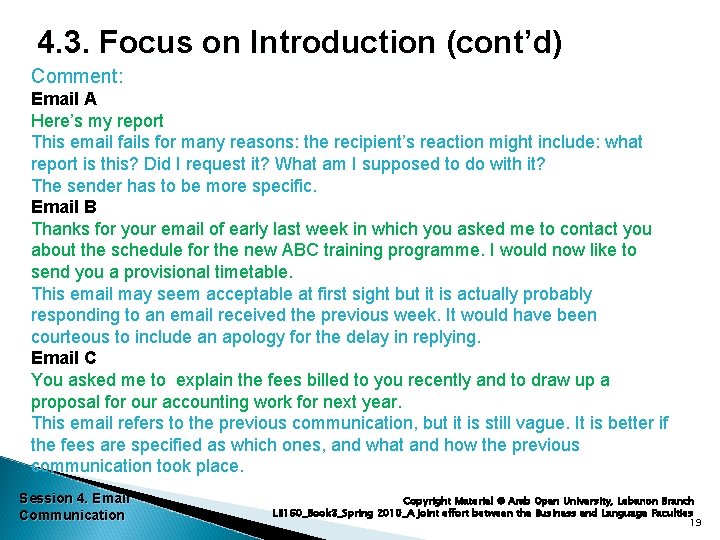
4. 3. Focus on Introduction (cont’d) Comment: Email A Here’s my report This email fails for many reasons: the recipient’s reaction might include: what report is this? Did I request it? What am I supposed to do with it? The sender has to be more specific. Email B Thanks for your email of early last week in which you asked me to contact you about the schedule for the new ABC training programme. I would now like to send you a provisional timetable. This email may seem acceptable at first sight but it is actually probably responding to an email received the previous week. It would have been courteous to include an apology for the delay in replying. Email C You asked me to explain the fees billed to you recently and to draw up a proposal for our accounting work for next year. This email refers to the previous communication, but it is still vague. It is better if the fees are specified as which ones, and what and how the previous communication took place. Session 4. Email Communication Copyright Material © Arab Open University, Lebanon Branch LB 160_Book 3_Spring 2010_A joint effort between the Business and Language Faculties 19
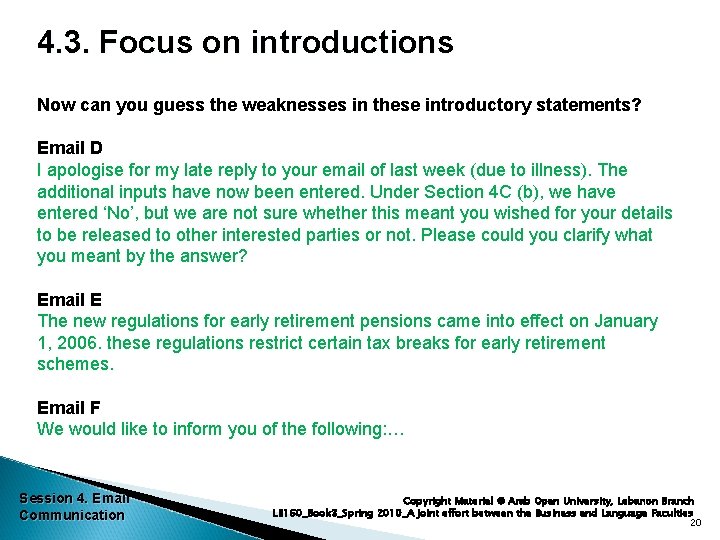
4. 3. Focus on introductions Now can you guess the weaknesses in these introductory statements? Email D I apologise for my late reply to your email of last week (due to illness). The additional inputs have now been entered. Under Section 4 C (b), we have entered ‘No’, but we are not sure whether this meant you wished for your details to be released to other interested parties or not. Please could you clarify what you meant by the answer? Email E The new regulations for early retirement pensions came into effect on January 1, 2006. these regulations restrict certain tax breaks for early retirement schemes. Email F We would like to inform you of the following: … Session 4. Email Communication Copyright Material © Arab Open University, Lebanon Branch LB 160_Book 3_Spring 2010_A joint effort between the Business and Language Faculties 20
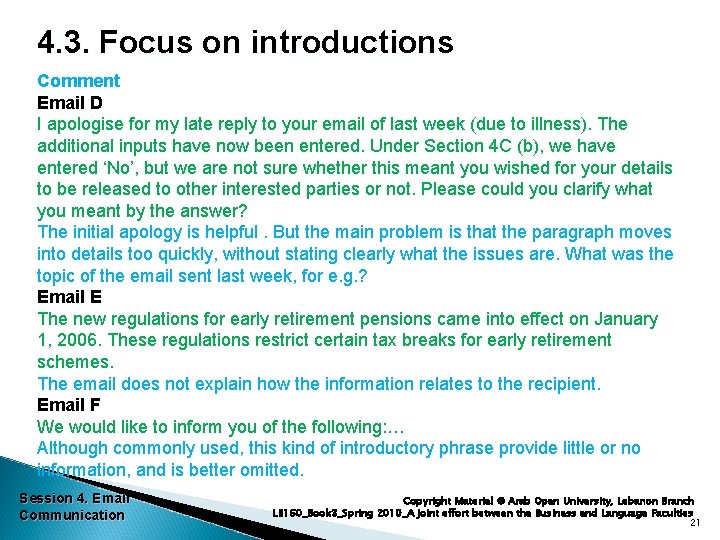
4. 3. Focus on introductions Comment Email D I apologise for my late reply to your email of last week (due to illness). The additional inputs have now been entered. Under Section 4 C (b), we have entered ‘No’, but we are not sure whether this meant you wished for your details to be released to other interested parties or not. Please could you clarify what you meant by the answer? The initial apology is helpful. But the main problem is that the paragraph moves into details too quickly, without stating clearly what the issues are. What was the topic of the email sent last week, for e. g. ? Email E The new regulations for early retirement pensions came into effect on January 1, 2006. These regulations restrict certain tax breaks for early retirement schemes. The email does not explain how the information relates to the recipient. Email F We would like to inform you of the following: … Although commonly used, this kind of introductory phrase provide little or no information, and is better omitted. Session 4. Email Communication Copyright Material © Arab Open University, Lebanon Branch LB 160_Book 3_Spring 2010_A joint effort between the Business and Language Faculties 21
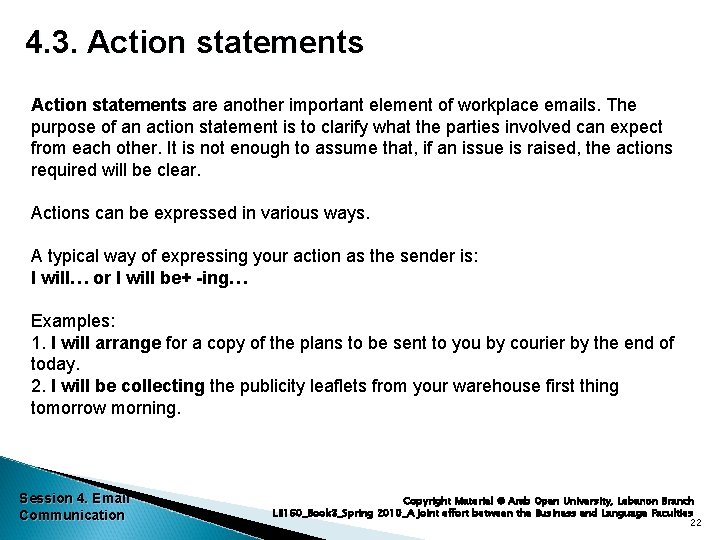
4. 3. Action statements are another important element of workplace emails. The purpose of an action statement is to clarify what the parties involved can expect from each other. It is not enough to assume that, if an issue is raised, the actions required will be clear. Actions can be expressed in various ways. A typical way of expressing your action as the sender is: I will… or I will be+ -ing… Examples: 1. I will arrange for a copy of the plans to be sent to you by courier by the end of today. 2. I will be collecting the publicity leaflets from your warehouse first thing tomorrow morning. Session 4. Email Communication Copyright Material © Arab Open University, Lebanon Branch LB 160_Book 3_Spring 2010_A joint effort between the Business and Language Faculties 22
4. 3. Action statements Typical ways of referring to the recipient’s action include a range of request expressions, such as: Please could you…? I understand that you will… I hope you will be able to… I look forward to + -ing… Examples 1. Please ensure that any requests for equipment you wish to purchase from this budget year are with me by midday, Friday 13 th July. 2. I look forward to hearing from you shortly. The following examples refer to possible action by both the sender and the recipient. 1. Please advise whether you would like me to go ahead and book accommodation for Thursday 12 th July. 2. If you don’t have a key for your desk, please let me know and I can order one for you. To understand also how emails messages can have various meanings, do activities 4. 6 and 4. 7, pp. 98 -99. Session 4. Email Communication Copyright Material © Arab Open University, Lebanon Branch LB 160_Book 3_Spring 2010_A joint effort between the Business and Language Faculties 23
4. 4. Other forms of communication In addition to email, many organisations use other forms of online communication to conduct their business, both internally and externally. Examples of these are forums and wikis. Moodle for example is one form of online communication tool that is designed for educational and academic purposes. Session 4. Email Communication Copyright Material © Arab Open University, Lebanon Branch LB 160_Book 3_Spring 2010_A joint effort between the Business and Language Faculties 24
- Slides: 24