
Session 35 Program Integrity Institutional and Program Eligibility
Session #35 Program Integrity: Institutional and Program Eligibility: Credit Hour and Clock-to-Credit Hour Conversion Fred Sellers U. S. Department of Education Note: Print slide 38 as a full page
Negotiated Rulemaking 2
Negotiated Rulemaking • Hearings and negotiations – June 2009 through January 2010 – No consensus • Notice of proposed rulemaking: June 18, 2010 – http: //edocket. access. gpo. gov/2010/pdf/2010 -14107. pdf – Credit hour provisions • Preamble: pp. 34810 -34812 • Proposed regulations: p. 34872, 34874 – Nearly 1, 200 comments on NPRM 3
Negotiated Rulemaking • Final regulations: October 29, 2010 – http: //edocket. access. gpo. gov/2010/pdf/2010 -26531. pdf – Credit hour provisions: • Preamble: pp. 66844 -66857 • Regulations: pp. 66946, 66949 -66950 – Effective date: July 1, 2011 • Technical corrections: April 13, 2011 – http: //ifap. ed. gov/fregisters/attachments/FR 041311 Progra m. Integrity. Issues. pdf 4
Definition 5
Regulations • For purposes of federal programs, the regulations: – Provide a definition of a credit hour or its equivalent; and – Establish consistent measure of eligibility for, and payments of, federal funds • The regulations do not preclude an institution using a different definition for academic or other purposes 6
Credit Hour Definition • An institutionally established equivalency of an amount of student work represented in intended learning outcomes and evidence of student achievement that reasonably approximates minimum measures Final Regulations § 600. 2, p. 66946 (preamble: pp. 66844 -66850) 7
Credit Hour Definition (cont. ) • Must approximate not less than— – For a semester or trimester hour, one hour of classroom and two hours out of class student work each week in approximately a 15 -week semester or trimester – For a quarter hour, one hour classroom and two hours out of class student work each week in a 10 - to 12 -week term quarter • Not required to use these ratios 8
Credit Hour Definition (cont. ) • Must approximate equivalent work for other academic activities as established by the institution, e. g. , lab work, internships, practica, studio work, and other academic work 9 9
Accrediting Agencies and State Agencies 10
Accrediting Agencies • Applies to agencies if accreditation is to enable institutions to establish Title IV, HEA program eligibility • Must conduct an effective review and evaluation of the reliability and accuracy of the institution’s assignment of credit hours as part of an agency’s review of an institution for initial accreditation or preaccreditation or renewal of accreditation 11 Final regulations § 602. 24(f)) , p. 66947 (preamble: pp. 66850 -66853) 11
Accrediting Agencies • Must review the institution’s— – Policies and procedures for determining the credit hours, as defined in 34 CFR 600. 2, that the institution awards for courses and programs, and – The application of the institution’s policies and procedures to its programs and coursework 12 12
Accrediting Agencies • Must make a reasonable determination of whether the institution's assignment of credit hours conforms to commonly accepted practice in higher education • May use sampling or other methods in the evaluation 13 13
Accrediting Agencies • Must take such actions that it deems appropriate to address any deficiencies that it identifies at an institution as part of its reviews and evaluations as it does in relation to other deficiencies it may identify • If an agency finds systemic noncompliance with the agency’s policies or significant noncompliance regarding one or more programs at the institution, must promptly notify the Secretary 14 14
Accrediting Agencies • Is no requirement that an accrediting agency or State agency make determinations about credit hours assigned to individual coursework though some agencies are providing such reviews • Is the institution’s responsibility to ensure its compliance with Title IV requirements 15 15
Credit Hour: State Agencies • Agencies for the approval of public postsecondary vocational institutions • Similar requirements as apply to accrediting agencies • Currently agencies in four States ‒New York ‒Pennsylvania ‒Oklahoma ‒Puerto Rico Final regulations: § 603. 24, p. 66947 (preamble: pp. 66853 -66854) 16
Clock-to-Credit Hour Conversion 17
General • § 668. 8(k) and (l) in eligible program definition • An exception to the credit-hour definition in § 600. 2 that applies for purposes of the Title IV, HEA programs • Modification of prior regulations – The requirements for when an institution must use clock hours – The standards for clock-to-credit hour conversions Final regulations: § 668. 8(k) and (l), p. 66949 -66950 (preamble: pp. 66854 -66857) 18
General • Section 668. 8(k) and (l) continues to apply to undergraduate gainful employment (GE) programs • For public and private nonprofit institutions, GE programs generally are— – Non-degree programs • For postsecondary vocational institutions proprietary institutions, GE programs generally are— – Degree programs, and – Non-degree programs 19
General • Detailed information on whether programs are considered GE programs – http: //ifap. ed. gov/dpcletters/GEN 1110. html – http: //ifap. ed. gov/eannouncements/052020 11 GETeacher. Cert. Program. html – http: //ifap. ed. gov/eannouncements/062411 Whatis. Gainful. Employment. GEAnnounce. Num ber 11. html – http: //ifap. ed. gov/eannouncements/070811 Determin. Whether. An. Edu. Prog. Is. GE. html – http: //ifap. ed. gov/eannouncements/083111 GEAnnounce 19 Prep. Courses. Not. GEProg. html 20
Clock Hour Only - § 668. 8(k)(2) • The program is required to be measured in clock hours for federal or state approval except if required for only a limited component of the program • Completing clock hours is a requirement for licensure to practice an occupation except if required for a limited component of the program • Note: If a state uses another measure but that measure represents clock hours, we consider the state to require clock hours 21
Clock Hour Only (cont. ) • A program that might otherwise qualify to do conversion to credit hours must be in clock hours for Title IV if the institution— – Does not continue to provide the clock hours that are the basis for the conversion to credit hours, and – Does not require attendance in those hours (apart from excused absences under § 668. 4(e)) • Checking attendance for the day does not satisfy this requirement 22
Clock Hour Only: Not Eligible for Conversion – (cont. ) • The credit hours awarded are not in compliance with the definition of a credit hour in § 600. 2 23
No Conversion Required - § 668. 8(k)(1) • Unless § 668. 8(k)(2) applies, an undergraduate GE program may use credit hours as defined in § 600. 2 without applying the conversion formula if one of two conditions is met • Condition #1 is that the GE program is at least two academic years in length and provides an associate degree, a bachelor's degree, an undergraduate professional degree, or an equivalent undergraduate degree as determined by the Secretary 24
No Conversion Required (cont. ) • Condition #2 is that the GE program is an undergraduate non-degree program with— ‒ Each course in the program being fully acceptable toward a degree program at the institution, and ‒ The institution being able to demonstrate that students enroll in, and graduate from, that degree program 25
No Conversion Required (cont. ) • A GE program not meeting condition #1 or #2 must use either— – The conversion formula, or – Clock hours • A program may always use clock hours • If using the conversion formula— – The program must be eligible to use it, and – The conversion must be properly implemented 26
New Conversion Ratios - § 668. 8(l)(1) • Ratios – One semester or trimester credit hour is equal to at least 37. 5 clock hours – One quarter credit hour is equal to at least 25 clock hours 27
New Conversion Ratios – (cont. ) • Default option – Using these ratios based only on clock hours in class is always acceptable – Generally must apply by individual class or program activity 28
New Conversion Ratios Exception - § 668. 8(l)(2) • Full formula option – Option is an exception to new ratios – Option takes into account out-of-class work – Credit hours must meet new definition – Accreditor, or state approving agency, has identified no deficiencies • Out-of-class student work determination: Is based on individual coursework components, e. g. , classroom study versus practica with little outside study (NPRM, Preamble, p. 34810) 29
New Conversion Ratios Exception (cont. ) • Regardless, must meet these minimums: – One semester or trimester credit hour must include at least 30 clock hours – One quarter credit hour must include at least 20 clock hours • May need to use greater than 30 or 20 clock hours per semester or quarter hour if insufficient out-of-class student work in a course to support at least 37. 5 or 25 hours of student work per semester or quarter hour 30
Conversion Case Study (to semester hours) 31
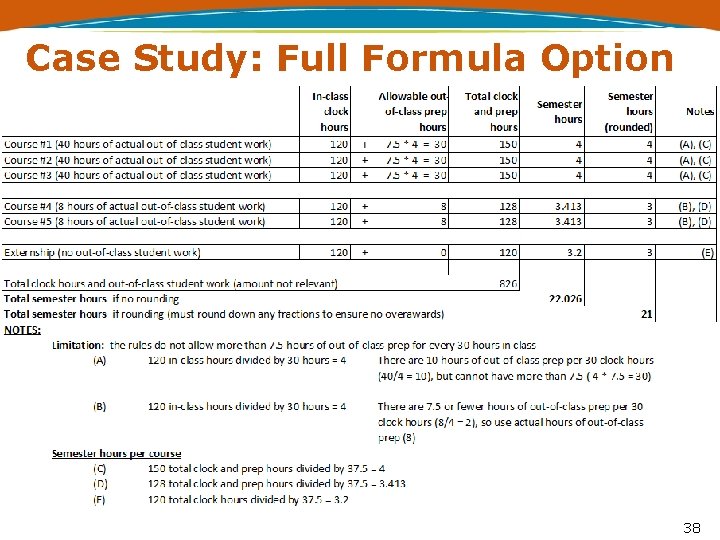
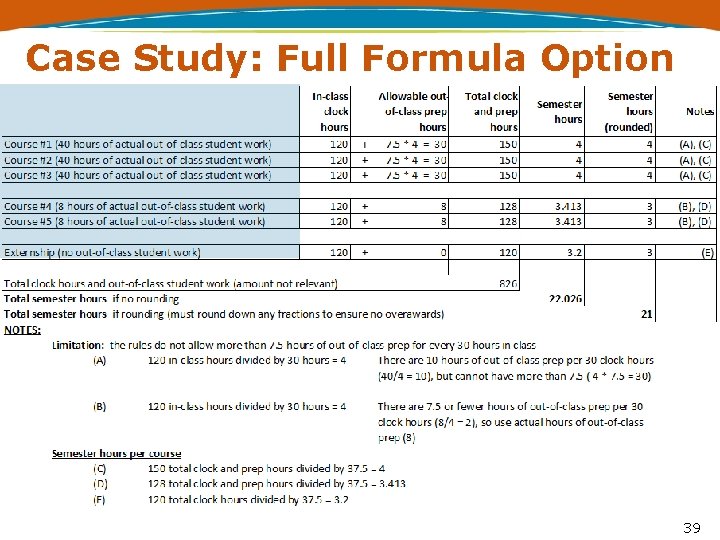
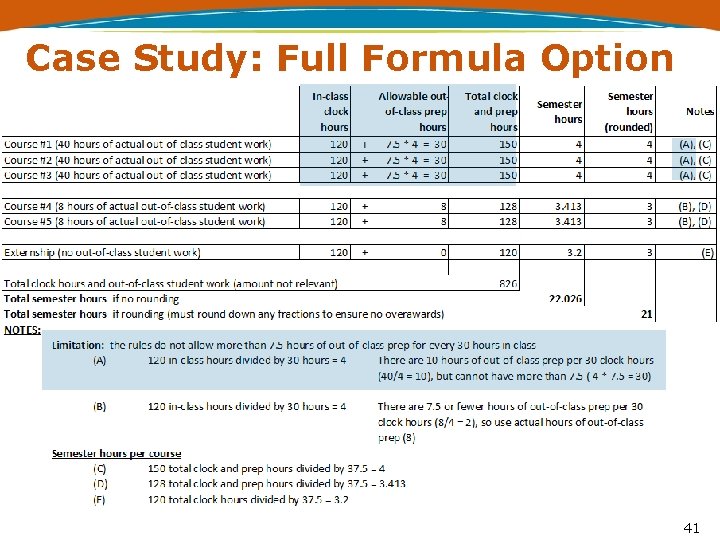
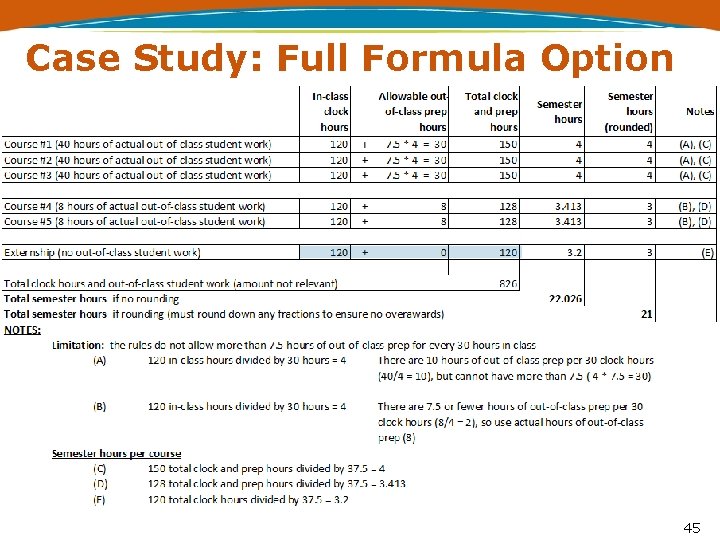
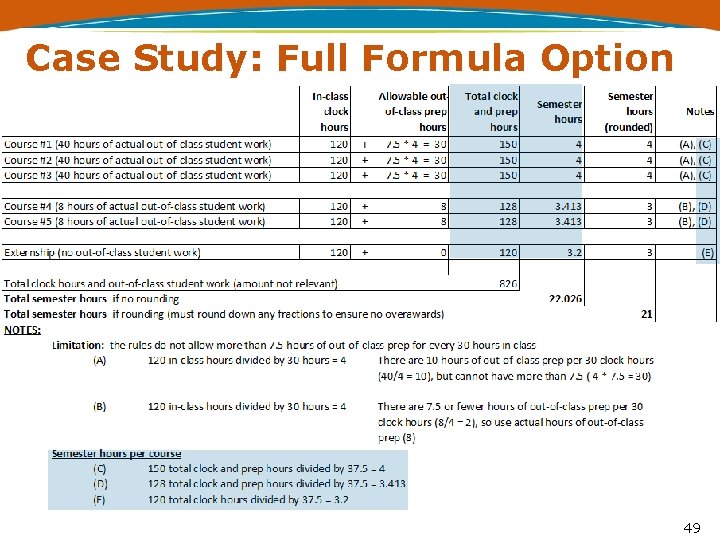
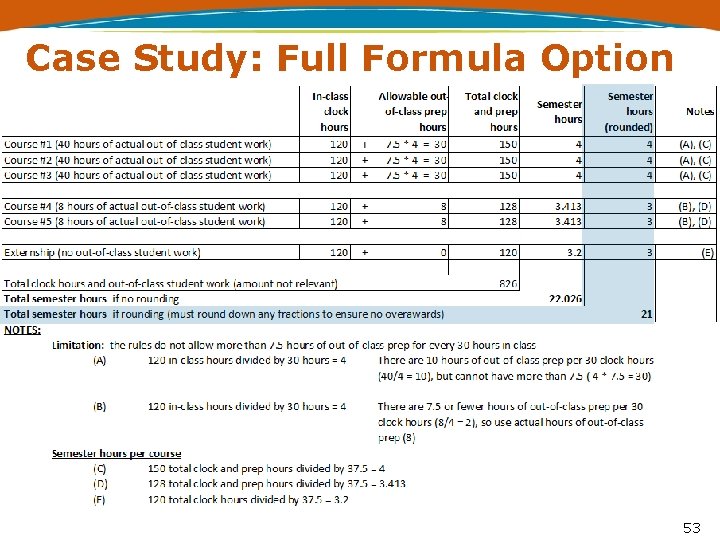
Case Study • A program with 720 clock hours consists of— – Five classroom courses with 120 clock hours each, and – A 120 clock hour externship with no out-ofclass student work • The institution determines that for— – The first three classroom courses, a student generally is required to perform 40 hours of out-of-class work for each course, and – The last two classroom courses have eight hours of out-of-class work for each course 32
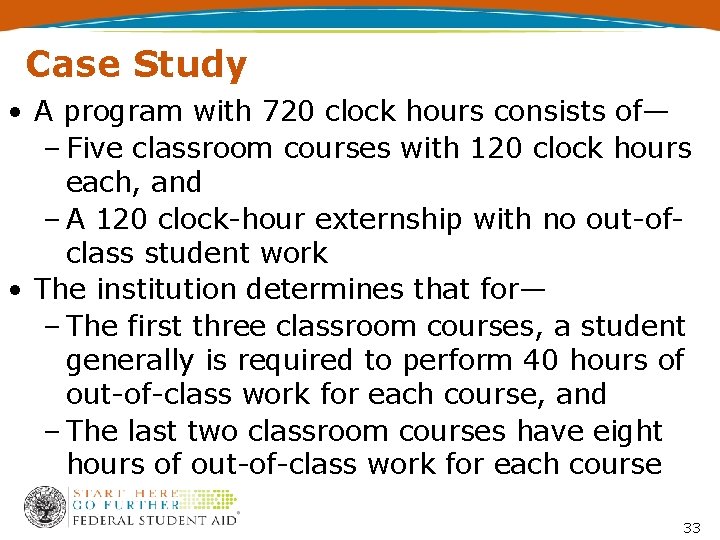
Case Study • A program with 720 clock hours consists of— – Five classroom courses with 120 clock hours each, and – A 120 clock-hour externship with no out-ofclass student work • The institution determines that for— – The first three classroom courses, a student generally is required to perform 40 hours of out-of-class work for each course, and – The last two classroom courses have eight hours of out-of-class work for each course 33
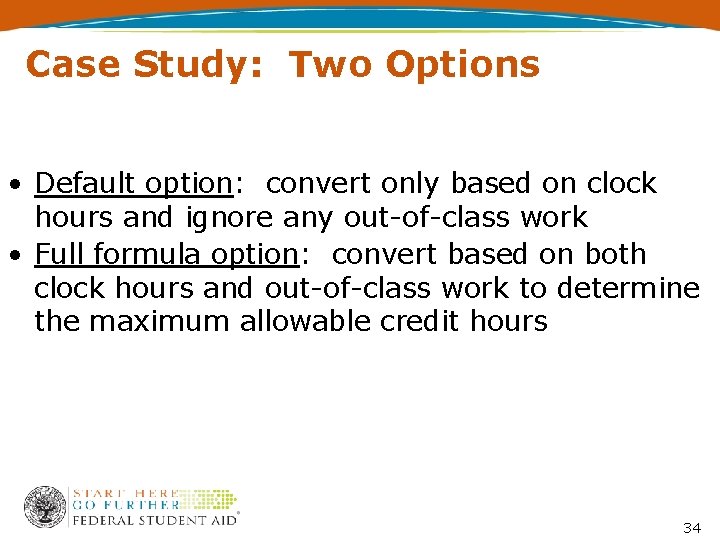
Case Study: Two Options • Default option: convert only based on clock hours and ignore any out-of-class work • Full formula option: convert based on both clock hours and out-of-class work to determine the maximum allowable credit hours 34
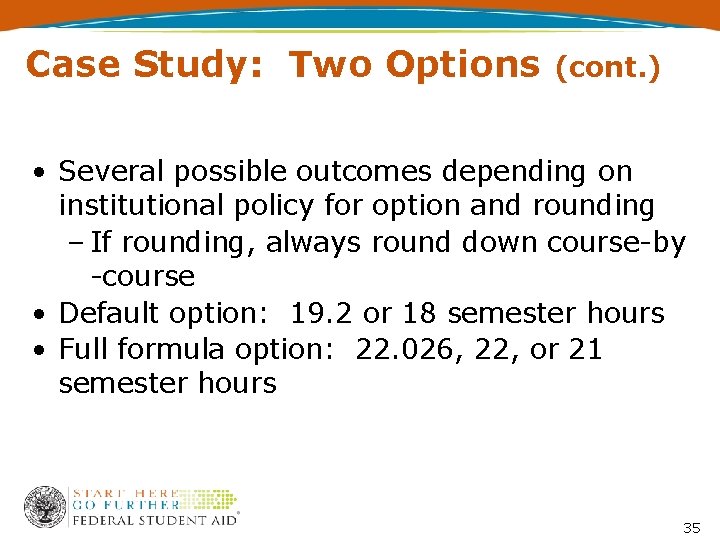
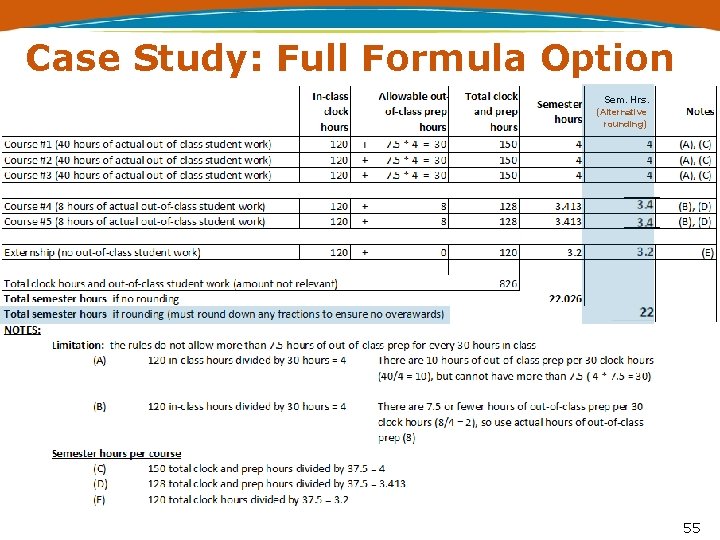
Case Study: Two Options (cont. ) • Several possible outcomes depending on institutional policy for option and rounding – If rounding, always round down course-by -course • Default option: 19. 2 or 18 semester hours • Full formula option: 22. 026, 22, or 21 semester hours 35
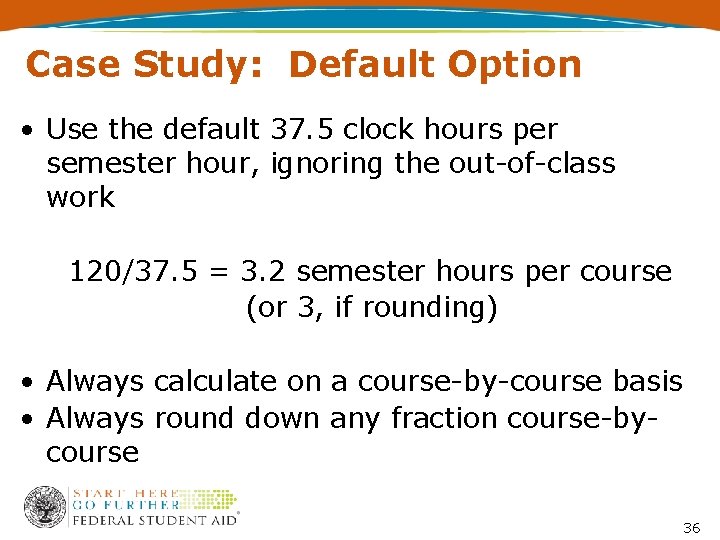
Case Study: Default Option • Use the default 37. 5 clock hours per semester hour, ignoring the out-of-class work 120/37. 5 = 3. 2 semester hours per course (or 3, if rounding) • Always calculate on a course-by-course basis • Always round down any fraction course-bycourse 36
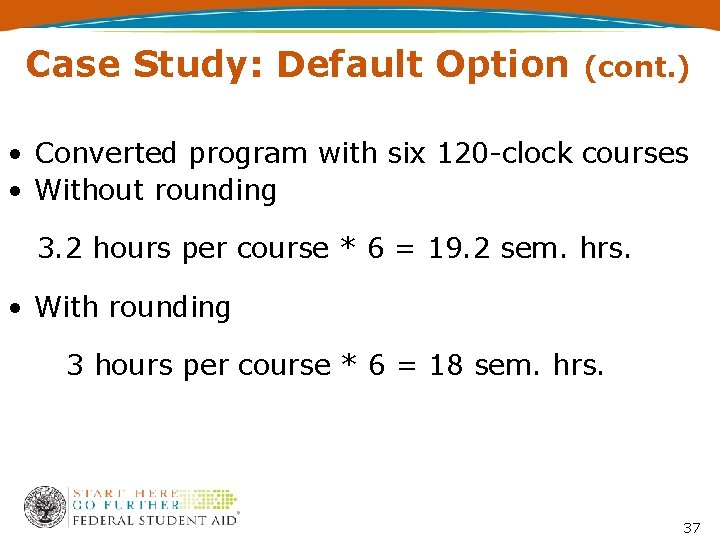
Case Study: Default Option (cont. ) • Converted program with six 120 -clock courses • Without rounding 3. 2 hours per course * 6 = 19. 2 sem. hrs. • With rounding 3 hours per course * 6 = 18 sem. hrs. 37
Case Study: Full Formula Option 38
Case Study: Full Formula Option 39
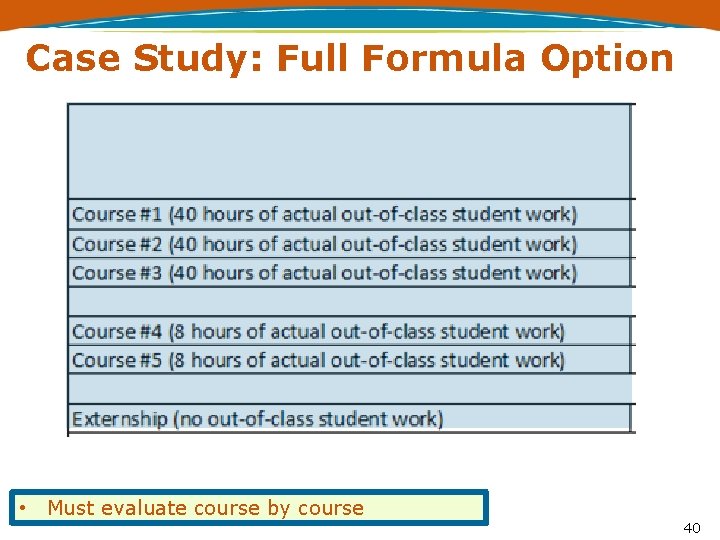
Case Study: Full Formula Option • Must evaluate course by course 40
Case Study: Full Formula Option 41
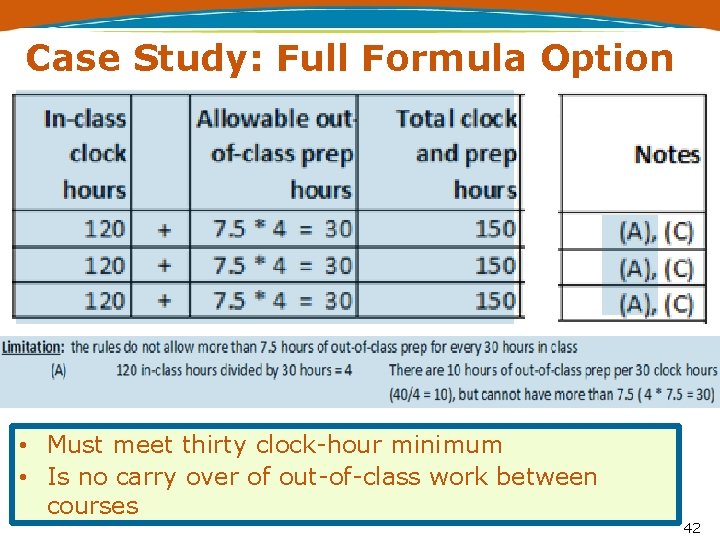
Case Study: Full Formula Option • Must meet thirty clock-hour minimum • Is no carry over of out-of-class work between courses 42
Case Study: Full Formula Option 43
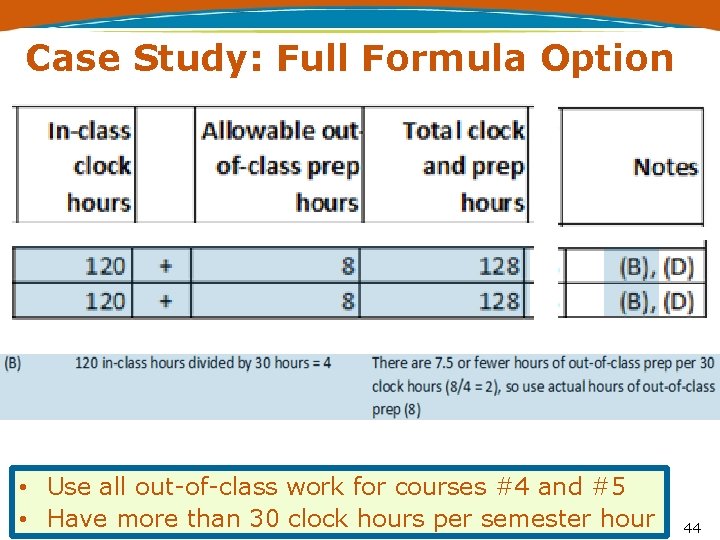
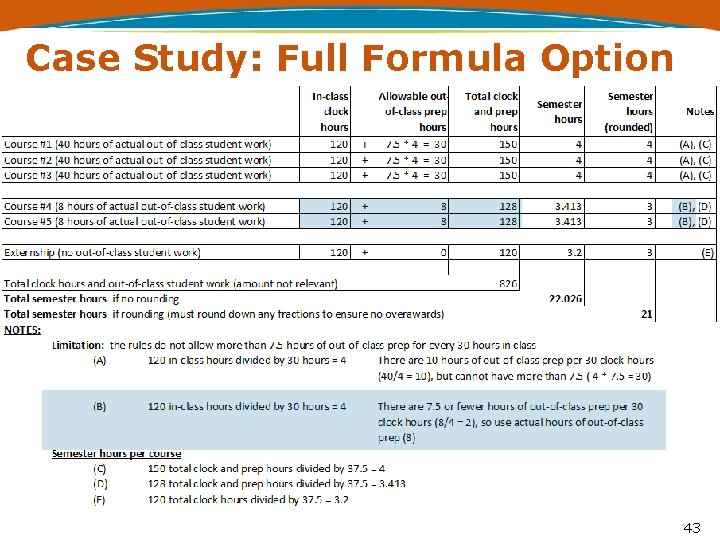
Case Study: Full Formula Option • Use all out-of-class work for courses #4 and #5 • Have more than 30 clock hours per semester hour 44
Case Study: Full Formula Option 45
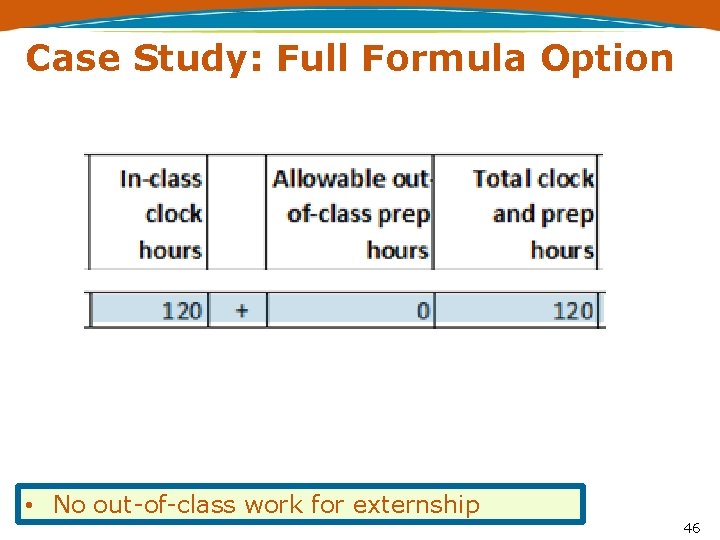
Case Study: Full Formula Option • No out-of-class work for externship 46
Case Study: Full Formula Option 47
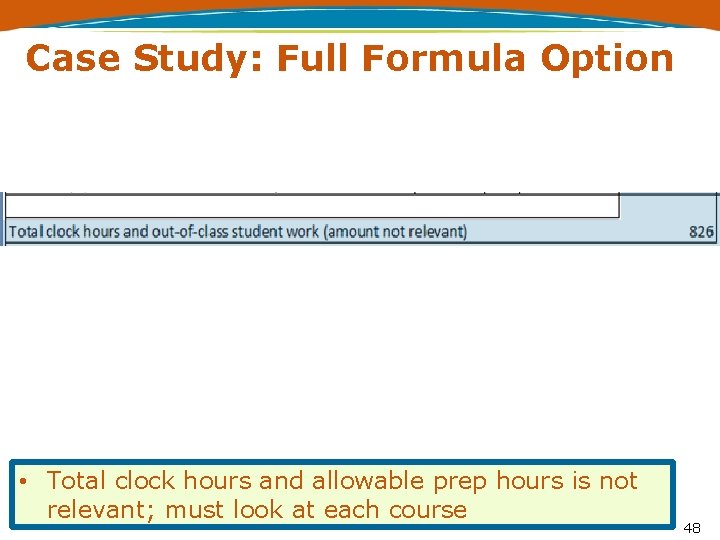
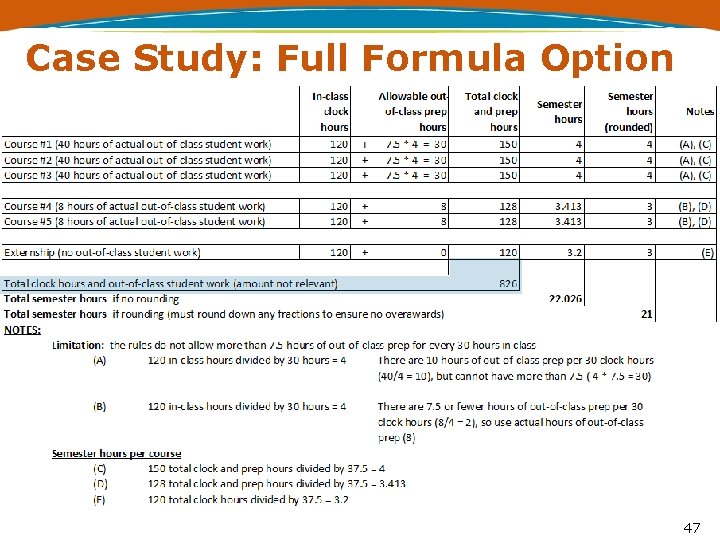
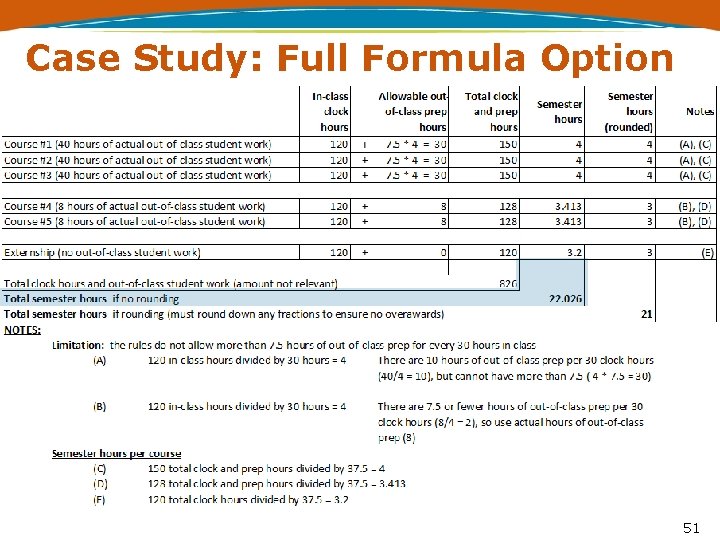
Case Study: Full Formula Option • Total clock hours and allowable prep hours is not relevant; must look at each course 48
Case Study: Full Formula Option 49
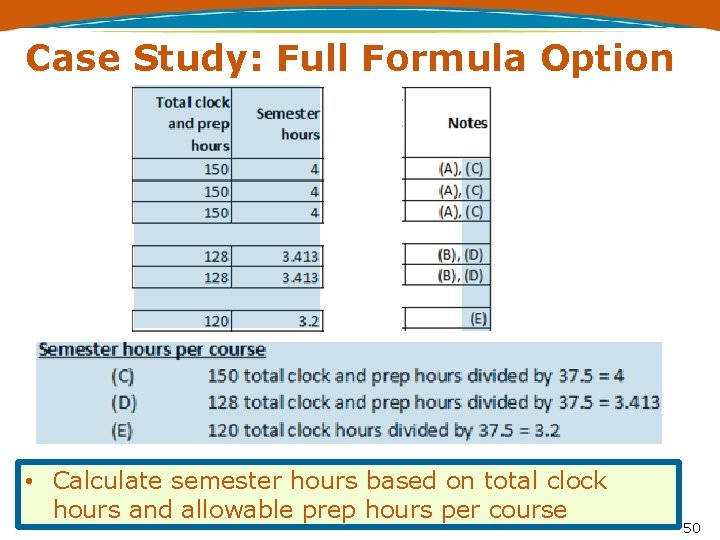
Case Study: Full Formula Option • Calculate semester hours based on total clock hours and allowable prep hours per course 50
Case Study: Full Formula Option 51
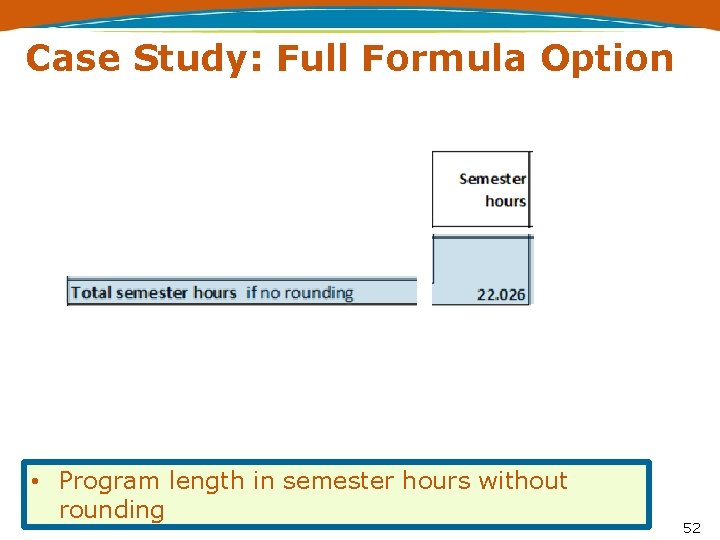
Case Study: Full Formula Option • Program length in semester hours without rounding 52
Case Study: Full Formula Option 53
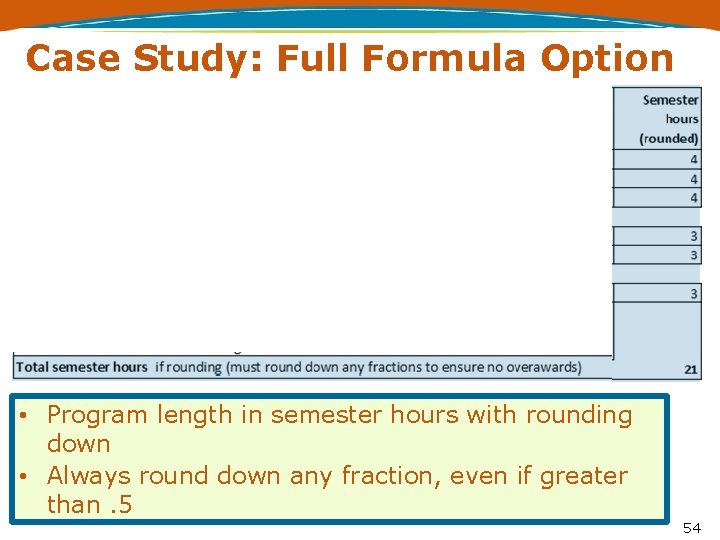
Case Study: Full Formula Option • Program length in semester hours with rounding down • Always round down any fraction, even if greater than. 5 54
Case Study: Full Formula Option Sem. Hrs. (Alternative rounding) 55
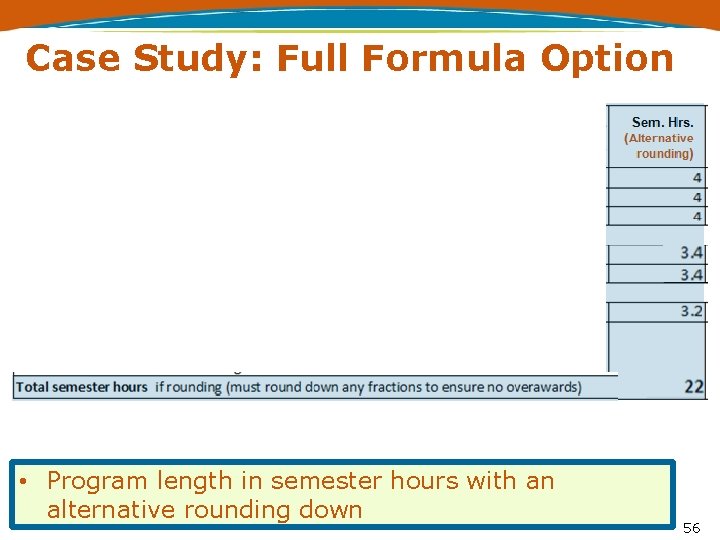
Case Study: Full Formula Option • Program length in semester hours with an alternative rounding down 56
Additional Resources and Information
OPE Website and DCLs • Access at either— – http: //www 2. ed. gov/policy/highered/reg/h earulemaking/2009/integrity-qa. html, or – Under IFAP Hot Topics: Program Integrity Information – Questions and Answers • Dear Colleague Letters – GEN-11 -06 58
E-App • Use your E-App if— – The information for a program on your ECAR has changed, or – You need to add programs that you were not previously required to report • You must update program information if— – The program previously used credit hours but must now uses clock hours, or – The number of credit hours has changed • For any questions about E-App reporting, contact your School Participation Team – http: //www. eligcert. ed. gov/ 59
E-App: Transition Options • Amended clock-to-credit hour regulations effective date: July 1, 2011 • Transition options for students attending a program prior to July 1— – Apply pre-July 1 regulations and policies until these students complete the program and amended regulations to students starting on or after July 1, or – Apply amended regulations to all students in the program in payment periods assigned to the 2011 -12 and subsequent award years 60
E-App: Transition Options • If you are teaching out students under the pre. July 1 regulations— – Add a program with new information, and – Retain the pre-July 1 program until all the students have finished it • When all students finish the pre-July 1 program, report an “end date” for that program • The two programs together would be ongoing GE program—no new GE program 61
Contact Information • Fred Sellers – Phone: 202 -502 -7502 – E-mail: fred. sellers@ed. gov – Fax: 202 -502 -7874 • FSA Regional Training Officers 62
- Slides: 62