
Session 3 Welcome To session 3 the first

- Slides: 20
Session 3 Welcome: To session 3 - the first learning sequence “ Introduction to Relational Model“ Recap : In the previous learning sequences, we discussed the EER model and its reduction to tables. Present learning: We shall explore the following topics: - Relational model. - Relation schema and instances. 1
Relational Model 2
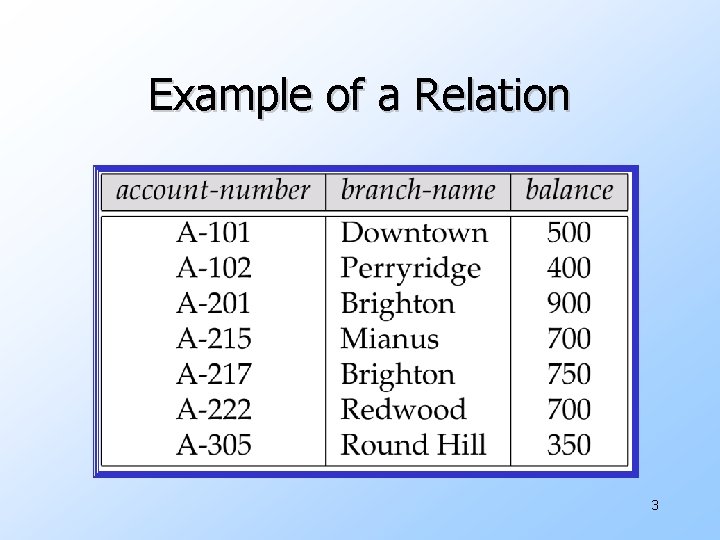
Example of a Relation 3
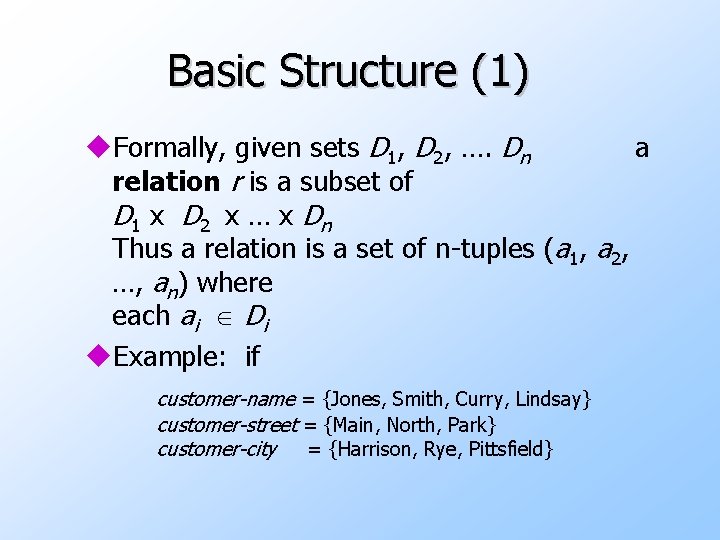
Basic Structure (1) u. Formally, given sets D 1, D 2, …. Dn a relation r is a subset of D 1 x D 2 x … x Dn Thus a relation is a set of n-tuples (a 1, a 2, …, an) where each ai Di u. Example: if customer-name = {Jones, Smith, Curry, Lindsay} customer-street = {Main, North, Park} customer-city = {Harrison, Rye, Pittsfield}
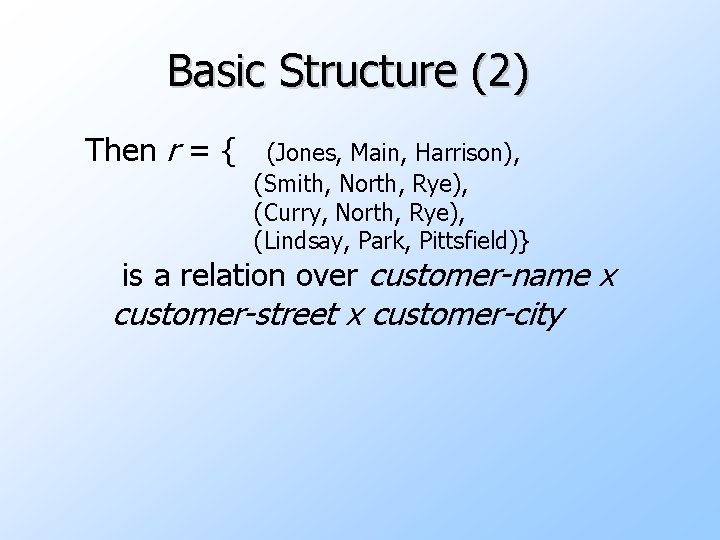
Basic Structure (2) Then r = { (Jones, Main, Harrison), (Smith, North, Rye), (Curry, North, Rye), (Lindsay, Park, Pittsfield)} is a relation over customer-name x customer-street x customer-city
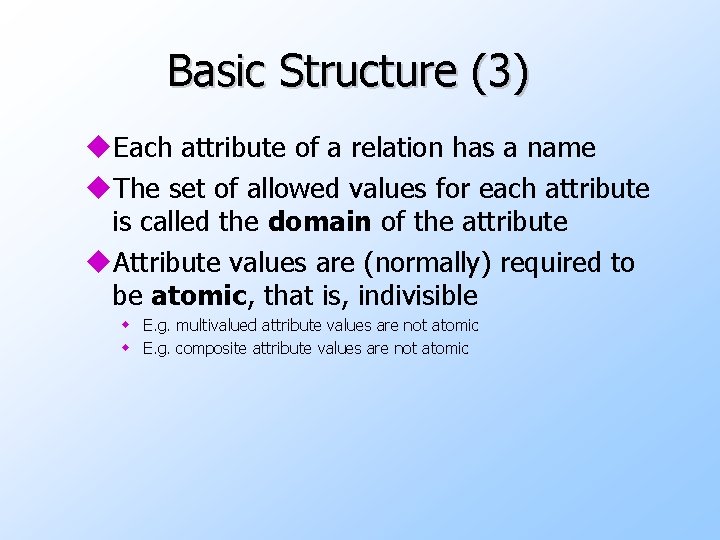
Basic Structure (3) u. Each attribute of a relation has a name u. The set of allowed values for each attribute is called the domain of the attribute u. Attribute values are (normally) required to be atomic, that is, indivisible w E. g. multivalued attribute values are not atomic w E. g. composite attribute values are not atomic
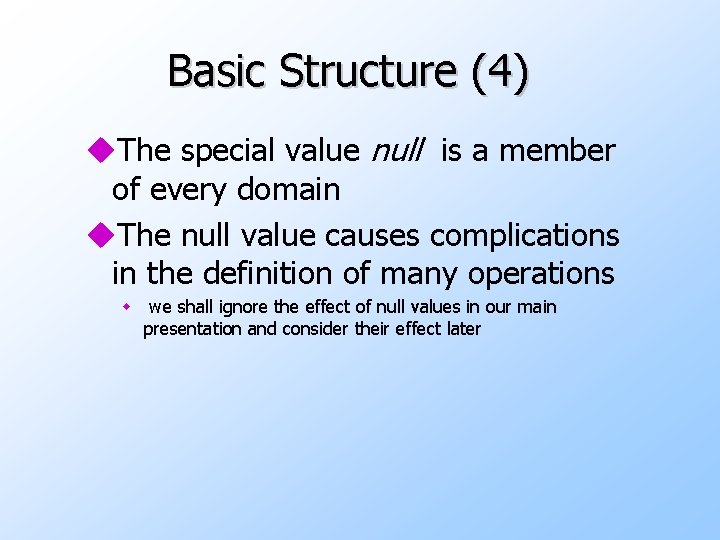
Basic Structure (4) u. The special value null is a member of every domain u. The null value causes complications in the definition of many operations w we shall ignore the effect of null values in our main presentation and consider their effect later
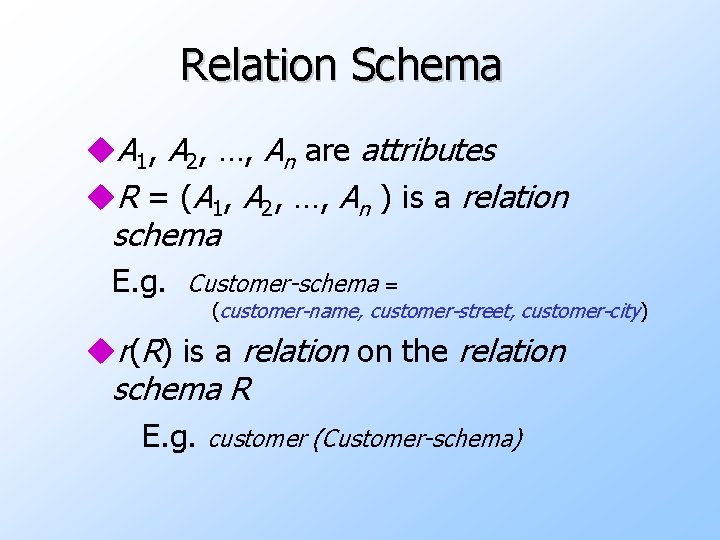
Relation Schema u. A 1, A 2, …, An are attributes u. R = (A 1, A 2, …, An ) is a relation schema E. g. Customer-schema = (customer-name, customer-street, customer-city) ur(R) is a relation on the relation schema R E. g. customer (Customer-schema)
Relation Instance u. The current values (relation instance) of a relation are specified by a table u. An element t of r is a tuple, represented by a row in a table
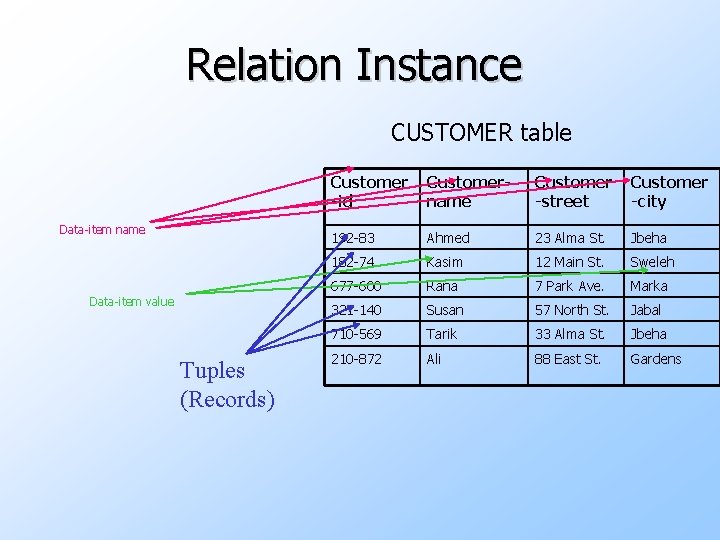
Relation Instance CUSTOMER table Data-item name Data-item value Tuples (Records) Customer -id Customername Customer -street Customer -city 192 -83 Ahmed 23 Alma St. Jbeha 182 -74 Kasim 12 Main St. Sweleh 677 -600 Rana 7 Park Ave. Marka 321 -140 Susan 57 North St. Jabal 710 -569 Tarik 33 Alma St. Jbeha 210 -872 Ali 88 East St. Gardens
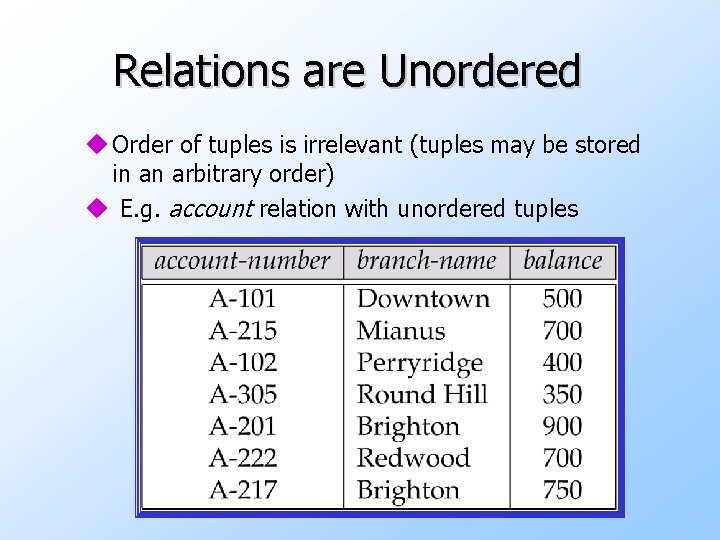
Relations are Unordered u Order of tuples is irrelevant (tuples may be stored in an arbitrary order) u E. g. account relation with unordered tuples
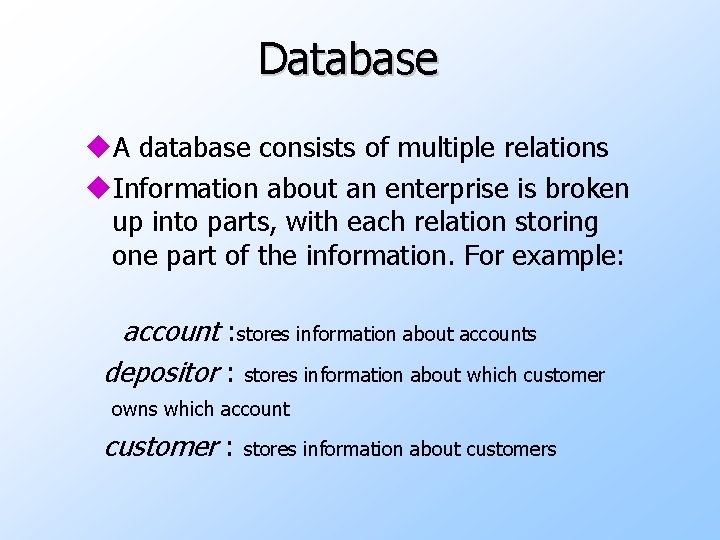
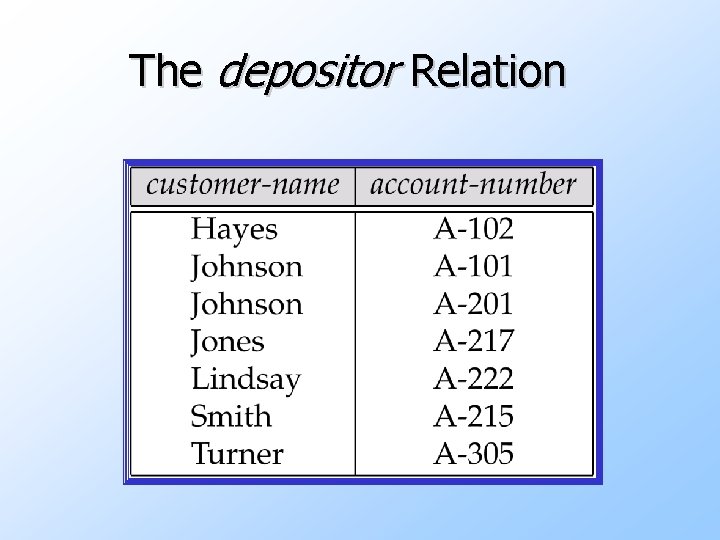
Database u. A database consists of multiple relations u. Information about an enterprise is broken up into parts, with each relation storing one part of the information. For example: account : stores information about accounts depositor : stores information about which customer owns which account customer : stores information about customers
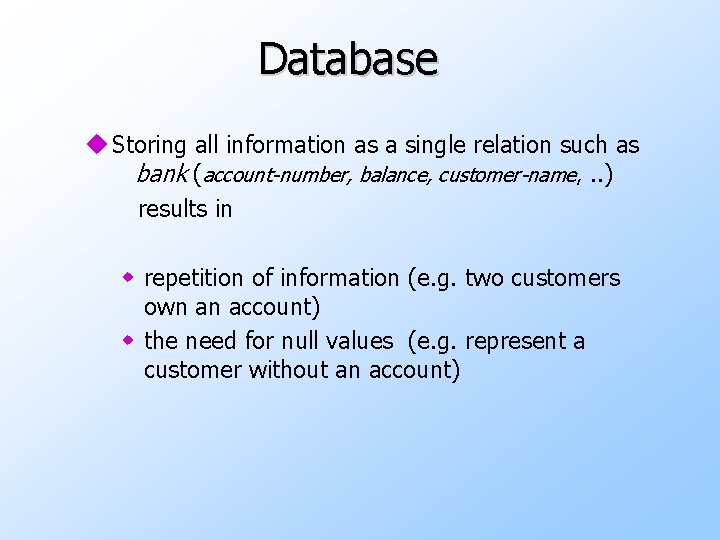
Database u Storing all information as a single relation such as bank (account-number, balance, customer-name, . . ) results in w repetition of information (e. g. two customers own an account) w the need for null values (e. g. represent a customer without an account)
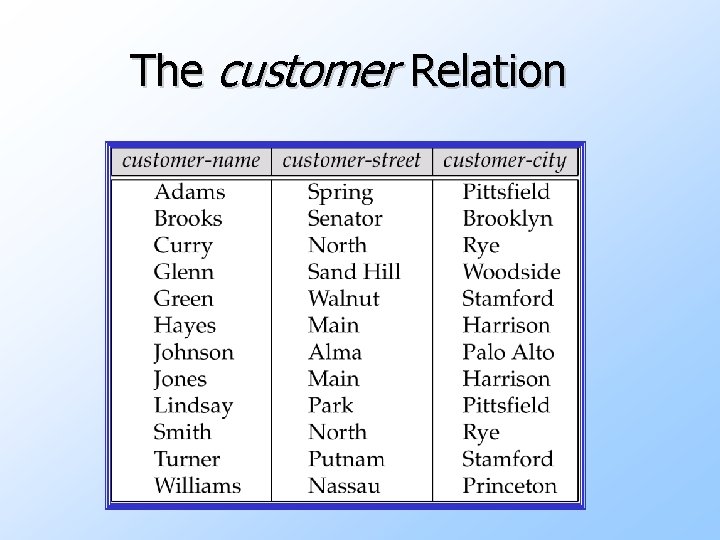
The customer Relation
The depositor Relation
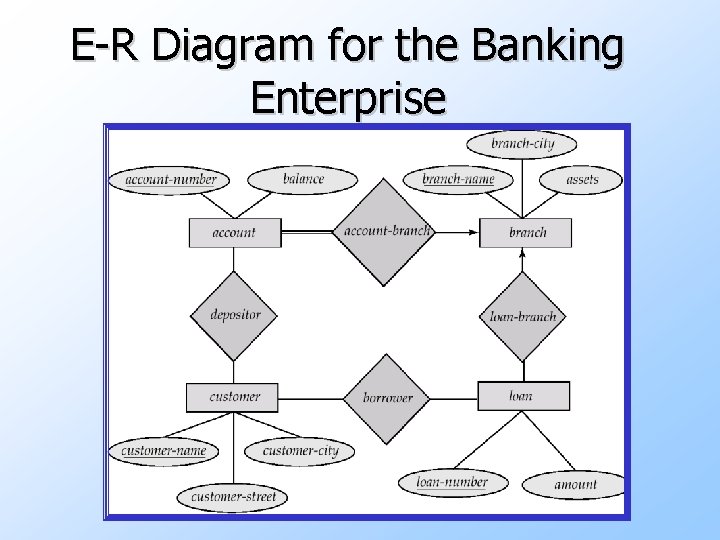
E-R Diagram for the Banking Enterprise
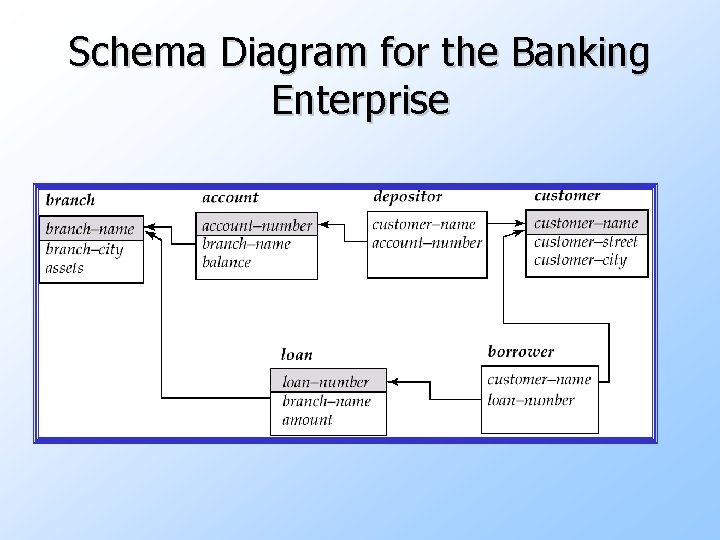
Schema Diagram for the Banking Enterprise
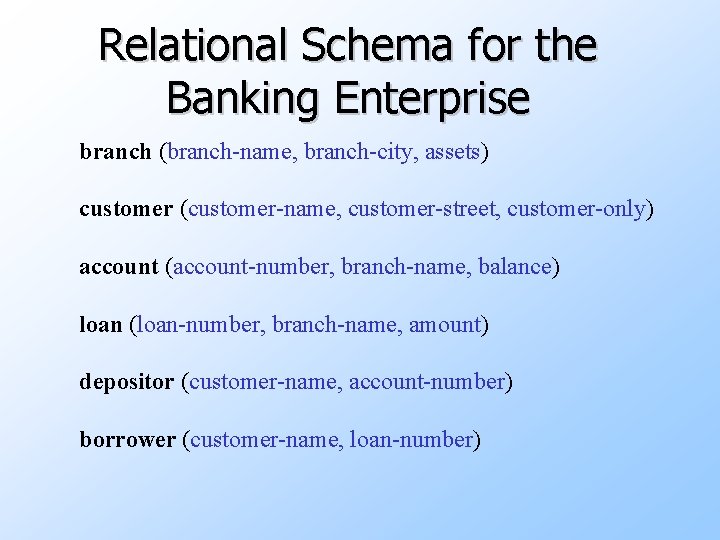
Relational Schema for the Banking Enterprise branch (branch-name, branch-city, assets) customer (customer-name, customer-street, customer-only) account (account-number, branch-name, balance) loan (loan-number, branch-name, amount) depositor (customer-name, account-number) borrower (customer-name, loan-number)
Reduction of an E-R Schema to Tables Summary: In this learning sequence, we discussed the relational model with its schema and instances. 19
END 20