
SESSION 3 Understanding Our Education System The U
- Slides: 20
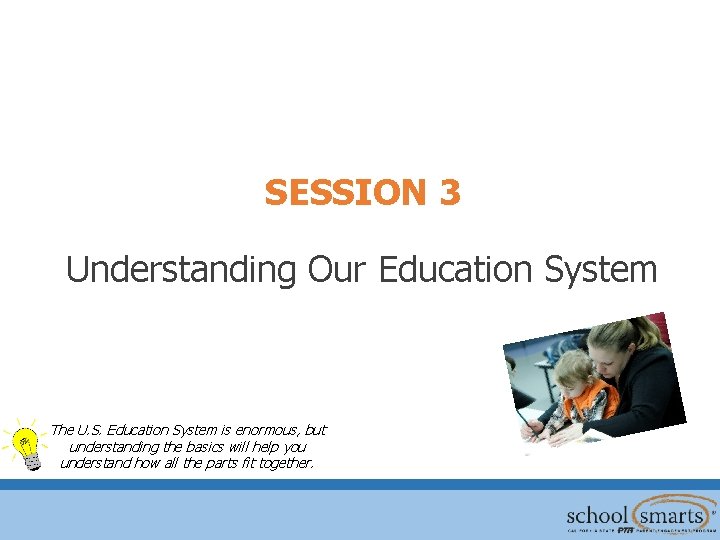
SESSION 3 Understanding Our Education System The U. S. Education System is enormous, but understanding the basics will help you understand how all the parts fit together.
Session 3 Objectives In this session, you will learn: 1. How California’s public school system is organized. 2. What your child will learn in school. 3. How your child’s progress will be measured. Recap: Has your knowledge of learning styles made a difference in your interactions with your child? What did you learn or try from Session 2? We’ll be taking a look at the “big picture” of public education.
How is the public school system organized? California’s public school system is a vast operation. • The state legislature and governor adopt the annual state education budget. • Each county has a County Office of Education and a County Superintendent that is responsible for providing services to schools. • The federal government also provides funding and sets national education policy. The core of public education is the local school district. • Each school district is governed by a Board of Education (school board) made up of community members elected by local voters. • A district superintendent also works with the school board as the top administrator for the district. Due to LCFF, local school districts play an even greater role in deciding how to spend funding from the state. PG. 1
How is the public school system organized? Schools are divided into several basic levels: • • • Preschool – not legally required, but preschool helps children become “school ready. ” Elementary School – Most children are eligible to enter kindergarten at age 5. For those whose 5 th birthday falls later than September 1, Transitional Kindergarten (TK) is an option. Middle and High School – offer both academic and elective classes from grade 6 -12. There also different types of schools that can be found in most cities/communities: • Public neighborhood schools – provide free instruction to all children from age 5 -18. • Public magnet schools – offer free, specialized programs in language, science, or arts. • Public charter schools – free public schools organized around a focused educational approach. • Private or independent schools – outside the public system and not supported by public funds. Title 1 schools are public schools in which at least 40% of students are from low-income families, and qualify for free or reduced lunches. PG. 1 -3
What will my child be learning in school? All public schools in California base their curriculum on content standards that describe what students are expected to learn as they advance from kindergarten through grade 12. Standards are important because they: ü set out a clear roadmap for learning to teachers, parents and students ü help ensure students receive a high quality education consistently, from school to school ü help teachers build the best curriculum lessons and classroom environments ü help parents set clear and realistic goals for their child ü are designed to prepare all students for success in college and the workforce Common Core State Standards make it possible for us to know where students stand in comparison to their peers in other states/countries. PG. 4
California’s Common Core State Standards In 2010, California adopted new standards for English Language Arts (ELA), English Language Development (ELD) and Math. These standards, called Common Core State Standards, help prepare students to be part of California’s future economy by building critical thinking and problem solving skills that can be applied to any context. The new standards increase focus on: • In-depth understanding of the material • Critical thinking and analytical skills • Creative solutions and applying learning to the real world (linked learning) • Connecting learning across different subject areas • Preparing students for success in college and careers Review the Parents’ Guide to Student Success on pages 21 -43 for an overview of what your child will learn in grades K-12. A list of full standards is available at: cde. ca. gov/re/cc PG. 4
How will my child’s progress be measured? Student progress is measured in multiple ways: ü teacher assigned projects ü homework ü written and oral quizzes and tests ü observation of student participation Academic progress is aligned with state standards and measured using a variety of scales, including those developed by individual teachers and school districts. Progress reports or report cards are sent to parents at regular intervals. These can include both letter grades as well as updates on their work habits and effort. Do you currently access your student’s grades online using a parent portal? See the handout on page 43 for more information. Parent portals are powerful tools that help both students and parents track progress. PG. 5
How will by child’s progress be measured? Student progress is measured in multiple ways: ü teacher assigned projects ü homework ü written and oral quizzes and tests ü observation of student participation How often do you get progress reports? Electronic grading systems and parent portals are powerful tools for both parents and students to monitor progress, including missing assignments, in real time. If your student is in any specialized programs (AVID, special ed. , ) check with their advisors regularly for updates on grades. TO DO: Register for your district’s parent portal before our next session! In middle/high school, letter grades and student Grade Point Average (GPA) become important measures used to determine placement in honors and advanced placement classes. Ask your child’s teacher or counselor about resources available to monitor student’s grades. PG. 5
Standardized Tests A standardized test is any type of test that: • requires all test takers to answer the same questions • is given and scored in a consistent manner which makes it possible to compare the performance of different students. California conducts annual standardized testing, under the umbrella of California Assessment of Student Performance (CAASSP). The most comprehensive of these tests is known as Smarter Balanced Assessments (SBA). • used to assess proficiency in selected Common Core State Standards for language arts and math. • conducted online and taken by all students in grades 3 -8 and 11, with modifications for English language learners and students with disabilities. • designed to be computer adaptive – questions get harder when students answer correctly, and easier when they answer incorrectly, in order to provide a very customized assessment. As a parent, you will receive a breakdown of your students Smarter Balanced test results. PG. 5 -6
Other important tests… California Physical Fitness Test (PFT): Taken by all students in grades 5, 7, and 9. This test helps students, teachers and parents become aware of the current levels of physical fitness and encourages life-long habits of regular physical activity. Some students may also take these tests: California English Language Development Test (CELDT): given to all newly enrolled students whose primary language is not English. High School Equivalency Tests (HSE): California residents over 18 (in some cases 17) who are not physically attending school can take an exam to demonstrate they have the academic skills needed to graduation from high school. These exams are administered through testing centers for a fee. Speak to your child’s teacher or counselor if you have questions about testing or results. PG. 7
What are the laws that govern our public schools? In California, education policies and other decisions are made by two bodies: • The State Board of Education appointed by the governor • California Department of Education, headed by the superintendent of public instruction. Every Student Succeeds Act (ESSA): Enacted by Congress in December 2015, this law redefines the role that the federal government plays and moves key decisionmaking authority to states and local communities. Major provisions include: • State control on education standards with empowerment to create their own accountability systems • Provides greater funding flexibility to enhance support for students and schools (LCFF) • Helps states improve teacher and administrator quality • Supports and targets funds to at-risk children and families • Maintains and strengthens critical programs for the lowest 5% The ESSA explicitly requires that families be involved in developing and implementing education plans. Your voice matters! PG. 7 -8
How can parents evaluate their school’s performance? Information on all schools is provided in annual reports prepared by the California Department of Education. The School Accountability Report Card (SARC): By law, every school must provide information to parents and the community such as: ü Characteristics of school population ü School safety and learning climate ü Academic performance ü Graduation and dropout rates ü Class sizes ü Curriculum and instruction ü Fiscal and spending matters You can find your school’s SARC at sarconline. org PG. 9
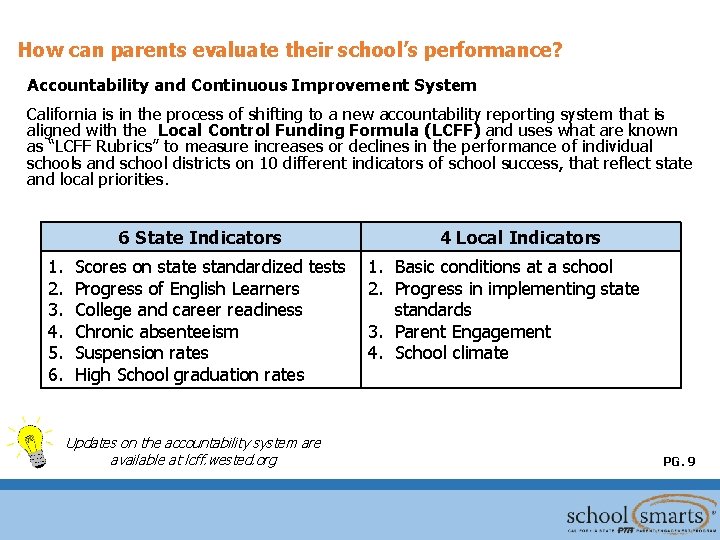
How can parents evaluate their school’s performance? Accountability and Continuous Improvement System California is in the process of shifting to a new accountability reporting system that is aligned with the Local Control Funding Formula (LCFF) and uses what are known as “LCFF Rubrics” to measure increases or declines in the performance of individual schools and school districts on 10 different indicators of school success, that reflect state and local priorities. 6 State Indicators 1. 2. 3. 4. 5. 6. Scores on state standardized tests Progress of English Learners College and career readiness Chronic absenteeism Suspension rates High School graduation rates Updates on the accountability system are available at lcff. wested. org 4 Local Indicators 1. Basic conditions at a school 2. Progress in implementing state standards 3. Parent Engagement 4. School climate PG. 9
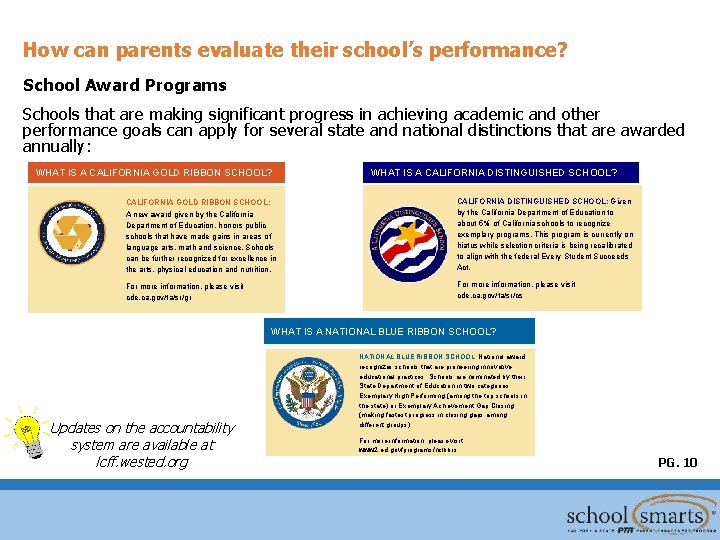
How can parents evaluate their school’s performance? School Award Programs Schools that are making significant progress in achieving academic and other performance goals can apply for several state and national distinctions that are awarded annually: WHAT IS A CALIFORNIA GOLD RIBBON SCHOOL? WHAT IS A CALIFORNIA DISTINGUISHED SCHOOL? CALIFORNIA GOLD RIBBON SCHOOL: A new award given by the California Department of Education, honors public schools that have made gains in areas of language arts, math and science. Schools can be further recognized for excellence in the arts, physical education and nutrition. CALIFORNIA DISTINGUISHED SCHOOL: Given by the California Department of Education to about 5% of California schools to recognize exemplary programs. This program is currently on hiatus while selection criteria is being recalibrated to align with the federal Every Student Succeeds Act. For more information, please visit cde. ca. gov/ta/sr/gr For more information, please visit cde. ca. gov/ta/sr/cs WHAT IS A NATIONAL BLUE RIBBON SCHOOL? Updates on the accountability system are available at lcff. wested. org NATIONAL BLUE RIBBON SCHOOL: National award recognizes schools that are pioneering innovative educational practices. Schools are nominated by their State Department of Education in two categories: Exemplary High Performing (among the top schools in the state) or Exemplary Achievement Gap Closing (making fastest progress in closing gaps among different groups). For more information, please visit www 2. ed. gov/programs/nclbbrs PG. 10
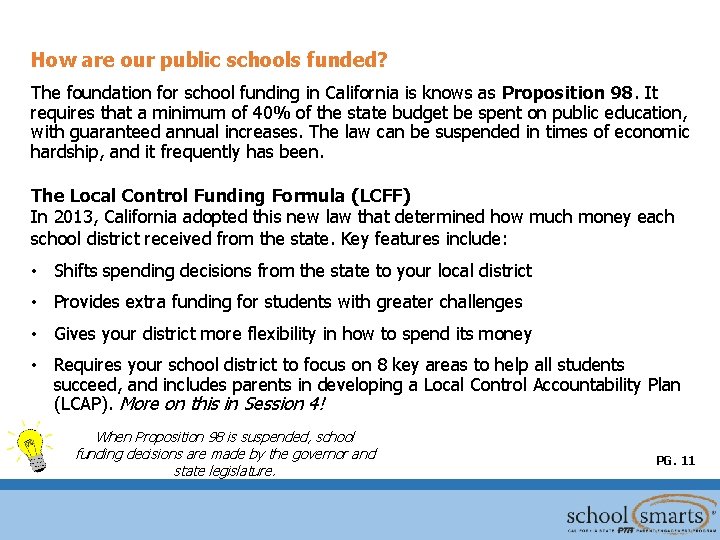
How are our public schools funded? The foundation for school funding in California is knows as Proposition 98. It requires that a minimum of 40% of the state budget be spent on public education, with guaranteed annual increases. The law can be suspended in times of economic hardship, and it frequently has been. The Local Control Funding Formula (LCFF) In 2013, California adopted this new law that determined how much money each school district received from the state. Key features include: • Shifts spending decisions from the state to your local district • Provides extra funding for students with greater challenges • Gives your district more flexibility in how to spend its money • Requires your school district to focus on 8 key areas to help all students succeed, and includes parents in developing a Local Control Accountability Plan (LCAP). More on this in Session 4! When Proposition 98 is suspended, school funding decisions are made by the governor and state legislature. PG. 11
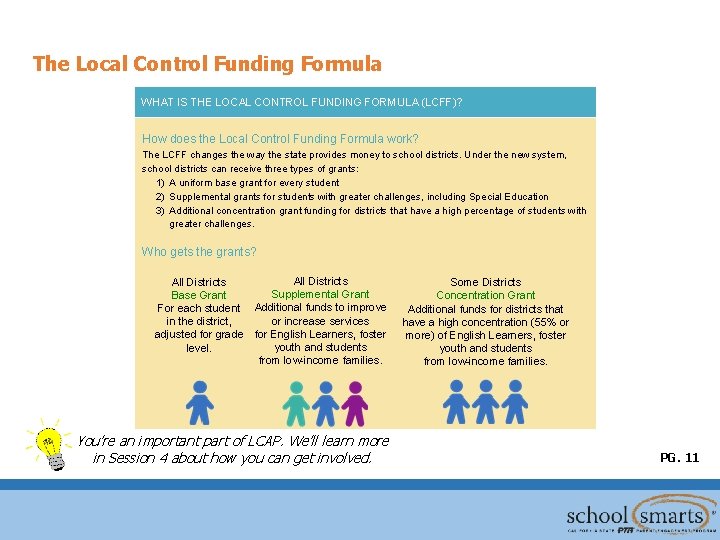
The Local Control Funding Formula WHAT IS THE LOCAL CONTROL FUNDING FORMULA (LCFF)? How does the Local Control Funding Formula work? The LCFF changes the way the state provides money to school districts. Under the new system, school districts can receive three types of grants: 1) A uniform base grant for every student 2) Supplemental grants for students with greater challenges, including Special Education 3) Additional concentration grant funding for districts that have a high percentage of students with greater challenges. Who gets the grants? All Districts Supplemental Grant Base Grant For each student Additional funds to improve or increase services in the district, adjusted for grade for English Learners, foster youth and students level. from low-income families. You’re an important part of LCAP. We’ll learn more in Session 4 about how you can get involved. Some Districts Concentration Grant Additional funds for districts that have a high concentration (55% or more) of English Learners, foster youth and students from low-income families. PG. 11
How are our public schools funded? Other funds for schools In addition to money provided by the state and federal government, K-12 funding can come from multiple sources including foundations, grants, investments, donations and school fundraising activities. Additional funds come from locally approved school bonds, parcel taxes and other ballot measures, as well as the state lottery, businesses and other private sources. How does California’s school funding compare with other states? For more than three decades, California has funded its public schools at lower levels than the national average. California also ranked among the five lowest states in terms of the percentage of state and local taxable resources spent on K-12 education. Even as the LCFF is fully implemented, school funding is projected to be below the national average. PG. 12 -13
Session 3 Wrap-Up and Homework We’ve covered a lot of information, but now the system can work for you! • Understanding the basics of the U. S. education system will help you understand how the different parts fit together. • It’s worth your time to become familiar with the Common Core State Standards. Knowing what your child is expected to learn will help you provide the best support for their success. • While it’s appropriate for you to focus most of your attention on what is happening at your child’s school, this bigger picture can help make an impact for all children. Try some standards based activities with your child. Check out khanacademy. org/commoncore for some ideas. Our next academy date is: Next week, we’ll learn about how our local school system is structured! PG. 14
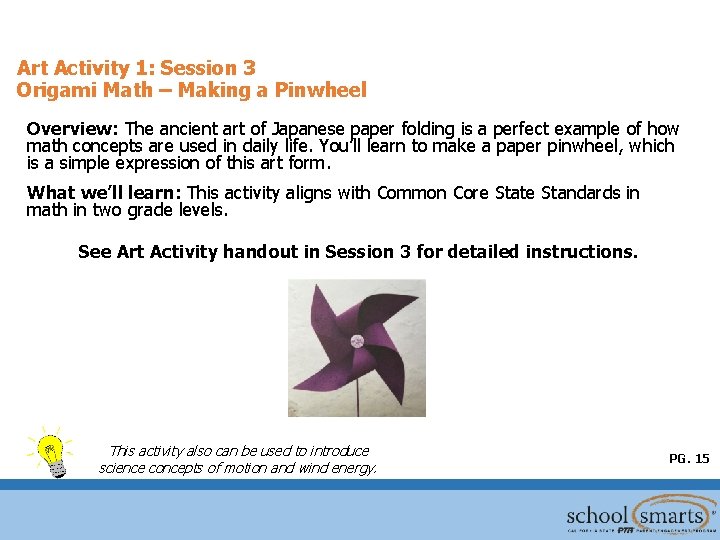
Art Activity 1: Session 3 Origami Math – Making a Pinwheel Overview: The ancient art of Japanese paper folding is a perfect example of how math concepts are used in daily life. You’ll learn to make a paper pinwheel, which is a simple expression of this art form. What we’ll learn: This activity aligns with Common Core State Standards in math in two grade levels. See Art Activity handout in Session 3 for detailed instructions. This activity also can be used to introduce science concepts of motion and wind energy. PG. 15
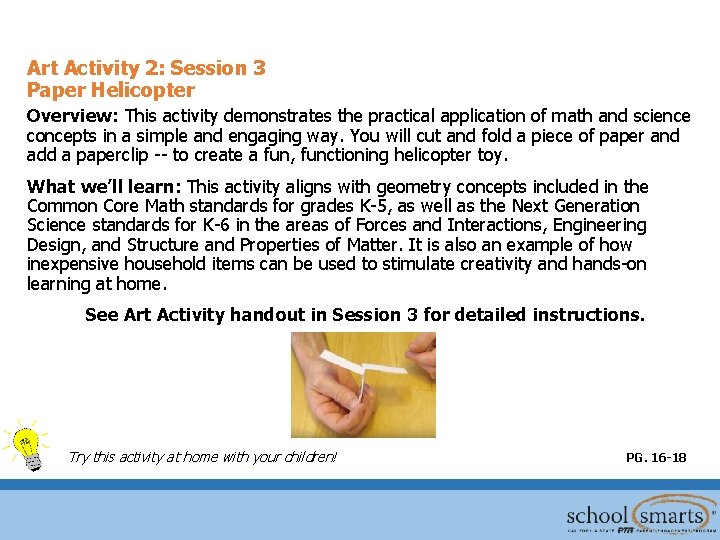
Art Activity 2: Session 3 Paper Helicopter Overview: This activity demonstrates the practical application of math and science concepts in a simple and engaging way. You will cut and fold a piece of paper and add a paperclip -- to create a fun, functioning helicopter toy. What we’ll learn: This activity aligns with geometry concepts included in the Common Core Math standards for grades K-5, as well as the Next Generation Science standards for K-6 in the areas of Forces and Interactions, Engineering Design, and Structure and Properties of Matter. It is also an example of how inexpensive household items can be used to stimulate creativity and hands-on learning at home. See Art Activity handout in Session 3 for detailed instructions. Try this activity at home with your children! PG. 16 -18