
Session 3 The TEEB Approach TEEB Training Using
Session 3: The ‘TEEB Approach’ ©TEEB Training
Using Economic Information to Improve Policy Coherence; An Introduction ©TEEB: : TEEB “Mofilm 3 rd prize” You. Tube ©TEEB Training
TEEB Origins and Genesis q Founded on the (MA) concept of ecosystem services for human well-being, under-pinned by biodiversity q Focus on underlying economic drivers of ecosystem decline and mainstreaming into economic decisions q Fill gap in economic evidence provided by the MA q Inspired by the Stern Review’s economic arguments for action on climate change ©TEEB Training
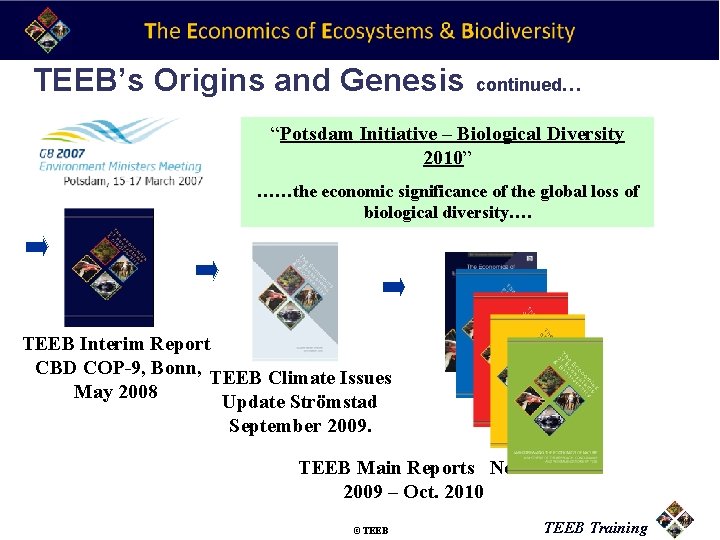
TEEB’s Origins and Genesis continued… “Potsdam Initiative – Biological Diversity 2010” ……the economic significance of the global loss of biological diversity…. TEEB Interim Report CBD COP-9, Bonn, TEEB Climate Issues May 2008 Update Strömstad September 2009. TEEB Main Reports Nov. 2009 – Oct. 2010 ©TEEB Training
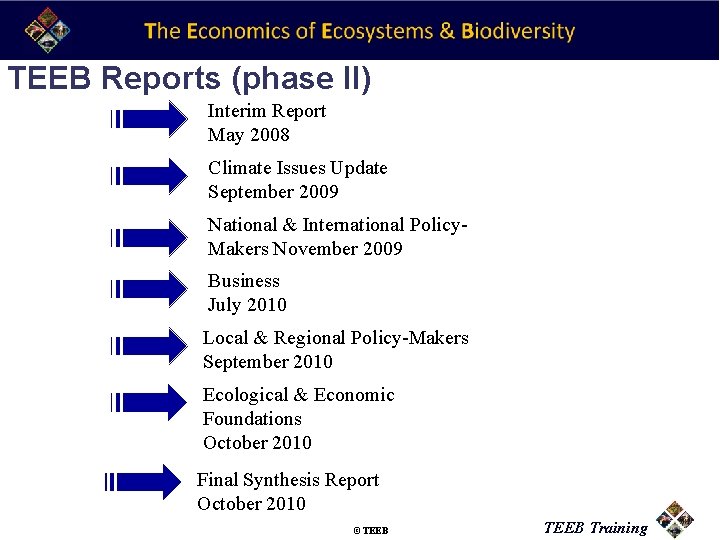
TEEB Reports (phase II) Interim Report May 2008 Climate Issues Update September 2009 National & International Policy. Makers November 2009 Business July 2010 Local & Regional Policy-Makers September 2010 Ecological & Economic Foundations October 2010 Final Synthesis Report October 2010 ©TEEB Training
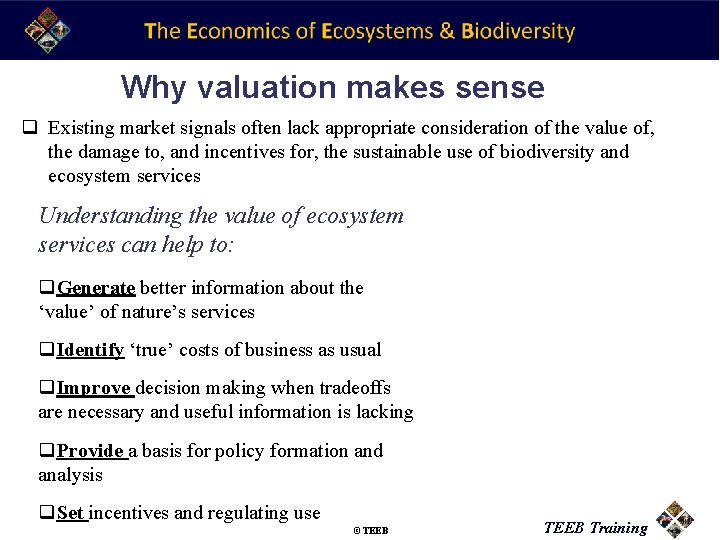
Why valuation makes sense q Existing market signals often lack appropriate consideration of the value of, the damage to, and incentives for, the sustainable use of biodiversity and ecosystem services Understanding the value of ecosystem services can help to: q. Generate better information about the ‘value’ of nature’s services q. Identify ‘true’ costs of business as usual q. Improve decision making when tradeoffs are necessary and useful information is lacking q. Provide a basis for policy formation and analysis q. Set incentives and regulating use ©TEEB Training
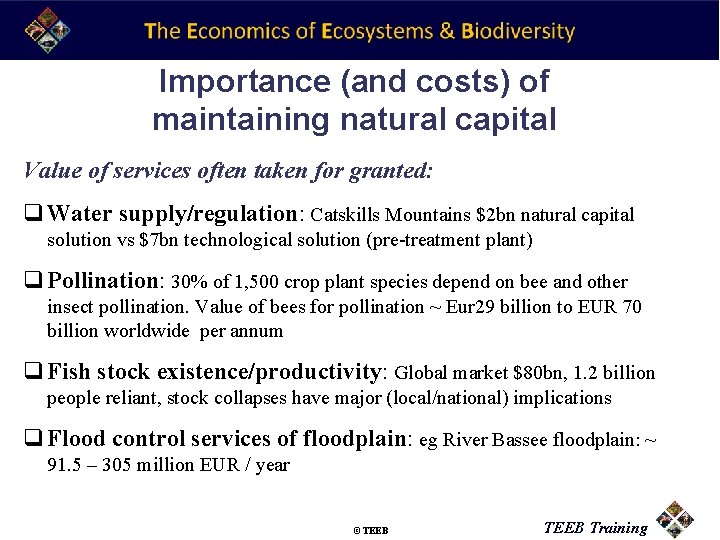
Importance (and costs) of maintaining natural capital Value of services often taken for granted: q Water supply/regulation: Catskills Mountains $2 bn natural capital solution vs $7 bn technological solution (pre-treatment plant) q Pollination: 30% of 1, 500 crop plant species depend on bee and other insect pollination. Value of bees for pollination ~ Eur 29 billion to EUR 70 billion worldwide per annum q Fish stock existence/productivity: Global market $80 bn, 1. 2 billion people reliant, stock collapses have major (local/national) implications q Flood control services of floodplain: eg River Bassee floodplain: ~ 91. 5 – 305 million EUR / year ©TEEB Training
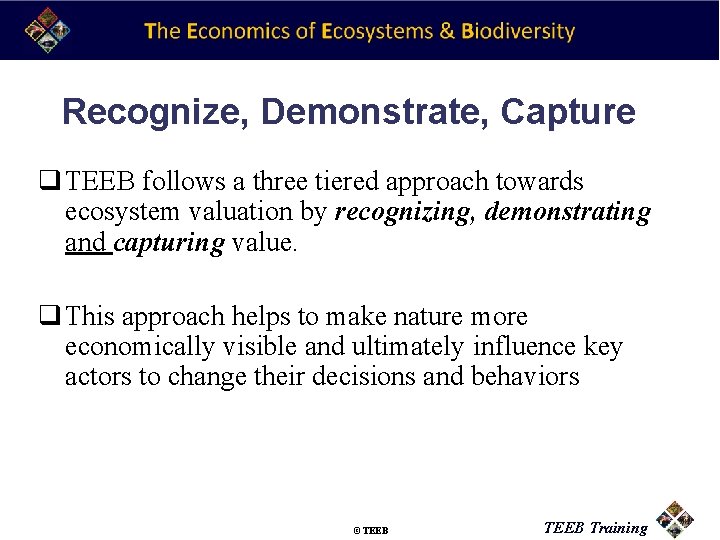
Recognize, Demonstrate, Capture q TEEB follows a three tiered approach towards ecosystem valuation by recognizing, demonstrating and capturing value. q This approach helps to make nature more economically visible and ultimately influence key actors to change their decisions and behaviors ©TEEB Training
THE TEEB APPROACH This means that society clearly acknowledges and understands the range of benefits, goods and RECOGNIZING VALUE: The simple fact services provided by ecosystems. of recognizing is sometimes sufficient to ensure conservation and sustainable use. This may be the case especially where the spiritual or cultural values of nature are strong. ©TEEB Training
THE TEEB APPROACH In economic terms to support decision making, to DEMONSTRATING VALUE: consider the full costs and benefits of a proposed use of an ecosystem. ©TEEB Training
THE TEEB APPROACH Final tier of the economic approach involves the CAPTURING VALUE: introduction of mechanisms that incorporate values of ecosystems into decision-making, through incentives and price signals (this can include payments for ecosystem services, reforming environmentally harmful subsidies, introducing tax breaks for conservation, creating new market for sustainably produced goods) ©TEEB Training
Valuation vs. Monetization TEEB is: TEEB is not: q Both market AND non-market q A narrow, market-centric view of valuation which expands beyond nature which just focuses on monetary valuation monetization of nature methodologies using also q A mechanism that puts a price tag on quantitative and qualitative nature to sell mother Earth methodologies q Nature commoditization q A holistic view of valuing nature which takes into account q About private profits environmental and social values and not just the market values of nature. ©TEEB Training
Why TEEB? q Because the economic invisibility of nature is a problem. q Because addressing losses requires knowledge from many disciplines (ecology, economics, policy. . ) to be synthesized, integrated and acted upon q Because different decision making groups (policy-makers, local managers down to citizens) need different types of information & guidance q Because successes need be understood, broadcast, replicated and scaled. . ©TEEB Training
Why TEEB? According to Benjamin Franklin: “I believe that a great part of the miseries of mankind are brought upon them by false estimates they have made of the value of things. ” Benjamin Franklin, 1706 - 1790 ©TEEB Training
- Slides: 14