
Session 3 3 Resource Mobilization Module 3 Persuasive
Session 3. 3: Resource Mobilization Module 3: Persuasive Communication & Resource Development Leadership and Management Course for ZHRC Coordinators and HTI Principals, and ZHRC/HTI Management Teams
Learning Objectives By the end of the session, participants will be able to: § Define the term income generating activity (IGA). § Describe how to use the SOAC process to create IGA ideas. § Describe common elements of a grant proposal. § Identify the stages in the grant application process. § Identify strategies for resource mobilization that they can implement in their organizations. 2
Why do we generate or raise funds? § Fill gaps in operating costs § Purchase necessary equipment, supplies, materials § Fund building improvement projects § Implement specific programs or projects § Others? 3
Strategies for Resource Mobilization § Income generating activities (IGA) § Donations • Supplies, equipment, money § Grants from development partners • Sub-grant relationships § Loans 4
What is your experience? § Do you have any experience with fundraising? • Professional? • Personal life (church, community, harambee)? § Does your organization have experience with resource mobilization or IGA? § Has anyone applied for a grant? 5
What is an income generation activity (IGA)? IGAs are schemes for incorporating some form of revenue generation into an institution’s operations. IGAs are any activity that can be initiated by a ZHRC/HTI for the purpose of providing supplementary income. 6
Types of IGA § There are two key types of IGA: • Cost Recovery (One-time approach) • Recovers costs related to delivering a specific service. It is a one-time approach – once the program or project ends, the cost recovery activity ends. • Earned Income (Ongoing approach) • Provides a stream of unrestricted revenue to the organization. This approach is ongoing, and is not tied to a specific program, service, or event. 7
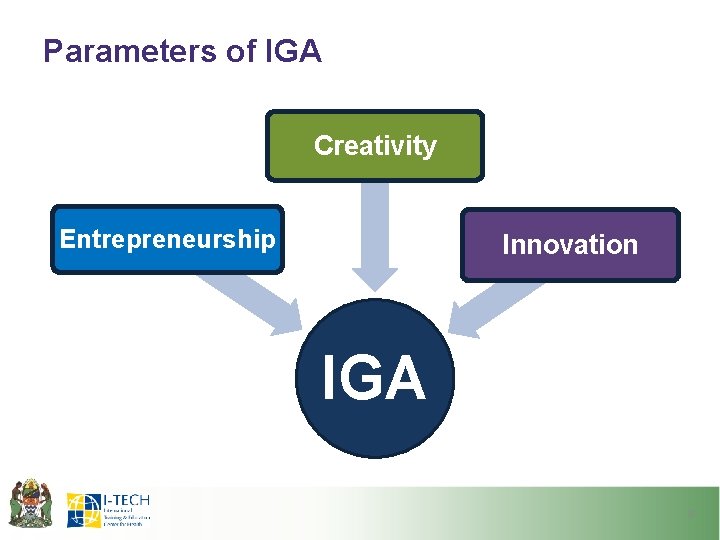
Parameters of IGA Creativity Entrepreneurship Innovation IGA 8
Creativity § The act of turning new and imaginative ideas into reality. § Involves two processes: • Thinking • Producing 9
Innovation § A change in the thought process for doing something. § The useful application of new inventions, discoveries, or approaches. § All organizations can innovate! § Innovation is the successful implementation of creative ideas within an organization. § Innovation transforms ideas into: • New or improved products • New or improved services or processes • New ways to compete and differentiate in the market 10
Entrepreneurship § Institutions and individuals who stimulate economic progress by finding new and better ways of doing things. § Entrepreneurs need: • • Courage to take calculated risks Perseverance through setbacks and challenges Skills at problem-solving Motivation to change difficult situations 11
IGA Examples § Hostel • Operating hostel in dormitory while school is not in session § Equipment Rental • Renting LCD projector, other equipment for a fee § Facility Rental • Charge fee to use space for conferences, weddings § Consultancy Services § Stationery Shop, Book Shop • Selling papers, supplies, and books to conference participants, students, etc. § Raising Domestic Animals for milk or food 12
Advantages of IGAs § § Increase operating revenue Provide supplementary income Provide funding for small projects and repairs Can provide funding for large improvement projects • Example: using an IGA scheme to raise funds for building a safe parking lot. 13
Challenges of IGAs § Require resources to operate and manage • Human resources, operating resources (electricity, space, etc. ), time, infrastructure § May require “seed money” or capital to start § Requires accounting & management of funds • Tracking revenues, expenditures, and profits in a clear, transparent manner § Requires periodic review and evaluation • Is this IGA scheme still successful/profitable? • Is it worth our investment of time and money? § Require a viable idea and plan 14
What makes a viable IGA? § Novel thinking (innovation & creativity) • What service or good can you provide that will meet a need in your area, or for your clients? § Management buy-in • Is it OK for the organization to take this risk? • Is the process and management transparent? § Sense of ownership • Workers and staff are supportive, willing to help make IGA successful § Not resource-intensive • Simple ideas that do not require additional staff, high start-up funding, or have high operating cost 15
How to Identify Viable IGAs § Internal and external factors can help or hinder the initiation of IGAs. § Potential IGAs can be identified using a process called SOAC: • • Strength Opportunities Areas of Improvement Challenge 16
SOAC: Strengths § Strengths consist of areas that facilitate initiation of IGAs. § These include the resources of ZHRCs/HTIs that can be used to develop IGAs: • Employee’s skills • Buildings and equipment that can potentially be used to generate additional income. 17
SOAC: Opportunities § Opportunities areas where the organization may have a competitive advantage over other organizations. § Examples include: • Customer base • Land • Buildings and equipment of the ZHRC/HTI. 18
SOAC: Areas of Improvement § Areas of improvement includes areas where the organization has the potential to maximize their income through perhaps minimal additional effort. § Examples include charging user fees for hall and conference rentals, copy machine use, etc. 19
SOAC: Challenges § Challenges are issues that could be detrimental to the organization or IGA. These can be: • External threats • Competitors or policy changes that negatively impact a ZHRC/HTI. • Internal challenges • Unfilled management positions which may cause a lack of leadership. 20
Starting and Managing an IGA (1) You need to have the following in place for starting and managing an IGA: § Plan • • • What is the product/service? Who will you serve? How will the IGA benefit your organization? How will the IGA be staffed and managed? What is the timeline for implementation? Do you need start-up funds? How will you get them? § Budget • Simple budget with expected operation and implementation costs, expected revenue 21
Starting and Managing an IGA (2) § Capacity • Accounting and financial management capability • Operating costs § Management and Stakeholder Approval • Review viability of IGA proposal • Ensure system for recording, analysis, and review 22
Activity: Planning an IGA § Work in small groups to develop an IGA plan. § Use Worksheet 3. 1 to guide your discussion. § You will have 5 minutes to present your idea to the class. 23
What is a grant? § A sum of money, given by a government, nonprofit organization, philanthropic foundation, charity, or other agency for a specified purpose. § Usually, a grant is awarded a result of a formal decision-making process involving a written or oral presentation and review. § Do not include terms of repayment. § Grants usually involve accountability to the funder or development partner • Financial reporting, progress reporting, etc. 24
What is an in-kind contributions? § In-kind contributions are gifts of goods or services, other than cash grants. § Common types of in-kind contributions include: • Goods • Computers, software, furniture, equipment • Services • Meeting space, administrative or financial support • Expertise • Legal, tax, or business advice; marketing, advertising, or website development; strategic planning, etc. 25
What is a development partner? § An organization that gives funds for projects of a development nature. § Development partners include: • • • National governments Multilateral agencies Non-Governmental Organizations (NGOs) Philanthropic/charitable foundations Faith-based organizations 26
What is a loan? § A sum of money which an individual, group or other organization borrows from another individual, group, agency or institution on the condition that it be returned or repaid at a later date, often at interest. § Microloans are common in developing countries. • Microfinance is a type of lending involving small, non-collateralized loans to low-income, typically self-employed, workers who do not have access to traditional financial lending services. 27
Types of Grants § Grant funding is available for many different purposes and types of activities. • Basket Funding • Capacity Building Grants • Capital or Building Grants • Challenge Grants • General Operating Support • Matching Grants • Project or Program Grants • Seed Grants • Technology Grants 28
How to find Grants § Newspapers § Announcements from NGOs and Development Partners § Networking with colleagues & partners § Governments § Foundations § Private companies § Private individuals § Internet searches/online 29
Identifying Grants § Be strategic. • Applying for grants is a time and labour intensive process. § Find the grant that is the right fit for your organization. • It is better to find a grant that is a good match for your organization than to re-shape your organization to apply to a grant! § Look for grants that you have a good chance of winning. 30
Is it the right grant? § Before applying, ask key questions: • • • Are we eligible? Is it really competitive? Who else is applying? How do we measure up? Do we have the capacity to manage the grant? Do we have time to successfully apply? Is it worth the effort? Does the funding level make sense? • Does it support our mission and priorities? • Is it the right type of grant for our project? 31
Research the Development Partner § It is useful to research the development partner or funding agency. • What are their priorities and values? • What types of projects have received funding in the past? • Where have they funded projects? • What are the proposal guidelines and due date? • What budget levels will they fund? 32
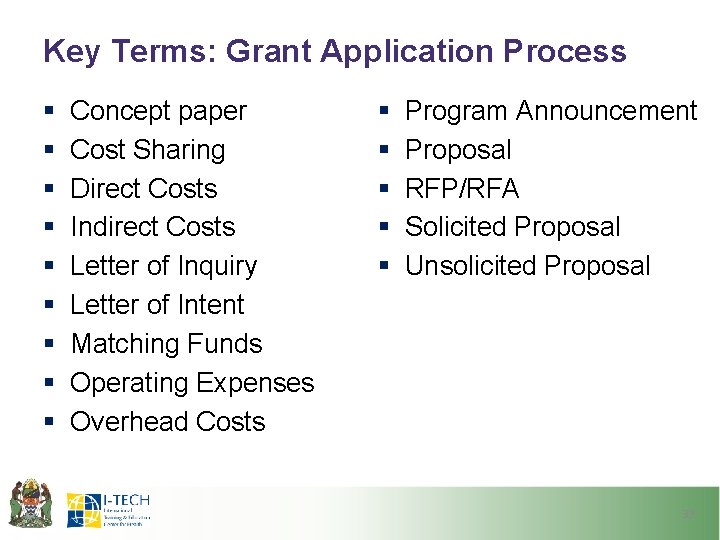
Key Terms: Grant Application Process § § § § § Concept paper Cost Sharing Direct Costs Indirect Costs Letter of Inquiry Letter of Intent Matching Funds Operating Expenses Overhead Costs § § § Program Announcement Proposal RFP/RFA Solicited Proposal Unsolicited Proposal 33
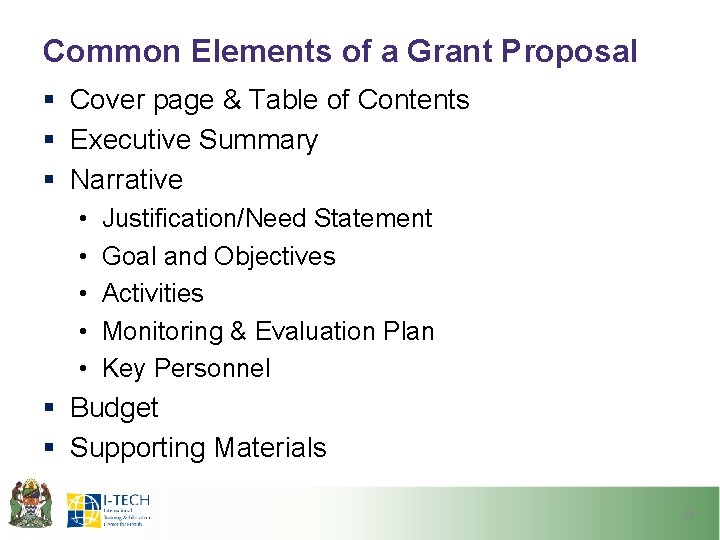
Common Elements of a Grant Proposal § Cover page & Table of Contents § Executive Summary § Narrative • • • Justification/Need Statement Goal and Objectives Activities Monitoring & Evaluation Plan Key Personnel § Budget § Supporting Materials 34
Timelines for Applying to a Grant § How much time do you need to write & submit a grant application? § Timeline depends on: • • • Complexity of application Stakeholder and partner involvement New or existing information Outside information or materials needed Availability of staff resources to write § Outline detailed steps, and set target deadlines Leave enough time!! 35
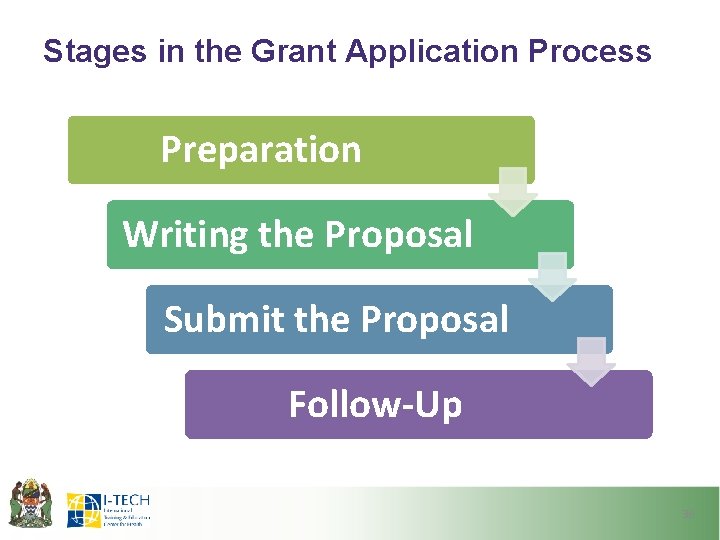
Stages in the Grant Application Process Preparation Writing the Proposal Submit the Proposal Follow-Up 36
Preparation § Define project • Scope of work, goals, objectives, beneficiaries § Identify funding sources § Contact donors • Letter of Intent § Acquire proposal guidelines & review carefully • Seek clarification on guidelines, if needed. § Confirm submission deadline § Determine personnel needs § Create a project timeline • Outline steps, and assign internal deadlines 37
Write the Proposal § Structure the proposal according to the guidelines. § Be specific, and include examples and evidence. § Be clear and concise. • Proposals must conform to a specific number of pages – it can be challenging to include all the information. Focused writing is essential. § § Be persuasive. Work as a team. Ask colleagues for review and feedback. Revise your draft to make proposal stronger. 38
Developing a Budget § The budget includes cost projections for your project. • All activities, staff, etc. mentioned in the narrative should be reflected in the budget. § Be sure to only include costs that the funding agency is willing to support. § Grant application should include: • Summary Budget • Budget Narrative/Budget Notes 39
Submit the Proposal § Use a submission checklist. • All forms are completed. • Proposal has correct number of pages, format, number of copies, signatures, etc. § Submit your proposal on time, on or before deadline. § Deliver it in the way the funding agency has requested. • Print, electronic, etc. § When possible, submit in person. § Verify that the proposal was received. 40
Follow-Up § Follow-up on application status after submission. § This may be an opportunity to get feedback on the strengths and weaknesses of your proposal. • Remember this feedback for next time! § You can contact the funding agency about: • Status of application • Evaluation results • Outcome/Decision 41
What makes a strong proposal? § § Match funding agency’s interests Innovative and interesting ideas Evidence of scientific reasoning & technical skill Follows the guidelines • Correct formatting, number of pages • Includes all requested information • Includes your contact information § Articulates your strengths and qualifications § Clearly written, focused and concise 42
Activity: Resource Mobilization Strategies § Reflect on ideas presented today related to IGA and grant writing. • What ideas align with your organization’s strengths? § Select two ideas for resource mobilization, and describe them using the Worksheet. 43
Key Points § ZHRCs/HTIs can develop IGAs through creative, innovative, and entrepreneurial efforts. § SOAC analysis can be used to develop IGA ideas. § IGAs require planning, systems, and resources to operate and maintain. § The grant application process entails preparation, writing, submission, and follow-up. § It is critical to carefully review the funding guidelines at every stage of the grant application process. 44
- Slides: 44