
Session 29 Rational and Irrational Numbers Surds and
Session 29 – Rational and Irrational Numbers, Surds and Bounds GCSE MATHS
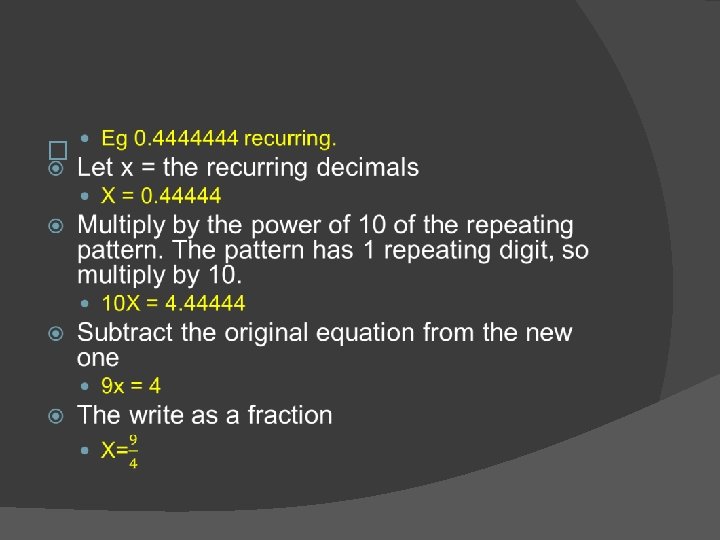
Rational Numbers Chapter 9 � Integers, and numbers that can be written as fractions where the parts are integers, and the denominator is not 0 are rational. � All fractions can be written as decimals, some have recurring digits. � All decimals that finish (terminate) or repeat in a pattern (recur) are rational numbers.
Irrational Numbers � Numbers that do not meet the conditions for rational numbers are called irrational numbers � When written as decimals they are nonrecurring and we cannot represent their exact value. � Often we use a symbol (such as pi) or surds to represent them.
� Ex 9. 2 Q 1 – consider the link with the decimals and square numbers. You may also need to use the previous techniques for repeating decimals. � Try a few from this exercise
Surds � Roots of rational numbers which cannot be expresses by a rational number is called a surd. � We leave irrational roots in ‘surd form’, rather than writing them out and having to round them off. � Not every root is a surd, only the irrational ones.
Manipulating Surds � When we calculate with surds, we can often simplify the answer. We may also want to manipulate surds, i. e. write them in different ways so that they are more useful to us. � We can do this by following some rules
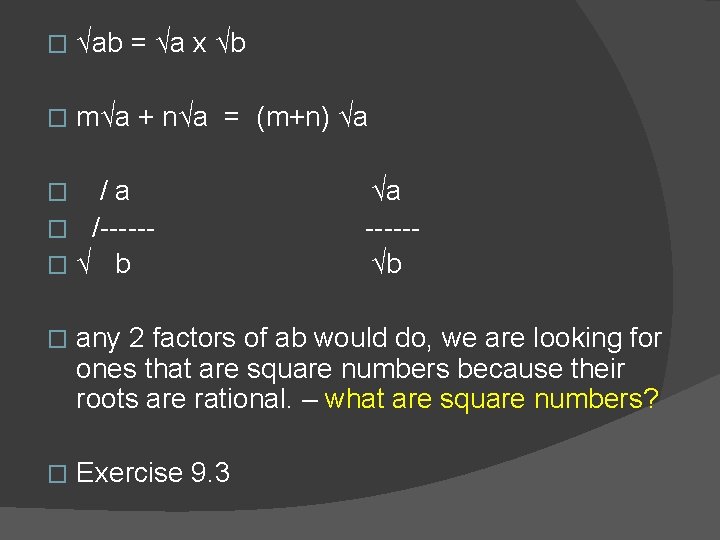
� √ab = √a x √b � m√a + n√a = (m+n) √a /a � /-----�√ b � √a -----√b � any 2 factors of ab would do, we are looking for ones that are square numbers because their roots are rational. – what are square numbers? � Exercise 9. 3
Rationalising the denominator � When we have a surd at the bottom of a fraction. It is usual to multiply both top and bottom by this surd in order to turn the denominator into a rational integer. � We may also need to simplify where possible. (see book examples) � Exercise 9. 4
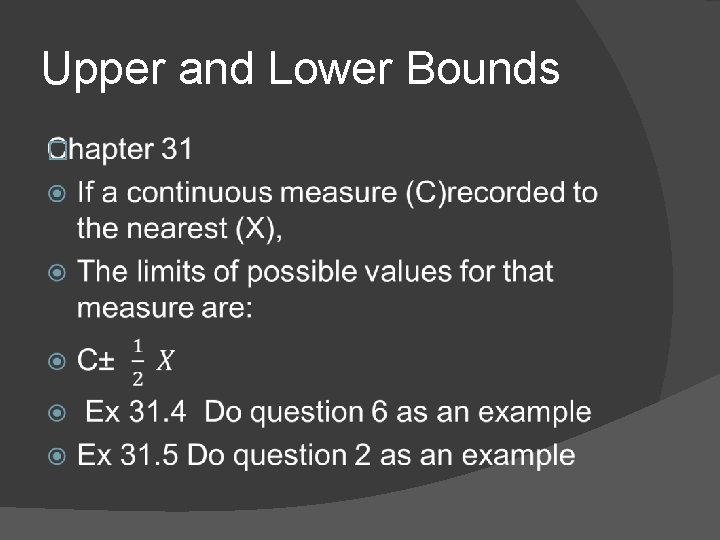
Upper and Lower Bounds �

Homework � Revise
- Slides: 11