
Session 25 Streamlined FFELP and Alternative Loan Processing
- Slides: 35
Session 25 Streamlined FFELP and Alternative Loan Processing Lisa Oldre Education Loan Servicing Corporation Erin Rose Key. Bank
Session Overview • • • Standards: Past and present Common Record Background Information What is XML? Developing the CR: C Standard Benefits of Common Record: Common. Line • Implementation and Next Steps 2
Importance of Standards • Post Secondary communication is complex: many parties, time sensitive, and accuracy is crucial • Facilitate efficiency • Make training and cross-training easier • Reduce change for the sake of change 3
Where are we now? • • • We have standards for FFELP We have standards for Direct Lending We have standards! BUT…. . We need standards across all loan programs and among all industry players 4
The Common Record Background Information • COD was an existing process that we were asked to mimic. However, there are processes that are unique to FFELP • Consequently, COD was the base, but CR: C was born out of the differences 5
Common Record Philosophy • Single standard Common Record • Support all financial aid programs – Pell, Direct Loans, FFELP, Campus-Based, Loan Counseling, Transcripts, etc. • Eliminate multiple flat file formats • Simplified process for submission of financial aid data 6
Common Record Philosophy (continued) • Maintenance and enhancements managed by the Postsecondary Electronic Standards Council (PESC) 7
The Technology Solution: Common Record and XML • Standard language of e-business and the internet • Lets the industry describe virtually any type of data • Allows easy inclusion of other student financial resource data in a single file (FFELP, ISIR, State Grant, etc. ) 8
The Technology Solution: Common Record and XML • Standardized validation of data order and content • Greater interest in new technology by developers 9
Streamlines Schema Changes • Old XML tags remain the same • Only need to add code for new or enhanced data elements 10
The Common Record • Common Record: – Common Origination and Disbursement COD (Direct Lending) – Common. Line (FFELP and Alternative Loans) – Transcripts (XML Transcript) – XML ISIR (future release) – Loan Counseling (in development) 11
The Common Record Terminology • Core Components Dictionary: – Standard structure – Naming conventions – Change control oversight • Schema: Defines structure and content for XML Documents 12
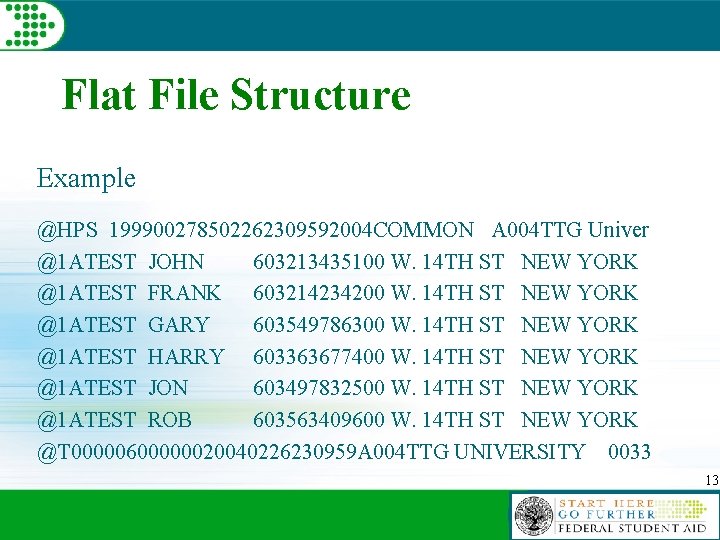
Flat File Structure Example @HPS 199900278502262309592004 COMMON A 004 TTG Univer @1 ATEST JOHN 603213435100 W. 14 TH ST NEW YORK @1 ATEST FRANK 603214234200 W. 14 TH ST NEW YORK @1 ATEST GARY 603549786300 W. 14 TH ST NEW YORK @1 ATEST HARRY 603363677400 W. 14 TH ST NEW YORK @1 ATEST JON 603497832500 W. 14 TH ST NEW YORK @1 ATEST ROB 603563409600 W. 14 TH ST NEW YORK @T 00000600000020040226230959 A 004 TTG UNIVERSITY 0033 13
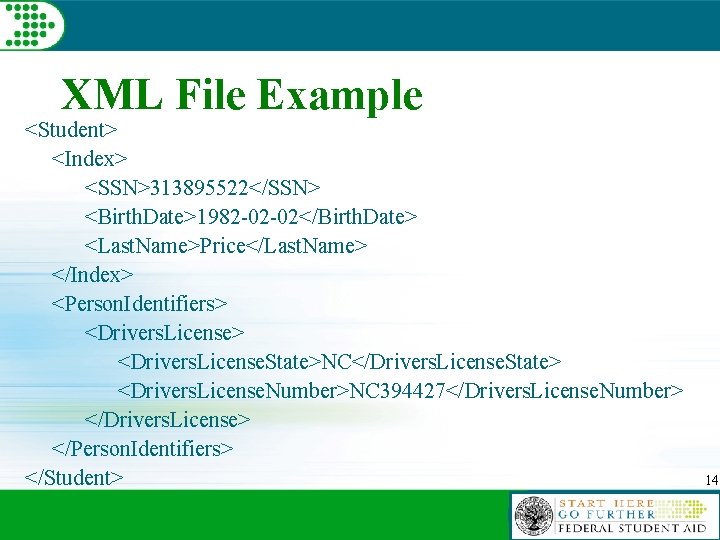
XML File Example <Student> <Index> <SSN>313895522</SSN> <Birth. Date>1982 -02 -02</Birth. Date> <Last. Name>Price</Last. Name> </Index> <Person. Identifiers> <Drivers. License. State>NC</Drivers. License. State> <Drivers. License. Number>NC 394427</Drivers. License. Number> </Drivers. License> </Person. Identifiers> </Student> 14
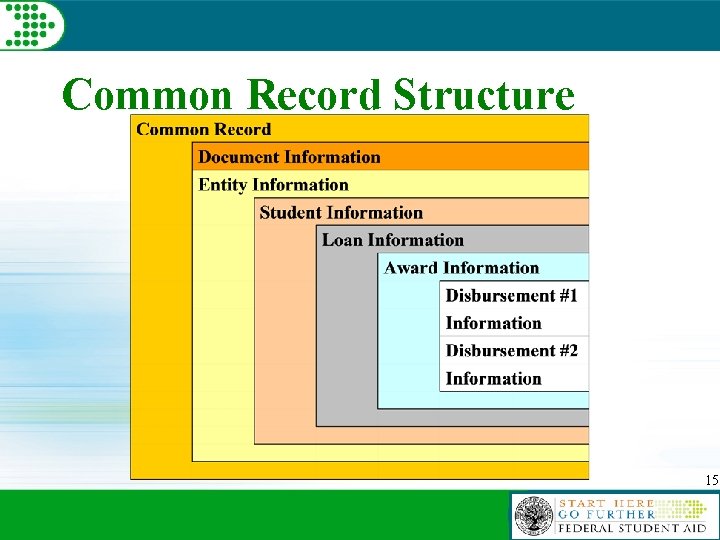
Common Record Structure 15
What’s In It for Me? 16
Benefits of Implementing Common Record: Common. Line • Human-Readable – Tags surround data <Last. Name>Smith</Last. Name> – Plain English values vs. Codes • Future software upgrades will be easier to manage 17
Benefits of Implementing Common Record: Common. Line • Eliminate need for double data entry – Reduces or eliminates data entry into multiple systems – Reduces or eliminates manual processing • Supports school-assigned student IDs – Addresses privacy concerns – Allows use among all data partners 18
Benefits of Implementing Common Record: Common. Line • Flexible Disbursement Processing – More than 4 disbursements – Separate disbursement dates for subsidized and unsubsidized loans – Ability to indicate disbursement amounts – Ability to override disbursement date profiles 19
Benefits of Implementing Common Record: Common. Line • Move from transaction-based to endresult changes (i. e. CLV 4 transaction model): – Eliminates need to determine transaction type (@1 -09, etc. ) – Eliminates sending multiple transactions to achieve desired result – Only changed fields will be sent to your service provider 20
Benefits of Implementing Common Record: Common. Line • Streamline Loan Status Information – Four Independent Statuses • Guarantee Status • Promissory Note Status • Credit Approval Status • Lender Approval Status 21
Benefits of Implementing Common Record: Common. Line – Not limited to one loan phase code – Schools have fewer interpretation issues – Trading partners each have their own status to update independently 22
Benefits of Implementing Common Record: Common. Line • Sets the Framework for Real-Time Processing – It is up to individual trading partners to add support for real-time processing – The PESC DTS Workgroup is currently developing real-time standards 23
Benefits of Implementing Common Record: Common. Line • Streamlines Alternative Loans – Easier transition from a still paper intensive process – Facilitates communication of the increased data requirements of alternative loans 24
Benefits of Implementing Common Record: Common. Line – Consistent process between Stafford and Alternative Loans • Eliminates Alternative Loan addendum records • Alternative Loan data easily incorporated into XML structure 25
Implementation • NCHELP Electronic Standards Committee has published the CR: C implementation guide • PESC has approved the CR: C schema • Most lenders, guarantors, and servicers are in various stages of implementation and are forecasting production readiness Spring ’ 06 - Spring ’ 07 26
Implementation • e-Library > Electronic Standards Documentation and Tools > Common Record - Common. Line Documentation 27
Implementation and Development Pitfalls • Schema changes • Logic of backward compatibility • Combination of loan types in the same document 28
Implementation and Development Pitfalls • Combination of pre-guarantee and post-guarantee records in the same document • End result for corrections and changes • Larger file size 29
Implementation and Development Pitfalls • Validation issues with documentation and schema • For Trading Partners, end-result process is a fundamental change in business practices • School-assigned student ID stored one person 30
Some Considerations for Schools • Prioritize CR: C benefits for your office • Use priorities to evaluate implementation options • Communicate priorities to your software providers and service providers 31
Some Considerations for Schools • Involvement in NCHELP Electronic Standards Committee – School Advisory Group – Origination Standards Advisory Team 32
Information Sources • NCHELP - The CR: C Implementation Guide is available in the e-Library at www. nchelp. org • IFAP – COD news, technical documentation, updates are available at www. ifap. ed. gov • PESC – XML Technical Specifications, Data Dictionaries, Schemas, assistance and approvals are available at www. pesc. org • XML Registry and Repository – Current schema and dictionary are available at www. fsaxmlregistry. ed. gov 33
Contact Information • Lisa Oldre • Director, Industry Standards ELSC lisa. oldre@elsc. com 216 -706 -7411 Erin Rose Vice President, Channel & Guarantor Management Key. Bank erin_rose@keybank. com 617 -449 -4879 34
Streamlined FFELP and Alternative Loan Processing Session #25 PLEASE FILL OUT SESSION EVALUATIONS 35