
Session 22 Valuing Equity in Distressed Firms as

- Slides: 12
Session 22: Valuing Equity in Distressed Firms as an option Aswath Damodaran 1
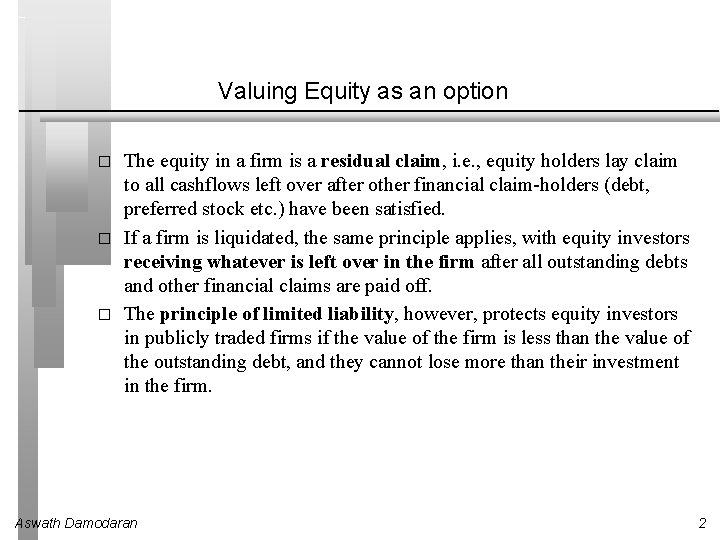
Valuing Equity as an option � � � The equity in a firm is a residual claim, i. e. , equity holders lay claim to all cashflows left over after other financial claim-holders (debt, preferred stock etc. ) have been satisfied. If a firm is liquidated, the same principle applies, with equity investors receiving whatever is left over in the firm after all outstanding debts and other financial claims are paid off. The principle of limited liability, however, protects equity investors in publicly traded firms if the value of the firm is less than the value of the outstanding debt, and they cannot lose more than their investment in the firm. Aswath Damodaran 2
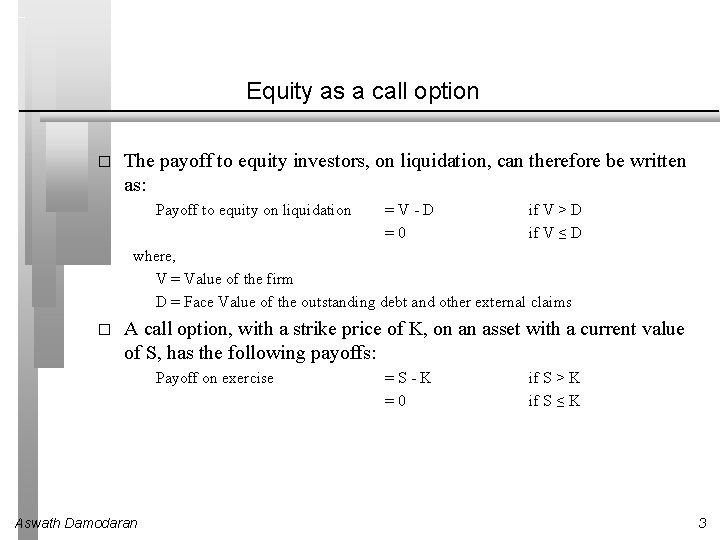
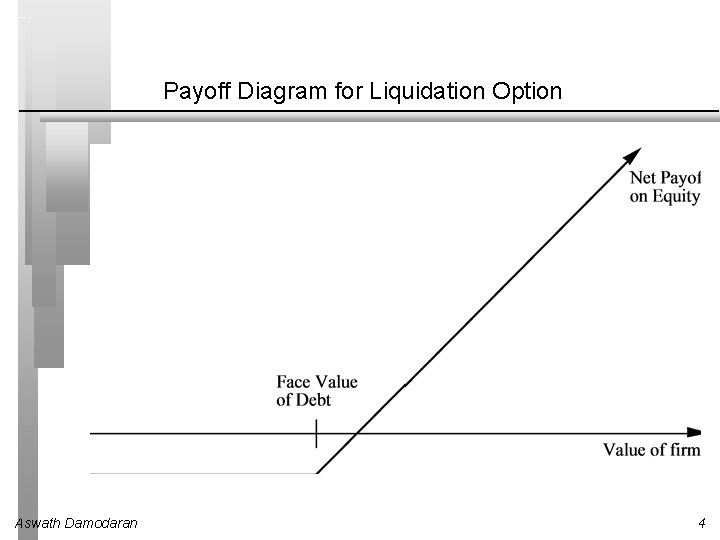
Equity as a call option � The payoff to equity investors, on liquidation, can therefore be written as: Payoff to equity on liquidation =V-D =0 if V > D if V ≤ D where, V = Value of the firm D = Face Value of the outstanding debt and other external claims � A call option, with a strike price of K, on an asset with a current value of S, has the following payoffs: Payoff on exercise Aswath Damodaran =S-K =0 if S > K if S ≤ K 3
Payoff Diagram for Liquidation Option Aswath Damodaran 4
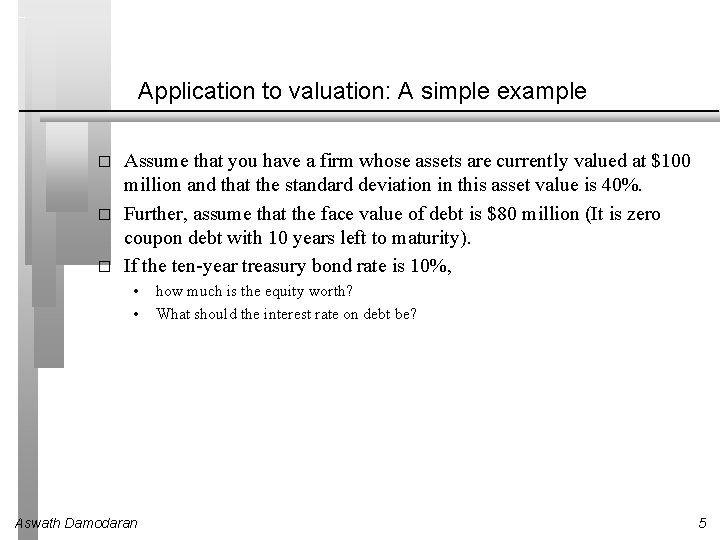
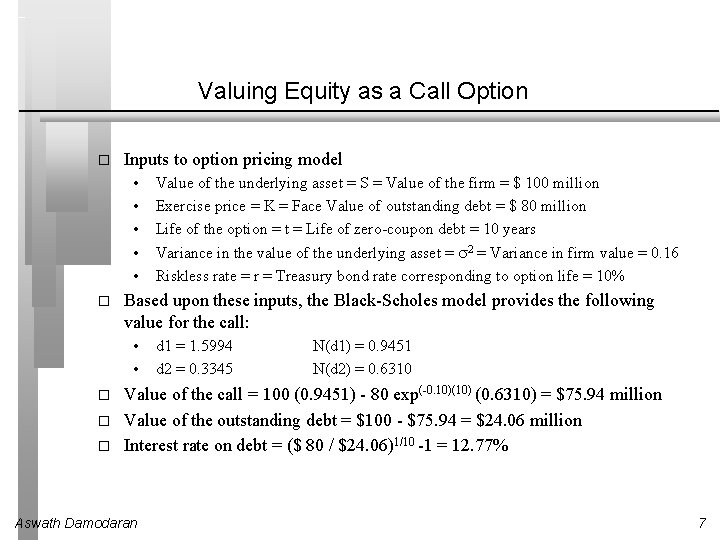
Application to valuation: A simple example � � � Assume that you have a firm whose assets are currently valued at $100 million and that the standard deviation in this asset value is 40%. Further, assume that the face value of debt is $80 million (It is zero coupon debt with 10 years left to maturity). If the ten-year treasury bond rate is 10%, • • Aswath Damodaran how much is the equity worth? What should the interest rate on debt be? 5
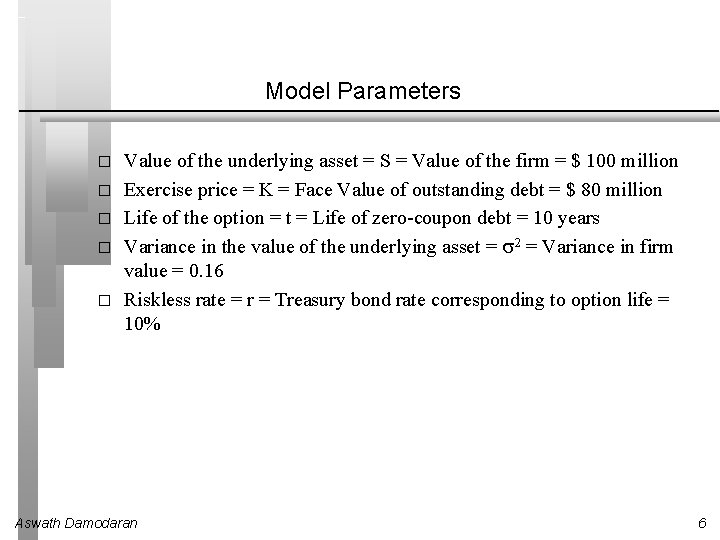
Model Parameters � � � Value of the underlying asset = S = Value of the firm = $ 100 million Exercise price = K = Face Value of outstanding debt = $ 80 million Life of the option = t = Life of zero-coupon debt = 10 years Variance in the value of the underlying asset = 2 = Variance in firm value = 0. 16 Riskless rate = r = Treasury bond rate corresponding to option life = 10% Aswath Damodaran 6
Valuing Equity as a Call Option � Inputs to option pricing model • • • � Based upon these inputs, the Black-Scholes model provides the following value for the call: • • � � � Value of the underlying asset = S = Value of the firm = $ 100 million Exercise price = K = Face Value of outstanding debt = $ 80 million Life of the option = t = Life of zero-coupon debt = 10 years Variance in the value of the underlying asset = 2 = Variance in firm value = 0. 16 Riskless rate = r = Treasury bond rate corresponding to option life = 10% d 1 = 1. 5994 d 2 = 0. 3345 N(d 1) = 0. 9451 N(d 2) = 0. 6310 Value of the call = 100 (0. 9451) - 80 exp(-0. 10)(10) (0. 6310) = $75. 94 million Value of the outstanding debt = $100 - $75. 94 = $24. 06 million Interest rate on debt = ($ 80 / $24. 06)1/10 -1 = 12. 77% Aswath Damodaran 7
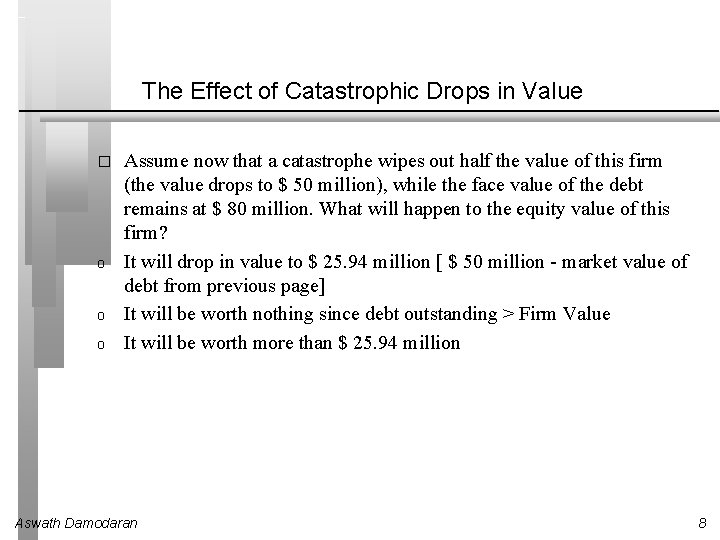
The Effect of Catastrophic Drops in Value � o o o Assume now that a catastrophe wipes out half the value of this firm (the value drops to $ 50 million), while the face value of the debt remains at $ 80 million. What will happen to the equity value of this firm? It will drop in value to $ 25. 94 million [ $ 50 million - market value of debt from previous page] It will be worth nothing since debt outstanding > Firm Value It will be worth more than $ 25. 94 million Aswath Damodaran 8
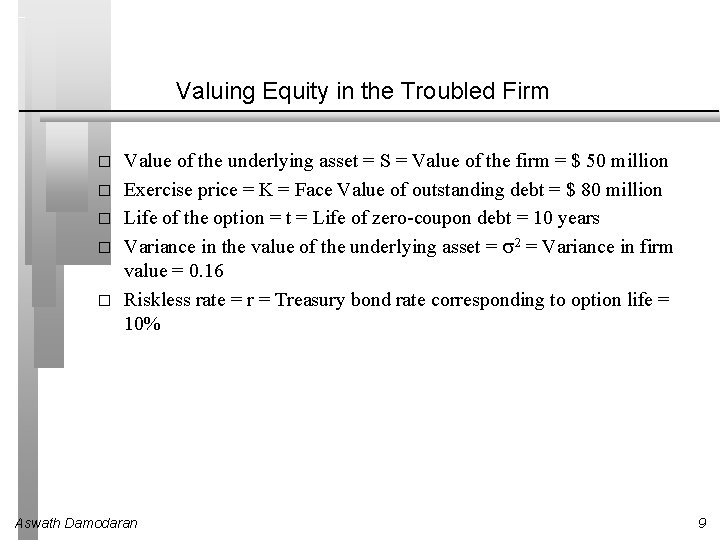
Valuing Equity in the Troubled Firm � � � Value of the underlying asset = S = Value of the firm = $ 50 million Exercise price = K = Face Value of outstanding debt = $ 80 million Life of the option = t = Life of zero-coupon debt = 10 years Variance in the value of the underlying asset = 2 = Variance in firm value = 0. 16 Riskless rate = r = Treasury bond rate corresponding to option life = 10% Aswath Damodaran 9
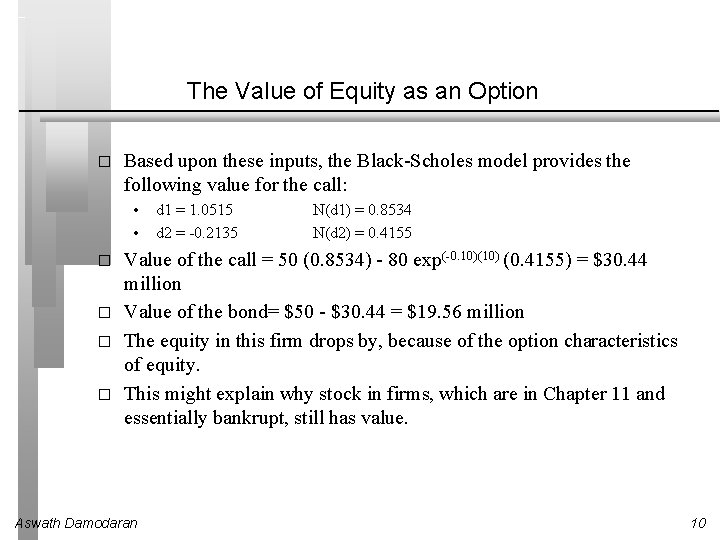
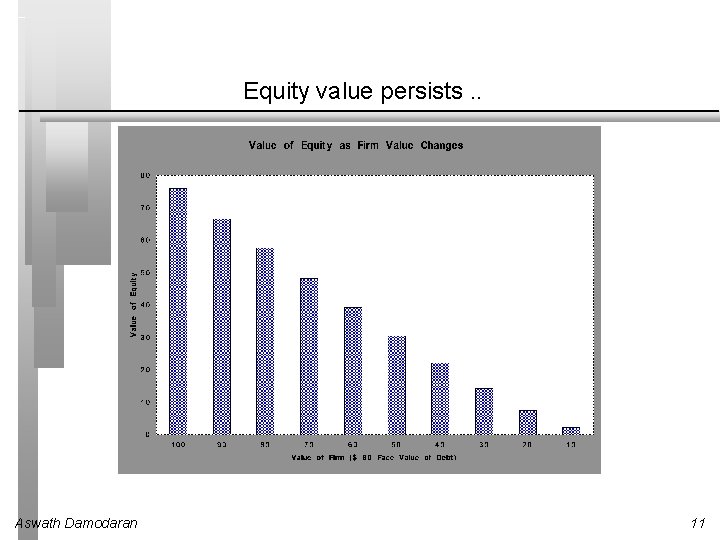
The Value of Equity as an Option � Based upon these inputs, the Black-Scholes model provides the following value for the call: • • � � d 1 = 1. 0515 d 2 = -0. 2135 N(d 1) = 0. 8534 N(d 2) = 0. 4155 Value of the call = 50 (0. 8534) - 80 exp(-0. 10)(10) (0. 4155) = $30. 44 million Value of the bond= $50 - $30. 44 = $19. 56 million The equity in this firm drops by, because of the option characteristics of equity. This might explain why stock in firms, which are in Chapter 11 and essentially bankrupt, still has value. Aswath Damodaran 10
Equity value persists. . Aswath Damodaran 11
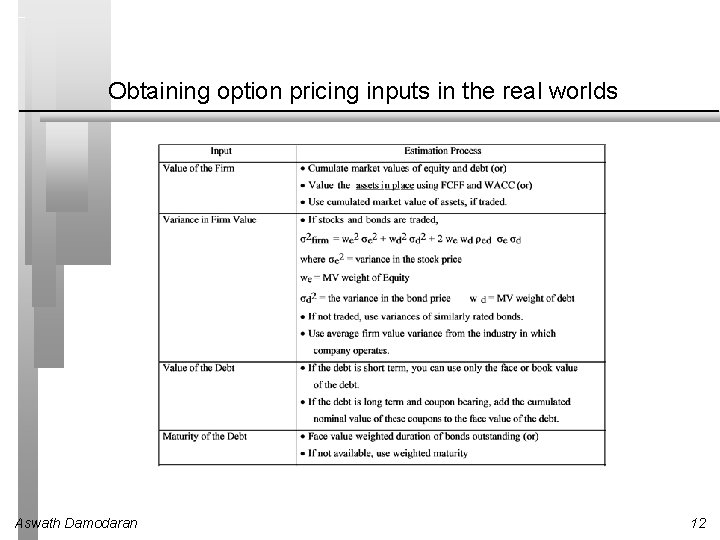
Obtaining option pricing inputs in the real worlds Aswath Damodaran 12