
Session 22 Need Analysis The EFC Formula Beyond
Session #22 Need Analysis: The EFC Formula Beyond 2010 -11 Trevor Summers, U. S. Department of Education
Introduction • What’s the EFC? • What’s fair? • What’s reasonable? • Who writes the EFC formula? • How does this affect your students? 2
AGENDA • • Recent Changes Proposed Changes Discussion Questions & Answers 3
Recent Changes Cost of Attendance • Section 472 of HEA • Cost of Attendance will include an allowance to cover basic expenses incurred for board (NOT ROOM) – For students living in housing provided on a military base, or – For which a basic living allowance is provided – Effective July 1, 2010 4
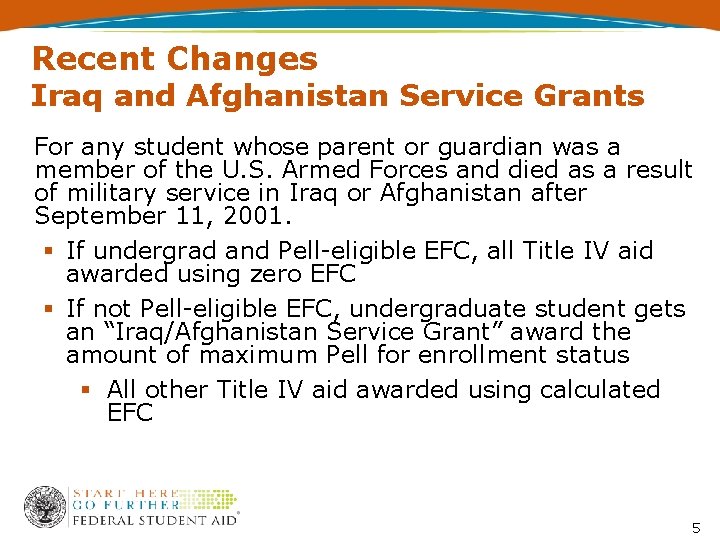
Recent Changes Iraq and Afghanistan Service Grants For any student whose parent or guardian was a member of the U. S. Armed Forces and died as a result of military service in Iraq or Afghanistan after September 11, 2001. § If undergrad and Pell-eligible EFC, all Title IV aid awarded using zero EFC § If not Pell-eligible EFC, undergraduate student gets an “Iraq/Afghanistan Service Grant” award the amount of maximum Pell for enrollment status § All other Title IV aid awarded using calculated EFC 5
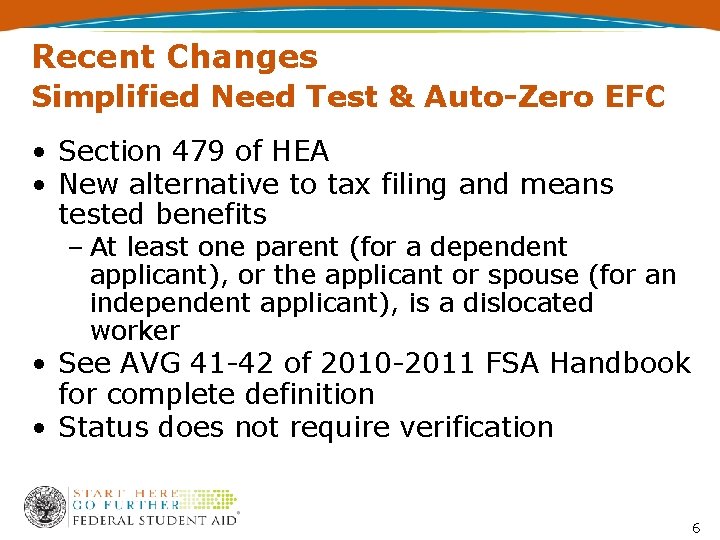
Recent Changes Simplified Need Test & Auto-Zero EFC • Section 479 of HEA • New alternative to tax filing and means tested benefits – At least one parent (for a dependent applicant), or the applicant or spouse (for an independent applicant), is a dislocated worker • See AVG 41 -42 of 2010 -2011 FSA Handbook for complete definition • Status does not require verification 6
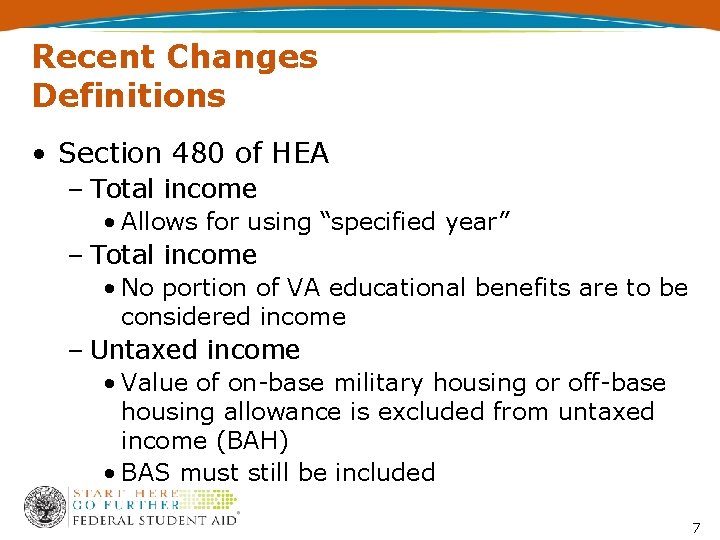
Recent Changes Definitions • Section 480 of HEA – Total income • Allows for using “specified year” – Total income • No portion of VA educational benefits are to be considered income – Untaxed income • Value of on-base military housing or off-base housing allowance is excluded from untaxed income (BAH) • BAS must still be included 7
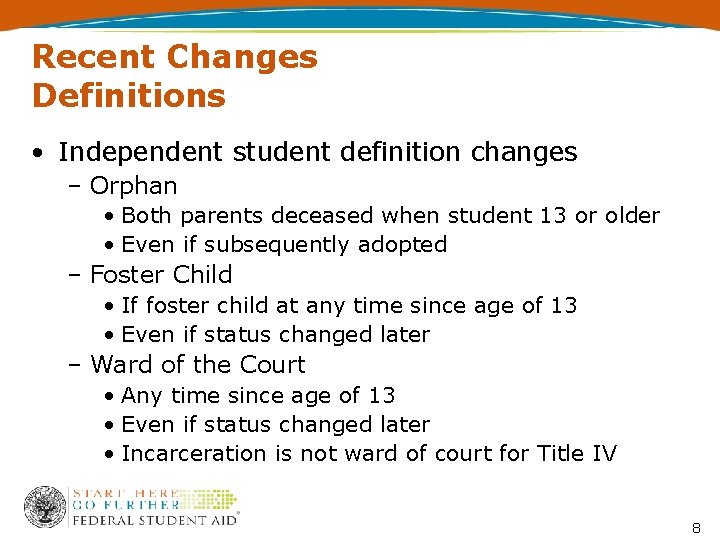
Recent Changes Definitions • Independent student definition changes – Orphan • Both parents deceased when student 13 or older • Even if subsequently adopted – Foster Child • If foster child at any time since age of 13 • Even if status changed later – Ward of the Court • Any time since age of 13 • Even if status changed later • Incarceration is not ward of court for Title IV 8
Independent Student Definition • Emancipated Minor – Anytime at or prior to 18 years of age – Determined by a court in student’s state of legal residence • In a Legal Guardianship – Anytime at or prior to 18 years of age – Determined by a court in student’s state of legal residence 9
Independent Student Definition • Homeless definitions – Homeless • Lacking fixed, regular and adequate housing – At risk of being homeless • Housing may cease to be fixed, regular, and adequate – e. g. student is being evicted and has been unable to find fixed, regular, and adequate housing 10
Independent Student Definition • Homeless definitions – Self-supporting • Student pays for his own living expenses, including fixed, regular, and adequate housing – Unaccompanied • Student is not living in the physical custody of a parent or guardian – Youth • Student who is 21 years old or younger or still enrolled in high school as of date he signs FAFSA 11
Independent Student Definition • States of Homelessness – Anytime after July 1, 2009 – Student has been verified as an unaccompanied youth who is a homeless child or youth, by • School or school district homeless liaison, or • Director, or designee, of an emergency shelter program funded by HUD, or • Director, or designee, of a homeless youth basic center or transitional living program, or • Financial aid administrator • OR 12
Independent Student Definition • States of Homelessness – Student has been verified as an unaccompanied youth who is at risk of homelessness and self-supporting by • Director, or designee, of a homeless youth basic center or transitional living program, or • Financial aid administrator 13
FAA Determination of Homelessness • Must Be Case by Case but Is Not PJ • Must be documented – If no official documentation can be obtained, documented interview of the student will suffice • FAFSA does not ask student if FAA is making determination, asks only if homelessness professionals mentioned on previous slides are making determination – Determination, however, is NOT a dependency override or PJ 14
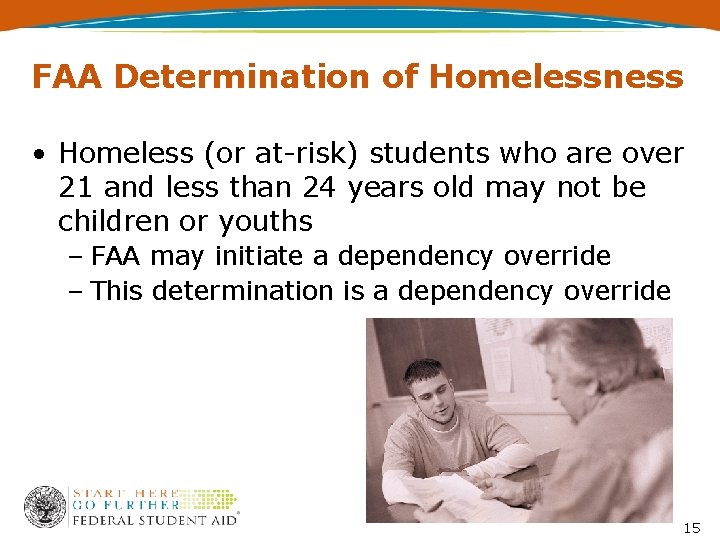
FAA Determination of Homelessness • Homeless (or at-risk) students who are over 21 and less than 24 years old may not be children or youths – FAA may initiate a dependency override – This determination is a dependency override 15
Recent Changes Definitions • Section 480 of HEA – Excludable income • Any income from work under a cooperative education program offered by an institution of higher education – Other Financial Assistance • Excludes VA educational benefits 16
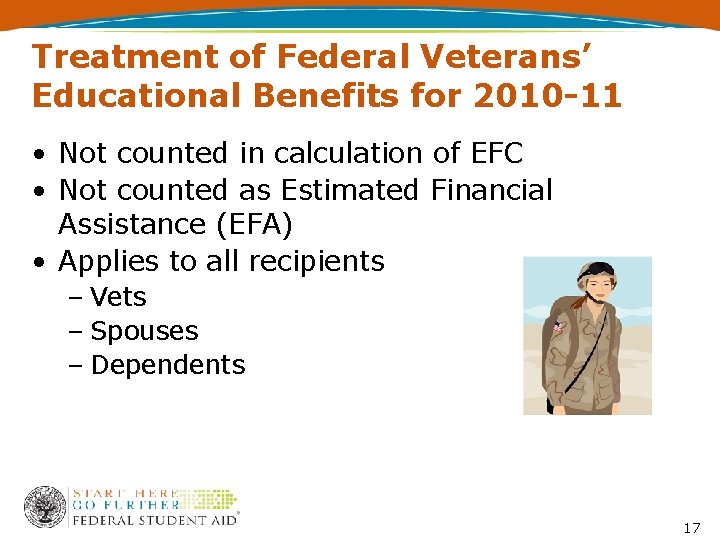
Treatment of Federal Veterans’ Educational Benefits for 2010 -11 • Not counted in calculation of EFC • Not counted as Estimated Financial Assistance (EFA) • Applies to all recipients – Vets – Spouses – Dependents 17
VA Educational Benefits Changes – Guidance on Federal Veterans’ Education Benefits for Purposes Title IV Aid posted on August 13, 2009 • Includes Q and A’s • List of updated applicable programs included 18
Beyond 2010 -11 • The Administration’s Plan for simplification – Each year more than 16 million students & their families complete the FAFSA – Current process is complicated, burdensome and difficult – The Administration is proposing taking 3 steps to make the application process easier and to make college more accessible 19
3 Steps • The online application is being streamlined using a shorter, simplified form • Since January 2010, some students and parents were able to electronically retrieve their tax information from the IRS and transfer it to the online FAFSA (FOTW) • Congress considered the Administration’s proposal to simplify the eligibility formula but took no action 20
The Simplified FAFSA • Financial Information used for EFC calculation – In general, only information that can be obtained from an IRS Tax Return will be collected – Other income-related questions would be dropped – Assets Dropped (except for asset cap) 21
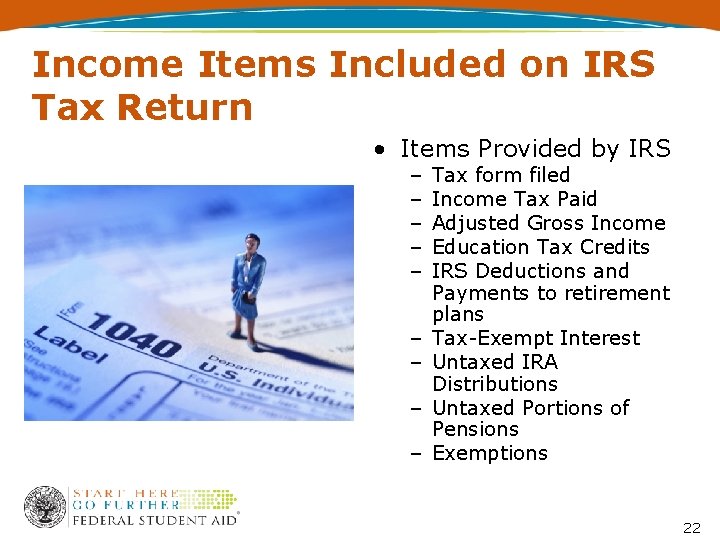
Income Items Included on IRS Tax Return • Items Provided by IRS – – – – – Tax form filed Income Tax Paid Adjusted Gross Income Education Tax Credits IRS Deductions and Payments to retirement plans Tax-Exempt Interest Untaxed IRA Distributions Untaxed Portions of Pensions Exemptions 22
Items to be Removed from EFC Calculation • • • Mother’s income from work Father’s income from work Student’s income from work Spouse’s income from work Taxable earnings from needbased employment • Cash, savings and checking amounts • Investments and real estate • Net worth of businesses and investment farms • Combat pay • Living allowances paid to members of military, clergy & others • Other untaxed income – e. g. workers’ comp • Child support received/paid • Payments to tax-deferred pensions & savings plans • Grants & scholarship aid included in AGI • Veteran’s non-educational benefits • Other money received or paid on your behalf (students only) 23
Proposed Changes - Assets • Reporting assets discourages savings, is not verifiable, and leads to misreporting • Current FAFSA asks multiple questions about assets • Federal Pell Grant eligible students generally have low levels of savings and almost no other investments • In 2007 -2008, only 4% of applicants had assets that exceeded $150, 000 24
Proposed Changes - Assets • Asset Cap is a bright line test that replaces an asset contribution in the calculation of the EFC • A simple check-off question asking whether the student (and parents) have more than “X” in assets – Does not include • Principal place of residence • Family owned and operated farm • Small business 25
Proposed Changes - Assets • For a dependent student – if student’s and parent’s combined net assets equal or are greater than $ X • For an independent student – if the student’s and spouse’s combined net assets equal or are greater than $ X 26
The Asset Threshold Check-Off Box • If the applicant responds “YES” to the Asset question, then applicant is only eligible for non-need based Title IV aid – Unsubsidized Stafford Loan – PLUS Loan 27
The Asset Threshold Check-Off Box • If the applicant responds “NO” to the Asset question, eligible for consideration of all Title IV aid 28
The Simplified FAFSA • Sample Asset Threshold Question – For Dependent students – • Do you and your parents have assets (savings and investments) totaling “X” or more? NO – continue to complete and submit FAFSA YES – sign certification statement below and submit your FAFSA for processing 29
The Simplified FAFSA • Sample Asset Threshold Question – For Independent students – • Do you (and your spouse) have assets (savings and investments) totaling “X” or more? NO – continue to complete and submit FAFSA YES – sign certification statement below and submit your FAFSA for processing 30
Proposed Changes – Untaxed Income • Section 480 of HEA – Removes from definitions of untaxed income • Child support received • Workman’s compensation • Veteran’s benefits • Housing, food, and other allowances • Cash support paid on your behalf • Any other untaxed income & benefits 31
Proposed Changes – Untaxed Income • Section 480 of HEA – Untaxed income is limited to • Interest on tax-free bonds • Untaxed portions of pensions • Payments to IRAs & Keogh accounts excluded from income for Federal income tax purposes 32
Proposed Changes – Excludable Income • Section 480 of HEA – Excludable income is removed • Currently that includes – Any student financial assistance awarded based on need – Income from work under a cooperative education program – Any living allowance under the National & Community Service Act – Child support paid by the student or parent – Payments made under Part E of title IV of the Social Security Act – Special Combat Pay 33
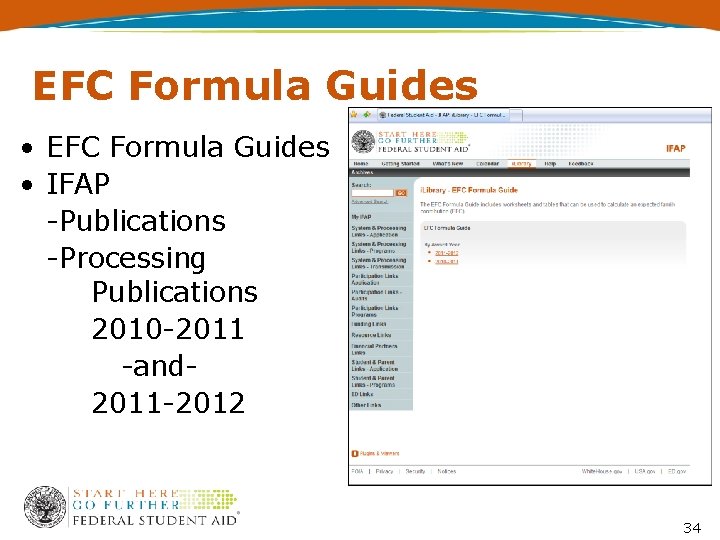
EFC Formula Guides • IFAP -Publications -Processing Publications 2010 -2011 -and 2011 -2012 34
Continuing the Conversation • Questions, Concerns, Comments ? ? ? 35
Contact Information We appreciate your feedback and comments. We can be reached at: • Phone: 214 -661 -9468 • E-mail: trevor. summers@ed. gov • Fax: 214 -661 -9662 36
- Slides: 36