
Session 2 The Gap Theory Also known as


- Slides: 38
Session 2 – The Gap Theory Also known as the ruin restoration theory (and other names) God created everything in six days and rested on the seventh day (Roughly six thousand years ago) Adam and Eve sinned and the human race and creation are subject to the curse of sin
The first world became wicked and was destroyed by a worldwide flood (Forty four hundred years ago) What is the Gap Theory? Genesis 1: 1 “In the beginning God created the heavens and the earth. The earth was without form, and void; and darkness was on the face of the deep. And the Spirit of God was hovering over the face of the waters. ”
So where is the gap in the verse? Genesis 1: 1 “In the beginning God created the heavens and the earth. ( GAP! )The earth was without form, and void; and darkness was on the face of the deep. And the Spirit of God was hovering over the face of the waters. ” This is an attempt to fit millions of years inside the Bible
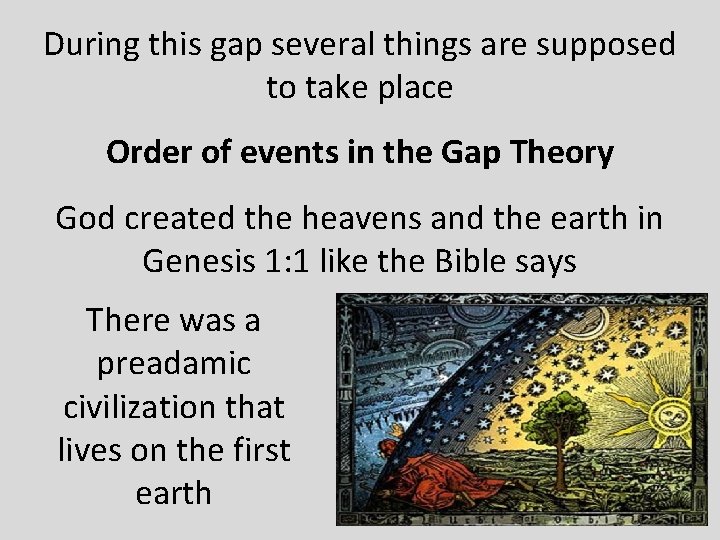
During this gap several things are supposed to take place Order of events in the Gap Theory God created the heavens and the earth in Genesis 1: 1 like the Bible says There was a preadamic civilization that lives on the first earth
During the first earth, Lucifer rebelled and was cast out of heaven, and the first earth was destroyed because of it from Lucifer's flood After the first earth was destroyed, we come back in Genesis 1: 2 when God is recreating the world that we live in now Does the Bible support this view? Why did this view come about?
Where did the Gap Theory come from? This idea of the gap theory can be traced back to the rather obscure writings of the Dutchman Episcopius (1583– 1643) It was first recorded from one of the lectures of Thomas Chalmers (1780– 1847) was a Scottish theologian and he was perhaps the man most responsible for the gap theory.
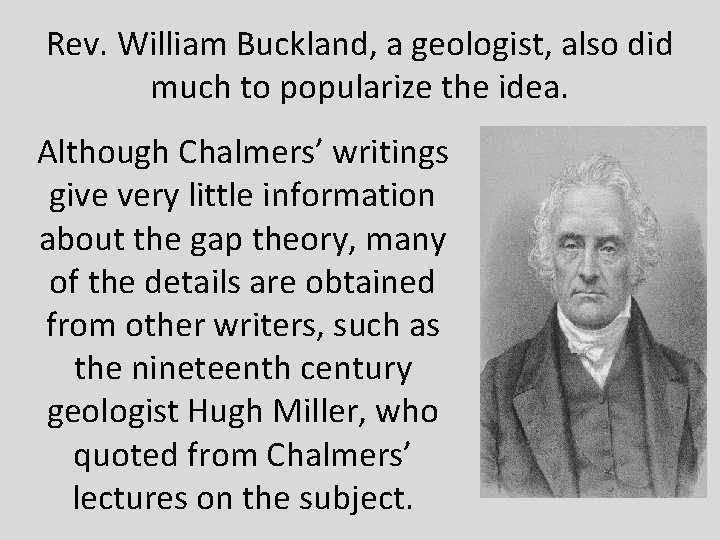
Rev. William Buckland, a geologist, also did much to popularize the idea. Although Chalmers’ writings give very little information about the gap theory, many of the details are obtained from other writers, such as the nineteenth century geologist Hugh Miller, who quoted from Chalmers’ lectures on the subject.
The most noteworthy nineteenth century writer to popularize the Gap Theory was G. H. Pember, he wrote the book Earth’s Earliest Ages which was first published in 1884. Many editions came after, the 15 th edition being published in 1942. The 20 th-century writer who wrote most in defense of the gap theory was Arthur C. Custance with his work titled Without Form and Void.
Bible study aids such as the Scofield Reference Bible, Dake’s Annotated Reference Bible, and The Newberry Reference Bible all include the gap theory in commentary and have caused many to accept it. Here are some quotes that show the reason for accepting the gap theory: Scofield Study Bible: Relegate fossils to the primitive creation, and no conflict of science with the Genesis cosmogony remains.
Dake's Annotated Reference Bible: “When men finally agree on the age of the earth, then place the many years (over the historical 6, 000) between Genesis 1: 1 and 1: 2, there will be no conflict between the Book of Genesis and science” They are not usually shy about admitting why they hold to this view, they hold to it because they think science has proven one thing, and we need to fit it in the Bible
“Evidences” for the Gap Theory “Was” or “Became” Genesis 1: 2 “The earth was without form, and void; and darkness was” They have a different interpretation Genesis 1: 2 for a Gap theorist “And the earth became without form, and void”
By reinterpreting the word “Was” as “Became” you give the impression that there was something existing before Genesis 1: 2 (The preadamic civilization according to the Gap Theory) Is this reinterpretation justified? One helpful thing to do when interpreting passages is to compare the grammar of them with other similar passages
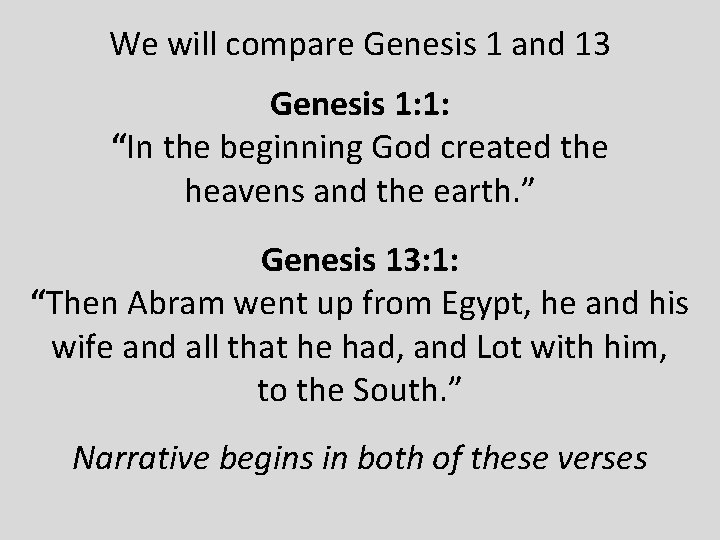
We will compare Genesis 1 and 13 Genesis 1: 1: “In the beginning God created the heavens and the earth. ” Genesis 13: 1: “Then Abram went up from Egypt, he and his wife and all that he had, and Lot with him, to the South. ” Narrative begins in both of these verses
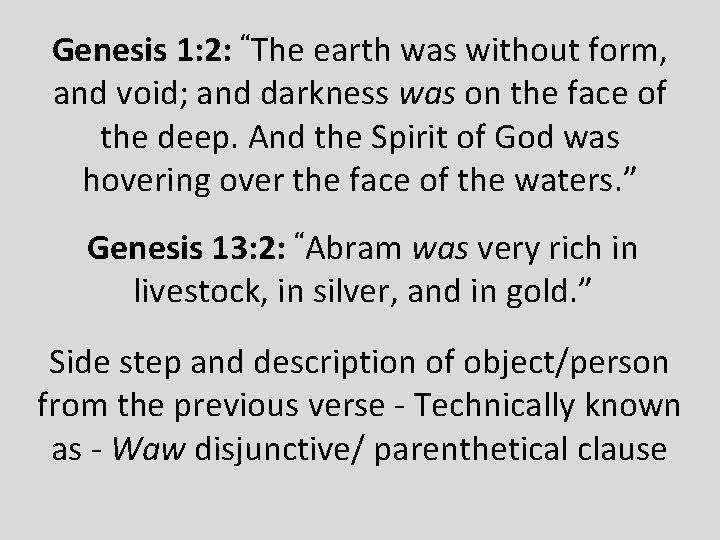
Genesis 1: 2: “The earth was without form, and void; and darkness was on the face of the deep. And the Spirit of God was hovering over the face of the waters. ” Genesis 13: 2: “Abram was very rich in livestock, in silver, and in gold. ” Side step and description of object/person from the previous verse - Technically known as - Waw disjunctive/ parenthetical clause
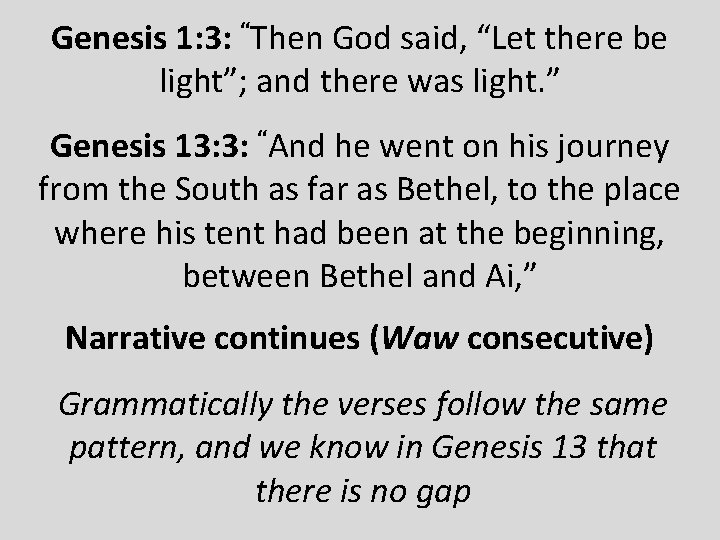
Genesis 1: 3: “Then God said, “Let there be light”; and there was light. ” Genesis 13: 3: “And he went on his journey from the South as far as Bethel, to the place where his tent had been at the beginning, between Bethel and Ai, ” Narrative continues (Waw consecutive) Grammatically the verses follow the same pattern, and we know in Genesis 13 that there is no gap
The Hebrew word that is used ‘hayah’ is best translated to “was” and not “became”. In all the standard translations of the Old Testament that is the way the verse is translated. In some occasions with an unusual situation if the context requires it the word can be translated ‘Become’, but the context in Genesis 1: 2 and most other places do not support that translation
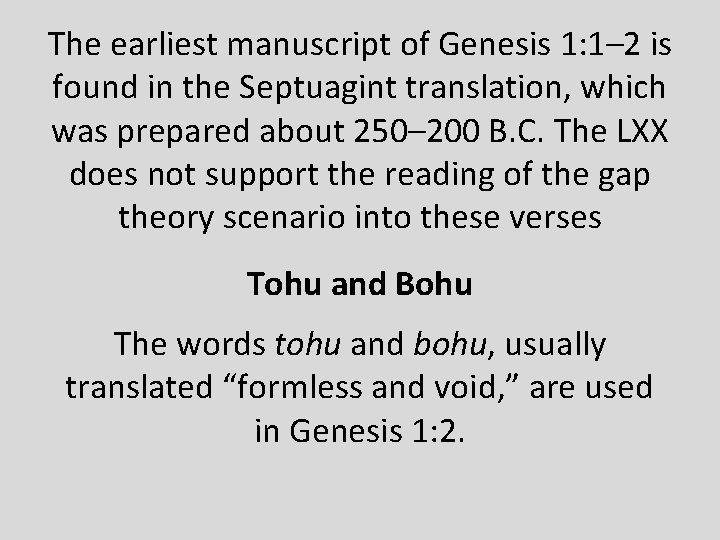
The earliest manuscript of Genesis 1: 1– 2 is found in the Septuagint translation, which was prepared about 250– 200 B. C. The LXX does not support the reading of the gap theory scenario into these verses Tohu and Bohu The words tohu and bohu, usually translated “formless and void, ” are used in Genesis 1: 2.
Gappists claim that these words imply a process of judgmental destruction and that they indicate a sinful, and therefore not an original, state of the earth. Tohu and bohu appear together in two passages outside of Genesis 1: 2 (Isaiah 34: 11 and Jeremiah 4: 23) Gappists often look at these passages to show that those words refer to judgment and destruction
It is true the expression “tohu and bohu” in Isaiah 34: 11 and Jeremiah 4: 23 speaks of a formlessness and emptiness because of divine judgment resulting from sin, this meaning however is not implicit in the expression itself but is gained from the particular contexts in which it occurs. It is not valid to infer that same meaning from Genesis 1: 2, where the context does not suggest any judgment.
An analogy would be a blank computer screen It could be blank from being erased, or just being started! tohu appears by itself in a number of other places and in all these areas simply means “formless. ” The word itself does not tell us about the cause of formlessness
Isaiah 45: 18 (often quoted by gappists) is rendered in the KJV “he created it not in vain [tohu], he formed it to be inhabited. ” In context, Isaiah is speaking about Israel, God’s chosen people, and His grace in restoring them. He did not choose His people in order to destroy them, but to be their God and for them to be His people.
Isaiah draws an analogy from God’s purpose in creating: He did not create the world for it to be empty, but formed and filled. Gappists miss the point completely when they say that because Isaiah says God did not create the world tohu, it must have become tohu later on Isaiah 45: 18 is about God’s purpose for creating, not the original state of creation.
Creation began like a ball of clay would, formless and void! And over the six days, we see the potter create a world from the formless clay. The purpose of the creation was not to be formless, and that is why God didn’t stop after the first day of creation This does not support the gap theory
Asah and Bara? Gap Theorists to differentiate between the words Create (Bara) and made (Asah) inside your Bible Genesis 1: 1 uses the word Bara to talk about the whole heaven and earth, while Genesis 1: 16 uses the word Asah to address God making the planets (Out of what was already created)
This idea has several problems though when we examine scripture here in Genesis chapter one, and in other areas of the Bible. Bara and Asah are used interchangeably Genesis 1: 26 -27 “ 26 Then God said, “Let Us make (Asah) man in Our image, according to Our likeness; let them have dominion over the fish of the sea, over the birds of the air, and over the cattle, over all the earth and over every…
creeping that creeps on the earth. ” 27 So God created (Bara) man in His own image; in the image of God He created him; male and female He created them. ” They are used interchangeably within the same verse! Not convinced yet? Genesis 1: 1 (NKJV) says: “In the beginning God created the heavens and the earth. ”
Exodus (NKJV) 20: 11 A: “For in six days the LORD made the heavens and the earth, the sea, and all that is in them” Both of these verses are referring to the same thing (God creating the heavens and the earth) but use different words The words are interchangeable
Did God say to replenish the earth? This argument isn’t made by theologians, but lay people who are confused Genesis 1: 28 ”And God blessed them, and said unto them, Be fruitful, and multiply, and replenish the earth, and subdue it” Problem: Words can change meaning over the course of time, God promised to preserve his word but he did not promise to preserve our English language
The word replenish did not mean “To fill again” until about 1632, before that it simply meant to fill something Do the events during the Gap match scripture? When did Lucifer fall from heaven? Two texts speak to Lucifer falling:
Isaiah 14: 12 -15: “How you are fallen from heaven, O Lucifer, son of the morning! How you are cut down to the ground, You who weakened the nations! For you have said in your heart: ‘I will ascend into heaven, I will exalt my throne above the stars of God; I will also sit on the mount of the congregation On the farthest sides of the north; I will ascend above the heights of the clouds, I will be like the Most High. ’ Yet you shall be brought down to Sheol, To the lowest depths of the Pit.
The less popular text discussing Lucifer's fall gives us a hint as to when the fall occurred Ezekiel 28: 13 -15: “Thou hast been in Eden the garden of God; every precious stone was thy covering, the sardius, topaz, and the diamond, the beryl, the onyx, and the jasper, the sapphire, the emerald, and the carbuncle, and gold: the workmanship of thy tabrets and of thy pipes was prepared in thee in the day that thou wast created…
…Thou art the anointed cherub that covereth; and I have set thee so: thou wast upon the holy mountain of God; thou hast walked up and down in the midst of the stones of fire. Thou wast perfect in thy ways from the day that thou wast created, till iniquity was found in thee. ” Look at the order of events inside the verse “Thou hast been in Eden the garden of God… till iniquity was found in thee. ”
Lucifer was in Eden (made on day six) until iniquity was found in him This is the only order of events that makes sense in light of other verses: Genesis 1: 31 ”And God saw every thing that he had made, and, behold, it was very good. And the evening and the morning were the sixth day. ” Everything would not be “very good”
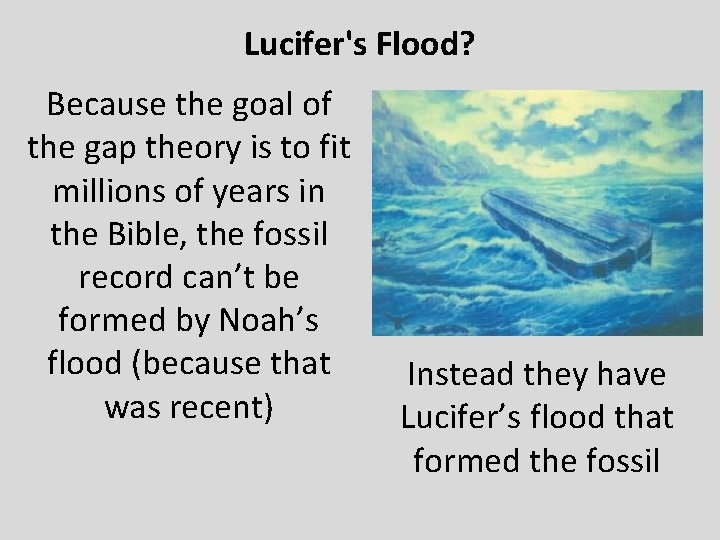
Lucifer's Flood? Because the goal of the gap theory is to fit millions of years in the Bible, the fossil record can’t be formed by Noah’s flood (because that was recent) Instead they have Lucifer’s flood that formed the fossil
If the fossil record and geologic formations we see today was formed by Lucifer’s flood, that means there is virtually no evidence for Noah’s flood A worldwide flood would certainly leave evidence (massive amounts) of the event, and because we don’t have that for Noah’s flood, they are usually forced into accepting the idea of a local flood We address that in more detail later
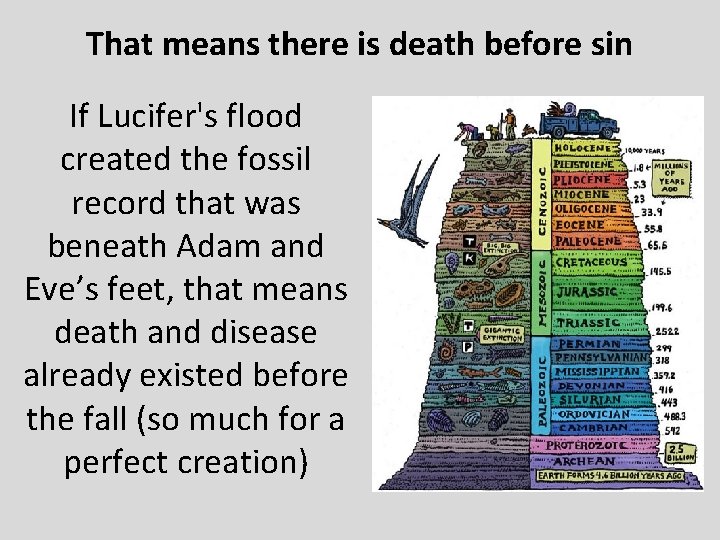
That means there is death before sin If Lucifer's flood created the fossil record that was beneath Adam and Eve’s feet, that means death and disease already existed before the fall (so much for a perfect creation)
This is the biggest doctrinal problem in the Gap Theory, if it was true, death existed before sinned enter the world To wrap it up, are we on the second earth? Revelation 21: 1: “And I saw a new heaven and a new earth: for the first heaven and the first earth were passed away” There is no scriptural support for the Gap Theory! And much scripture opposing it!
Memory Verse Revelation 21: 1 “And I saw a new heaven and a new earth: for the first heaven and the first earth were passed away”