
Session 2 Information System and its types MBA
Session 2 : Information System and its types MBA IV Semester Ashima Wadhwa
Data and Information ◦ Data are raw facts about the organization and its business transactions. Most data items have little meaning and use by themselves. ◦ Information: Data that is organized is called information.
Databases �A shared collection of logically related data designed to meet the information needs of multiple users in organization. � Database – Files – Records -- Fields
What is an Information Systems? � Interrelated components working together to ◦ ◦ Collect Process Store Disseminate information
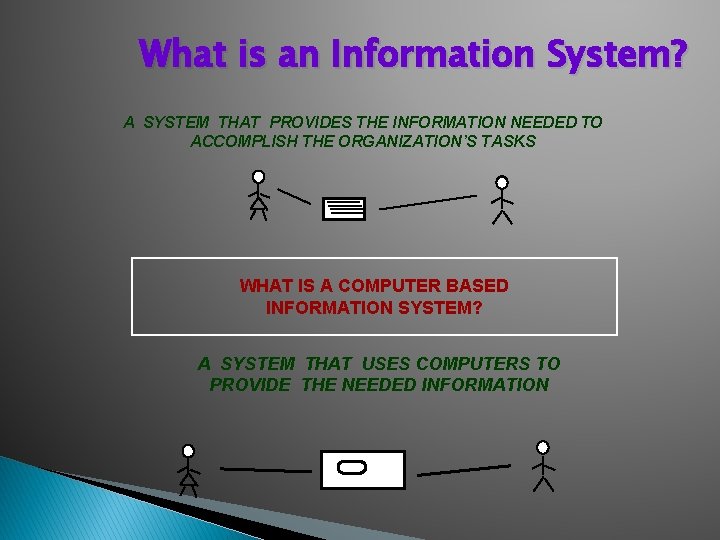
What is an Information System? A SYSTEM THAT PROVIDES THE INFORMATION NEEDED TO ACCOMPLISH THE ORGANIZATION’S TASKS WHAT IS A COMPUTER BASED INFORMATION SYSTEM? A SYSTEM THAT USES COMPUTERS TO PROVIDE THE NEEDED INFORMATION

Information System Types 1. 2. 3. 4. Transaction Processing Systems (TPS) Management Information Systems (MIS) Decision Support Systems (DSS) Expert System and Artificial Intelligence (ES &AI)
Transaction Processing Systems (TPS) � � TPS are computerized information systems that were developed to process large amounts of data for routine business transaction. Automate the handling of data about business activities and transactions, which can be thought of a simple discrete events in the life of an organization. ◦ ◦ ◦ Data about each transaction are captured, Transactions are verified and accepted/rejected, Validation transactions are stored for later aggregation. Report may be produced to provide summarization of the transactions, and Transaction may be moved from process to process in order to handle all aspects of the business activities.
Management Information Systems (MIS) � Information system at the management level of an organization that serves the functions of planning, controlling, and decision making by providing routine summary and exception reports. � It takes the relatively raw data available through a TPS and converts them into a meaningful aggregated form that mangers need to conduct their responsibilities. � Developing an MIS calls for a good understanding of what kind of information managers require and how managers use information in their jobs.
Decision Support systems (DSS) � Information system at the management level of an organization that combines data and sophisticated analytical models or data analysis tools to support semi-structured and unstructured decision making. � DSS are designed to help organizational decision make decision. � A DSS is composed of a: ◦ Database ( may be extracted from a TPS/MIS) ◦ Graphical/mathematical models for business process ◦ User interface that provides a way to communicate with DSS
Expert System and Artificial Intelligence (ES & AI) � � � Knowledge representation describes the way an expert would approach the problem. It attempts to codify and manipulate knowledge rather than information, (for example if. . Then rule) User communication with an ES via an interactive dialogue. The ES asks questions ( that an expert would ask) and the end user supplies the answers. The answers are then used to determine which rules apply and the ES provides a recommendation based on the rule. Knowledge Engineers perform knowledge acquisition; they are similar with system analyst but are trained to use different techniques.

Questions? ?
- Slides: 11