
SESSION 2 BASIC CONCEPT OF ACADEMIC WRITING SRI
SESSION 2 BASIC CONCEPT OF ACADEMIC WRITING SRI LESTARI, MA ENGLISH EDUCATION DEPARTMENT
What to discuss: 01. What is academic writing? 02. What is genre? 03. Which genres are academic? 04. What are the characteristics of academic writing?

ACADEMIC GENRE • Which of the following genres are academic? A journal article A critical review Dissertation /thesis A Research Proposal Application letter A novel A text messag e Literature review Research report Essay
DISCUSS with a person next to you … • Which academic writing genres are you familiar with? • Are there any types or genres you are unfamiliar with? • Based on the academic genres, discuss the following questions 1. How is the text structured / organised? 2. Why is the text structured / organised in this way? 3. What is the purpose of each text? 4. Who is the audience for each text? 5. What style of writing is used in each text? 6. Are distinctions between different texts always clear or sometimes blurred?
What is genre? Genres: • ‘serve the situations in which they arise’ (23) • ‘represent certain recognizable occasions’ (23) • are ‘connected to social contexts where people do things: like selling a house or finding a mate’ (24) or passing a course • are ‘not universal but cultural’ (25) 'Introducing Genre' (Giltrow, 2002)
EXERCISE • Read the extracts in your handout • Discuss to answer the questions below: 1. 2. 3. 4. 5. What kind of source do you think each text comes from? How do you know? What is the purpose of each? What audience is each aimed at? Which extracts are from ‘academic’ texts? What features of the writing distinguishes them from the ‘other’ text(s)? Consider vocabulary/terms, register (formal/informal, etc. ), sentence structure and length, length of paragraphs, linking of paragraphs, use of evidence/sources, geographical/temporal precision of contexts referred to. How can the ‘non-academic’ text be made more ‘academic’ and can some of the phrasing of the ‘non-academic’ texts be used in academic texts? Are there any features of the text(s) you’ve identified as ‘academic’ that align them with non-academic writing? Why do you think I have placed the word ‘academic’ in quotation marks? When are quotation marks used in academic writing?
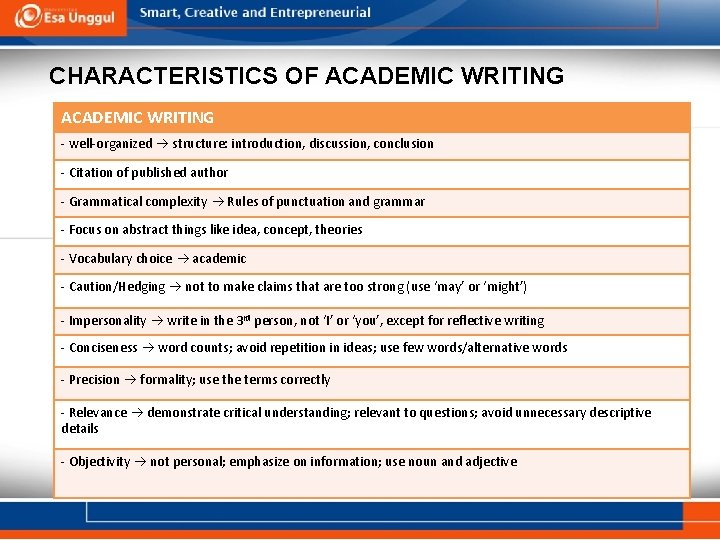
CHARACTERISTICS OF ACADEMIC WRITING - well-organized structure: introduction, discussion, conclusion - Citation of published author - Grammatical complexity Rules of punctuation and grammar - Focus on abstract things like idea, concept, theories - Vocabulary choice academic - Caution/Hedging not to make claims that are too strong (use ‘may’ or ‘might’) - Impersonality write in the 3 rd person, not ‘I’ or ‘you’, except for reflective writing - Conciseness word counts; avoid repetition in ideas; use few words/alternative words - Precision formality; use the terms correctly - Relevance demonstrate critical understanding; relevant to questions; avoid unnecessary descriptive details - Objectivity not personal; emphasize on information; use noun and adjective

CONSIDERATIONS IN ACADEMIC WRITING
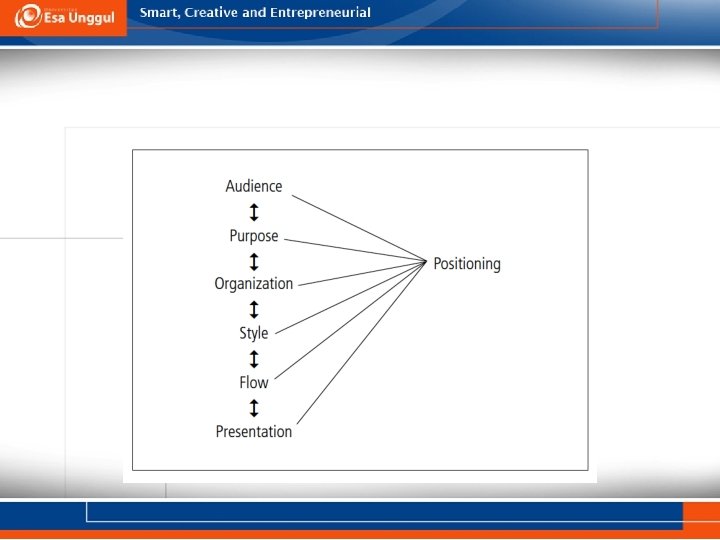
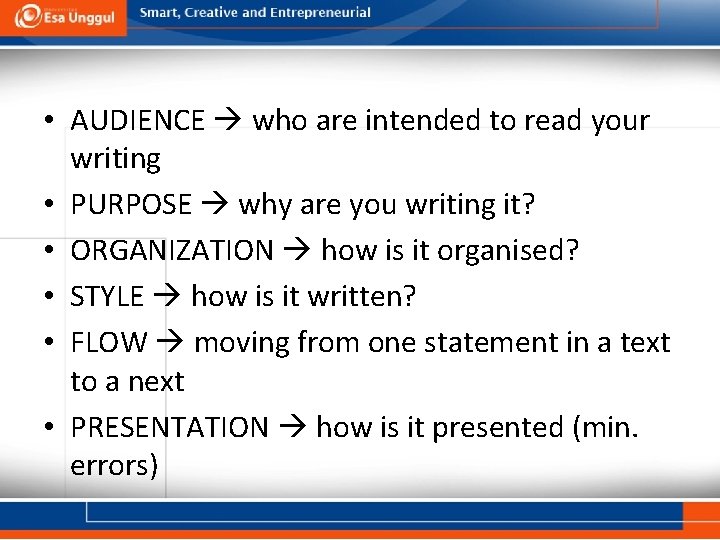
• AUDIENCE who are intended to read your writing • PURPOSE why are you writing it? • ORGANIZATION how is it organised? • STYLE how is it written? • FLOW moving from one statement in a text to a next • PRESENTATION how is it presented (min. errors)
PURPOSE • The purpose of academic writing effects: – The content: the ideas you write – The format : the lay out of your writing – The style or language used: how formal and informal you are
REFERENCES • Bowker, Natilene. (2007). Academic Writing: A Guide to Tertiary Level Writing. NZ: Student Learning Development Series of Massey University. • Giltrow, J. (2002) Academic Writing: Writing and Reading in the Disciplines. 3 rd ed. Ormskirk: Broadview press. • Swales J M and Feak C B (2004) Academic Writing for Graduate Students, 2 nd edition, University of Michigan Press. USA • Wallwork, Adrian. (2013). English for Academic Research: Writing Exercises. New York: Springer.
- Slides: 12