
Session 2 Aisling Enright Speech and Language Therapist

- Slides: 57
Session 2 Aisling Enright Speech and Language Therapist Southill Health Centre 061 410988
Week 2 o o o o o How we assess speech Phonology vs. articulation Delay vs. disorder Definition of error processes Treatment Tips on correction Games/ideas for resource time Phonological awareness Fluency Question Time
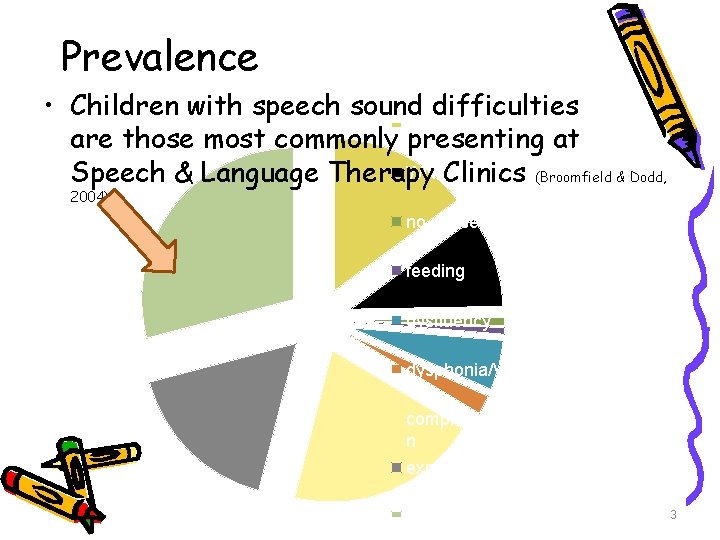
Prevalence • Children with speech sound difficulties DNA are those most commonly presenting at WNLClinics (Broomfield & Dodd, Speech & Language Therapy 2004) no consent feeding dysfluency dysphonia/VPI comprehensio n expressive speech 3
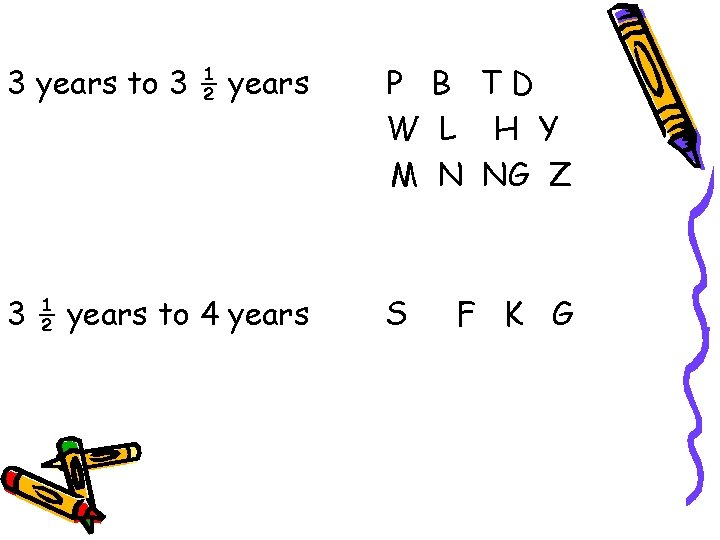
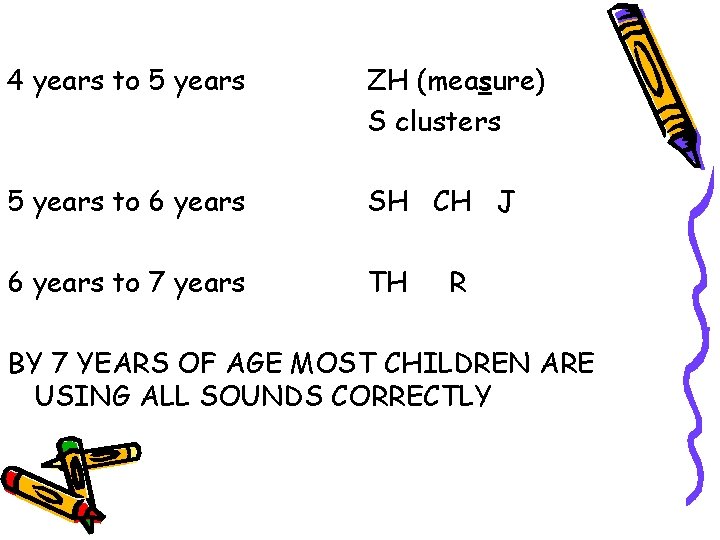
Stages of speech sound acquisition
3 years to 3 ½ years P B TD W L H Y M N NG Z 3 ½ years to 4 years S F K G
4 years to 5 years ZH (measure) S clusters 5 years to 6 years SH CH J 6 years to 7 years TH R BY 7 YEARS OF AGE MOST CHILDREN ARE USING ALL SOUNDS CORRECTLY
Assessment
Assessments used • Diagnostic Evaluation of Articulation and Phonology (DEAP) • South Tyneside Assessment of Phonology (STAP)
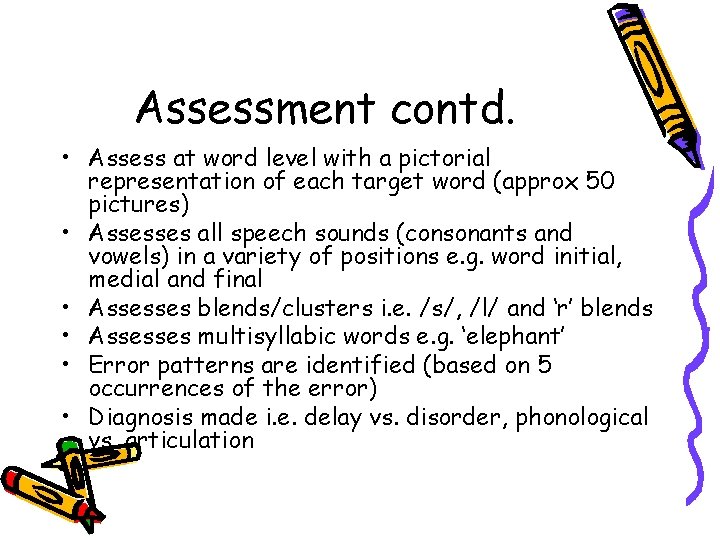
Assessment contd. • Assess at word level with a pictorial representation of each target word (approx 50 pictures) • Assesses all speech sounds (consonants and vowels) in a variety of positions e. g. word initial, medial and final • Assesses blends/clusters i. e. /s/, /l/ and ‘r’ blends • Assesses multisyllabic words e. g. ‘elephant’ • Error patterns are identified (based on 5 occurrences of the error) • Diagnosis made i. e. delay vs. disorder, phonological vs. articulation
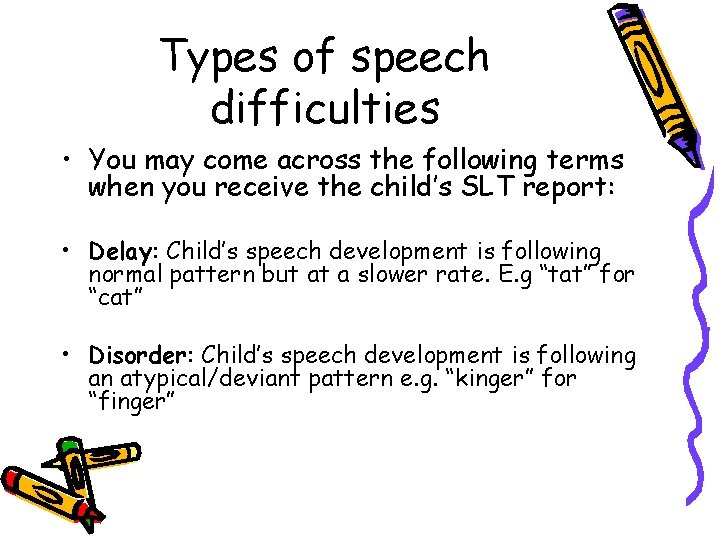
Types of speech difficulties • You may come across the following terms when you receive the child’s SLT report: • Delay: Child’s speech development is following normal pattern but at a slower rate. E. g “tat” for “cat” • Disorder: Child’s speech development is following an atypical/deviant pattern e. g. “kinger” for “finger”
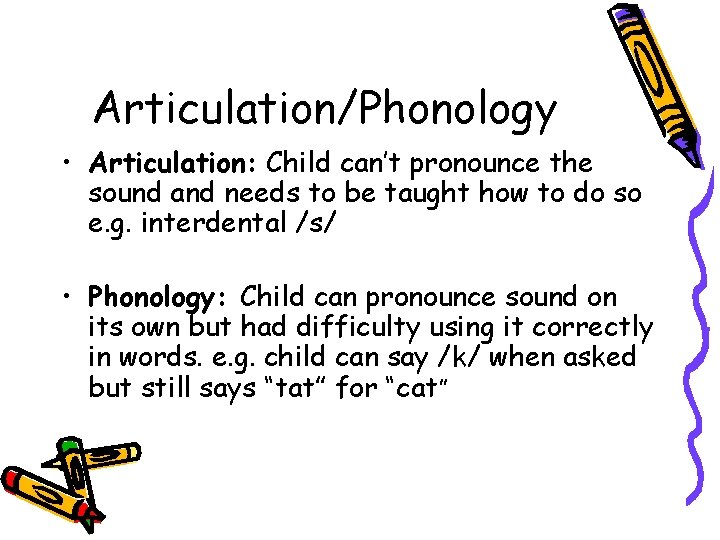
Articulation/Phonology • Articulation: Child can’t pronounce the sound and needs to be taught how to do so e. g. interdental /s/ • Phonology: Child can pronounce sound on its own but had difficulty using it correctly in words. e. g. child can say /k/ when asked but still says “tat” for “cat”
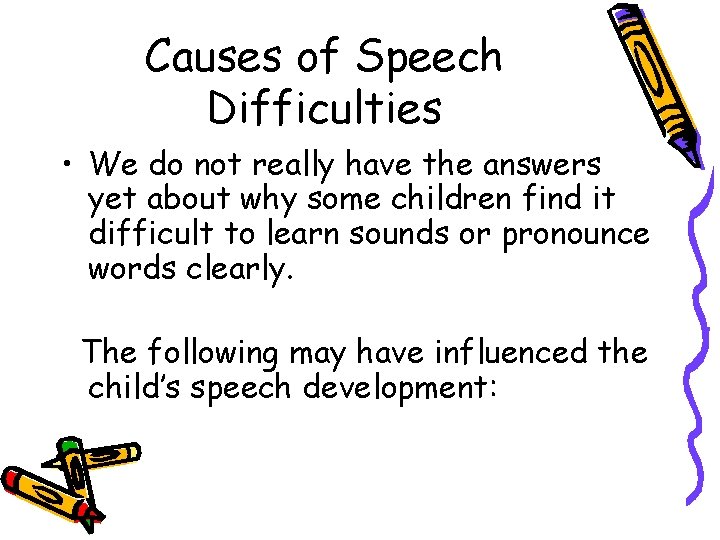
Causes of Speech Difficulties • We do not really have the answers yet about why some children find it difficult to learn sounds or pronounce words clearly. The following may have influenced the child’s speech development:
…. causes of speech difficulties • Starting to talk late. • Having a lot of colds and/or ear infections especially before the age of 12 months. • Being overactive and having poor concentration.
…. causes of speech difficulties • A family history of speech, language, reading and writing/spelling problems. • Using a dummy/soother/bottle a lot until 2½ or 3 years old. • Lack of experience of hearing others talk or being talked or listened to. • An event in the family which meant the child ‘went back to being baby’.
The following usually do not cause delays in speech development: • • Laziness. Tongue tie. Gaps in the teeth. Copying other siblings.
Articulation Therapy • Oro-motor exercises are recommended for working with articulation difficulties • This is very useful for “waking up” and exercising the speech muscles prior to speech therapy
Stages of teaching sounds • • • Sound in isolation CV syllables – fee, fah, fay Words - fog, fun etc… Phrases/sentences Carryover in stories, quiz, conversation etc….
Prior to therapy – What can I do? • If the child cannot produce the sound, e. g. ‘k’, model the sound for your child and await SLT contact. The SLT may check to see if the child can identify words beginning with ‘k’ as they may have difficulty hearing the difference between ‘k’ and the sound they are using instead e. g. ‘t’. • Do not correct the child’s speech or ask the child to “say the sound properly". This will not help the child and may lead to unnecessary anxiety • Do model the correct sound for the child, i. e. - Let them hear you say the sound correctly Example: Child: I lost my sot. Parent: Oh you lost your sock?
Phonological Therapy • If the child has a phonological delay/disorder we use a variety of cues to help the child repair their speech errors • Example; Child say ‘that’s a tat’ • You say ’Is it a tat or a ‘CAT’ • If child says ‘tat’ your next cue is ‘oh you mean a cat’ (with emphasis on the ‘k’) • If the child says ‘cat’ correctly you positively reinforce him/her and say ‘yes you’re right it is a cat’ • If the child is achieving success at this level you should continue to monitor and correct at every given opportunity
Targeting Speech Errors • Listen to “what” the child is saying and not “how” - avoid over correction of errors as anxiety may lead to avoidance. • Model the correct way of saying the word. • Repetition of error: Repeat the error and allow the child time to self-correct. If s/he still has difficulty correcting this error then try:
Targeting Speech Errors • Forced alternatives where you give the child the choice between the correct and incorrect form e. g. child says: “boon” You: Ask is it “boon or spoon? ” • Reinforcement - “your finger is sore”, highlight words occurring daily, promote the words in play activities
Tips to help the child in school 1) Timing: Doing work for 5 -10 (maximum) minutes each day is much better than 50 minutes once a week. 2) Designate a specific time for speech work 3) Only work at the level suggested to you by your therapist, e. g. You should not expect the child to be using a sound appropriately in conversation if they are still working at syllable and word level.
Tips to help the child in school 4) Make practise fun and motivating. Keeping charts or giving stickers, stars etc can be a great way of allowing your child to see their progress 5) If the child is attempting the work but failing, let the child know they are not achieving their target sound in a positive way i. e. ‘good try but that was your old sound’. 6) Keep a diary of how the child is making sounds to monitor progress.
Tips to help your child in school 7) If the child is sick/tired/upset working on speech sounds is not advised. 8) Monitor your own behaviours, avoid working on speech with the child if you are feeling stressed or anxious 9) Also, avoid working on speech sounds at particular times when the child may be ‘missing out’ on something e. g. P. E. , music class etc
MAKING PRACTISE FUN • Use The Argos Catalogue, magazines, Toy catalogues etc. to find pictures of words with the sounds you and the child are working on. Use pairs of pictures to play ‘snap’. • Use pairs of pictures to play ‘fish’, a memory game where all the pictures are placed face down. Each player takes turning 2 cards over in an attempt to find a pair. The picture turned over must be named by that player.
…MAKING PRACTISE FUN • Hide pictures in a room i. e. under cushions, on book shelves, on top of the computer etc. and then ask the child to find them all! Each word must be said X 3 when it is found. • Spread Pictures out on the floor. Use a beanbag/soft object and ask the child to throw it and say the picture it lands on.
…MAKING PRACTISE FUN • Colouring; allow the child to colour in one segment of the picture for practising a certain amount of words a certain amount of times e. g. say these 5 words and then you can colour in the clowns hat.
…MAKING PRACTISE FUN • Lucky Dip; Use your pictures/objects and put them in a container. Take it in turns to ‘have a dip’ and say the pictures as you pull them out. You might choose one picture as the winning one and have a race to find this one. • Use skittles, board games etc. Use the number of skittles that are knocked down or the number thrown on the dice to dictate how many words/sounds a child has to practise.
Phonological Awareness
Phonological awareness • Phonological awareness is awareness of sounds within words and therefore phonological awareness training aims to give the child access to the sounds within words. It is auditory based. The child is taught to discriminate, segment and blend sounds – E. g. what is the first/last/medial sound in ‘cat’ – If you take the first sound away from ‘cat’ and replace it with ‘s’, what word do you get?
Phonological Awareness • Phonics is the last stage of phonological awareness where training is aimed at letter to sound correspondence enabling children to encode and decode thus read and write. • Children who have had speech sound difficulties (specifically phonological) are more likely to have reading and spelling difficulties.
Why is Phonological Awareness important? • Phonological awareness is the strongest predictor of success in early reading. • 35% of the children who enter primary school have not naturally acquired phonological awareness and need to be taught these skills. • Phonological awareness allows children to play with blending, segmenting and manipulating sounds prior to having to do this with the additional knowledge required to blend, segment and manipulate letters into words in isolation or text.
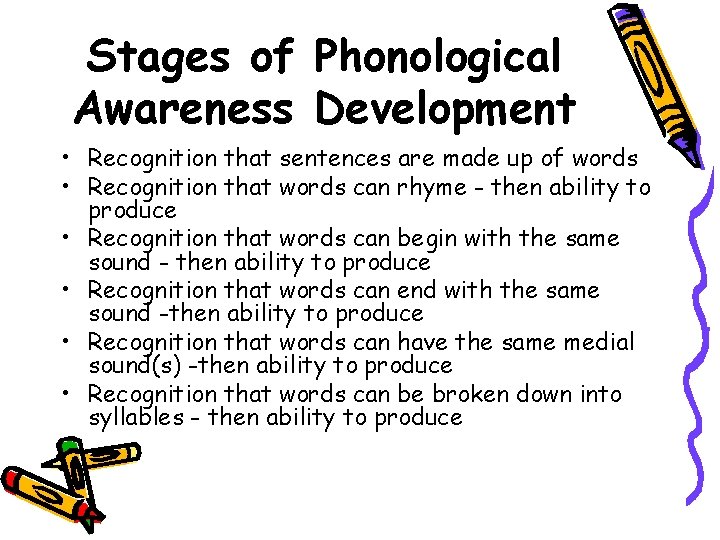
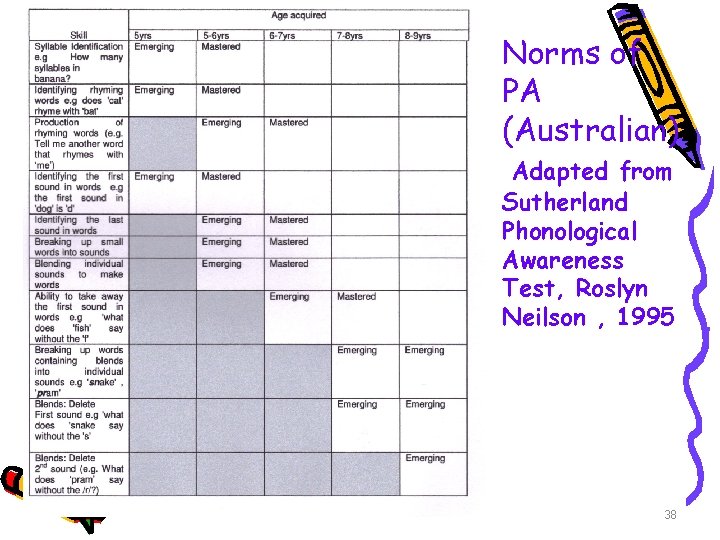
Stages of Phonological Awareness Development • Recognition that sentences are made up of words • Recognition that words can rhyme - then ability to produce • Recognition that words can begin with the same sound - then ability to produce • Recognition that words can end with the same sound -then ability to produce • Recognition that words can have the same medial sound(s) -then ability to produce • Recognition that words can be broken down into syllables - then ability to produce
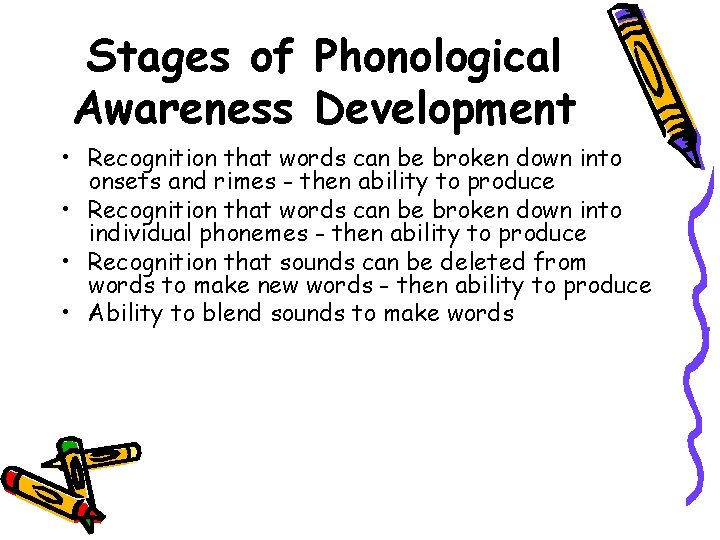
Stages of Phonological Awareness Development • Recognition that words can be broken down into onsets and rimes - then ability to produce • Recognition that words can be broken down into individual phonemes - then ability to produce • Recognition that sounds can be deleted from words to make new words - then ability to produce • Ability to blend sounds to make words
Working on P. A. • See handout for games and ideas
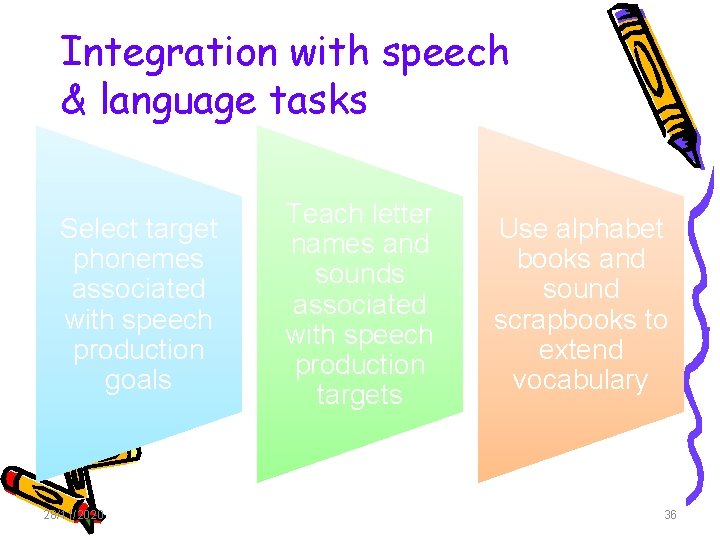
Integration with speech & language tasks Select target phonemes associated with speech production goals 28/11/2020 Teach letter names and sounds associated with speech production targets Use alphabet books and sound scrapbooks to extend vocabulary 36
Impact of speech/language difficulties on literacy • Dodd & Gillon (2005) • Children with speech/language impairment 4 -5 times more likely to experience reading/spelling problems • 50 -70% of children with spoken language impairment present with academic difficulties in adolescence • Children with disorder rather than delay are more likely to have persisting difficulties • Phonological processing profiles of children with speech impairment are similar to those of children identified as at risk of dyslexia but with no diagnosed speech impairment 13/11/2008 37
Norms of PA (Australian) Adapted from Sutherland Phonological Awareness Test, Roslyn Neilson , 1995 38
Fluency
General information on stammering • Involuntary repetitions or stoppages of sounds which occur so often that they interfere with the ability to communicate adequately or cause distress to either the speaker or the listener. • Commonly occurs between the ages of 2 – 6 years. • 4 times more common in males
General information on stammering • Can affect anyone regardless of intelligence, social background, personality or race. • No single cause and a combination of factors are involved. • Early detection is invaluable.
What is normal nonfluency? • • • Whole word repetitions Phrase repetitions Easy Hesitations Revisions Interjections Occur mostly when tired/excited/upset/using new words
What is normal non-fluency ‘at risk’ / stammering? • • Family History 1 year post onset Associated speech/language problems Associated emotional/behavioural difficulties
What is ‘stammering’? • Prolongations/Blocking • Part-word repetitions/multiple repetitions • Use of schwa vowels • Avoidance • Struggle/poor eye contact • Awareness/anxiety/fear
What Causes Stammering? • There are many theories but no one theory has been accepted as being able to explain stammering: - Psychoanalytic theory - Learning theory - Physiological theory
Psychoanalytic Theory • Popular in the 1940’s, but finds less support today. • Stammering is caused by higher levels of anxiety, more problems in social adjustment and lower self -esteem • Currently experts feel these traits may be the results rather than the cause of stammering – Does anxiety cause stammering Does stammering cause anxiety? ? ?
Learning Theory • Stammering is a learned behaviour: - a child who is punished in some way for repeating words and hesitating while speaking may experience fear and anxiety each time the stammering occurs; - soon even the expectation of stammering makes the child afraid and this fear of stammering makes the child stammer more (this leads to avoiding words and situations)
Physiological Theory • Something different exists in the physical make-up of the person who stammers (difficulties controlling speech muscles, inability to use the correct timing needed for fluent speech).
The demands/capacity model. . • Weigh up what stresses/demands are causing the stammer and what you can do to alleviate the stress – Demands: (what factors contribute to stammer increasing) – Capacities: (what needs to be taken into account) *If the demands placed on the child exceeds their capacity for communicating, then the stammer may increase.
Demands. . • Demands: (what factors contribute to stammer increasing) Communication style of parent/child minder/preschool teacher Speaking situation the child is in Family pressures/stresses Lifestyle High expectations of speech behaviours
Capacities… • Capacities: (what needs to be taken into account) Genetic factors – family history Language skills – associated speech and/or language difficulties Associated emotional/behavioural difficulties *Need to balance demands with capacities.
Indirect management (NNF) • Reduce anxieties/stresses by: - adopting non-reacting attitude to the child’s non-fluency. - avoid pressure (it is better to relax and listen) • Monitor daily routine lifestyle: - maintain a calm and happy environment • Monitor speaking situations: - listen, face to face, be interested - remind others this is a normal phase (no teasing or laughing)
Indirect management (NNF) • Change your communication style: - reduce number of questions - turn-taking and allow time to respond (take 5 seconds before responding) - maintain eye-contact - listen to what your child says and not how he says it - use a slower, relaxed way of speaking yourself - use short sentences when speaking to your child - avoid asking question requiring long answers i. e. avoid why/how and ask yes/no type questions - listen more, speak less - don’t finish their sentences
Indirect management (NNF) • Use talk-time situations – (one-to-one) – 15/20 minutes a day – Incorporate changing your communication style into this time • Encourage your child to discuss worries / anxieties about his speech with you.
Therapy • There is no guaranteed cure for stammering, but therapy can help to increase confidence and self-esteem, lessen the amount of stammering, and improve individual lifestyles. • The Lidcombe Program of Early Stammering Intervention
Question Time!!
Next session 23/02/10 • Areas of language: – Syntax – Morphology – Semantics • Differentiating between the areas • Norms of development for each area • Tips for working on each area for all age groups with sample programmes