
Session 2 a Overview Sensitivity Analysis Goal Seek






















- Slides: 52
Session 2 a
Overview • Sensitivity Analysis – Goal Seek and Data Table – Marketing and Finance examples • Call Center LP • More Sensitivity Analysis – Solver. Table Decision Models -- Prof. Juran 2
Sensitivity Analysis • How do key outputs change in response to changes in inputs? • Which inputs are the most important? • How robust is our decision? Decision Models -- Prof. Juran 3
Finance Example • A European call option on a stock earns the owner an amount equal to the price at expiration minus the exercise price, if the price of the stock on which the call is written exceeds the exercise price. Otherwise, the call pays nothing. • A European put option earns the owner an amount equal to the exercise price minus the price at expiration, if the price at expiration is less than the exercise price. Otherwise the put pays nothing. Decision Models -- Prof. Juran 4
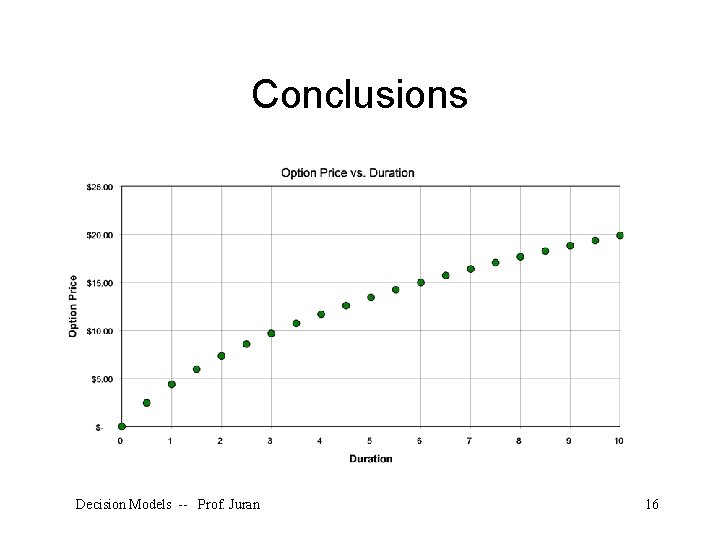
Finance Example • The Black-Scholes formula calculates the price of a European options based on the following inputs: – – – today's stock price the duration of the option (in years) the option's exercise price the risk-free rate of interest (per year) the annual volatility (standard deviation) in stock price Decision Models -- Prof. Juran 5
Managerial Problem Definition How do the parameters in Black-Scholes affect the option price? Decision Models -- Prof. Juran 6
Formulation Decision Models -- Prof. Juran 7
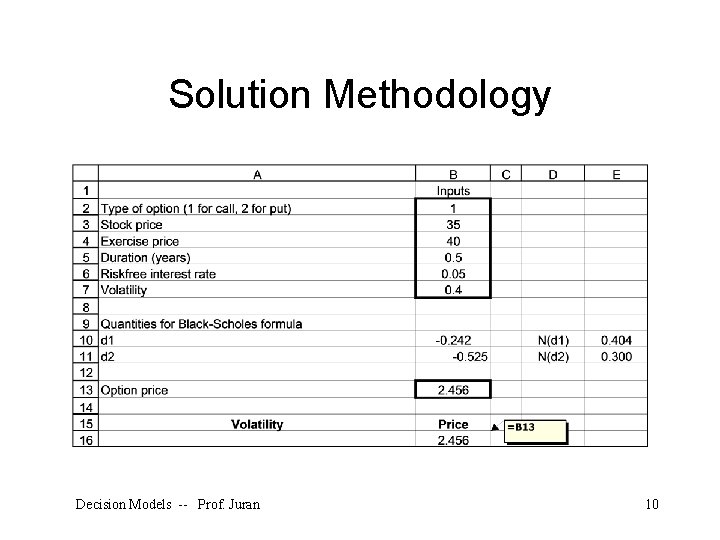
Solution Methodology Notice the use of “if” statements in cells E 10: E 11 and B 13, so that the same model can be used for both puts and calls. Decision Models -- Prof. Juran 8
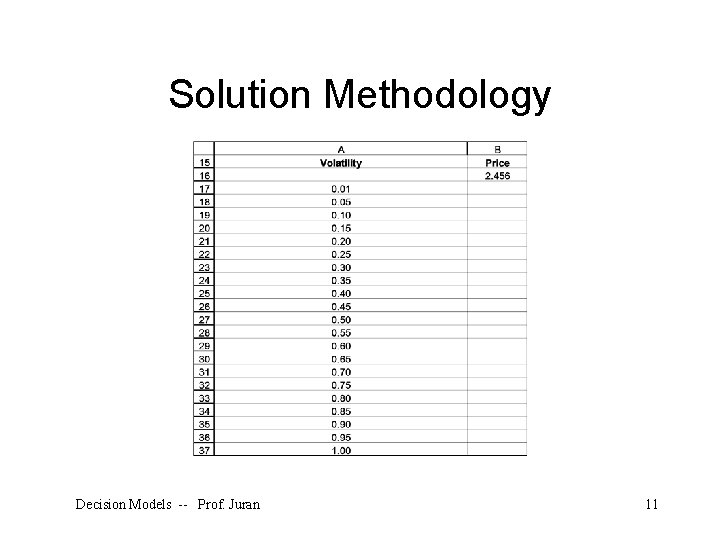
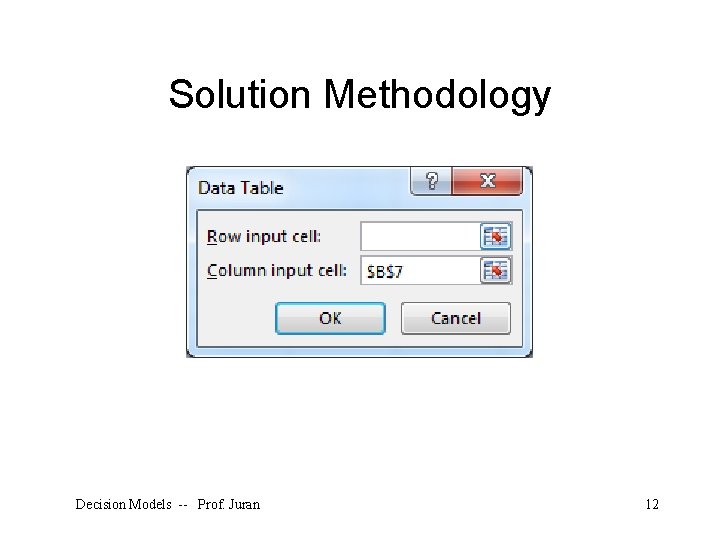
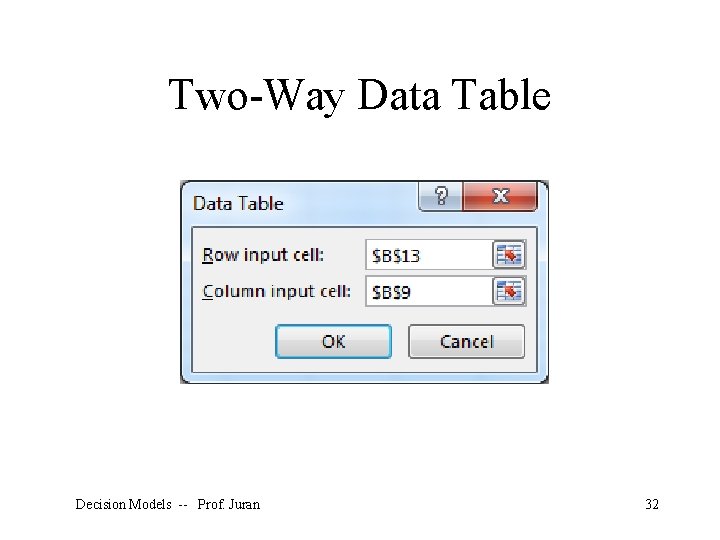
Data Table • Similar to copying a formula over many cells, but better for complicated functions (e. g. Black-Scholes) • Specify Row and/or Column Input Cells • Tricky to learn, but worth it Decision Models -- Prof. Juran 9
Solution Methodology Decision Models -- Prof. Juran 10
Solution Methodology Decision Models -- Prof. Juran 11
Solution Methodology Decision Models -- Prof. Juran 12
Solution Methodology Decision Models -- Prof. Juran 13
Conclusions Decision Models -- Prof. Juran 14
Conclusions Decision Models -- Prof. Juran 15
Conclusions Decision Models -- Prof. Juran 16
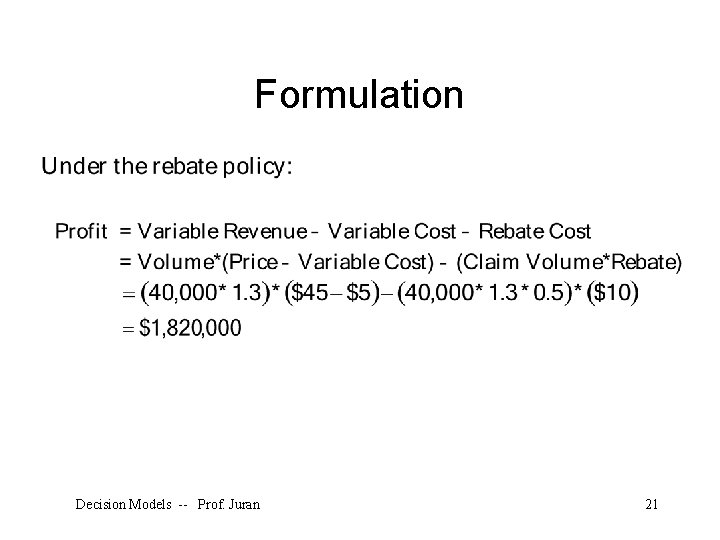
Marketing Example • Microsoft is trying to determine whether to give a $10 rebate, a $6 price cut, or have no price change on a software product. • Currently 40, 000 units of the product are sold each week for $45. • The variable cost of the product is $5. • The most likely case appears to be that a $10 rebate will increase sales 30% and half of all people will claim the rebate. • For the price cut, the most likely case is that sales will increase 20%. Decision Models -- Prof. Juran 17
Managerial Problem Definition Under what circumstances should Microsoft offer the rebate, and under what circumstances should they offer the price cut? (Or should they do neither? ) Decision Models -- Prof. Juran 18
Formulation Decision variables: 3 possible marketing policies. Objective: Maximize Profit. Constraints: Various assumptions have been made (current sales level, current cost structure, consumer behavior in response to marketing policies). Decision Models -- Prof. Juran 19
Formulation Decision Models -- Prof. Juran 20
Formulation Decision Models -- Prof. Juran 21
Formulation Decision Models -- Prof. Juran 22
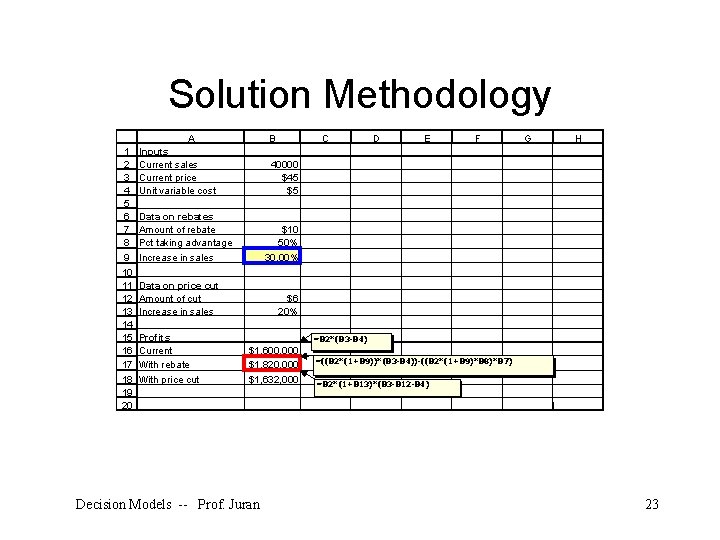
Solution Methodology 1 2 3 4 5 6 7 8 9 10 11 12 13 14 15 16 17 18 19 20 A Inputs Current sales Current price Unit variable cost B D E F G H 40000 $45 $5 Data on rebates Amount of rebate Pct taking advantage Increase in sales $10 50% 30. 00% Data on price cut Amount of cut Increase in sales Profits Current With rebate With price cut C $6 20% =B 2*(B 3 -B 4) $1, 600, 000 $1, 820, 000 $1, 632, 000 Decision Models -- Prof. Juran =((B 2*(1+B 9))*(B 3 -B 4))-((B 2*(1+B 9)*B 8)*B 7) =B 2*(1+B 13)*(B 3 -B 12 -B 4) 23
• Under current assumptions, the rebate policy appears to be optimal. • How sensitive is this result to possible errors in our assumptions? • Specifically, how wrong could we be as to the 30% assumption and still be correct in using the rebate? • What is the point of indifference between the rebate and the price cut? Decision Models -- Prof. Juran 24
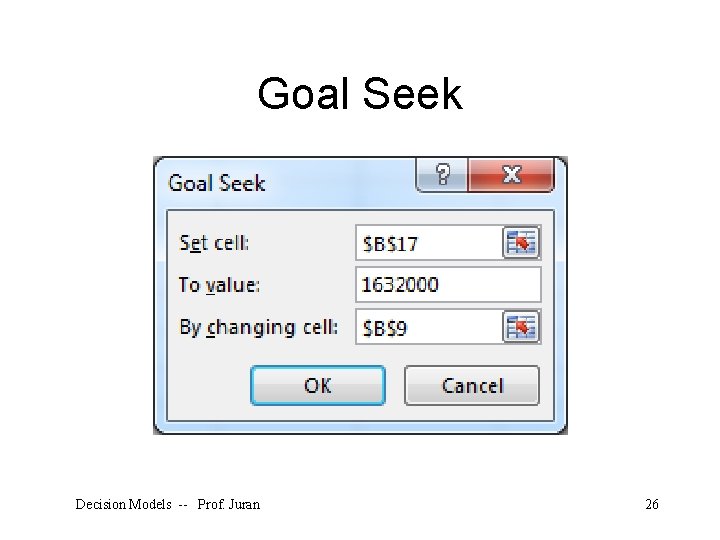
Goal Seek • Similar to Solver, but simpler • Specify a Target Cell and a Changing Cell • “Value” must be a number (not a cell reference) Decision Models -- Prof. Juran 25
Goal Seek Decision Models -- Prof. Juran 26
Solution Methodology Decision Models -- Prof. Juran 27
Conclusions and Recommendations • Go with the rebate as long as the increase in sales is expected to be at least 16. 57%. • Under current assumptions, Microsoft would earn $1, 820, 000 profit (an improvement of $220, 000). Decision Models -- Prof. Juran 28
What If? • Important parameters are not known; they are only estimates. • How robust is the rebate strategy? Decision Models -- Prof. Juran 29
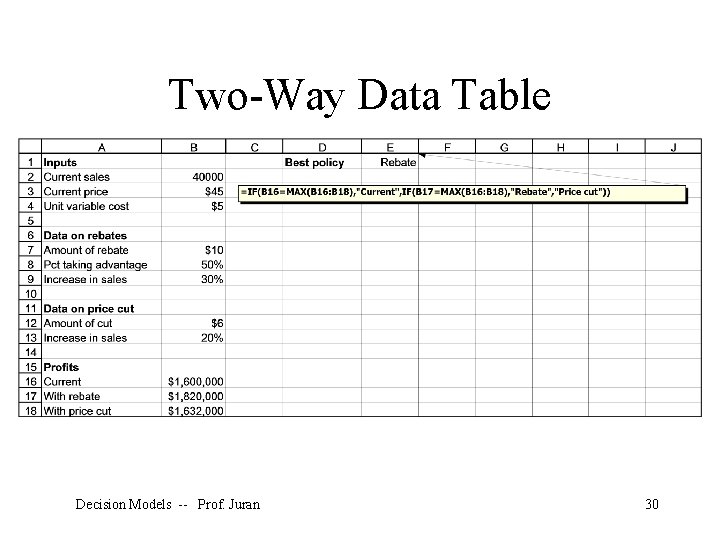
Two-Way Data Table Decision Models -- Prof. Juran 30
Two-Way Data Table A 1 2 3 4 5 6 7 8 9 10 11 12 13 14 15 16 17 18 Inputs Current sales Current price Unit variable cost B C 40000 $45 $5 Data on rebates Amount of rebate Pct taking advantage Increase in sales $10 50% 30% Data on price cut Amount of cut Increase in sales $6 20% Profits Current With rebate With price cut D Best policy E Rebate F G H I J =IF(B 16=MAX(B 16: B 18), "Current", IF(B 17=MAX(B 16: B 18), "Rebate", "Price cut")) Two-way data table for best policy Increase from rebate (along side) and from price cut (along top) Rebate 10% 15% 20% 25% 30% 15% 20% =E 1 25% 30% 35% 40% $1, 600, 000 $1, 820, 000 $1, 632, 000 Decision Models -- Prof. Juran 31
Two-Way Data Table Decision Models -- Prof. Juran 32
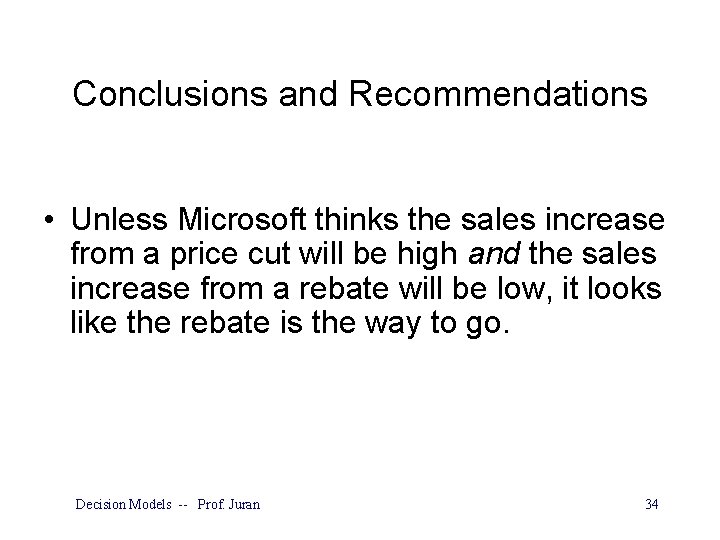
Two-Way Data Table 1 2 3 4 5 6 7 8 9 10 11 12 13 14 15 16 17 18 A Inputs Current sales Current price Unit variable cost B C 40000 $45 $5 Data on rebates Amount of rebate Pct taking advantage Increase in sales $10 50% 30% Data on price cut Amount of cut Increase in sales $6 20% Profits Current With rebate With price cut D Best policy E Rebate F G H I J =IF(B 16=MAX(B 16: B 18), "Current", IF(B 17=MAX(B 16: B 18), "Rebate", "Price cut")) $1, 600, 000 $1, 820, 000 $1, 632, 000 Decision Models -- Prof. Juran Two-way data table for best policy Increase from rebate (along side) and from price cut (along top) Rebate 10% 15% 20% 25% 30% 15% Rebate Price cut 20% =E 1 Rebate Price cut 25% Rebate Price cut 30% Rebate Rebate 35% Rebate Rebate 40% Rebate Rebate Unless Microsoft thinks the sales increase from a price cut will be high and the sales increase from a rebate will be low, it looks like the rebate is the way to go. 33
Conclusions and Recommendations • Unless Microsoft thinks the sales increase from a price cut will be high and the sales increase from a rebate will be low, it looks like the rebate is the way to go. Decision Models -- Prof. Juran 34
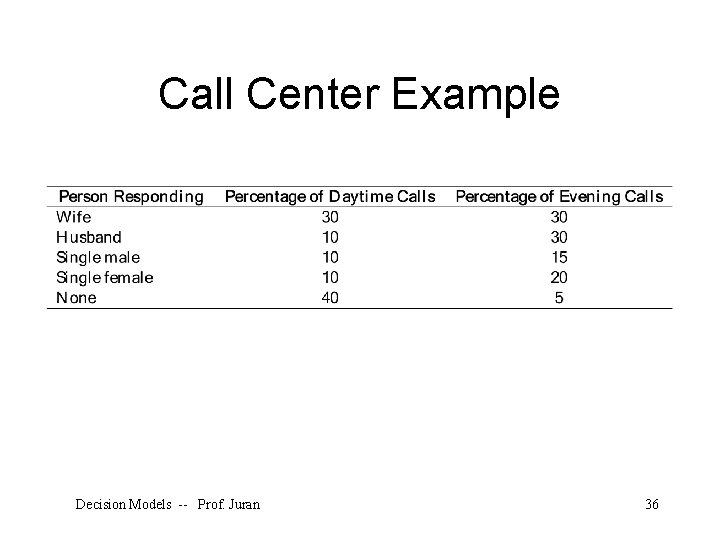
Call Center Example • For a telephone survey, a marketing research group needs to contact at least 150 wives, 120 husbands, 100 single adult males, and 110 single adult females. • It costs $2 to make a daytime call and (because of higher labor costs) $5 to make an evening call. • Because of a limited staff, at most half of all phone calls can be evening calls. Decision Models -- Prof. Juran 35
Call Center Example Decision Models -- Prof. Juran 36
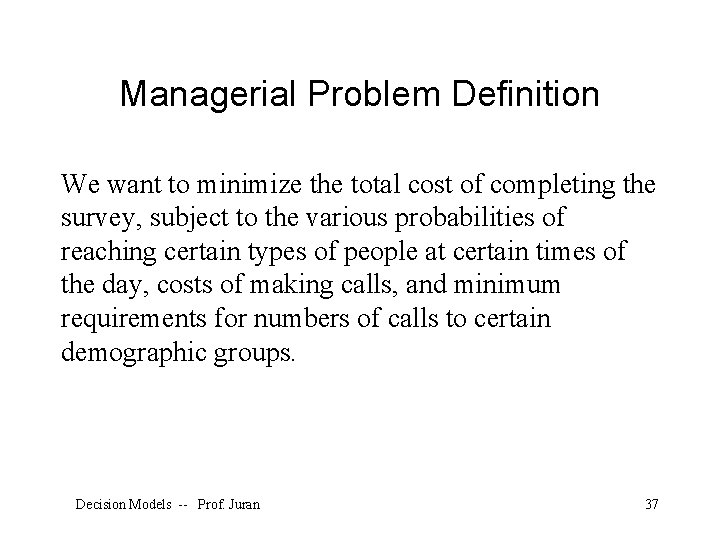
Managerial Problem Definition We want to minimize the total cost of completing the survey, subject to the various probabilities of reaching certain types of people at certain times of the day, costs of making calls, and minimum requirements for numbers of calls to certain demographic groups. Decision Models -- Prof. Juran 37
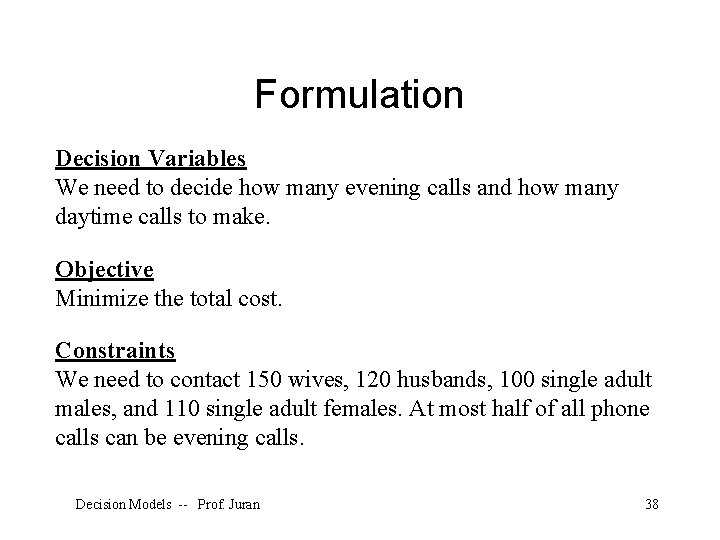
Formulation Decision Variables We need to decide how many evening calls and how many daytime calls to make. Objective Minimize the total cost. Constraints We need to contact 150 wives, 120 husbands, 100 single adult males, and 110 single adult females. At most half of all phone calls can be evening calls. Decision Models -- Prof. Juran 38
Formulation Decision Variables X 1 = Daytime Calls, X 2 = Evening Calls Objective Minimize Z = 2 X 1 + 5 X 2 Constraints 0. 30 X 1 + 0. 30 X 2 ≥ 150 0. 10 X 1 + 0. 30 X 2 ≥ 120 0. 10 X 1 + 0. 15 X 2 ≥ 100 0. 10 X 1 + 0. 20 X 2 ≥ 110 1 X 1 ≥ 1 X 2 1 X 1, 1 X 2 ≥ 0 Decision Models -- Prof. Juran 39
Solution Methodology Decision Models -- Prof. Juran 40
Solution Methodology Decision Models -- Prof. Juran 41
Solution Methodology Decision Models -- Prof. Juran 42
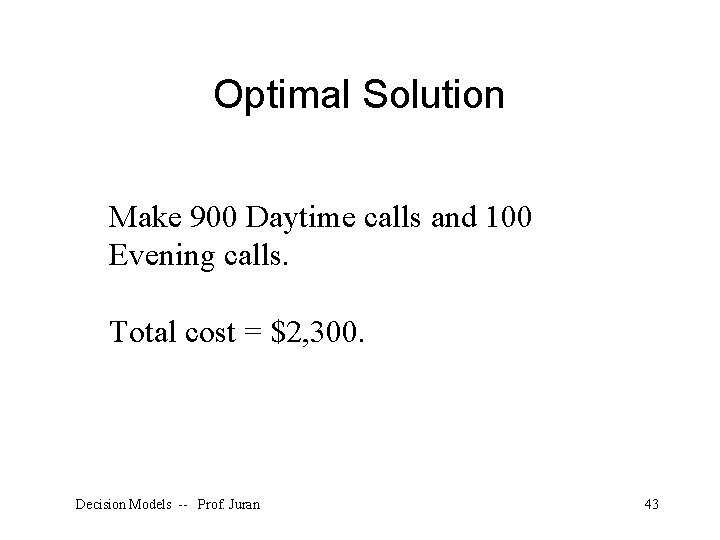
Optimal Solution Make 900 Daytime calls and 100 Evening calls. Total cost = $2, 300. Decision Models -- Prof. Juran 43
Solver. Table • Similar to Data Table; works with Solver • Solves optimization problems repeatedly and automatically • One or two inputs can be varied Decision Models -- Prof. Juran 44
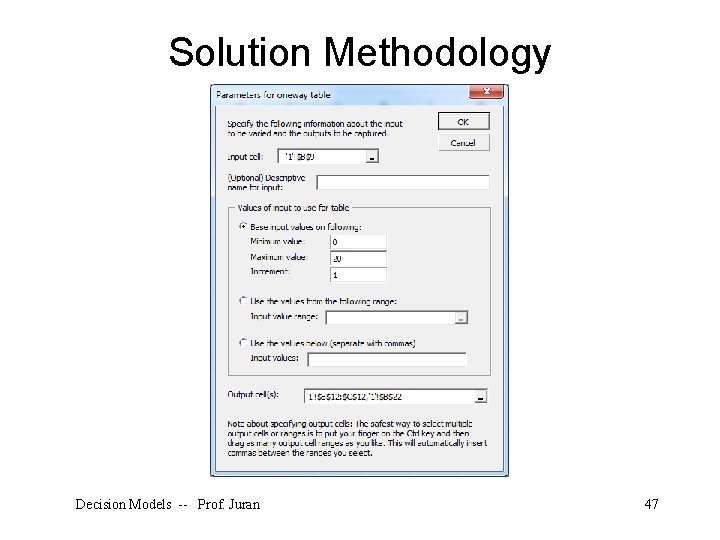
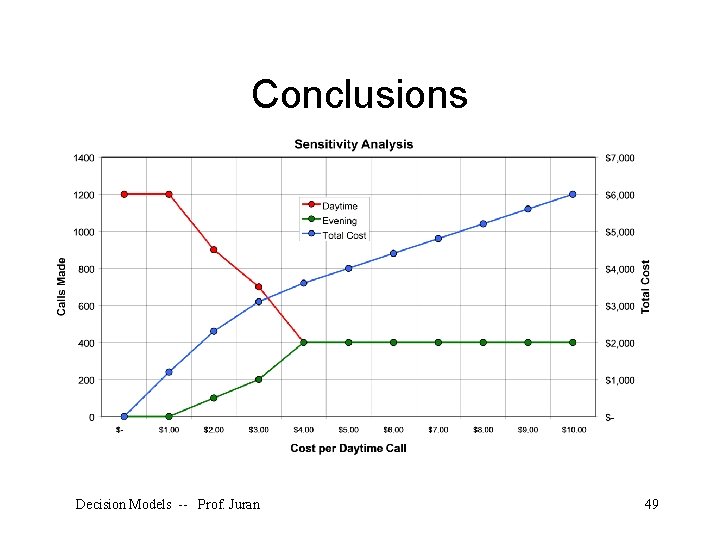
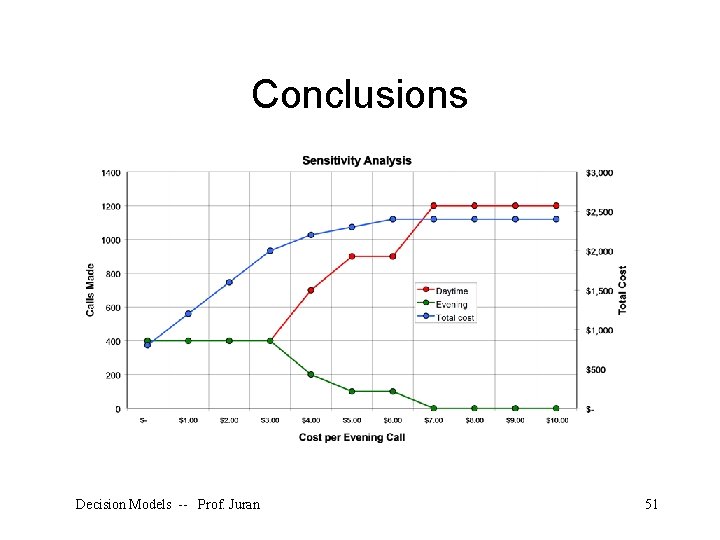
Example: Sensitivity to Calling Costs • Starting with the optimal solution to the initial problem, use the Solver. Table add-in to investigate changes in the unit cost of either type of call. • Specifically, investigate changes in the cost of a daytime call, with the cost of an evening call fixed, to see when (if ever) only daytime calls or only evening calls will be made. Decision Models -- Prof. Juran 45
Solution Methodology Decision Models -- Prof. Juran 46
Solution Methodology Decision Models -- Prof. Juran 47
Solver. Table Output Decision Models -- Prof. Juran 48
Conclusions Decision Models -- Prof. Juran 49
Conclusions If daytime calls are very inexpensive, we can dispense with evening calls altogether. However, we will always have to make at least 400 daytime calls, no matter how expensive they are. Decision Models -- Prof. Juran 50
Conclusions Decision Models -- Prof. Juran 51
Summary • Sensitivity Analysis – Goal Seek and Data Table – Marketing and Finance examples • Call Center LP • More Sensitivity Analysis – Solver. Table Decision Models -- Prof. Juran 52