
Session 2 3 Market Segments Customer Value group
















- Slides: 66
Session 2 & 3 Market, Segments & Customer Value group 3
2 Recap….
3 Market Segments Target Market Niche Market Mass Marketing Customization Mass Customization Forms of Competition – Direct – Indirect
4 Markets & Competitive Space
5 Markets And Competitive Space Markets and Strategies Product-Market Scope and Structure Describing and Analyzing End-Users Analyzing Competition Developing a Strategic Vision about the Future Market Size Estimation
6 Markets And Competitive Space The Challenges ― Markets are increasingly complex, turbulent, and interrelated. Importance of a broad view of the market. Essential to develop a vision about how the market is likely to change in the future. Continuous Monitoring is Necessary to: Find promising opportunities Identify shifts in value requirements Understand competitors’ positioning Guide targeting and positioning decisions
7 Markets And Strategies
8 Markets Impact Strategies Market changes often require altering strategies Forces of change create both market opportunities and threats Inherent danger in faulty market sensing
9 Value Migrations Customers shift purchasing to new business designs with enhanced value offering Beware of disruptive technologies Market sensing and organizational learning are essential
10 Product-market Scope And Structure Matching Needs with Product Benefits Product-Market Boundaries and Structure Forming Product-Markets for Analysis The Changing Composition of Markets
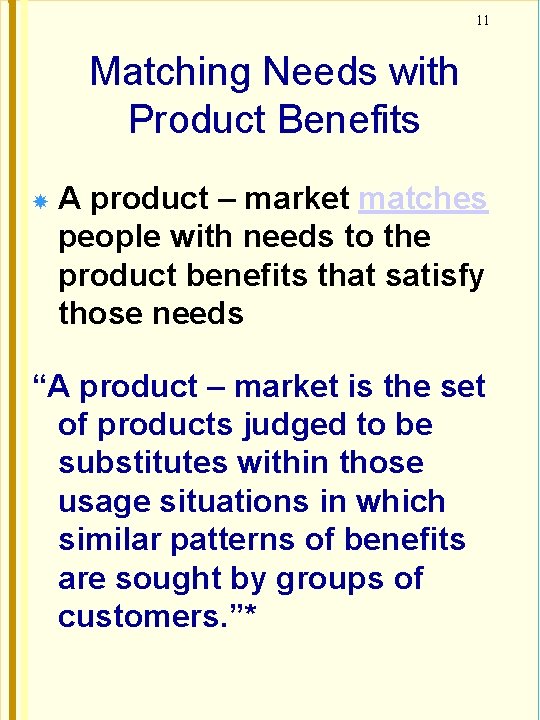
11 Matching Needs with Product Benefits A product – market matches people with needs to the product benefits that satisfy those needs “A product – market is the set of products judged to be substitutes within those usage situations in which similar patterns of benefits are sought by groups of customers. ”*
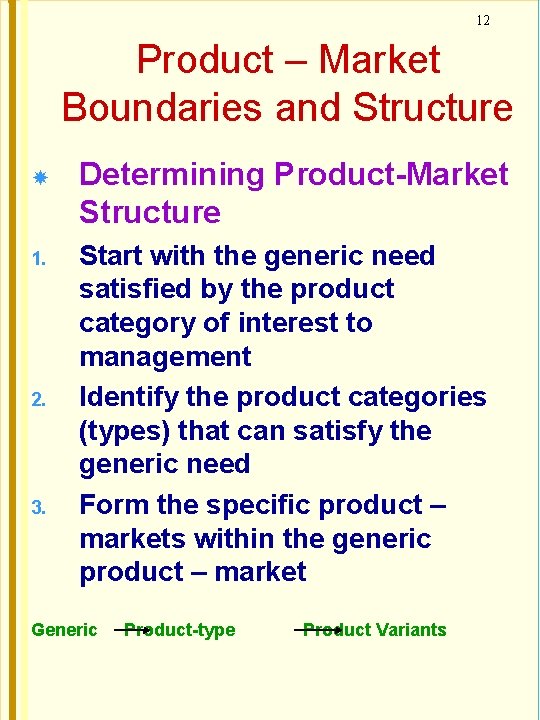
12 Product – Market Boundaries and Structure 1. 2. 3. Determining Product-Market Structure Start with the generic need satisfied by the product category of interest to management Identify the product categories (types) that can satisfy the generic need Form the specific product – markets within the generic product – market Generic Product-type Product Variants
13 Illustrative Fast-Food Product-Market Structure FAST-FOOD MARKET
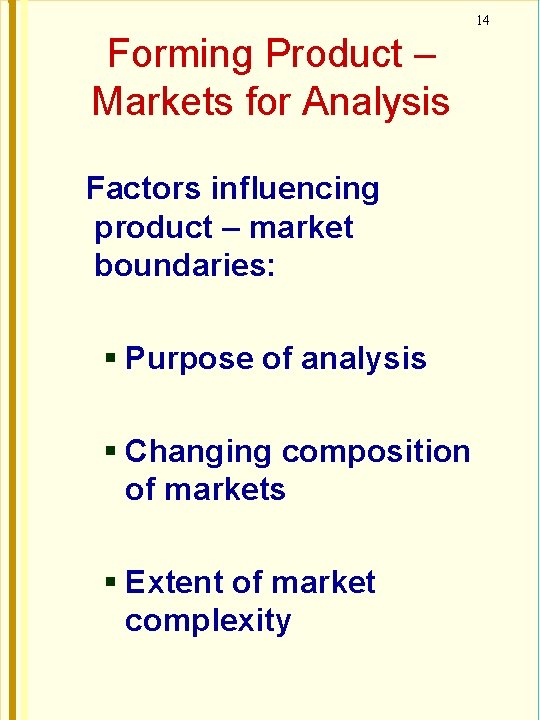
14 Forming Product – Markets for Analysis Factors influencing product – market boundaries: Purpose of analysis Changing composition of markets Extent of market complexity
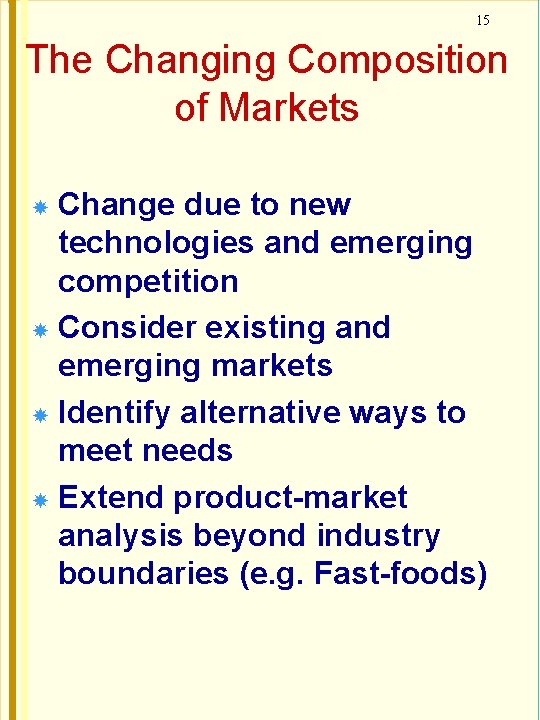
15 The Changing Composition of Markets Change due to new technologies and emerging competition Consider existing and emerging markets Identify alternative ways to meet needs Extend product-market analysis beyond industry boundaries (e. g. Fast-foods)
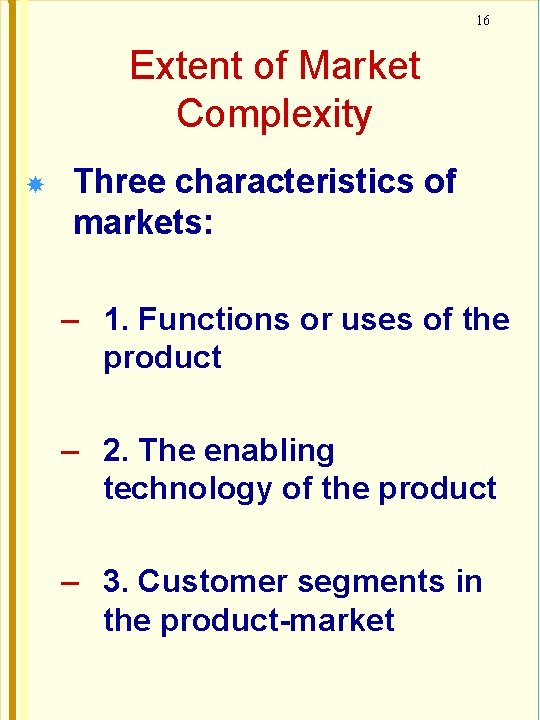
16 Extent of Market Complexity Three characteristics of markets: – 1. Functions or uses of the product – 2. The enabling technology of the product – 3. Customer segments in the product-market
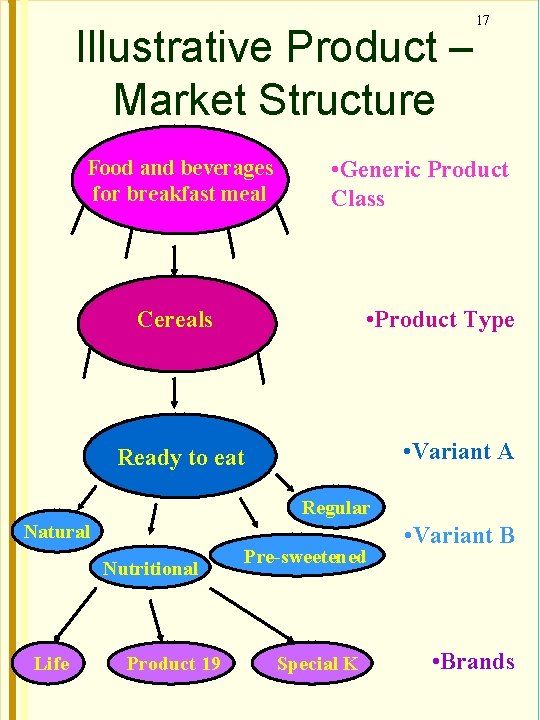
Illustrative Product – Market Structure Food and beverages for breakfast meal 17 • Generic Product Class • Product Type Cereals • Variant A Ready to eat Regular Natural Nutritional Life Product 19 Pre-sweetened Special K • Variant B • Brands
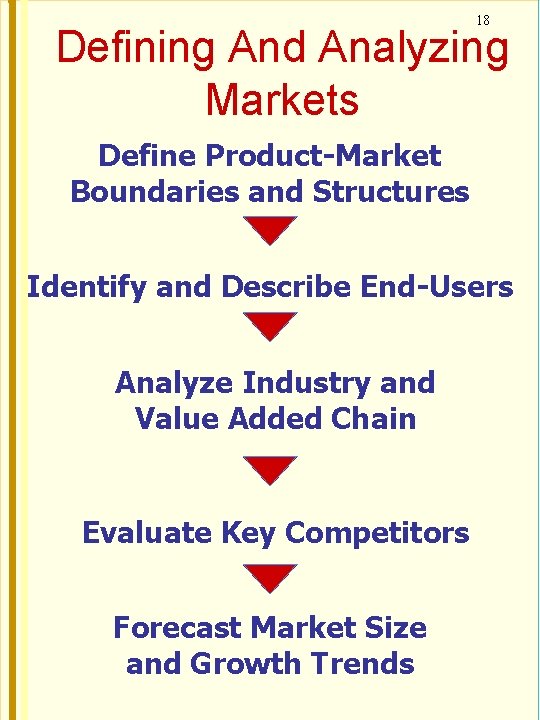
18 Defining And Analyzing Markets Define Product-Market Boundaries and Structures Identify and Describe End-Users Analyze Industry and Value Added Chain Evaluate Key Competitors Forecast Market Size and Growth Trends
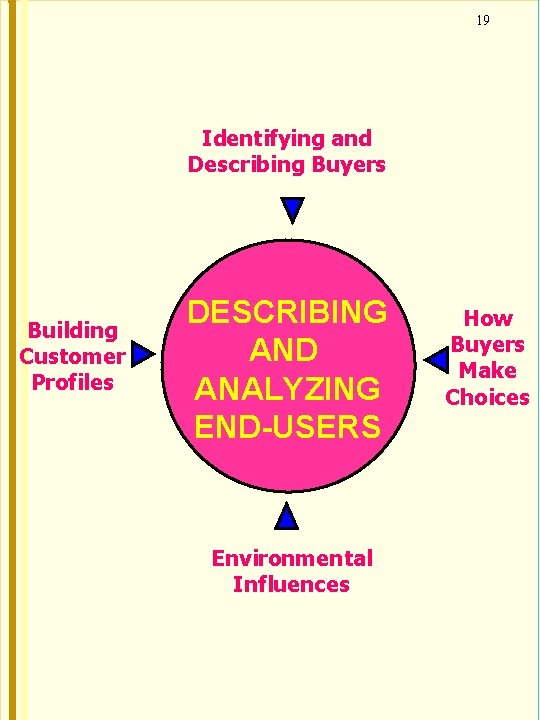
19 Identifying and Describing Buyers Building Customer Profiles DESCRIBING AND ANALYZING END-USERS Environmental Influences How Buyers Make Choices
20 Identifying and Describing End-Users Illustrative buyer characteristics in consumer markets: Family size, age, income, geographical location, sex, and occupation Illustrative factors in organizational markets: Type of industry Company size Location Type of products
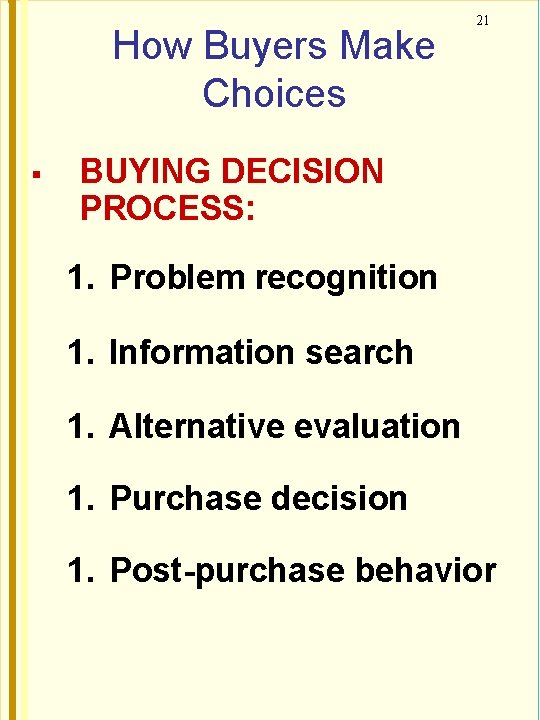
How Buyers Make Choices 21 BUYING DECISION PROCESS: 1. Problem recognition 1. Information search 1. Alternative evaluation 1. Purchase decision 1. Post-purchase behavior
22 Environmental Influences External factors influencing buyers’ needs and wants: Government, social change, economic shifts, technology etc. These factors are often non-controllable but can have a major impact on purchasing decisions
23 Building Customer Profiles Start with generic product – market Move next to producttype and variant profiles >> increasingly more specific Customer profiles guide decision making (e. g. targeting, positioning, market segmentation etc. )
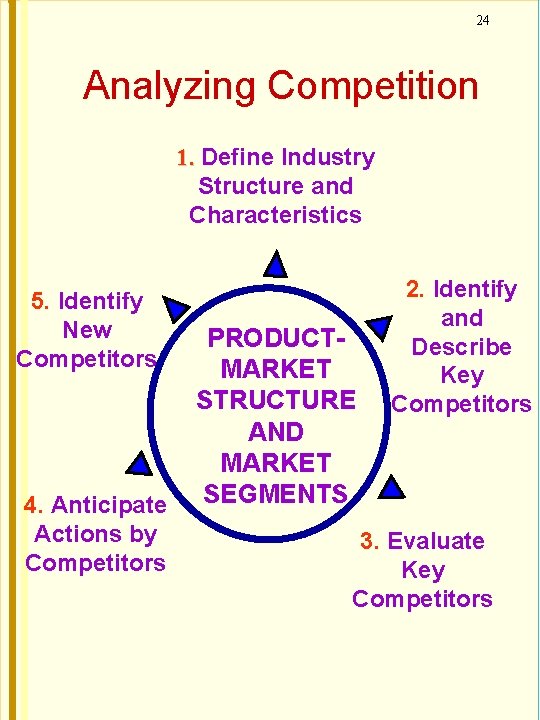
24 Analyzing Competition 1. Define Industry Structure and Characteristics 5. Identify New Competitors 4. Anticipate Actions by Competitors PRODUCTMARKET STRUCTURE AND MARKET SEGMENTS 2. Identify and Describe Key Competitors 3. Evaluate Key Competitors
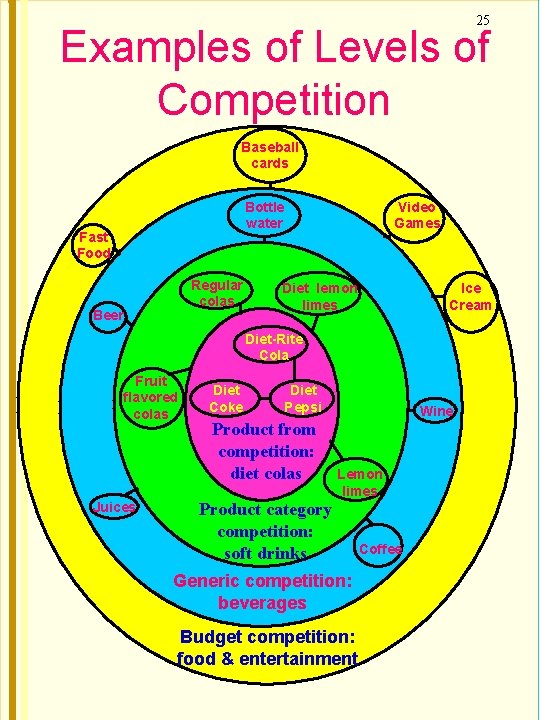
25 Examples of Levels of Competition Baseball cards Bottle water Fast Food Regular colas Beer Video Games Diet lemon limes Ice Cream Diet-Rite Cola Fruit flavored colas Juices Diet Coke Diet Pepsi Product from competition: diet colas Wine Lemon limes Product category competition: soft drinks Generic competition: beverages Budget competition: food & entertainment Coffee
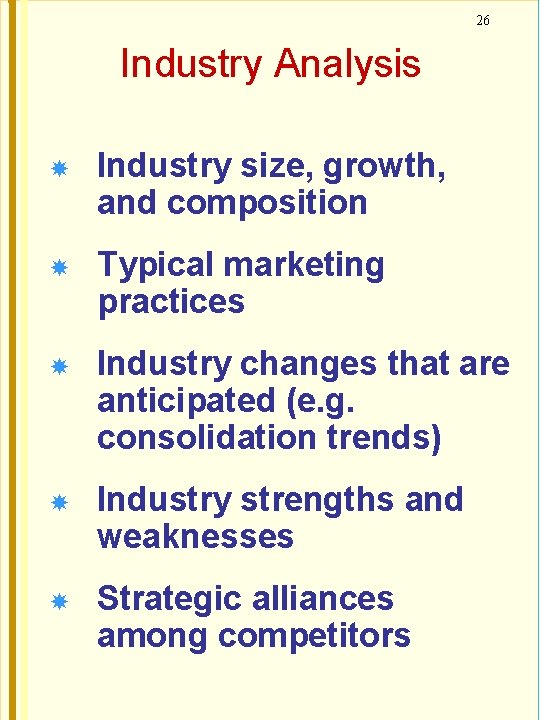
26 Industry Analysis Industry size, growth, and composition Typical marketing practices Industry changes that are anticipated (e. g. consolidation trends) Industry strengths and weaknesses Strategic alliances among competitors
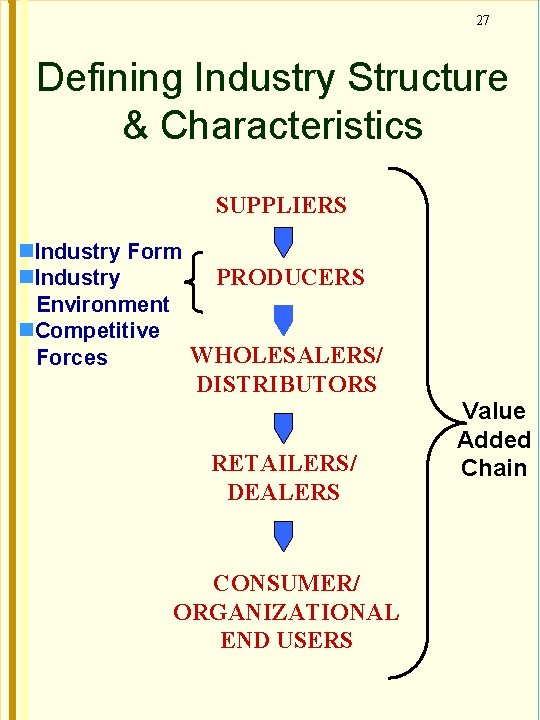
27 Defining Industry Structure & Characteristics SUPPLIERS Industry Form PRODUCERS Industry Environment Competitive WHOLESALERS/ Forces DISTRIBUTORS RETAILERS/ DEALERS CONSUMER/ ORGANIZATIONAL END USERS Value Added Chain
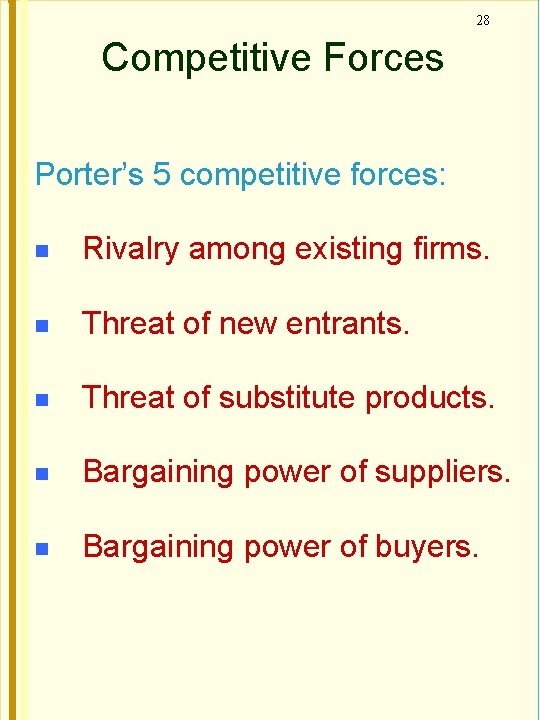
28 Competitive Forces Porter’s 5 competitive forces: Rivalry among existing firms. Threat of new entrants. Threat of substitute products. Bargaining power of suppliers. Bargaining power of buyers.
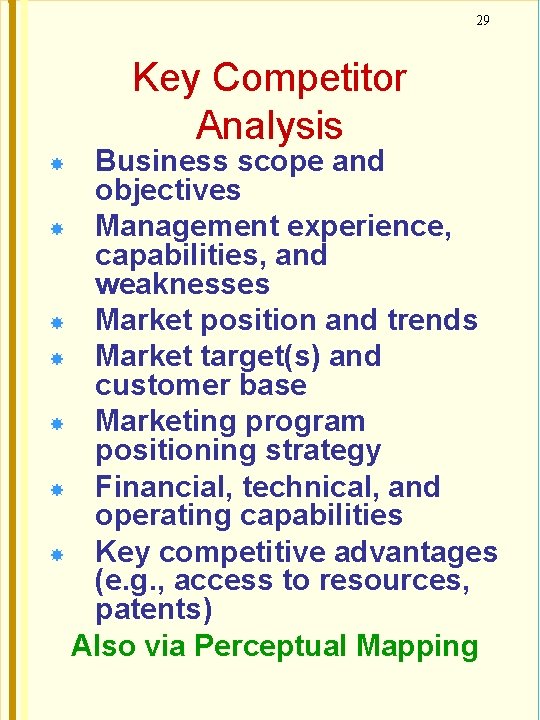
29 Key Competitor Analysis Business scope and objectives Management experience, capabilities, and weaknesses Market position and trends Market target(s) and customer base Marketing program positioning strategy Financial, technical, and operating capabilities Key competitive advantages (e. g. , access to resources, patents) Also via Perceptual Mapping
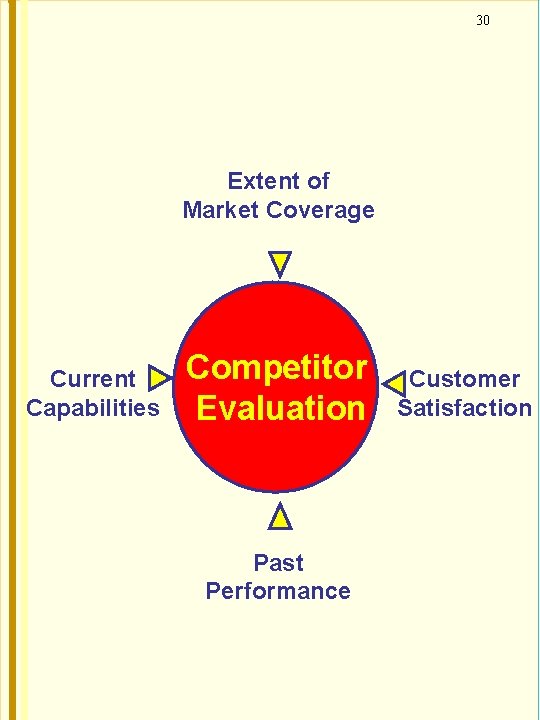
30 Extent of Market Coverage Current Capabilities Competitor Evaluation Past Performance Customer Satisfaction
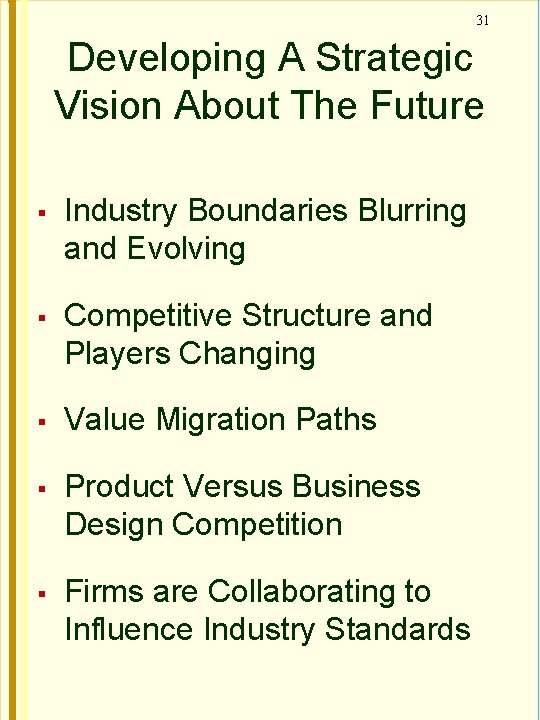
31 Developing A Strategic Vision About The Future Industry Boundaries Blurring and Evolving Competitive Structure and Players Changing Value Migration Paths Product Versus Business Design Competition Firms are Collaborating to Influence Industry Standards
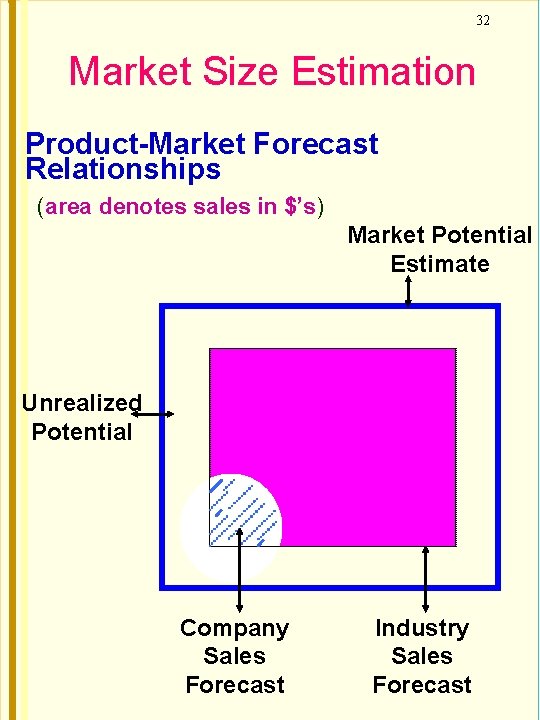
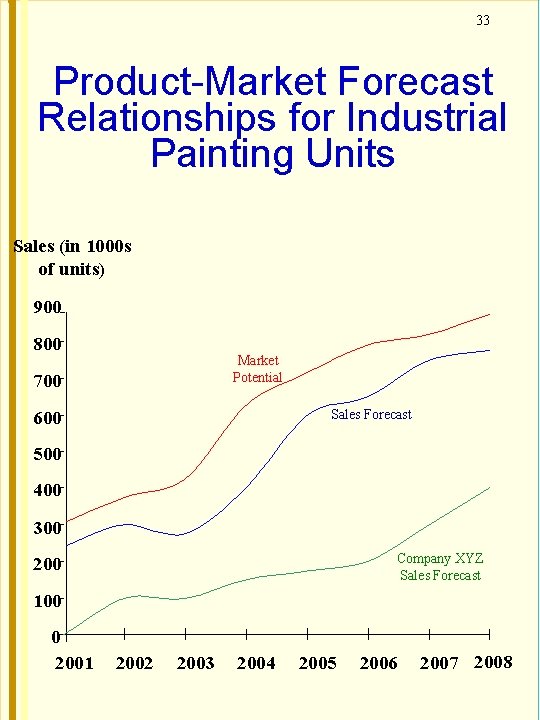
32 Market Size Estimation Product-Market Forecast Relationships (area denotes sales in $’s) Market Potential Estimate Unrealized Potential Company Sales Forecast Industry Sales Forecast
33 Product-Market Forecast Relationships for Industrial Painting Units Sales (in 1000 s of units) 900 800 Market Potential 700 Sales Forecast 600 500 400 300 Company XYZ Sales Forecast 200 100 0 2001 2002 2003 2004 2005 2006 2007 2008
34 Review: Appendix 3 A Forecasting Guidelines
35 Strategic Market Segmentation
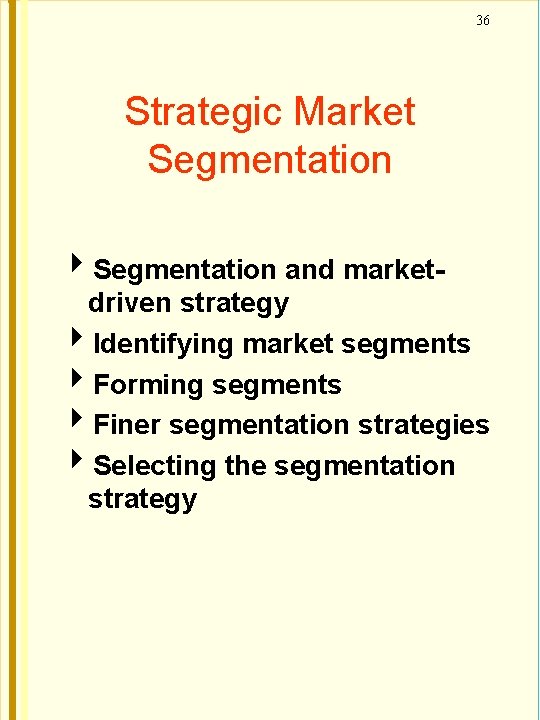
36 Strategic Market Segmentation and market- driven strategy Identifying market segments Forming segments Finer segmentation strategies Selecting the segmentation strategy
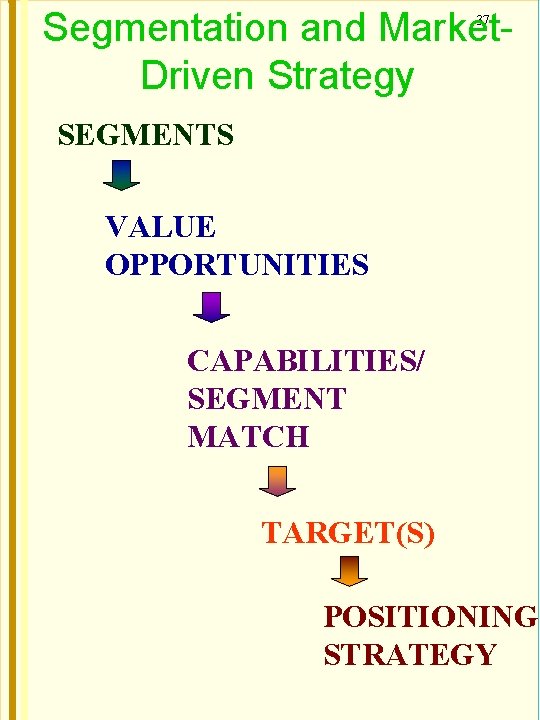
Segmentation and Market. Driven Strategy 37 SEGMENTS VALUE OPPORTUNITIES CAPABILITIES/ SEGMENT MATCH TARGET(S) POSITIONING STRATEGY
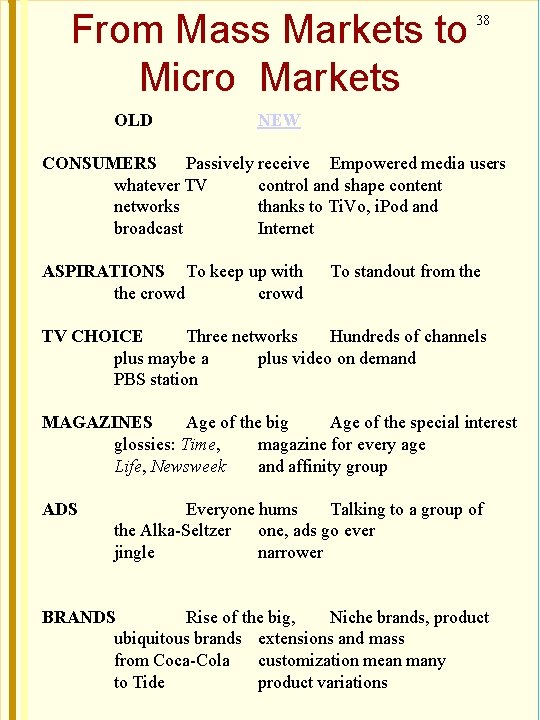
From Mass Markets to Micro Markets OLD 38 NEW CONSUMERS Passively receive Empowered media users whatever TV control and shape content networks thanks to Ti. Vo, i. Pod and broadcast Internet ASPIRATIONS To keep up with the crowd To standout from the TV CHOICE Three networks Hundreds of channels plus maybe a plus video on demand PBS station MAGAZINES Age of the big Age of the special interest glossies: Time, magazine for every age Life, Newsweek and affinity group ADS Everyone hums Talking to a group of the Alka-Seltzer one, ads go ever jingle narrower BRANDS Rise of the big, Niche brands, product ubiquitous brands extensions and mass from Coca-Cola customization mean many to Tide product variations
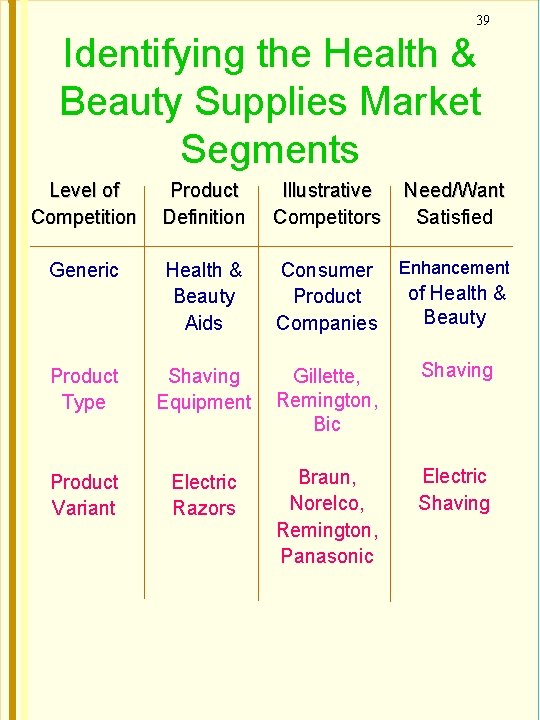
39 Identifying the Health & Beauty Supplies Market Segments Level of Competition Product Definition Illustrative Competitors Need/Want Satisfied Generic Health & Beauty Aids Consumer Product Companies Enhancement Product Type Shaving Equipment Gillette, Remington, Bic Shaving Product Variant Electric Razors Braun, Norelco, Remington, Panasonic Electric Shaving of Health & Beauty
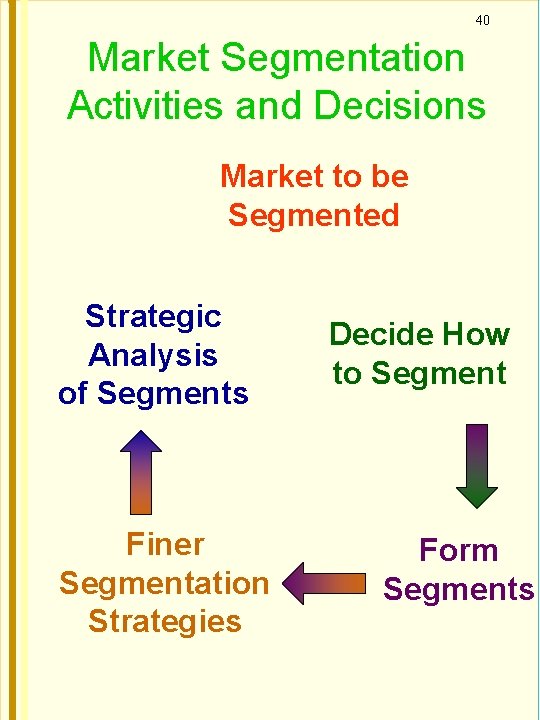
40 Market Segmentation Activities and Decisions Market to be Segmented Strategic Analysis of Segments Finer Segmentation Strategies Decide How to Segment Form Segments
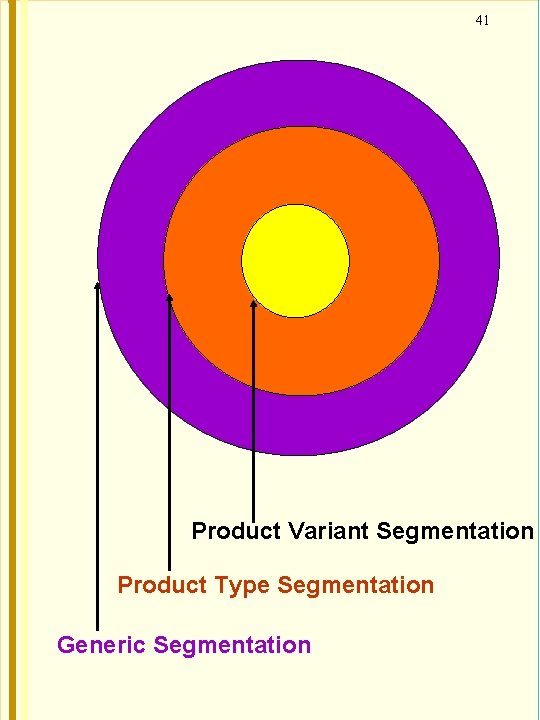
41 Product Variant Segmentation Product Type Segmentation Generic Segmentation
42 Segmentation Variables Purchase Behavior Buyers’ Needs/ Preferences Characteristics of People/ Organizations Use Situation
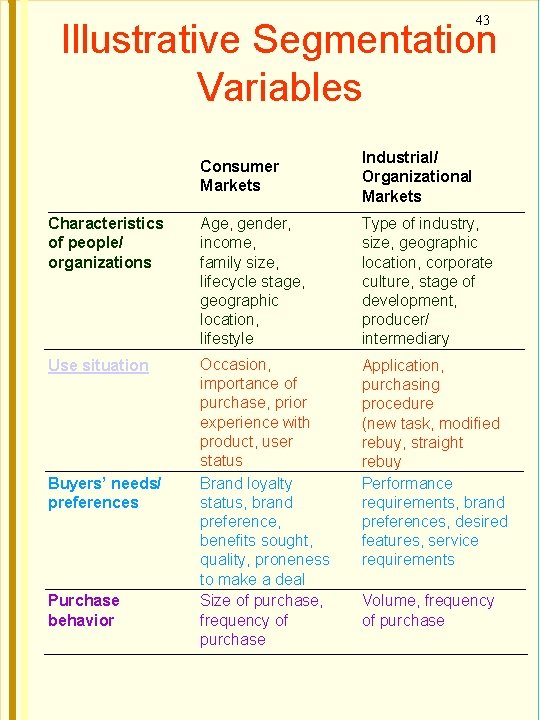
43 Illustrative Segmentation Variables Consumer Markets Industrial/ Organizational Markets Characteristics of people/ organizations Age, gender, income, family size, lifecycle stage, geographic location, lifestyle Type of industry, size, geographic location, corporate culture, stage of development, producer/ intermediary Use situation Occasion, importance of purchase, prior experience with product, user status Brand loyalty status, brand preference, benefits sought, quality, proneness to make a deal Size of purchase, frequency of purchase Application, purchasing procedure (new task, modified rebuy, straight rebuy Performance requirements, brand preferences, desired features, service requirements Buyers’ needs/ preferences Purchase behavior Volume, frequency of purchase
Requirements for Segmentation 44 Identifiable segments Response differences Actionable segments Segmentation Requirements Stability over time Favorable cost/benefit
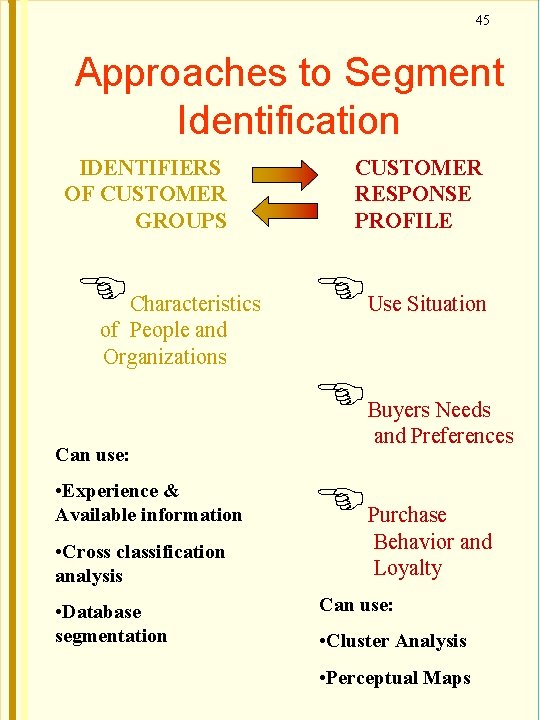
45 Approaches to Segment Identification IDENTIFIERS OF CUSTOMER GROUPS Characteristics of People and Organizations CUSTOMER RESPONSE PROFILE Can use: • Experience & Available information • Cross classification analysis • Database segmentation Use Situation Buyers Needs and Preferences Purchase Behavior and Loyalty Can use: • Cluster Analysis • Perceptual Maps
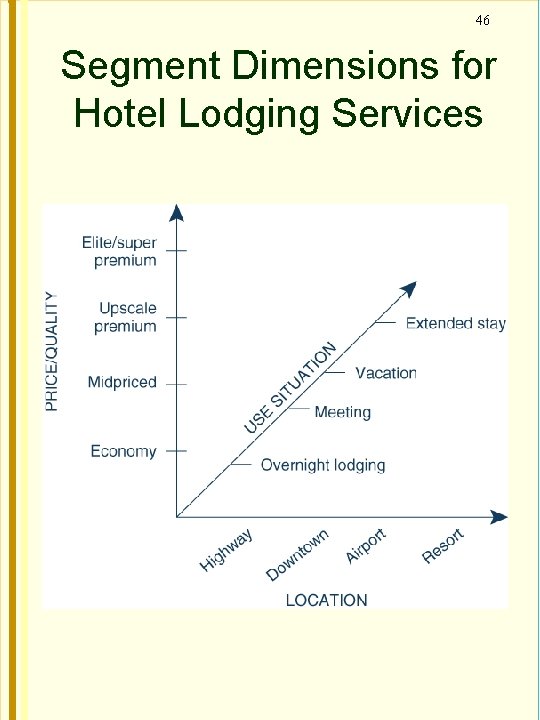
46 Segment Dimensions for Hotel Lodging Services
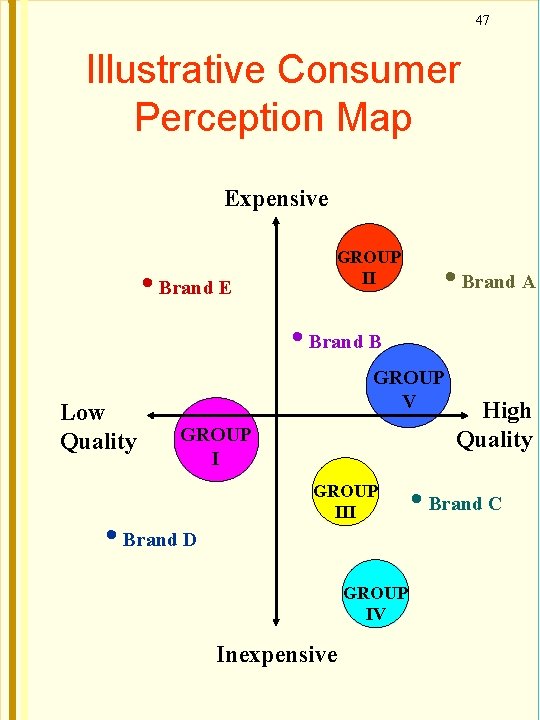
47 Illustrative Consumer Perception Map Expensive • Brand E GROUP II • Brand A • Brand B Low Quality GROUP V GROUP I • Brand D GROUP III GROUP IV Inexpensive High Quality • Brand C
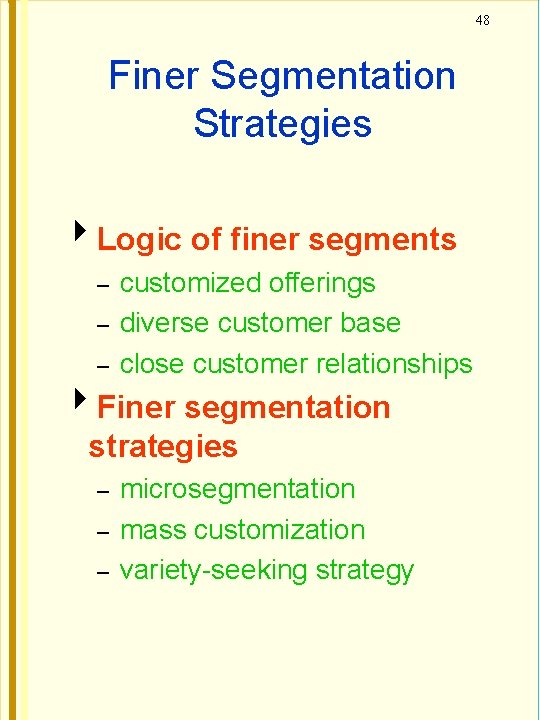
48 Finer Segmentation Strategies Logic of finer segments – – – customized offerings diverse customer base close customer relationships Finer segmentation strategies – – – microsegmentation mass customization variety-seeking strategy
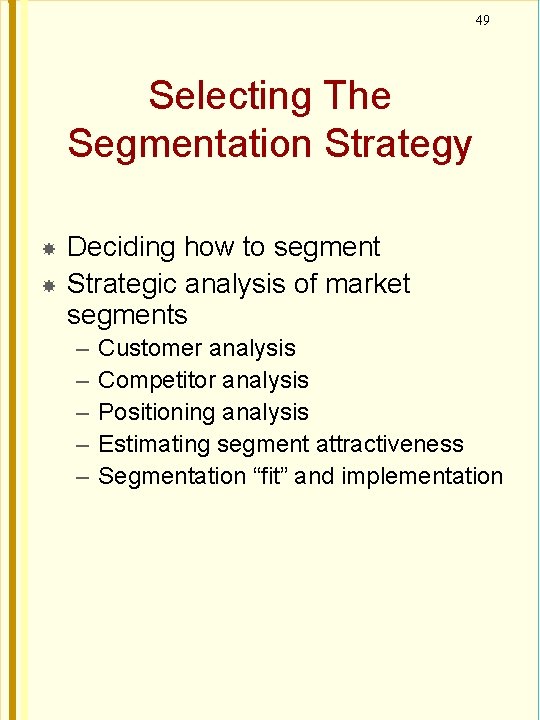
49 Selecting The Segmentation Strategy Deciding how to segment Strategic analysis of market segments – – – Customer analysis Competitor analysis Positioning analysis Estimating segment attractiveness Segmentation “fit” and implementation
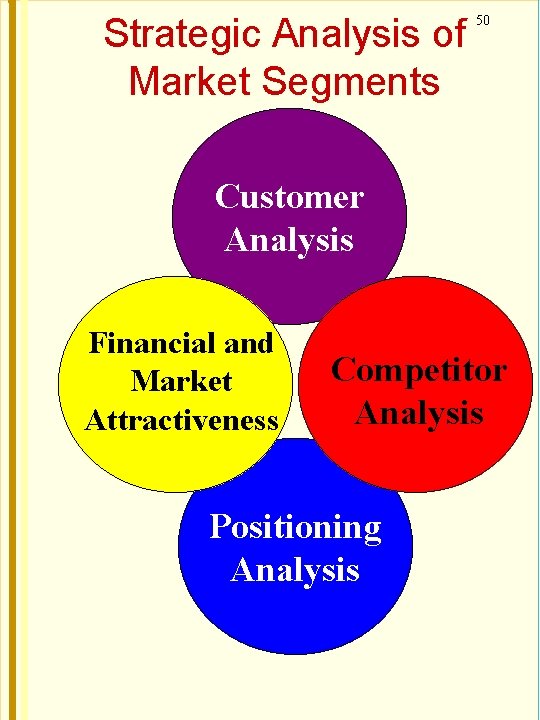
Strategic Analysis of Market Segments 50 Customer Analysis Financial and Market Attractiveness Competitor Analysis Positioning Analysis
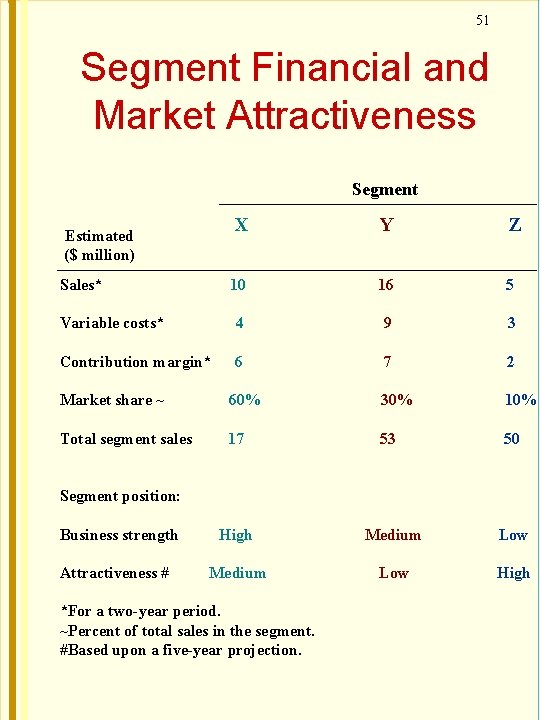
51 Segment Financial and Market Attractiveness Segment X Y Z 10 16 5 Variable costs* 4 9 3 Contribution margin* 6 7 2 Estimated ($ million) Sales* Market share ~ 60% 30% 10% Total segment sales 17 53 50 Segment position: Business strength Attractiveness # High Medium Low High *For a two-year period. ~Percent of total sales in the segment. #Based upon a five-year projection.
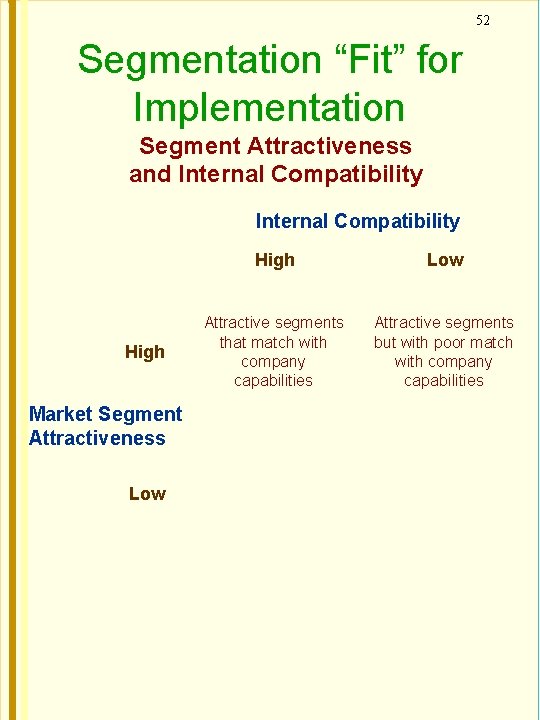
52 Segmentation “Fit” for Implementation Segment Attractiveness and Internal Compatibility High Market Segment Attractiveness Low High Low Attractive segments that match with company capabilities Attractive segments but with poor match with company capabilities
53 Continuous Learning About Markets
54 Continuous Learning About Markets Market orientation and organizational learning Marketing research information Information systems Marketing intelligence systems and knowledge management Ethical issues in collecting and using information
55 Market Orientation and Organizational Learning Market orientation perspective includes all relevant sources of knowledge and ideas Characteristics of the learning organization Learning and competitive advantage
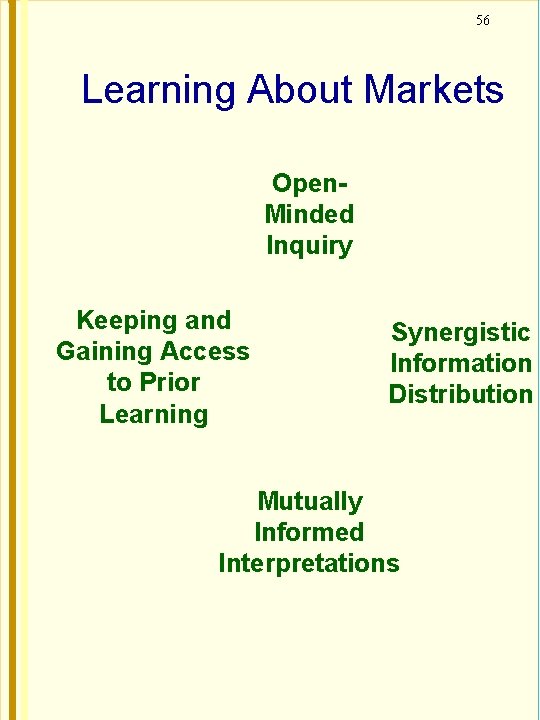
56 Learning About Markets Open. Minded Inquiry Keeping and Gaining Access to Prior Learning Synergistic Information Distribution Mutually Informed Interpretations
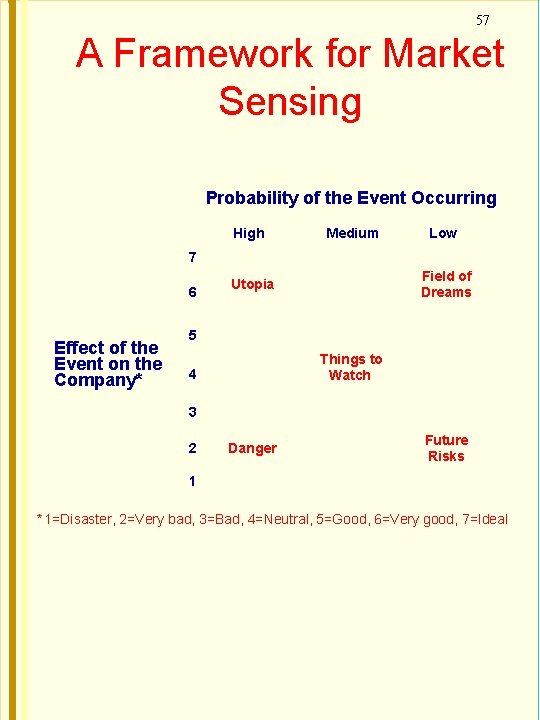
57 A Framework for Market Sensing Probability of the Event Occurring High Medium Low 7 6 Effect of the Event on the Company* Field of Dreams Utopia 5 Things to Watch 4 3 2 Danger Future Risks 1 * 1=Disaster, 2=Very bad, 3=Bad, 4=Neutral, 5=Good, 6=Very good, 7=Ideal
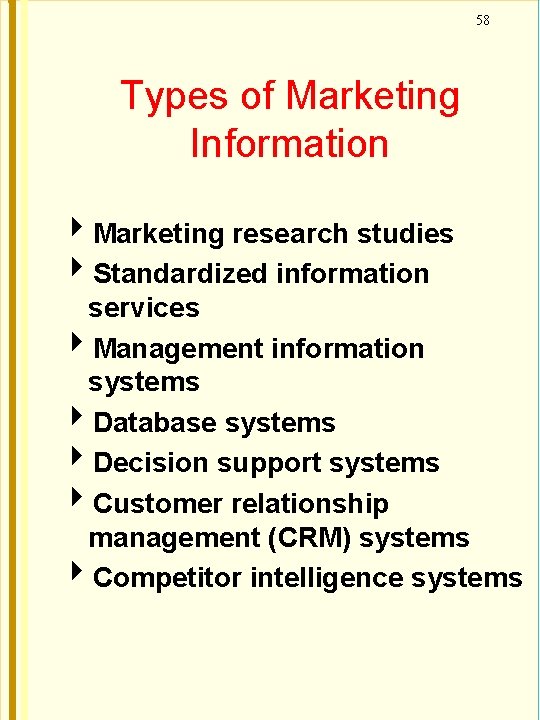
58 Types of Marketing Information Marketing research studies Standardized information services Management information systems Database systems Decision support systems Customer relationship management (CRM) systems Competitor intelligence systems
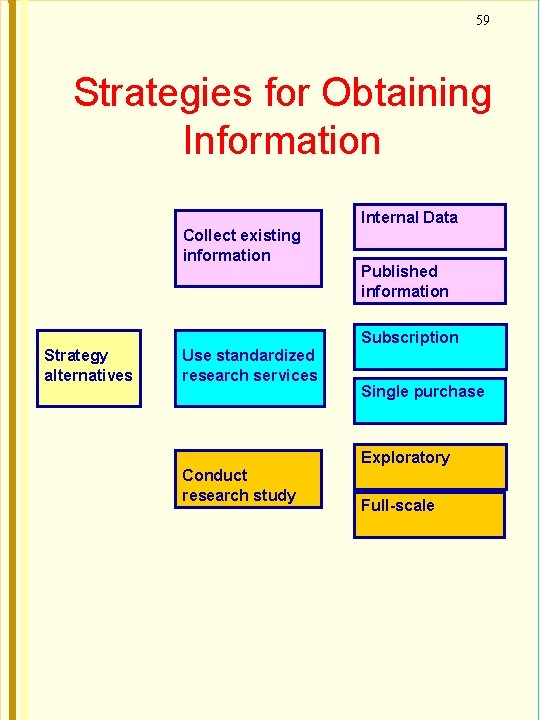
59 Strategies for Obtaining Information Internal Data Collect existing information Published information Subscription Strategy alternatives Use standardized research services Single purchase Exploratory Conduct research study Full-scale
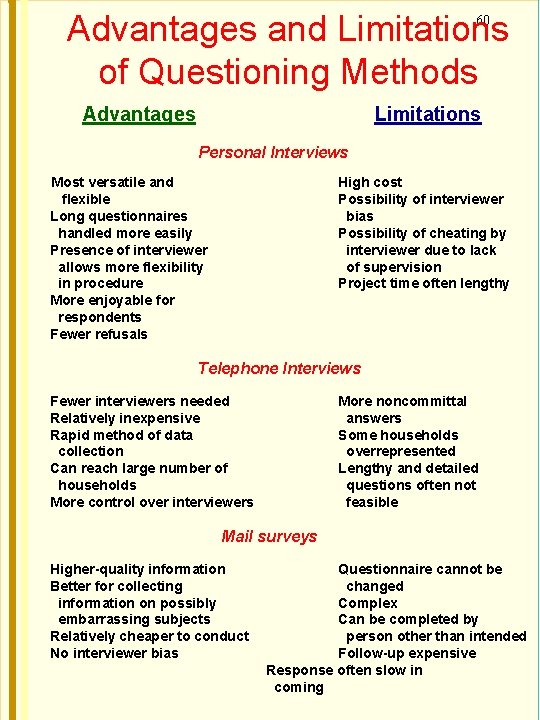
Advantages and Limitations of Questioning Methods 60 Advantages Limitations Personal Interviews Most versatile and flexible Long questionnaires handled more easily Presence of interviewer allows more flexibility in procedure More enjoyable for respondents Fewer refusals High cost Possibility of interviewer bias Possibility of cheating by interviewer due to lack of supervision Project time often lengthy Telephone Interviews Fewer interviewers needed Relatively inexpensive Rapid method of data collection Can reach large number of households More control over interviewers More noncommittal answers Some households overrepresented Lengthy and detailed questions often not feasible Mail surveys Higher-quality information Better for collecting information on possibly embarrassing subjects Relatively cheaper to conduct No interviewer bias Questionnaire cannot be changed Complex Can be completed by person other than intended Follow-up expensive Response often slow in coming
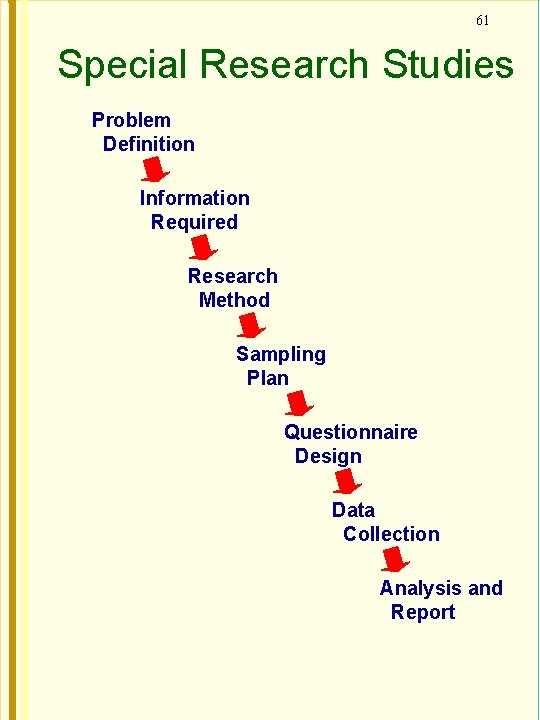
61 Special Research Studies Problem Definition Information Required Research Method Sampling Plan Questionnaire Design Data Collection Analysis and Report
62 Screening A New Research Supplier 1. Client Would you recommend this supplier? 2. Supplier Do you have sufficient funds for this project? 3. What parts of the project will be subcontracted, and how do you manage subcontractors? 4. May I see your interviewer’s manual and data entry manual? 5. How do you train and supervise interviewers? 6. What percentage of interviews are validated? 7. May I see a typical questionnaire? 8. Who draws your samples? 9. What percentage of your data entry is verified? 10. Ask Managers: What do you think about this supplier?
63 Impact of the Internet on Marketing Costs & Availability Online Surveys – – Fast Inexpensive Limitations in population coverage Resistance to excessive Web communications Customer feedback and peer-to-peer Web communications Monitoring customer Web behavior
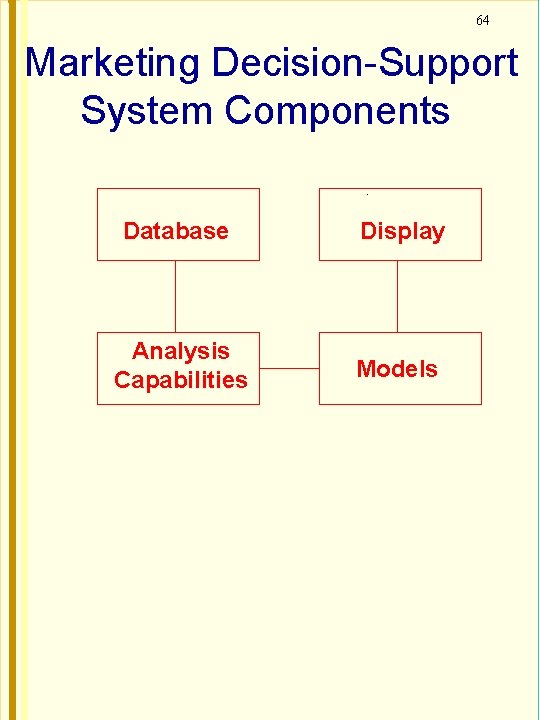
64 Marketing Decision-Support System Components Database Display Analysis Capabilities Models
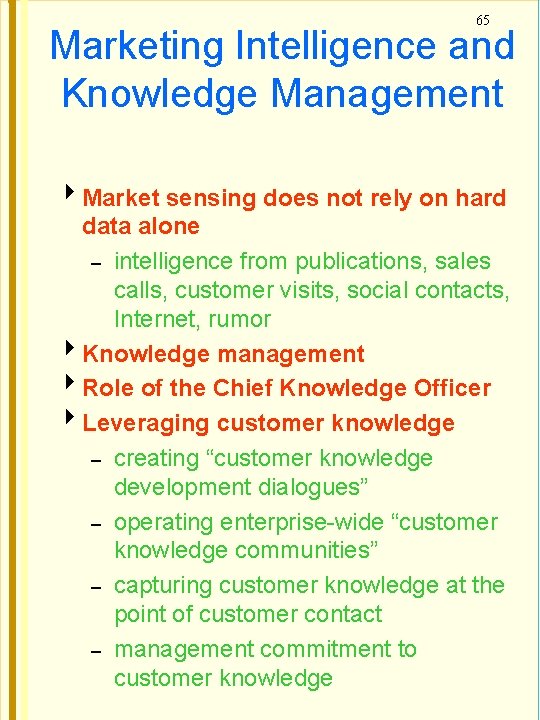
65 Marketing Intelligence and Knowledge Management Market sensing does not rely on hard data alone – intelligence from publications, sales calls, customer visits, social contacts, Internet, rumor Knowledge management Role of the Chief Knowledge Officer Leveraging customer knowledge – creating “customer knowledge development dialogues” – operating enterprise-wide “customer knowledge communities” – capturing customer knowledge at the point of customer contact – management commitment to customer knowledge
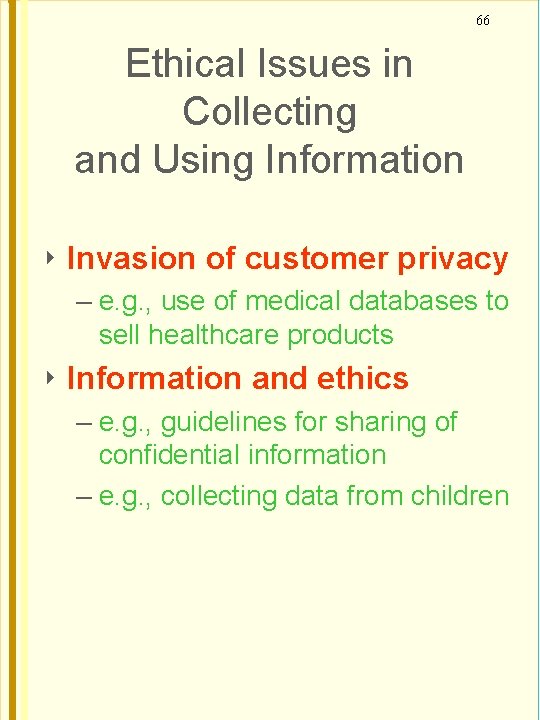
66 Ethical Issues in Collecting and Using Information Invasion of customer privacy – e. g. , use of medical databases to sell healthcare products Information and ethics – e. g. , guidelines for sharing of confidential information – e. g. , collecting data from children