
SESSION 18 RCRA CORRECTIVE ACTION INTERIM MEASURES STABILIZATION

SESSION 18 RCRA CORRECTIVE ACTION: INTERIM MEASURES / STABILIZATION / ADVANCED NOTICE OF PROPOSED RULEMAKING / TECHNICAL IMPRACTICABILITY
Session 18 Agenda: Interim Measures/Stabilization/Advanced Notice of Proposed Rulemaking/Technical Impracticability 4 Interim Measures/Stabilization 4 Advanced Notice of Proposed Rulemaking 4 Technical Impracticability
terim Measures/Stabilization Interim Measures 4 Definition – Umbrella term for wide range of institutional and physical corrective action activities to achieve stabilization 4 The goal of interim measures (IM) and stabilization is to control or abate imminent threats to human health and the environment from releases at RCRA facilities 4 Interim measures can be implemented at any time during the corrective action process 4 Intent of IM is to be implemented more quickly than traditional remedial measures
terim Measures/Stabilization Factors to consider when determining the need for interim measures/stabilization 4 Facility rank based on the National Corrective Action Prioritization System (NCAPs) 4 Location of contamination – Isolated or can it be isolated? 4 Significant exposure threats for human or ecological receptors 4 Potential for situation to deteriorate (i. e. , new release may occur due to storms, floods, and structural design failure) 4 Time required to develop and implement final remedies under corrective action program 4 Information regarding contaminant and site characteristics
terim Measures/Stabilization Factors to consider when determining the need for interim measures/stabilization (continued) 4 Presence of high levels of hazardous constituents in soil at or near the surface, and potential for release 4 Risk of fire, explosion, or other accident 4 Types of contaminants and volumes of releases 4 Technical complexity of remediation – Technical practicability of implementing a stabilization measure. Refer to Guidance for Evaluating Technical Impracticability of Groundwater Restoration (September 1993) – Appropriate technologies to deal with known contaminants 4 Media-specific characteristics, such as site hydrogeology or prevailing wind direction
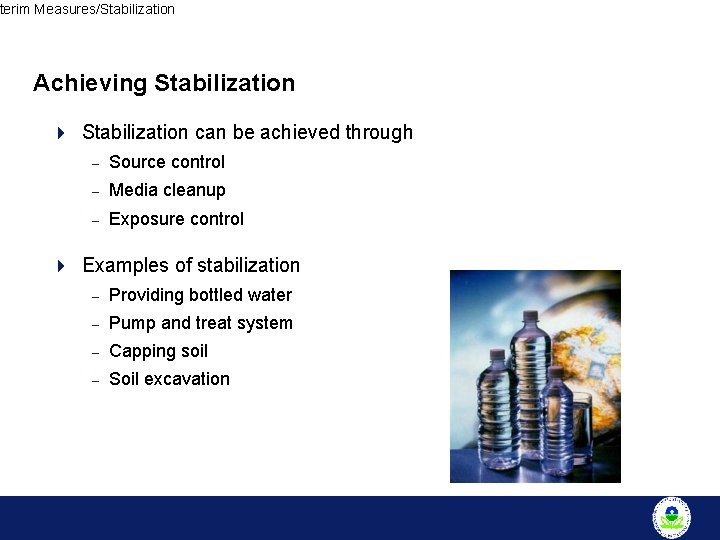
terim Measures/Stabilization Achieving Stabilization 4 Stabilization can be achieved through – Source control – Media cleanup – Exposure control 4 Examples of stabilization – Providing bottled water – Pump and treat system – Capping soil – Soil excavation
ANPR Advanced Notice of Proposed Rulemaking 4 Published Corrective Action Advance Notice of Proposed Rulemaking (ANPR) 5/1/96 (61 FR 19432) 4 Three primary purposes: – Strategy to improve corrective action program – Guidance for program implementation – Emphasize areas of available flexibility and innovative approaches
ANPR Content 4 Section I identifies regulatory basis 4 Section II discusses major guidance and policy milestones since 1990 proposal 4 Section III describes current expectations regarding program implementation 4 Section IV outlines key goals and strategies 4 Section V requests comment/data that will help identify improvements
ANPR Program Philosophy 4 Corrective action should be based on risk 4 Results driven rather than process driven 4 Interim actions and stabilization should be used to reduce risk and prevent exposure 4 Activities should be phased to focus resources on areas or pathways of greatest concern
ANPR Philosophy (continued) 4 Should provide meaningful inclusion of all stakeholders 4 Should be implemented using most appropriate authority, including state authorities and voluntary actions 4 States will be the primary implementers
ANPR Examples of Flexibility Highlighted in ANPR 4 Investigation tools and approaches – Conceptual site model – Data quality objectives – Innovative sampling and analytical techniques 4 Action levels – Industrial-based action levels may be appropriate in some settings, especially for interim actions
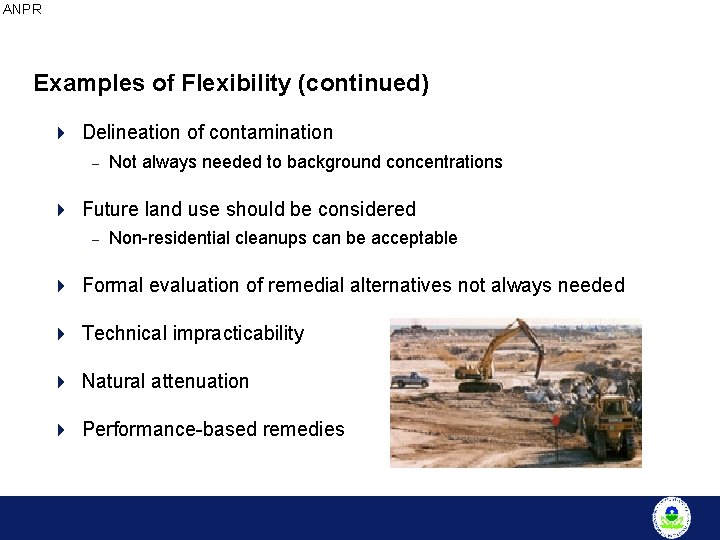
ANPR Examples of Flexibility (continued) 4 Delineation of contamination – Not always needed to background concentrations 4 Future land use should be considered – Non-residential cleanups can be acceptable 4 Formal evaluation of remedial alternatives not always needed 4 Technical impracticability 4 Natural attenuation 4 Performance-based remedies
ANPR Presumptive Remedies Defined 4 Presumptive remedies – Preferred technologies for common categories of sites Based on historical patterns of remedy selection Effective remedial technologies for specific contaminants EPA’s scientific and engineering evaluation of performance data on technology implementation 4 Advantages – Ensures remedy selection/implementation consistency – Reduces cost and time required as remedial technology is already accepted 4 Example – Soil Vapor Extraction for soil contaminated with VOCs
Technical Impracticability refers to: 4 A determination that restoration of an environmental medium or waste may not be achievable due to remediation technology limitations related to – Hydrogeologic factors – Contaminant-related factors – Waste-related factors – Site-related factors – Cost
Technical Impracticability (continued) 4 For portions of the site that can be restored, a technical impracticability (TI) determination would not apply 4 TI determinations are not a scaling back of efforts to achieve media cleanup goals – Require exposure control – Require source control – Require aqueous plume remediation
Technical Impracticability TI determinations are made: 4 Early in the remediation process when possible 4 At the time of statement of basis 4 The possibility that certain remedies are technically impracticable should be considered throughout the remedial process
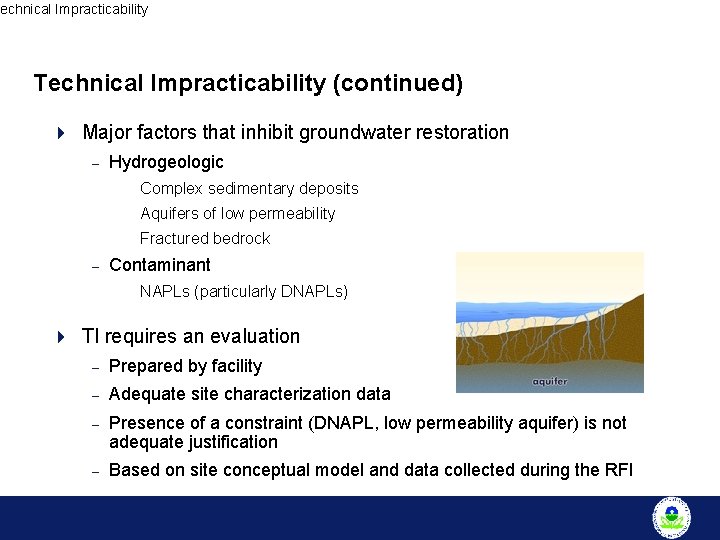
Technical Impracticability (continued) 4 Major factors that inhibit groundwater restoration – Hydrogeologic Complex sedimentary deposits Aquifers of low permeability Fractured bedrock – Contaminant NAPLs (particularly DNAPLs) 4 TI requires an evaluation – Prepared by facility – Adequate site characterization data – Presence of a constraint (DNAPL, low permeability aquifer) is not adequate justification – Based on site conceptual model and data collected during the RFI
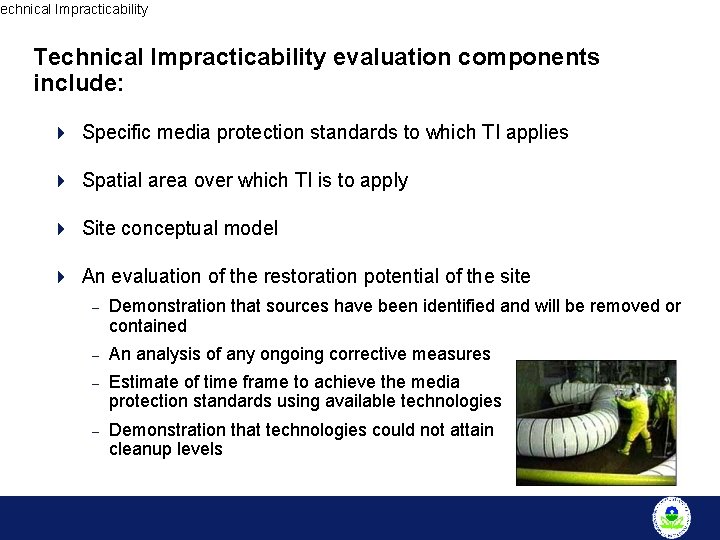
Technical Impracticability evaluation components include: 4 Specific media protection standards to which TI applies 4 Spatial area over which TI is to apply 4 Site conceptual model 4 An evaluation of the restoration potential of the site – Demonstration that sources have been identified and will be removed or contained – An analysis of any ongoing corrective measures – Estimate of time frame to achieve the media protection standards using available technologies – Demonstration that technologies could not attain cleanup levels
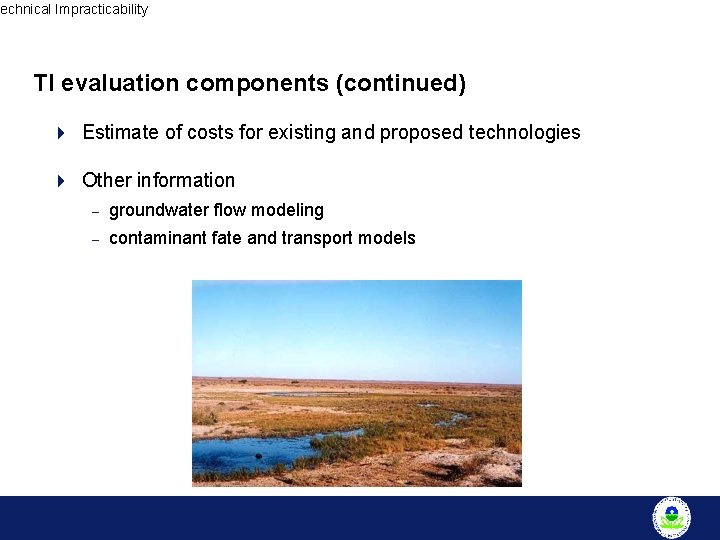
Technical Impracticability TI evaluation components (continued) 4 Estimate of costs for existing and proposed technologies 4 Other information – groundwater flow modeling – contaminant fate and transport models
Technical Impracticability (continued) 4 TI determinations always include selection of an alternative corrective measure that includes: – Exposure control via institutional controls Restrictions on groundwater use Deed notifications – Source control Remove or treat source to the extent feasible Isolate the source using a slurry wall or hydraulic containment system 4 If a source cannot be contained, plume restoration may be technically impracticable. However, facility must implement: – Hydraulic containment of leading edge of aqueous plume pump and treat – Hydraulic containment of the source area to the extent possible
Guidance The following guidance provides additional information: 4 U. S. Environmental Protection Agency. 2001. Handbook of Groundwater Protection and Cleanup Policies for RCRA Corrective Action. October 2001. (EPA 530 -F-01 -021) 4 www. epa. gov/compliance/resources/policies/cleanup/rcra/index. html 4 www. epa. gov/correctiveaction
- Slides: 21