
Session 18 LEARNING BEHAVIOR MODIFICATION Session 18 LEARNING
Session 18 LEARNING & BEHAVIOR MODIFICATION

Session 18 LEARNING Any relatively permanent change in behavior that occurs as a result of experience Learning components: Involves Change Is Relatively Permanent Is Acquired Through Experience 1
Theories of Learning Ø Classical Conditioning – A type of conditioning in which an individual responds to some stimulus that would not otherwise produce such a response. Ø Operant Conditioning – A type of conditioning in which desired voluntary behavior leads to a reward or prevents a punishment. Ø Social-Learning Theory – People learn through observation and direct experience. 2
Classical Conditioning Ø Pavlov’s (Russian Physiologist, 1900’s) Dog Drool Ø Key Concepts: – Unconditioned stimulus • A naturally occurring phenomenon. – Unconditioned response • The naturally occurring response to a natural stimulus. – Conditioned stimulus • An artificial stimulus introduced into the situation. – Conditioned response • The response to the artificial stimulus. e. g. , Every time the TOP EXECUTIVES from the Corporate office visited the mfg. plant, it would be made spic & span and exterior windows would be washed & cleaned. Employees would show best of their behaviors and look prim & proper.
Operant Conditioning Ø B. F. Skinner (Harvard Psychologist) Concept of Behaviorism: – Behavior follows stimuli. Ø Key Concepts: – People learn to behave to get something they want or to avoid something that they don’t want. – Reinforcement: The consequences of behavior can increase or decrease the probability of behavior repetition. – Unrewarded/punished behavior is unlikely to be repeated. e. g. , Boss commits that your O/T during next 3 busy weeks, will be compensated at your next performance appraisal. If the boss stands by his promise, you are most likely to repeat O/T in future or else you’ll certainly decline if not rewarded.
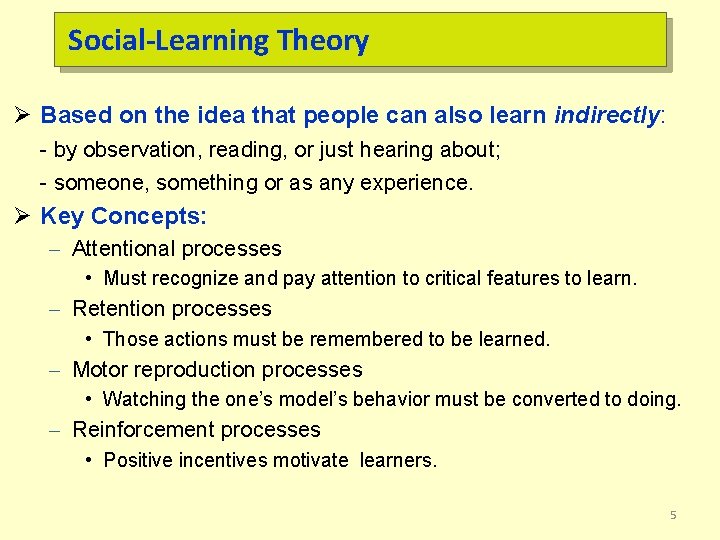
Social-Learning Theory Ø Based on the idea that people can also learn indirectly: - by observation, reading, or just hearing about; - someone, something or as any experience. Ø Key Concepts: – Attentional processes • Must recognize and pay attention to critical features to learn. – Retention processes • Those actions must be remembered to be learned. – Motor reproduction processes • Watching the one’s model’s behavior must be converted to doing. – Reinforcement processes • Positive incentives motivate learners. 5
- Slides: 6