
Session 18 3 D shapes GCSE MATHS Basic
Session 18 – 3 D shapes GCSE MATHS
Basic 3 D shapes � Discussion of � Nets � Isometric projection � Faces, edges and vertices � Ex 30. 1 on the board
3 D Symmetry � Planes � Axis � Ex of symmetry if rotational symmetry 30. 2 – 10 minutes
Plans and elevations �A plan view is to look down from above � An elevation is to look at an object from the front, back or side � In reality the drawings are usually done to scale and contain dimensions. (arrows labelling lengths)
Surface area � Consider every face of a 3 D shape. � These could be drawn as a 2 D shape, which we could then find the area of (using our knowledge from a few weeks ago) � Add up the area of each face for the total surface area. � For example, a cuboid is made up of rectangles and squares
Volume of a cuboid � The volume of a cuboid is found by multiplying all the lengths. � You could consider this as finding the area of one end, then multiplying by the length. � Ex 30. 4 – 10 minutes
Volume of a prism �A prism is a 3 D shape, which is continuous all the way through. � Its volume is found by working out the area of the end face, and multiplying this by the length of the shape. � Ex 30. 5 Q 1, 2 and 3
Surface area of a prism Total surface area of a prism is found by adding up the area of each face. For example, a triangular prism is made up of 2 identical triangular faces and 3 rectangular ones.
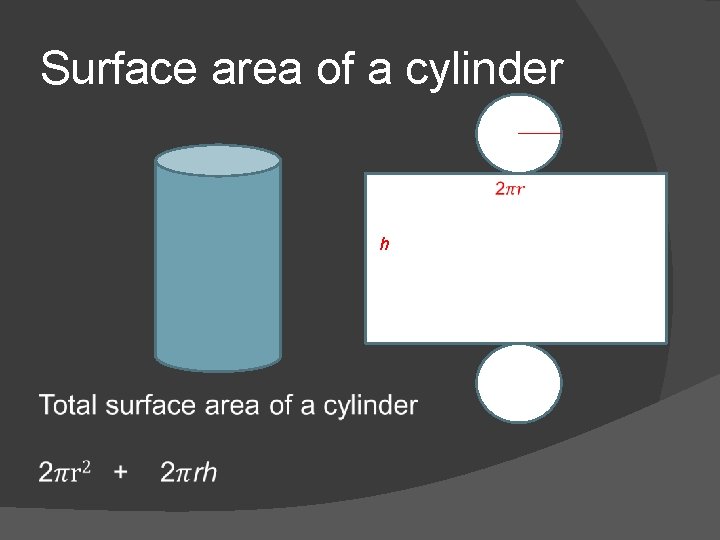
Surface area of a cylinder h
� Ex 30. 6 15 minutes � Foundation learners to go back over previous exercises for practice � Higher learners have more 3 D shapes to work with
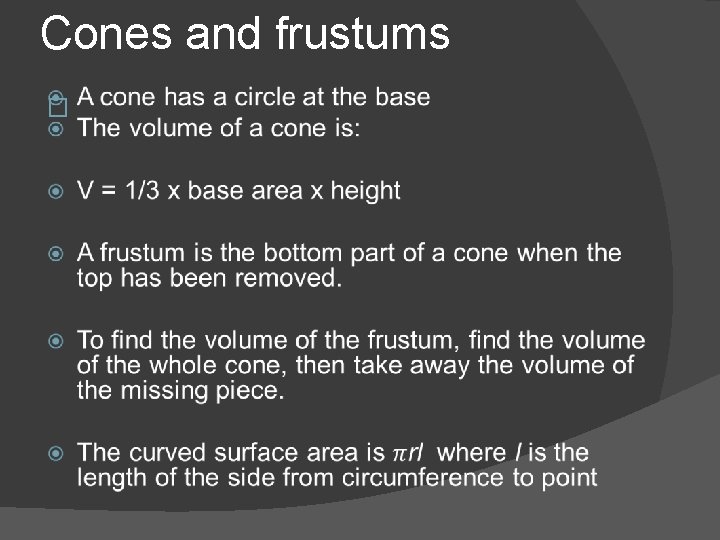
Cones and frustums �
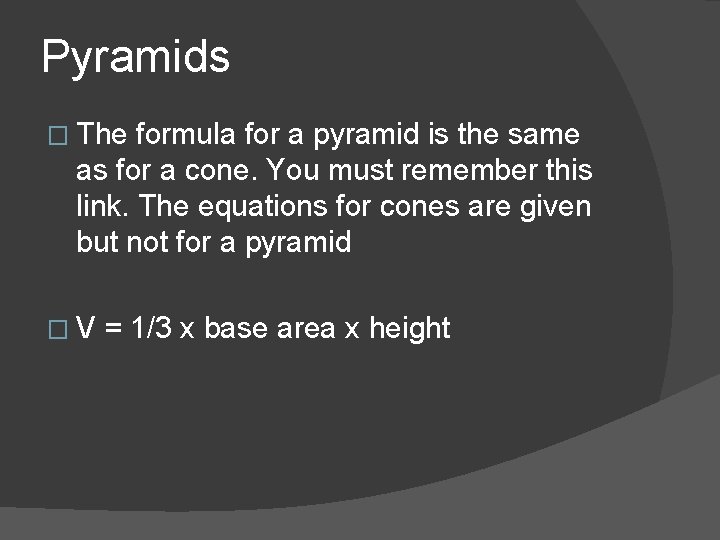
Pyramids � The formula for a pyramid is the same as for a cone. You must remember this link. The equations for cones are given but not for a pyramid �V = 1/3 x base area x height
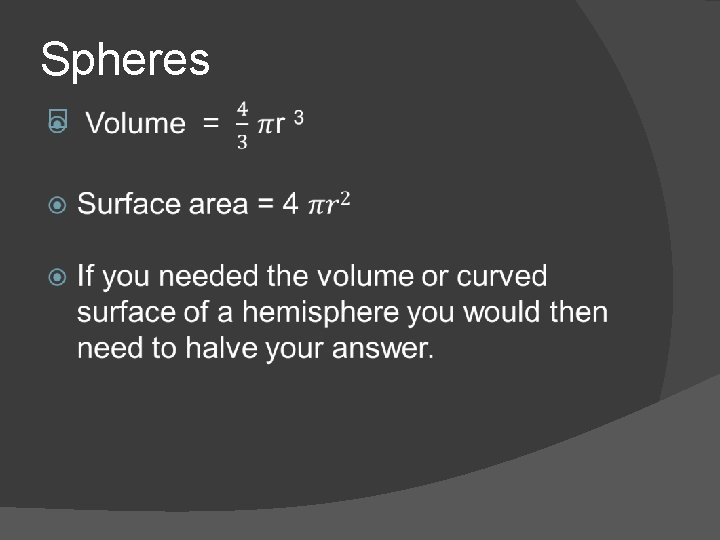
Spheres �
Homework � Use BKSB to revise topics � Produce a revision page for the geometry ‘what you need to knows’ � Including 2 D shapes, 3 D shapes and circles
- Slides: 14