
Session 17 Statewide Models When Modeling a City
- Slides: 40
Session 17: Statewide Models: When Modeling a City Isn’t Enough The Ohio Statewide Short Distance Travel Models 11 th National Transportation Planning Applications Conference May 6 -10, 2007, Daytona Beach, Florida Rosella Picado | PB | 206 -382 -5227 | picado@pbworld. com
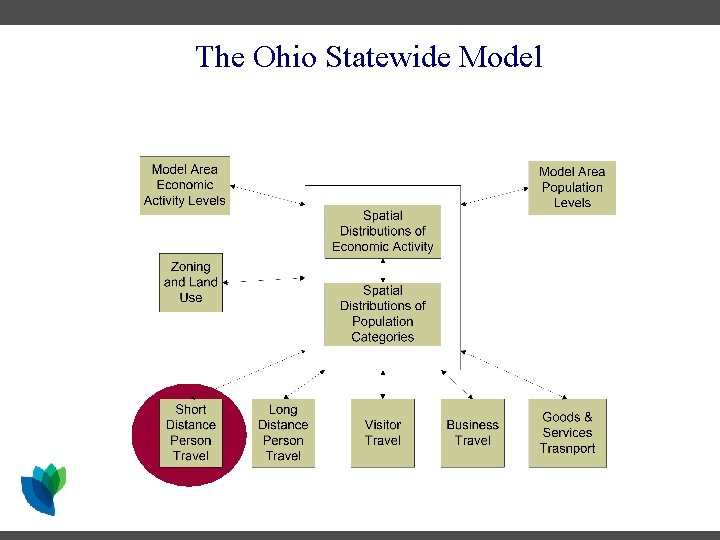
The Ohio Statewide Model
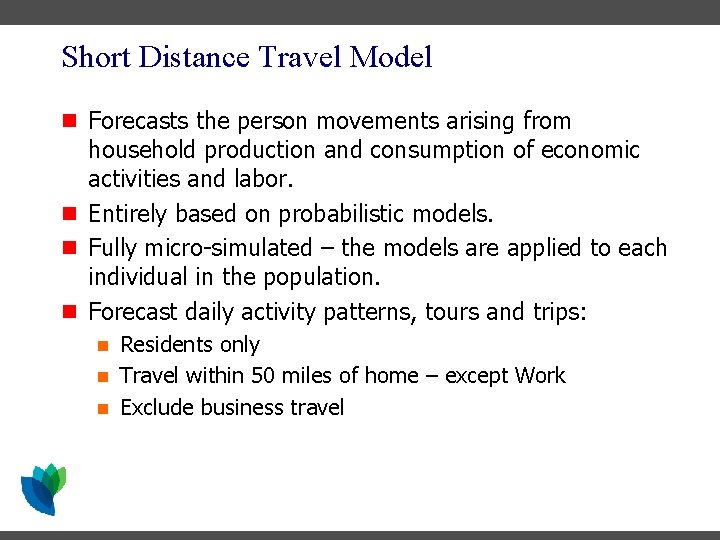
Short Distance Travel Model n Forecasts the person movements arising from household production and consumption of economic activities and labor. n Entirely based on probabilistic models. n Fully micro-simulated – the models are applied to each individual in the population. n Forecast daily activity patterns, tours and trips: n n n Residents only Travel within 50 miles of home – except Work Exclude business travel
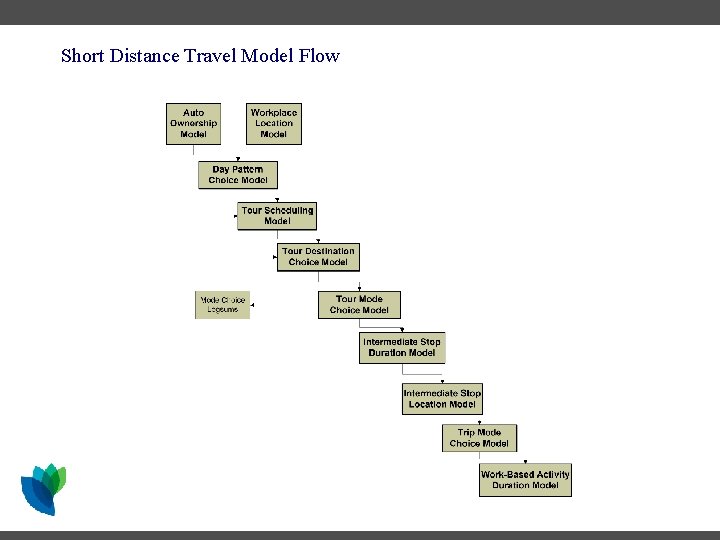
Short Distance Travel Model Flow
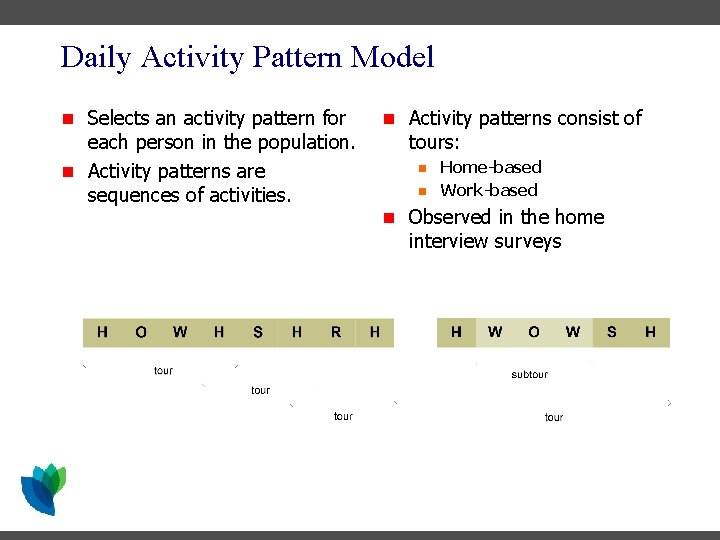
Daily Activity Pattern Model n Selects an activity pattern for each person in the population. n Activity patterns are sequences of activities. n Activity patterns consist of tours: n n Home-based Work-based n Observed in the home interview surveys
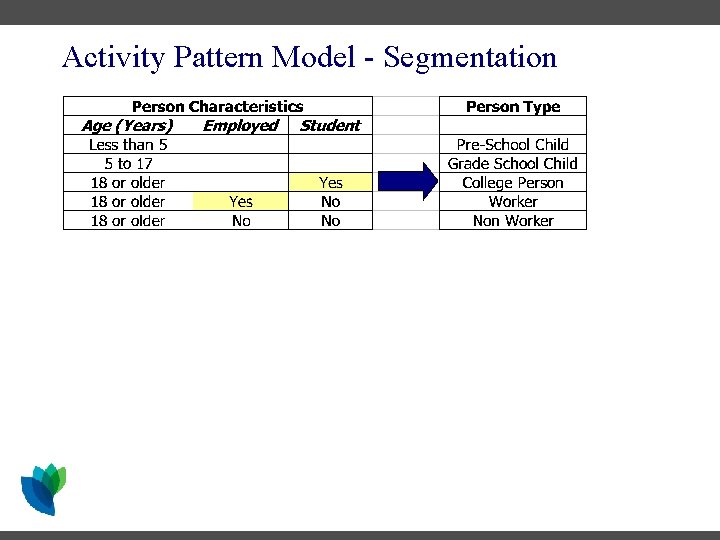
Activity Pattern Model - Segmentation
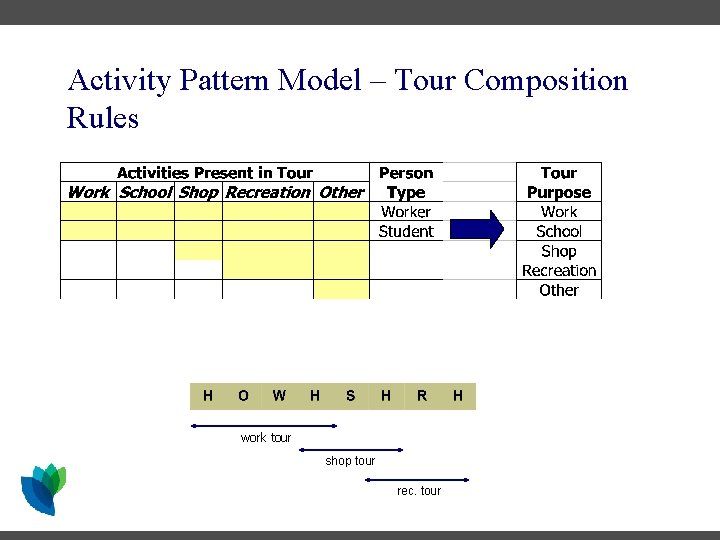
Activity Pattern Model – Tour Composition Rules work tour shop tour rec. tour
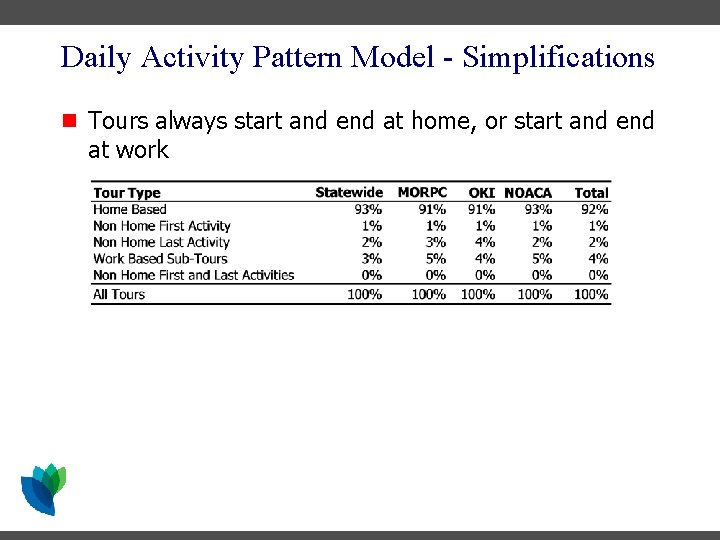
Daily Activity Pattern Model - Simplifications n Tours always start and end at home, or start and end at work
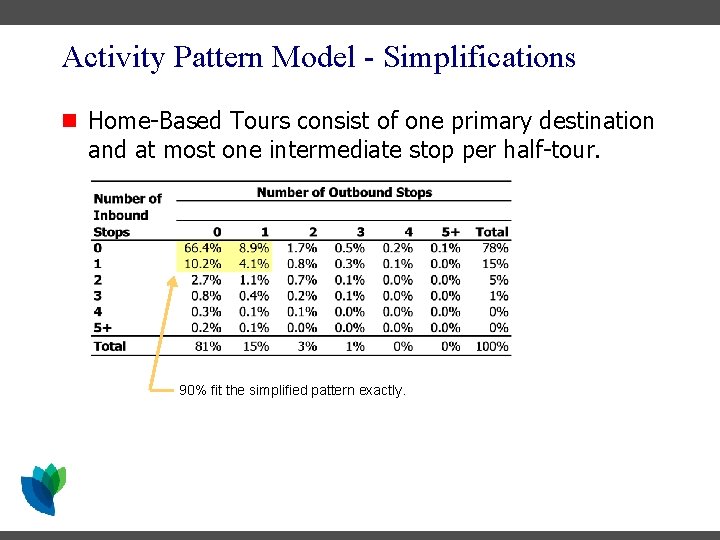
Activity Pattern Model - Simplifications n Home-Based Tours consist of one primary destination and at most one intermediate stop per half-tour. 90% fit the simplified pattern exactly.
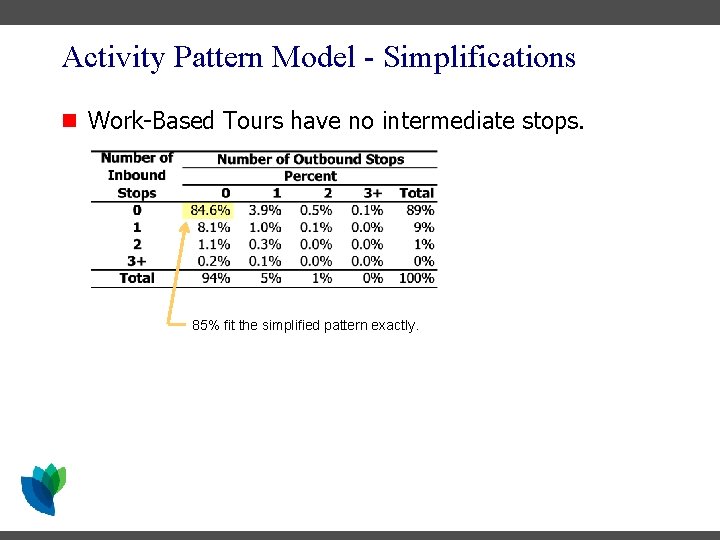
Activity Pattern Model - Simplifications n Work-Based Tours have no intermediate stops. 85% fit the simplified pattern exactly.
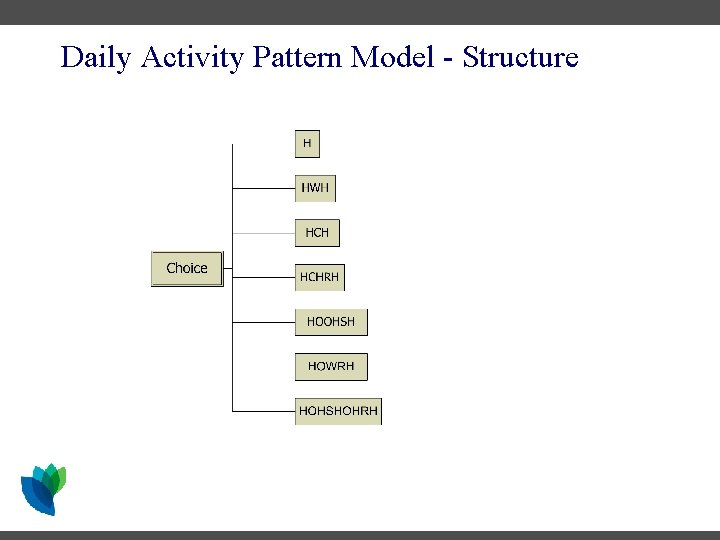
Daily Activity Pattern Model - Structure
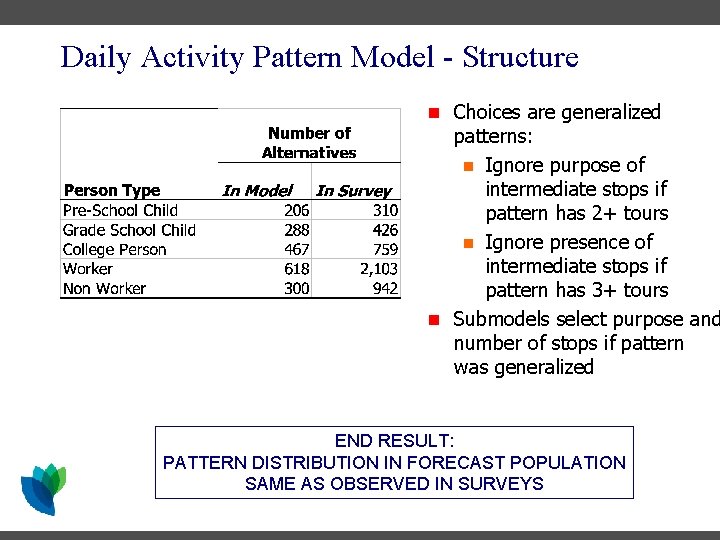
Daily Activity Pattern Model - Structure n Choices are generalized patterns: n Ignore purpose of intermediate stops if pattern has 2+ tours n Ignore presence of intermediate stops if pattern has 3+ tours n Submodels select purpose and number of stops if pattern was generalized END RESULT: PATTERN DISTRIBUTION IN FORECAST POPULATION SAME AS OBSERVED IN SURVEYS
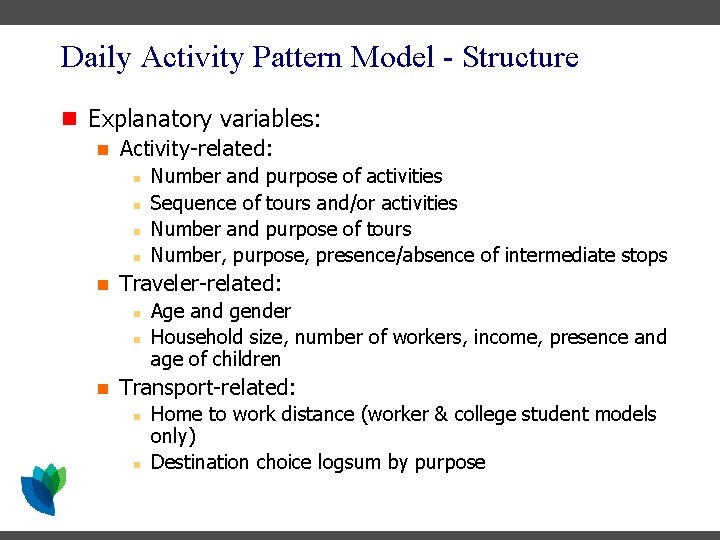
Daily Activity Pattern Model - Structure n Explanatory variables: n Activity-related: n n n Traveler-related: n n n Number and purpose of activities Sequence of tours and/or activities Number and purpose of tours Number, purpose, presence/absence of intermediate stops Age and gender Household size, number of workers, income, presence and age of children Transport-related: n n Home to work distance (worker & college student models only) Destination choice logsum by purpose
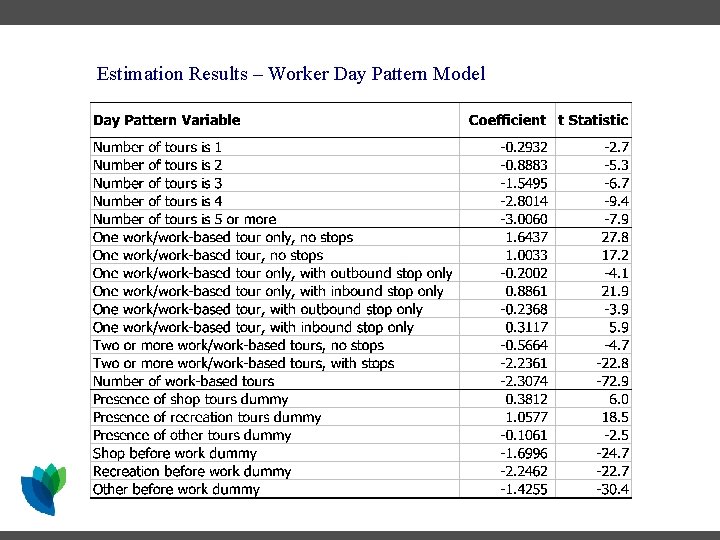
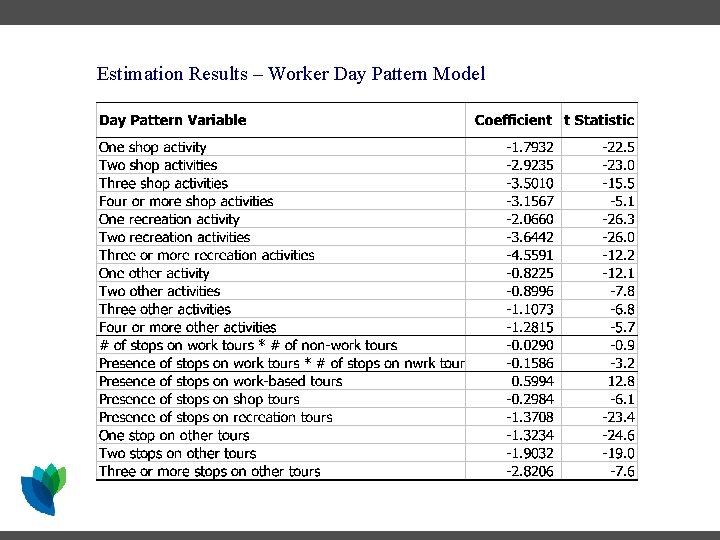
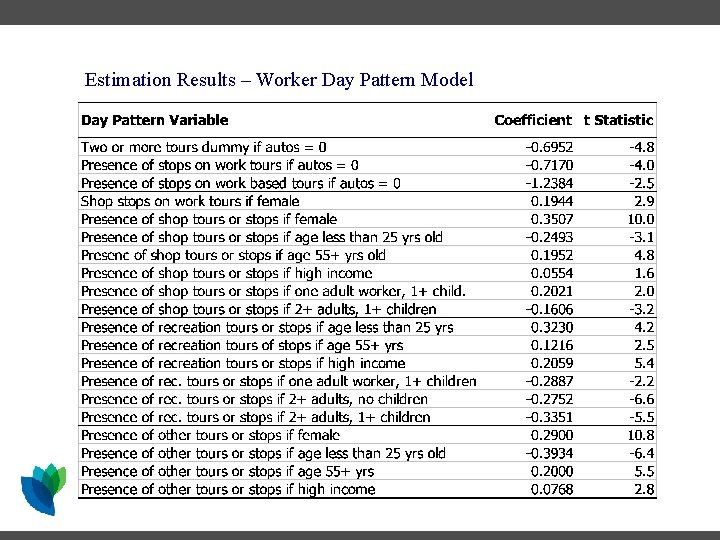
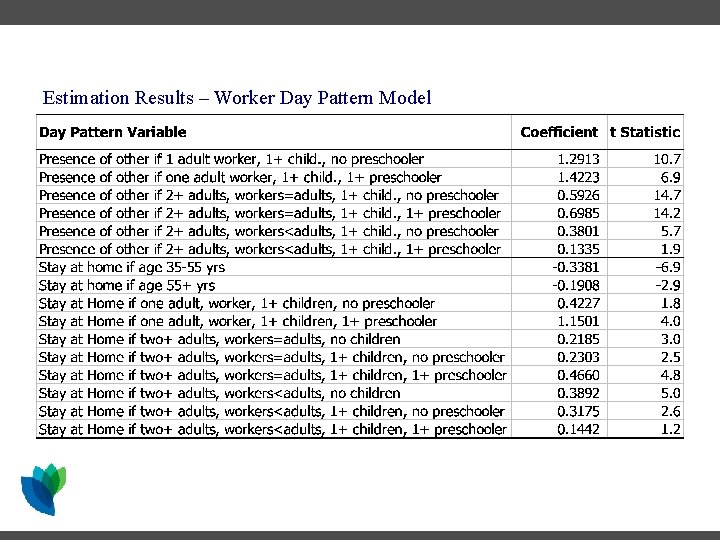
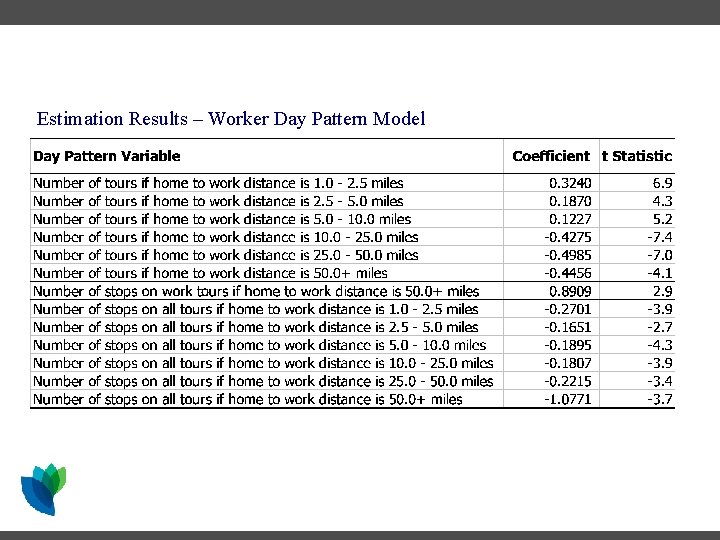
Estimation Results – Worker Day Pattern Model
Estimation Results – Worker Day Pattern Model
Estimation Results – Worker Day Pattern Model
Estimation Results – Worker Day Pattern Model
Estimation Results – Worker Day Pattern Model
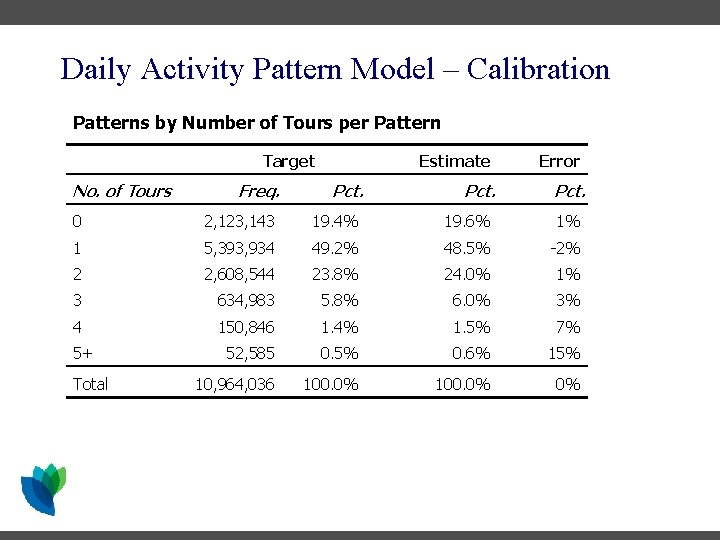
Daily Activity Pattern Model – Calibration Patterns by Number of Tours per Pattern Target No. of Tours Freq. Estimate Pct. Error Pct. 0 2, 123, 143 19. 4% 19. 6% 1% 1 5, 393, 934 49. 2% 48. 5% -2% 2 2, 608, 544 23. 8% 24. 0% 1% 3 634, 983 5. 8% 6. 0% 3% 4 150, 846 1. 4% 1. 5% 7% 52, 585 0. 5% 0. 6% 15% 10, 964, 036 100. 0% 0% 5+ Total
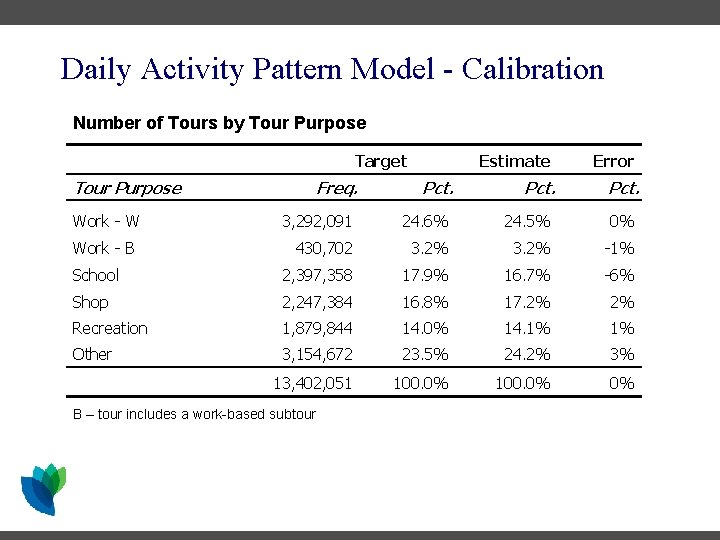
Daily Activity Pattern Model - Calibration Number of Tours by Tour Purpose Target Tour Purpose Work - W Freq. Estimate Pct. Error Pct. 3, 292, 091 24. 6% 24. 5% 0% 430, 702 3. 2% -1% School 2, 397, 358 17. 9% 16. 7% -6% Shop 2, 247, 384 16. 8% 17. 2% 2% Recreation 1, 879, 844 14. 0% 14. 1% 1% Other 3, 154, 672 23. 5% 24. 2% 3% 13, 402, 051 100. 0% 0% Work - B B – tour includes a work-based subtour
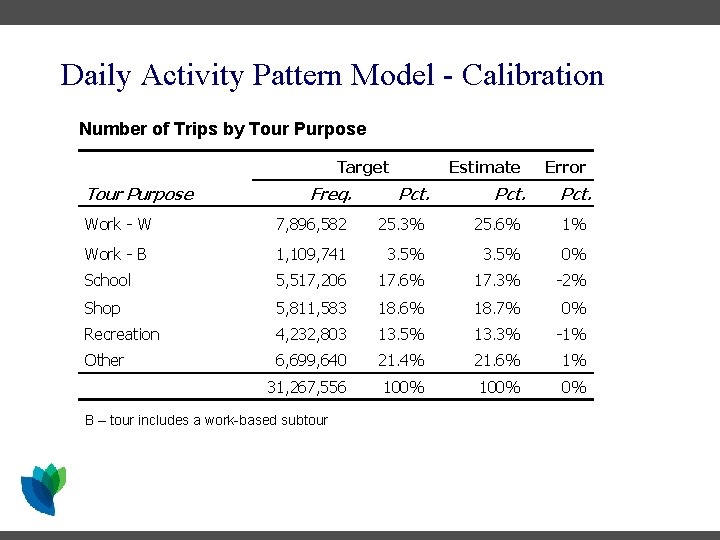
Daily Activity Pattern Model - Calibration Number of Trips by Tour Purpose Target Tour Purpose Freq. Estimate Pct. Error Pct. Work - W 7, 896, 582 25. 3% 25. 6% 1% Work - B 1, 109, 741 3. 5% 0% School 5, 517, 206 17. 6% 17. 3% -2% Shop 5, 811, 583 18. 6% 18. 7% 0% Recreation 4, 232, 803 13. 5% 13. 3% -1% Other 6, 699, 640 21. 4% 21. 6% 1% 31, 267, 556 100% 0% B – tour includes a work-based subtour
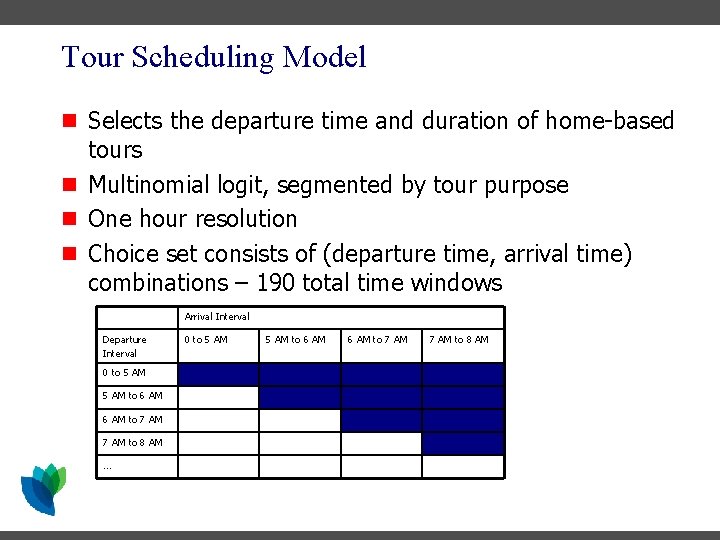
Tour Scheduling Model n Selects the departure time and duration of home-based tours n Multinomial logit, segmented by tour purpose n One hour resolution n Choice set consists of (departure time, arrival time) combinations – 190 total time windows Arrival Interval Departure Interval 0 to 5 AM to 6 AM to 7 AM to 8 AM … 0 to 5 AM to 6 AM to 7 AM to 8 AM
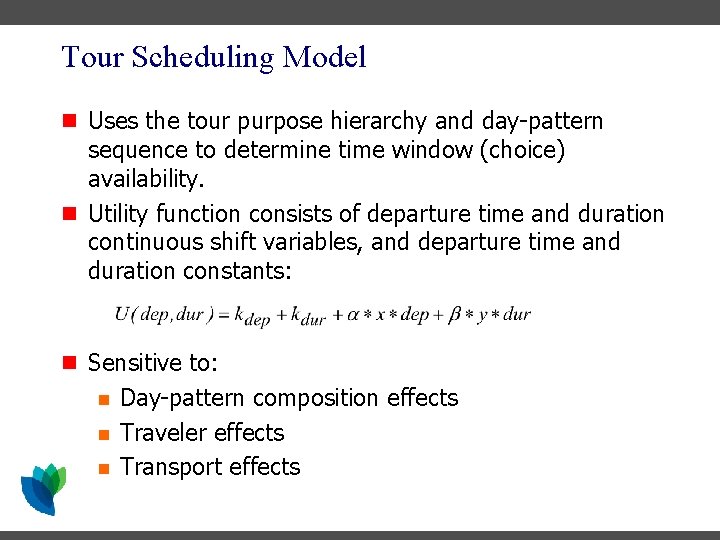
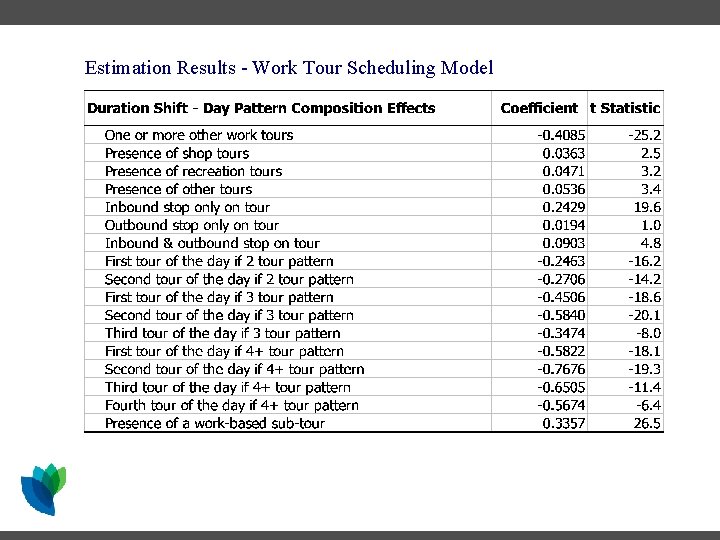
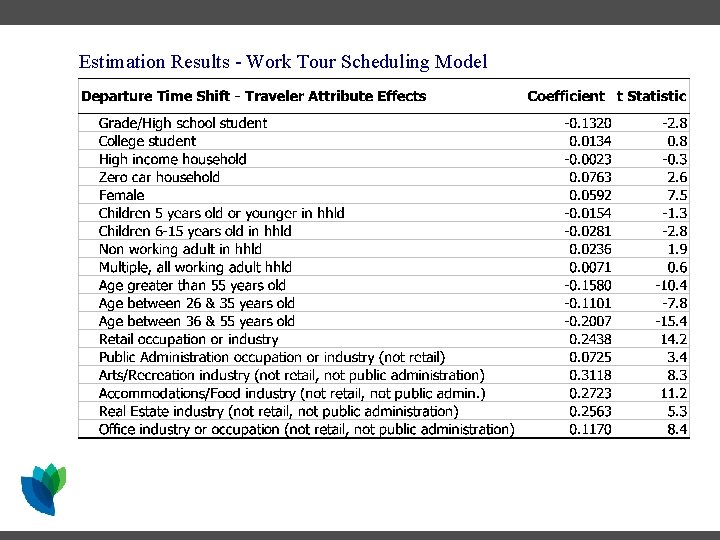
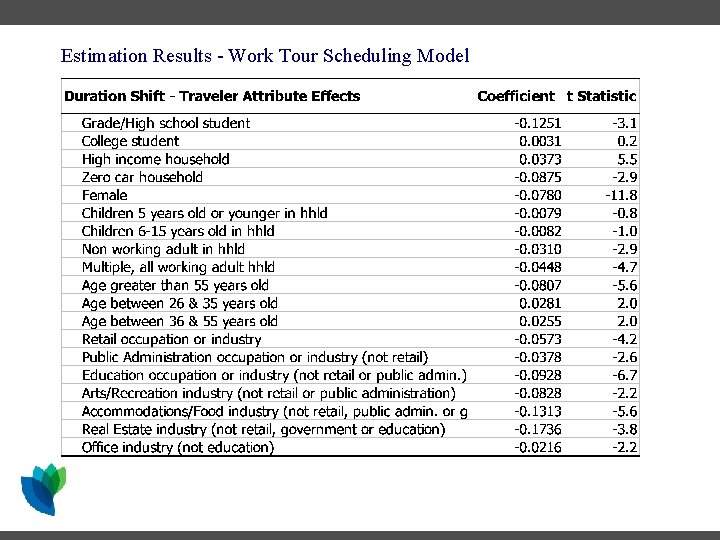
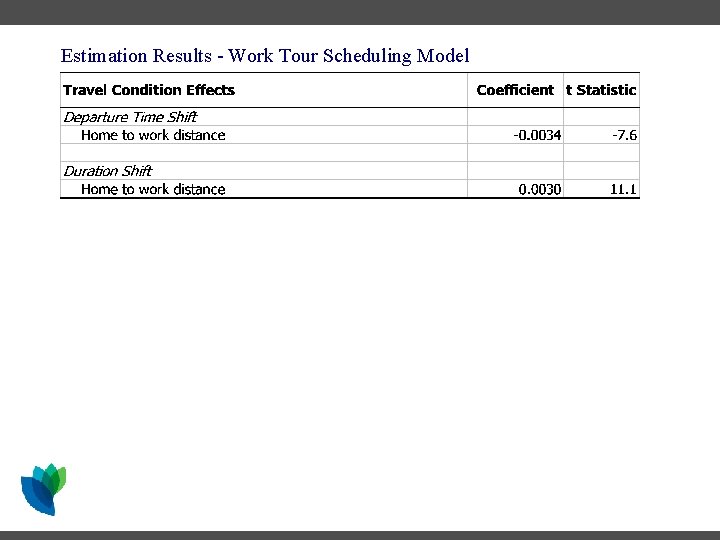
Tour Scheduling Model n Uses the tour purpose hierarchy and day-pattern sequence to determine time window (choice) availability. n Utility function consists of departure time and duration continuous shift variables, and departure time and duration constants: n Sensitive to: n n n Day-pattern composition effects Traveler effects Transport effects
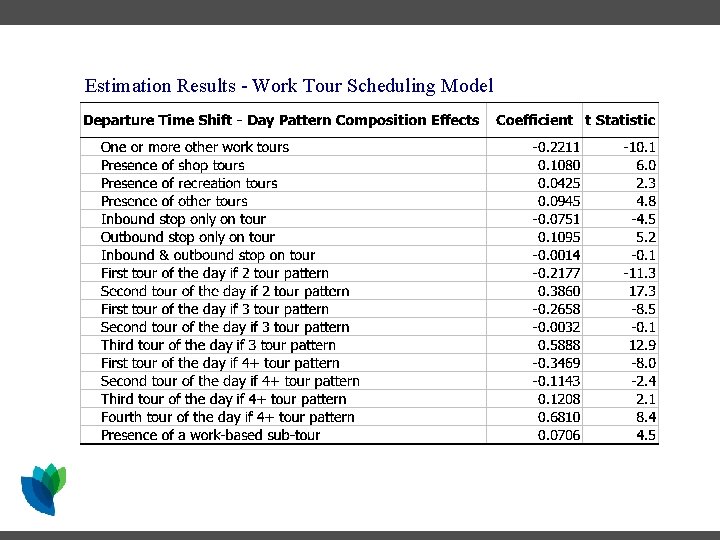
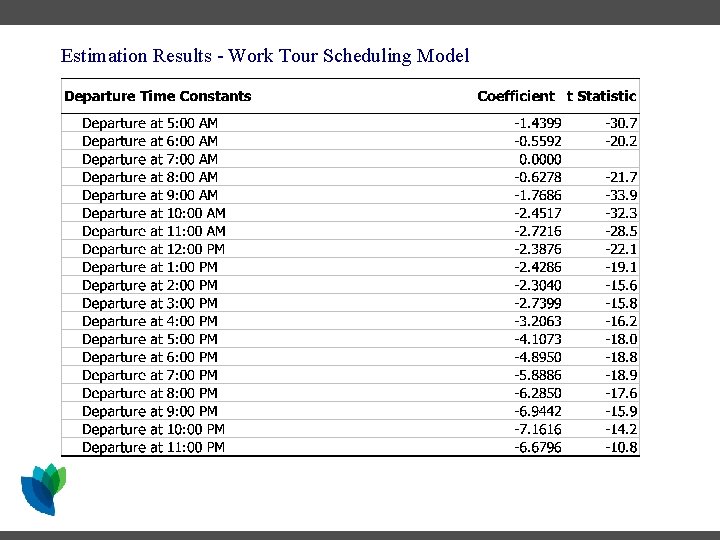
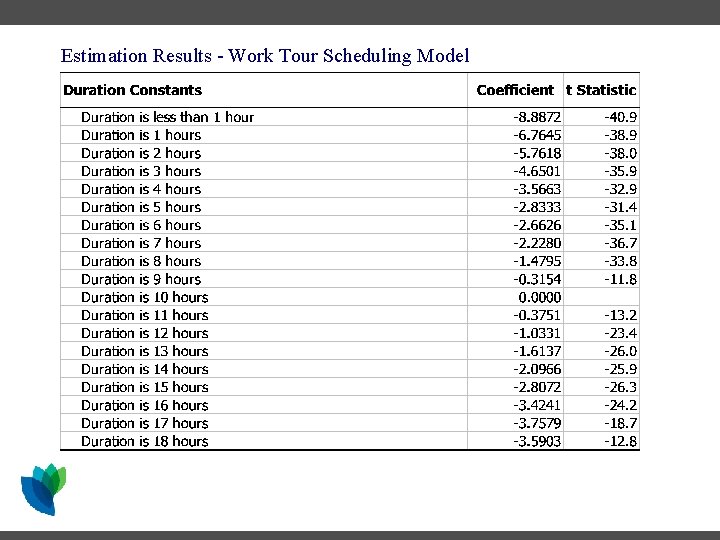
Estimation Results - Work Tour Scheduling Model
Estimation Results - Work Tour Scheduling Model
Estimation Results - Work Tour Scheduling Model
Estimation Results - Work Tour Scheduling Model
Estimation Results - Work Tour Scheduling Model
Estimation Results - Work Tour Scheduling Model
Estimation Results - Work Tour Scheduling Model
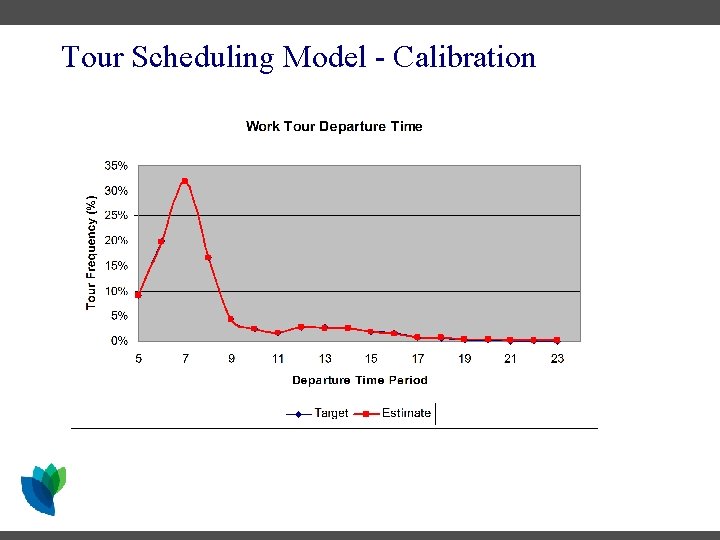
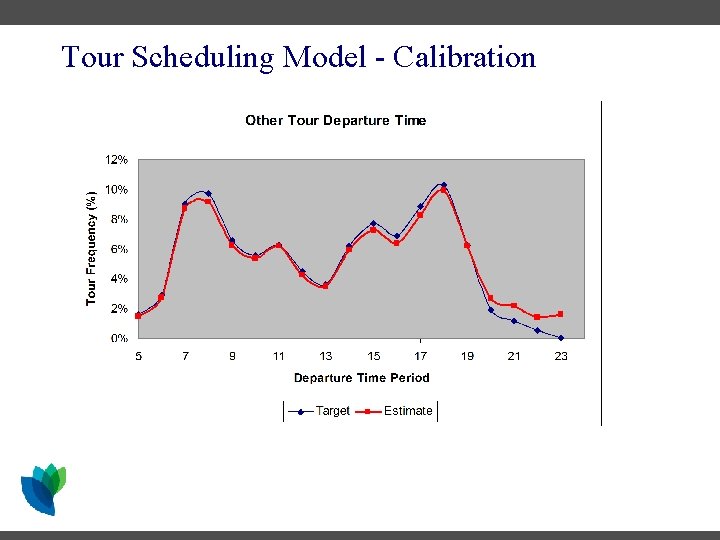
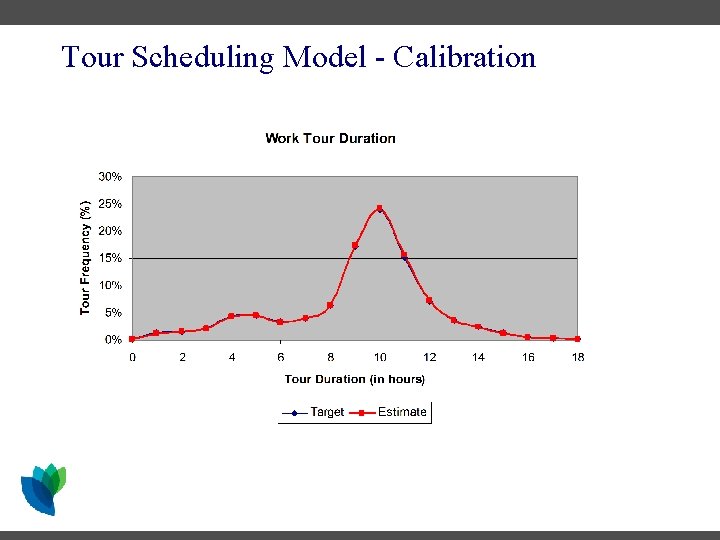
Tour Scheduling Model - Calibration
Tour Scheduling Model - Calibration
Tour Scheduling Model - Calibration
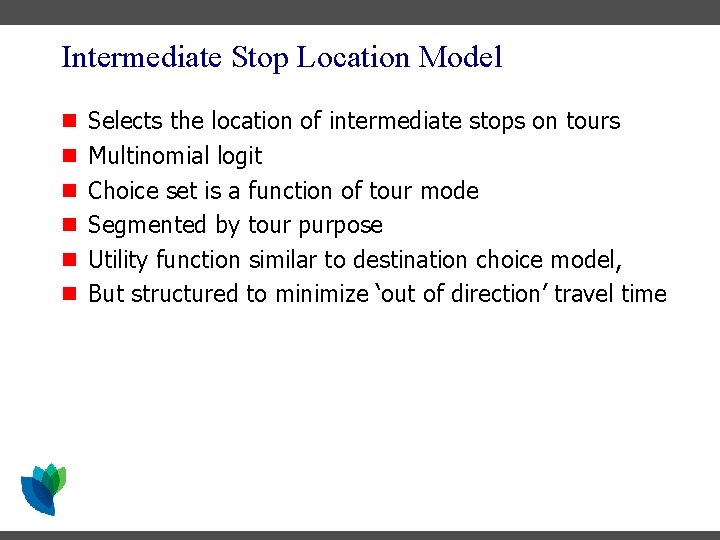
Intermediate Stop Location Model n Selects the location of intermediate stops on tours n Multinomial logit n Choice set is a function of tour mode n Segmented by tour purpose n Utility function similar to destination choice model, n But structured to minimize ‘out of direction’ travel time
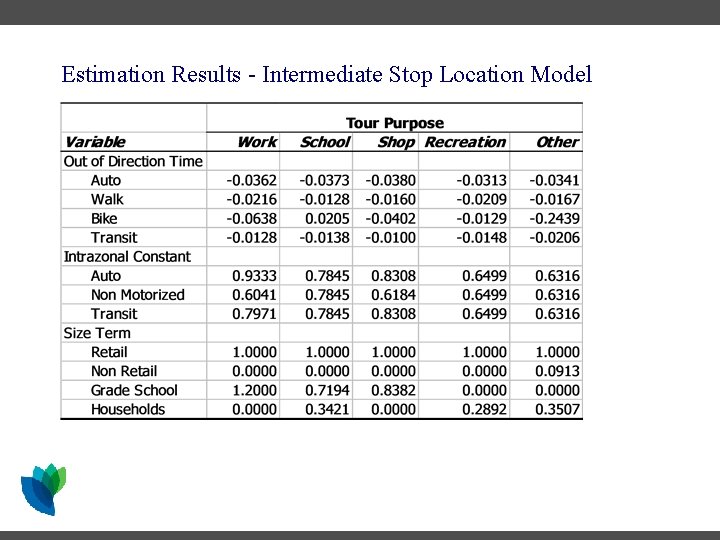
Estimation Results - Intermediate Stop Location Model
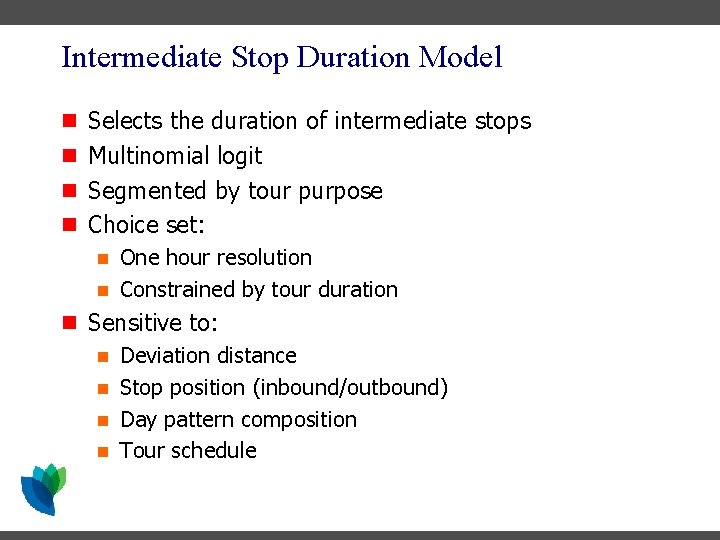
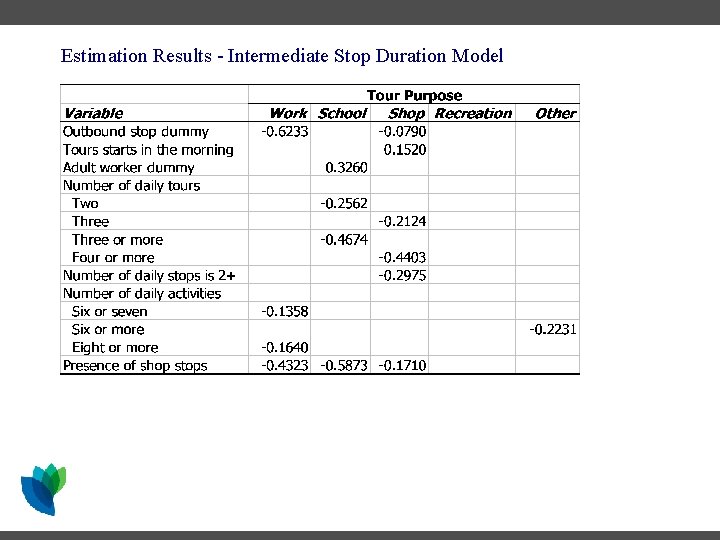
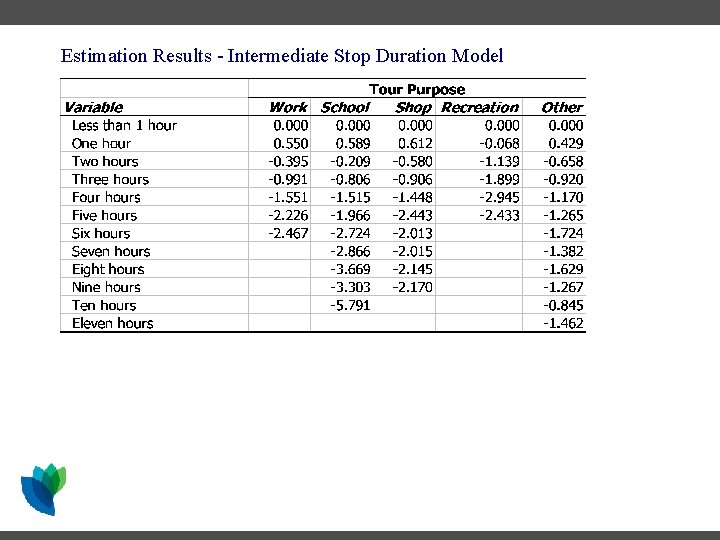
Intermediate Stop Duration Model n Selects the duration of intermediate stops n Multinomial logit n Segmented by tour purpose n Choice set: n One hour resolution n Constrained by tour duration n Sensitive to: n Deviation distance n Stop position (inbound/outbound) n Day pattern composition n Tour schedule
Estimation Results - Intermediate Stop Duration Model
Estimation Results - Intermediate Stop Duration Model
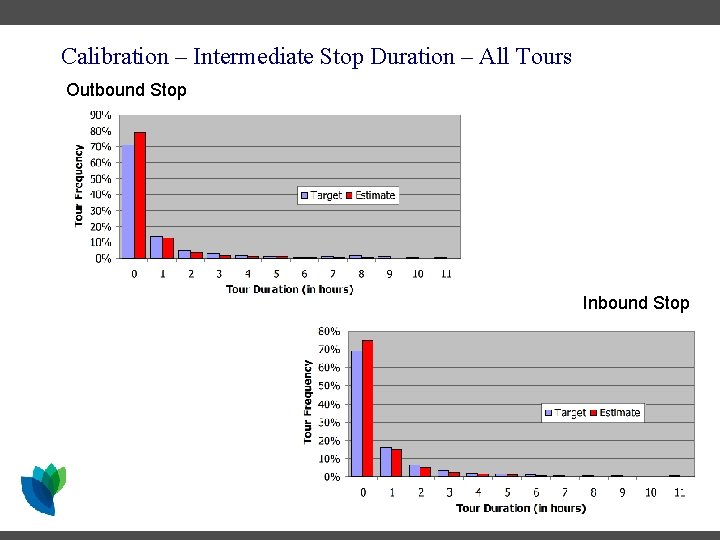
Calibration – Intermediate Stop Duration – All Tours Outbound Stop Inbound Stop
PB OSMP Team Short Distance Travel Models Rosella Picado Joel Freedman Andrew Stryker Greg Erhardt Ofir Cohen Christi Willison