
Session 16 Effective Communication Strategies People Skills PS
- Slides: 10
Session 16 Effective Communication Strategies People Skills (PS 10 -01) Accredited By: Copyright © 2010 by The Association of Business Practitioners
Effective Communication Strategies • • In this session, we will highlight the importance of communication, both at workplace and at a personal level. We have learned in the last session that different situations demand different types of communication media and there a number of various options available to a manager. Selecting the correct method is of great importance in achieving good levels of communication. You should by now be trying to find out the various barriers which might hinder your communication and be beginning to understand how good feedback can help you to improve your own communication skills. Session 1: Customer Service (CS 10 -01) © BBPSD 2010, All Rights Reserved 2
Effective Communication Strategies • You might be surprised to know that while business managers and leaders are often trained in a variety of other business skills, very few receive a formal training in effective communication. Below is an exercise that can help you to think about areas you may like to improve on. Activity 1. Write down your 3 strengths that you have in communication and also 3 areas in which you could improve. Session 1: Customer Service (CS 10 -01) © BBPSD 2010, All Rights Reserved 3
Effective Communication Strategies • • • Experts argue that communication is one of the most important skills people should have on their list of competencies. In order to ensure effective communication, you need to have good knowledge of verbal and non-verbal communication techniques. Research has shown that these types of communication, verbal and non-verbal are routinely exchanged without much thought or planning into which would be the most effective for getting a particular message across. Good communication is contingent on appropriate training, the extent of employee cooperation in that training, and the use of the appropriate communication media. In absence of factors such as those above, communication may not be effective. Session 1: Customer Service (CS 10 -01) © BBPSD 2010, All Rights Reserved 4
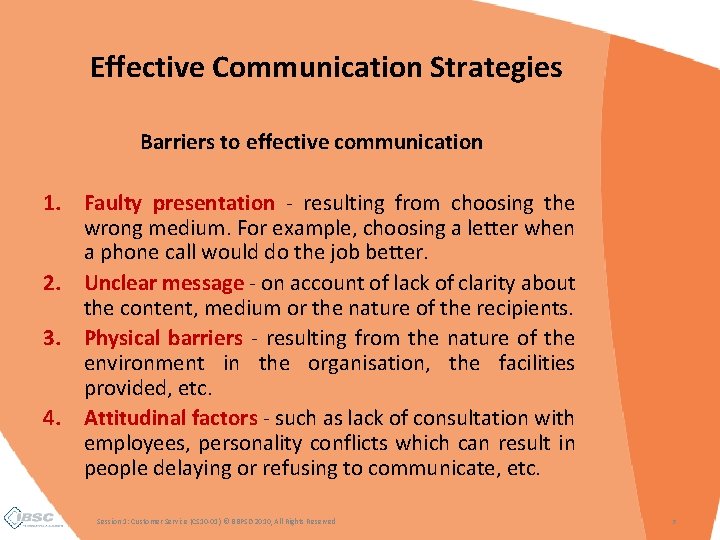
Effective Communication Strategies Barriers to effective communication 1. Faulty presentation - resulting from choosing the wrong medium. For example, choosing a letter when a phone call would do the job better. 2. Unclear message - on account of lack of clarity about the content, medium or the nature of the recipients. 3. Physical barriers - resulting from the nature of the environment in the organisation, the facilities provided, etc. 4. Attitudinal factors - such as lack of consultation with employees, personality conflicts which can result in people delaying or refusing to communicate, etc. Session 1: Customer Service (CS 10 -01) © BBPSD 2010, All Rights Reserved 5
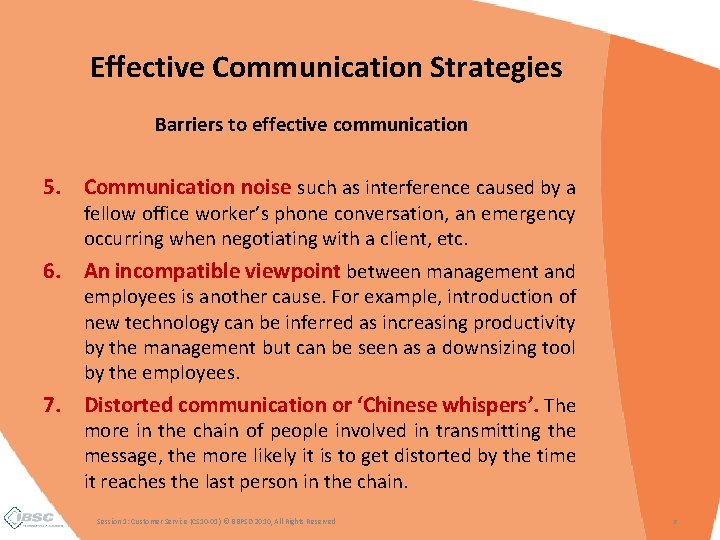
Effective Communication Strategies Barriers to effective communication 5. Communication noise such as interference caused by a fellow office worker’s phone conversation, an emergency occurring when negotiating with a client, etc. 6. An incompatible viewpoint between management and employees is another cause. For example, introduction of new technology can be inferred as increasing productivity by the management but can be seen as a downsizing tool by the employees. 7. Distorted communication or ‘Chinese whispers’. The more in the chain of people involved in transmitting the message, the more likely it is to get distorted by the time it reaches the last person in the chain. Session 1: Customer Service (CS 10 -01) © BBPSD 2010, All Rights Reserved 6
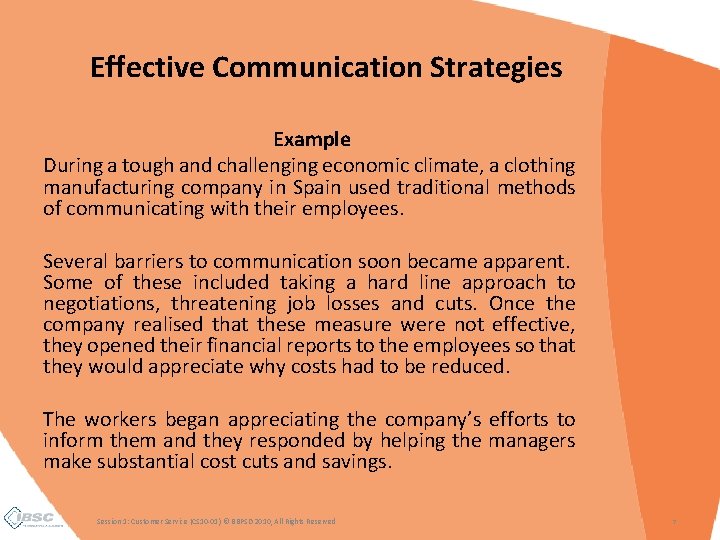
Effective Communication Strategies Example During a tough and challenging economic climate, a clothing manufacturing company in Spain used traditional methods of communicating with their employees. Several barriers to communication soon became apparent. Some of these included taking a hard line approach to negotiations, threatening job losses and cuts. Once the company realised that these measure were not effective, they opened their financial reports to the employees so that they would appreciate why costs had to be reduced. The workers began appreciating the company’s efforts to inform them and they responded by helping the managers make substantial cost cuts and savings. Session 1: Customer Service (CS 10 -01) © BBPSD 2010, All Rights Reserved 7
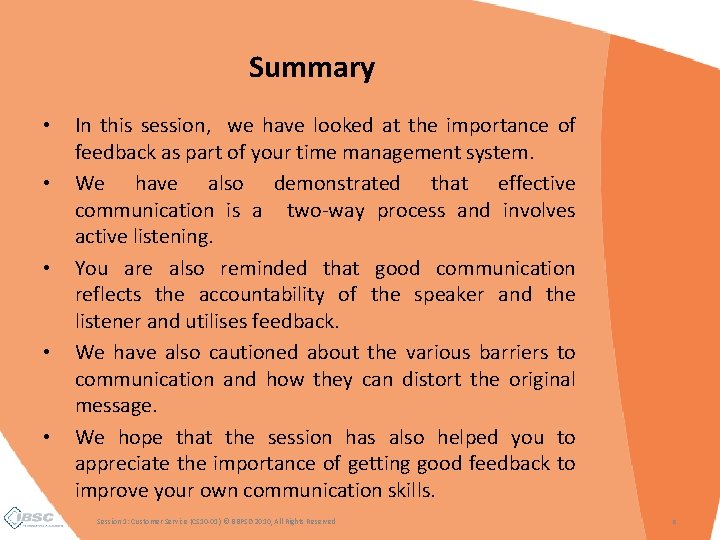
Summary • • • In this session, we have looked at the importance of feedback as part of your time management system. We have also demonstrated that effective communication is a two-way process and involves active listening. You are also reminded that good communication reflects the accountability of the speaker and the listener and utilises feedback. We have also cautioned about the various barriers to communication and how they can distort the original message. We hope that the session has also helped you to appreciate the importance of getting good feedback to improve your own communication skills. Session 1: Customer Service (CS 10 -01) © BBPSD 2010, All Rights Reserved 8
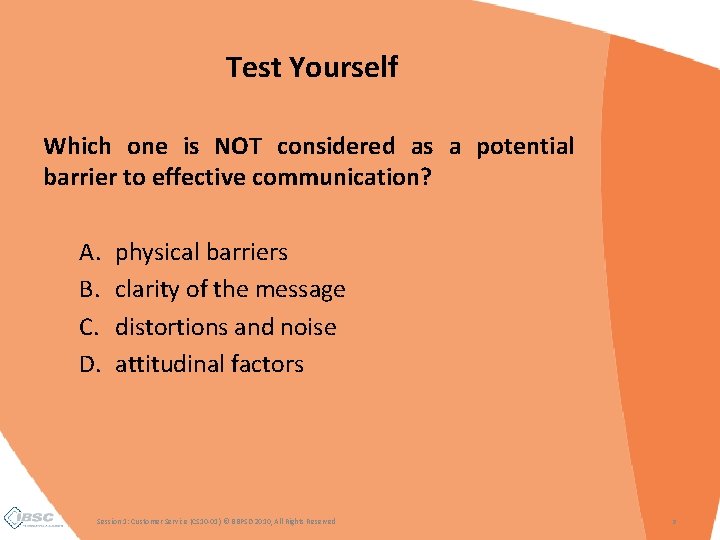
Test Yourself Which one is NOT considered as a potential barrier to effective communication? A. B. C. D. physical barriers clarity of the message distortions and noise attitudinal factors Session 1: Customer Service (CS 10 -01) © BBPSD 2010, All Rights Reserved 9
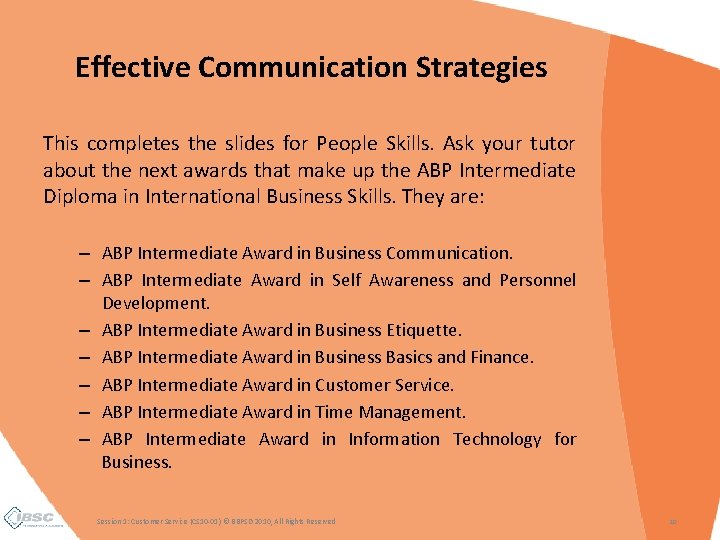
Effective Communication Strategies This completes the slides for People Skills. Ask your tutor about the next awards that make up the ABP Intermediate Diploma in International Business Skills. They are: – ABP Intermediate Award in Business Communication. – ABP Intermediate Award in Self Awareness and Personnel Development. – ABP Intermediate Award in Business Etiquette. – ABP Intermediate Award in Business Basics and Finance. – ABP Intermediate Award in Customer Service. – ABP Intermediate Award in Time Management. – ABP Intermediate Award in Information Technology for Business. Session 1: Customer Service (CS 10 -01) © BBPSD 2010, All Rights Reserved 10