
Session 14 NonMarket Valuation Morteza Rahmatian California State

- Slides: 34
Session 14 Non-Market Valuation Morteza Rahmatian California State University, Fullerton mrahmatian@fullerton. edu Ashgabad, November, 2005 Caspian EVE 2005/UNDP and WBI Morteza Rahmatian, Non-Market Valuation GEF
Notion of placing a value on nature “knowing the price of everything but the value of nothing. ” Value and prices are separate ideas. Caspian EVE 2005/UNDP and WBI Morteza Rahmatian, Non-Market Valuation GEF
What is value? Ø First, the economic view of “value” is anthropocentric. This means value is determined by people and not by either natural law or government. Ø Second, value is determined by peoples’ willingness to make trade-offs. When an individual spends money on one good, there is less available for other goods. Caspian EVE 2005/UNDP and WBI Morteza Rahmatian, Non-Market Valuation GEF
The argument against. . The notion that cars, houses and bus rides have prices. Putting a price on the environment destroys the notion that it has value - rather it becomes a chattel that can be sold off. How much would you be willing to pay to forego your freedom or health? Caspian EVE 2005/UNDP and WBI Morteza Rahmatian, Non-Market Valuation GEF
Why is monetary valuation important? Ø Planning process is influenced by economic analysis (CBA) Ø Goods and services which have quantities and prices can be taken into account in decision-making process Ø Economic valuation helps to bring the environment into decision-making process Caspian EVE 2005/UNDP and WBI Morteza Rahmatian, Non-Market Valuation GEF
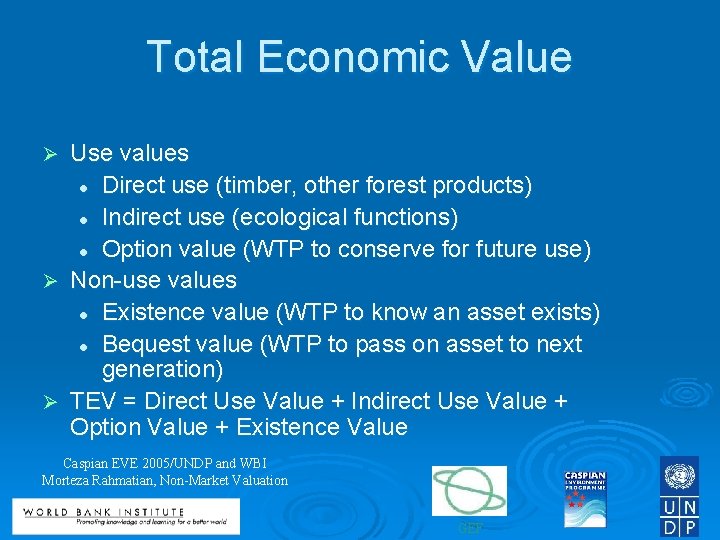
Total Economic Value Use values l Direct use (timber, other forest products) l Indirect use (ecological functions) l Option value (WTP to conserve for future use) Ø Non-use values l Existence value (WTP to know an asset exists) l Bequest value (WTP to pass on asset to next generation) Ø TEV = Direct Use Value + Indirect Use Value + Option Value + Existence Value Ø Caspian EVE 2005/UNDP and WBI Morteza Rahmatian, Non-Market Valuation GEF
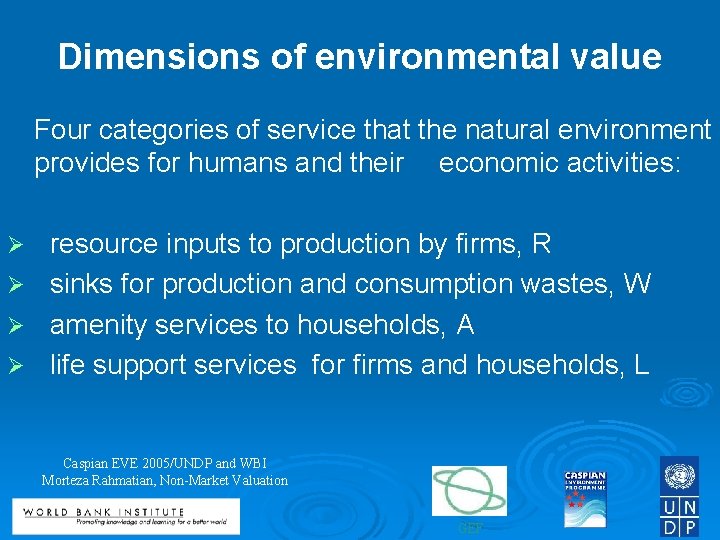
Dimensions of environmental value Four categories of service that the natural environment provides for humans and their economic activities: resource inputs to production by firms, R Ø sinks for production and consumption wastes, W Ø amenity services to households, A Ø life support services for firms and households, L Ø Caspian EVE 2005/UNDP and WBI Morteza Rahmatian, Non-Market Valuation GEF
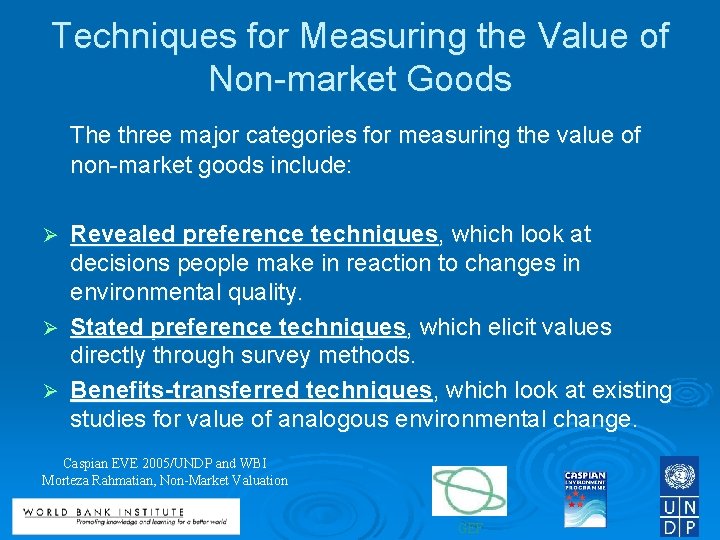
Techniques for Measuring the Value of Non-market Goods The three major categories for measuring the value of non-market goods include: Revealed preference techniques, which look at decisions people make in reaction to changes in environmental quality. Ø Stated preference techniques, which elicit values directly through survey methods. Ø Benefits-transferred techniques, which look at existing studies for value of analogous environmental change. Ø Caspian EVE 2005/UNDP and WBI Morteza Rahmatian, Non-Market Valuation GEF
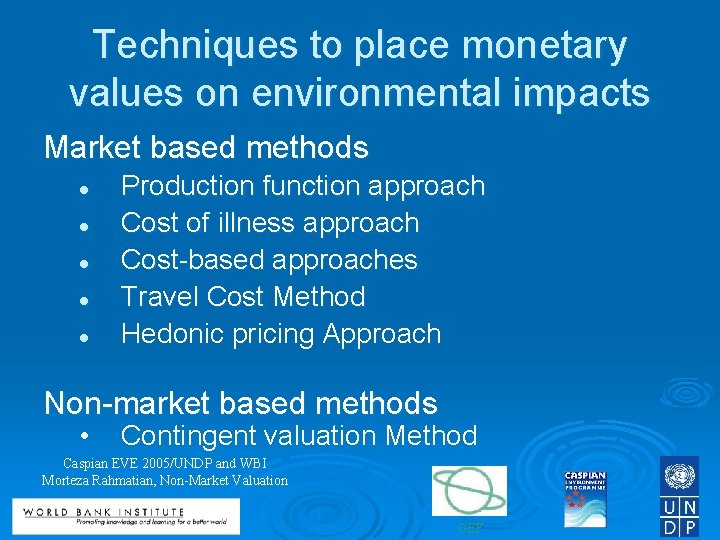
Techniques to place monetary values on environmental impacts Market based methods l l l Production function approach Cost of illness approach Cost-based approaches Travel Cost Method Hedonic pricing Approach Non-market based methods • Contingent valuation Method Caspian EVE 2005/UNDP and WBI Morteza Rahmatian, Non-Market Valuation GEF
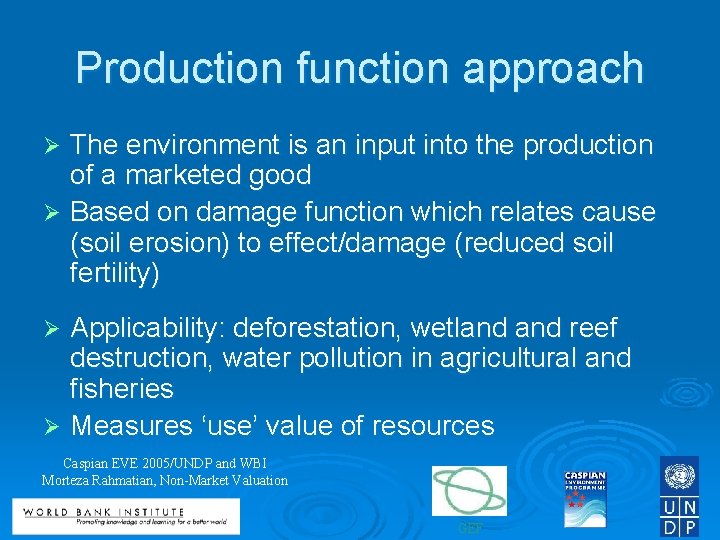
Production function approach The environment is an input into the production of a marketed good Ø Based on damage function which relates cause (soil erosion) to effect/damage (reduced soil fertility) Ø Applicability: deforestation, wetland reef destruction, water pollution in agricultural and fisheries Ø Measures ‘use’ value of resources Ø Caspian EVE 2005/UNDP and WBI Morteza Rahmatian, Non-Market Valuation GEF
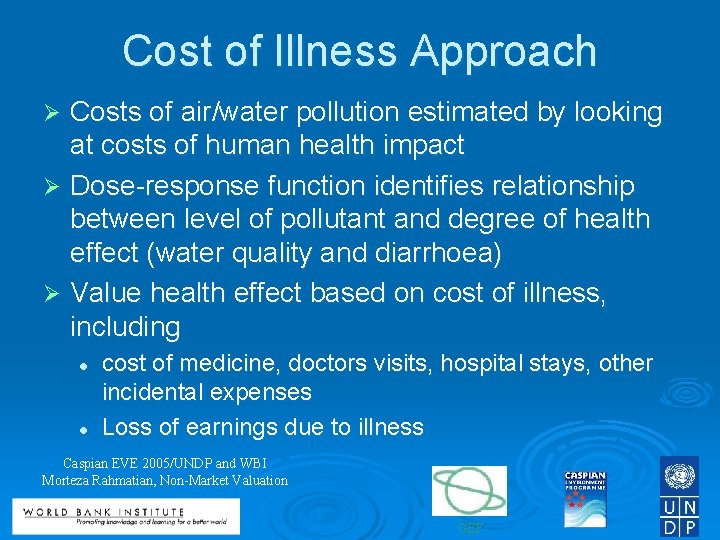
Cost of Illness Approach Costs of air/water pollution estimated by looking at costs of human health impact Ø Dose-response function identifies relationship between level of pollutant and degree of health effect (water quality and diarrhoea) Ø Value health effect based on cost of illness, including Ø l l cost of medicine, doctors visits, hospital stays, other incidental expenses Loss of earnings due to illness Caspian EVE 2005/UNDP and WBI Morteza Rahmatian, Non-Market Valuation GEF
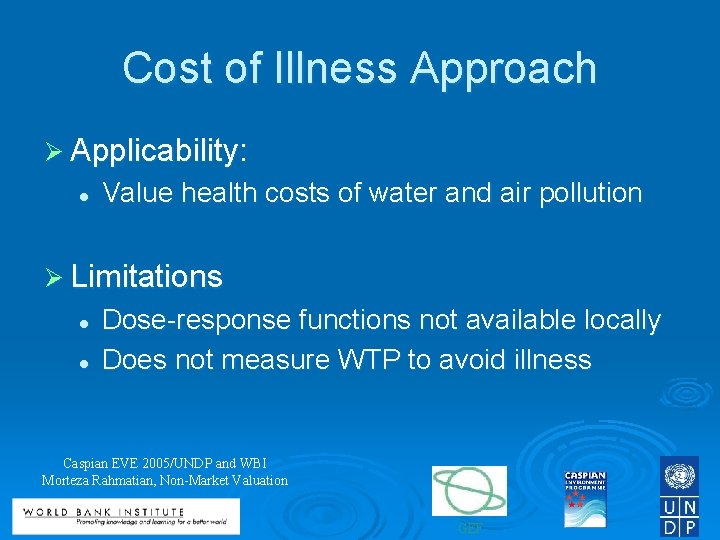
Cost of Illness Approach Ø Applicability: l Value health costs of water and air pollution Ø Limitations l l Dose-response functions not available locally Does not measure WTP to avoid illness Caspian EVE 2005/UNDP and WBI Morteza Rahmatian, Non-Market Valuation GEF
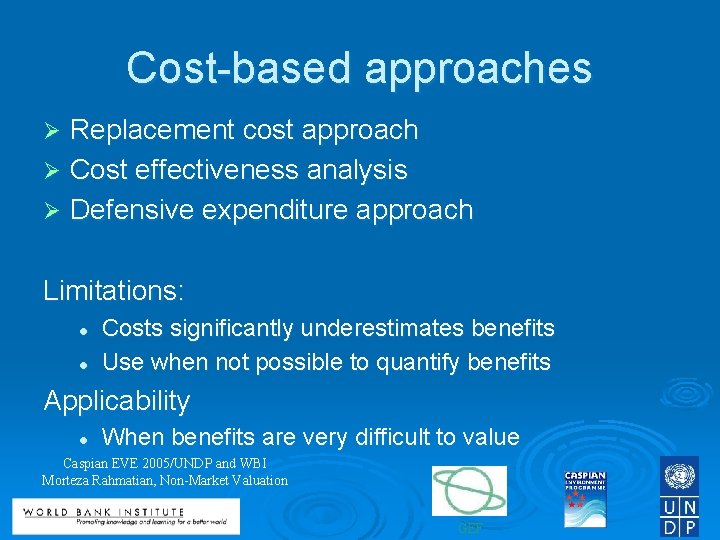
Cost-based approaches Replacement cost approach Ø Cost effectiveness analysis Ø Defensive expenditure approach Ø Limitations: l l Costs significantly underestimates benefits Use when not possible to quantify benefits Applicability l When benefits are very difficult to value Caspian EVE 2005/UNDP and WBI Morteza Rahmatian, Non-Market Valuation GEF
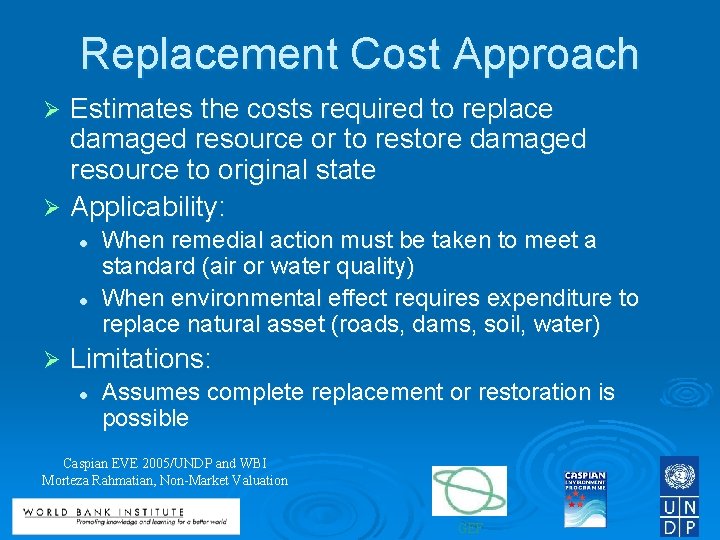
Replacement Cost Approach Estimates the costs required to replace damaged resource or to restore damaged resource to original state Ø Applicability: Ø l l Ø When remedial action must be taken to meet a standard (air or water quality) When environmental effect requires expenditure to replace natural asset (roads, dams, soil, water) Limitations: l Assumes complete replacement or restoration is possible Caspian EVE 2005/UNDP and WBI Morteza Rahmatian, Non-Market Valuation GEF
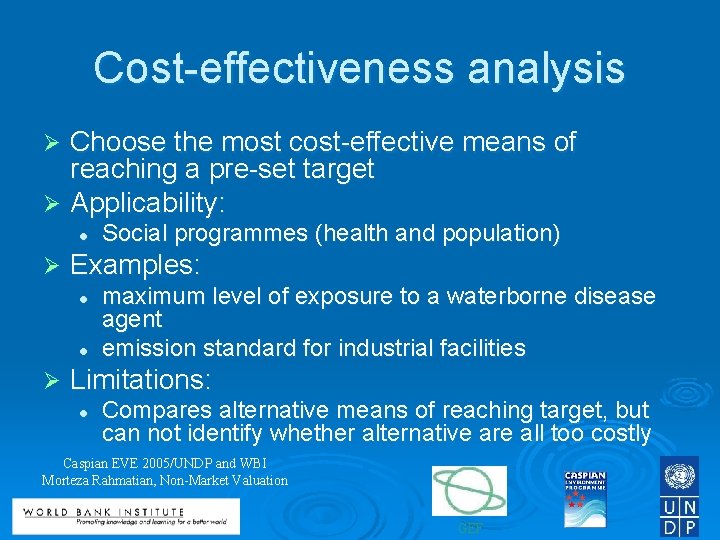
Cost-effectiveness analysis Choose the most cost-effective means of reaching a pre-set target Ø Applicability: Ø l Ø Examples: l l Ø Social programmes (health and population) maximum level of exposure to a waterborne disease agent emission standard for industrial facilities Limitations: l Compares alternative means of reaching target, but can not identify whether alternative are all too costly Caspian EVE 2005/UNDP and WBI Morteza Rahmatian, Non-Market Valuation GEF
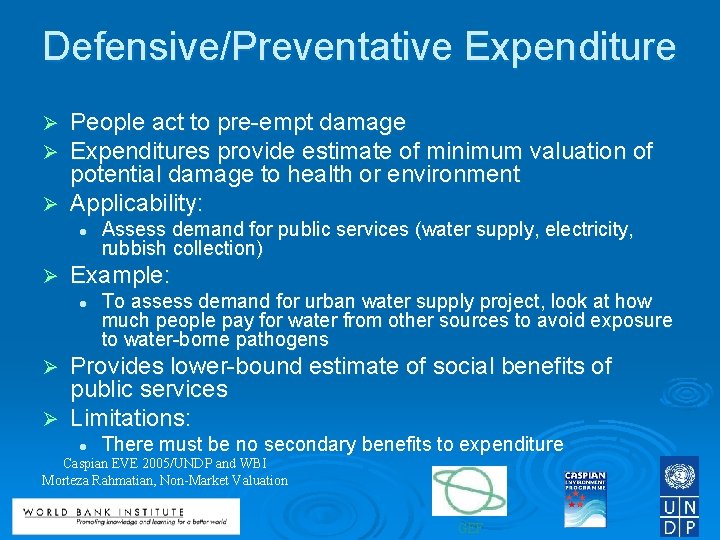
Defensive/Preventative Expenditure People act to pre-empt damage Expenditures provide estimate of minimum valuation of potential damage to health or environment Ø Applicability: Ø Ø l Ø Assess demand for public services (water supply, electricity, rubbish collection) Example: l To assess demand for urban water supply project, look at how much people pay for water from other sources to avoid exposure to water-borne pathogens Provides lower-bound estimate of social benefits of public services Ø Limitations: Ø l There must be no secondary benefits to expenditure Caspian EVE 2005/UNDP and WBI Morteza Rahmatian, Non-Market Valuation GEF
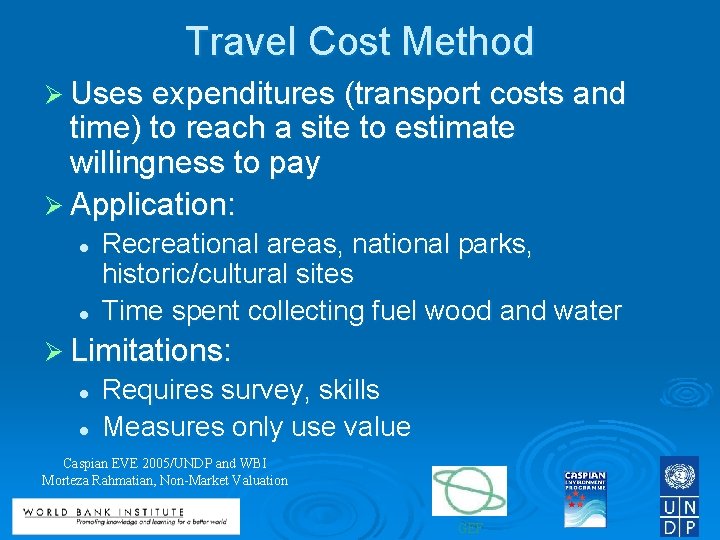
Travel Cost Method Ø Uses expenditures (transport costs and time) to reach a site to estimate willingness to pay Ø Application: l l Recreational areas, national parks, historic/cultural sites Time spent collecting fuel wood and water Ø Limitations: l l Requires survey, skills Measures only use value Caspian EVE 2005/UNDP and WBI Morteza Rahmatian, Non-Market Valuation GEF
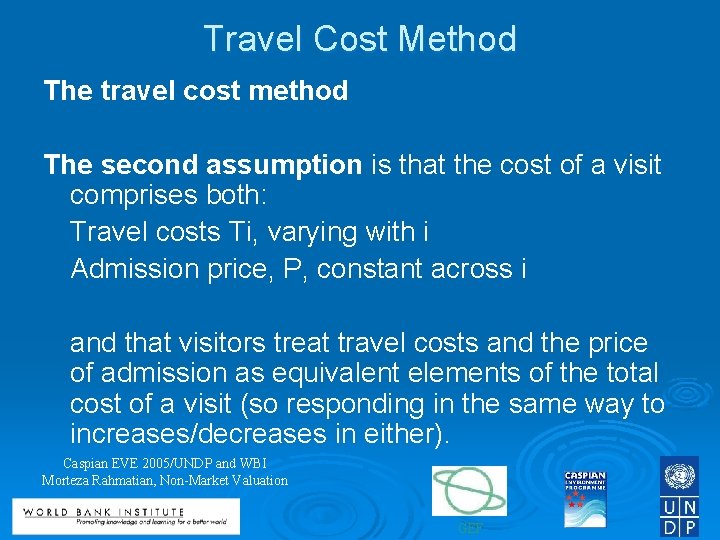
Travel Cost Method The travel cost method The second assumption is that the cost of a visit comprises both: Travel costs Ti, varying with i Admission price, P, constant across i and that visitors treat travel costs and the price of admission as equivalent elements of the total cost of a visit (so responding in the same way to increases/decreases in either). Caspian EVE 2005/UNDP and WBI Morteza Rahmatian, Non-Market Valuation GEF
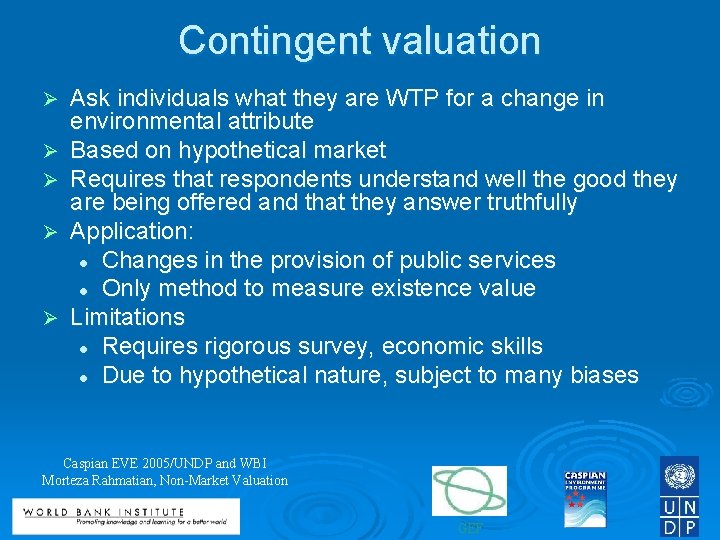
Contingent valuation Ø Ø Ø Ask individuals what they are WTP for a change in environmental attribute Based on hypothetical market Requires that respondents understand well the good they are being offered and that they answer truthfully Application: l Changes in the provision of public services l Only method to measure existence value Limitations l Requires rigorous survey, economic skills l Due to hypothetical nature, subject to many biases Caspian EVE 2005/UNDP and WBI Morteza Rahmatian, Non-Market Valuation GEF
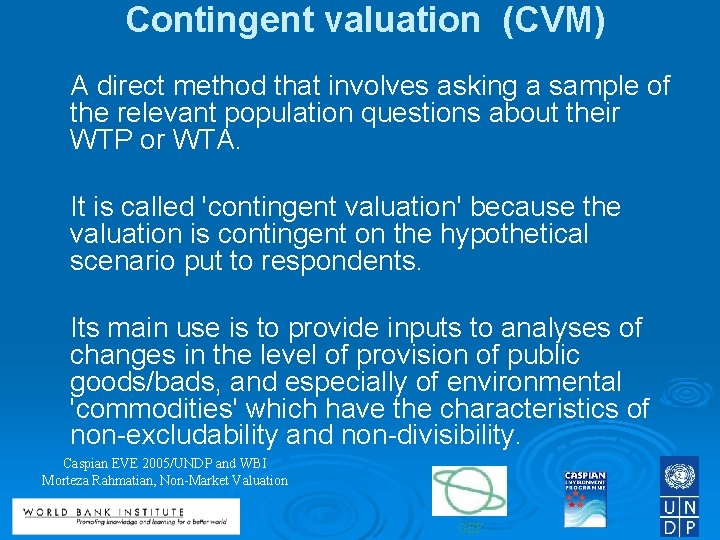
Contingent valuation (CVM) A direct method that involves asking a sample of the relevant population questions about their WTP or WTA. It is called 'contingent valuation' because the valuation is contingent on the hypothetical scenario put to respondents. Its main use is to provide inputs to analyses of changes in the level of provision of public goods/bads, and especially of environmental 'commodities' which have the characteristics of non-excludability and non-divisibility. Caspian EVE 2005/UNDP and WBI Morteza Rahmatian, Non-Market Valuation GEF
Contingent valuation: pros and cons CVM is seen by many economists as suffering from the problem that it asks hypothetical questions, whereas indirect methods exploit data on observed, actual, behaviour. On the other hand, the CVM has two advantages over indirect methods: First, it can deal with both use and non-use values, whereas the indirect methods cover only the former. Second, and unlike the indirect methods, CVM answers to WTP or WTA questions go directly to theoretically correct monetary measures of utility changes. Caspian EVE 2005/UNDP and WBI Morteza Rahmatian, Non-Market Valuation GEF
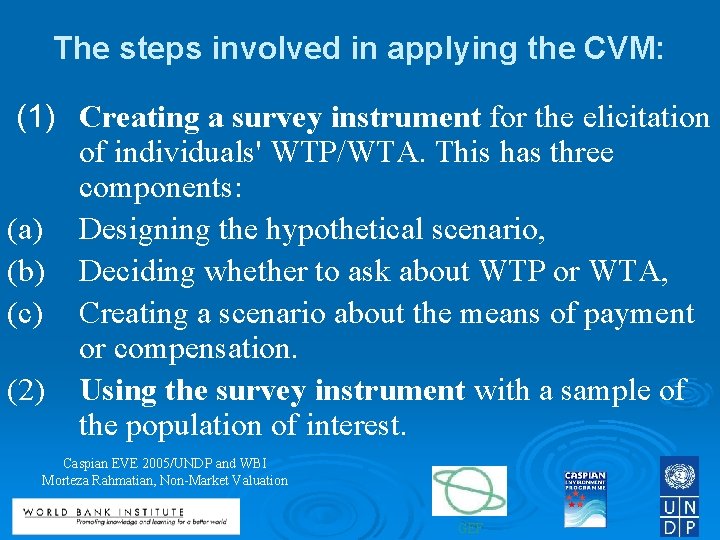
The steps involved in applying the CVM: (1) Creating a survey instrument for the elicitation of individuals' WTP/WTA. This has three components: (a) Designing the hypothetical scenario, (b) Deciding whether to ask about WTP or WTA, (c) Creating a scenario about the means of payment or compensation. (2) Using the survey instrument with a sample of the population of interest. Caspian EVE 2005/UNDP and WBI Morteza Rahmatian, Non-Market Valuation GEF
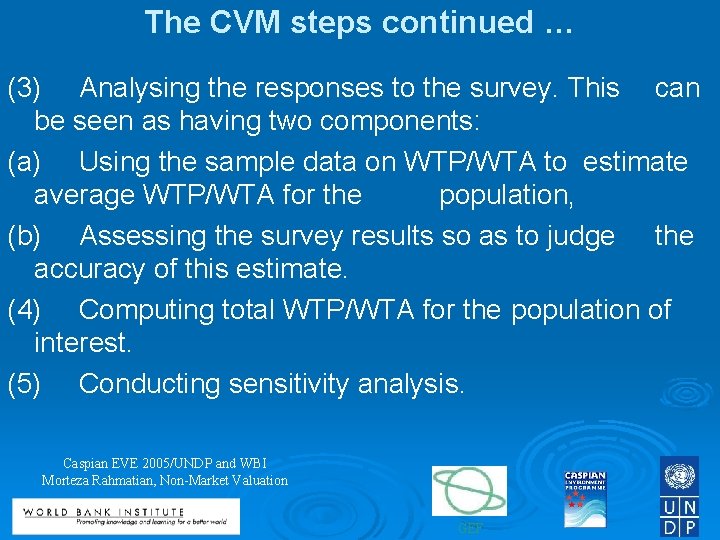
The CVM steps continued … (3) Analysing the responses to the survey. This can be seen as having two components: (a) Using the sample data on WTP/WTA to estimate average WTP/WTA for the population, (b) Assessing the survey results so as to judge the accuracy of this estimate. (4) Computing total WTP/WTA for the population of interest. (5) Conducting sensitivity analysis. Caspian EVE 2005/UNDP and WBI Morteza Rahmatian, Non-Market Valuation GEF
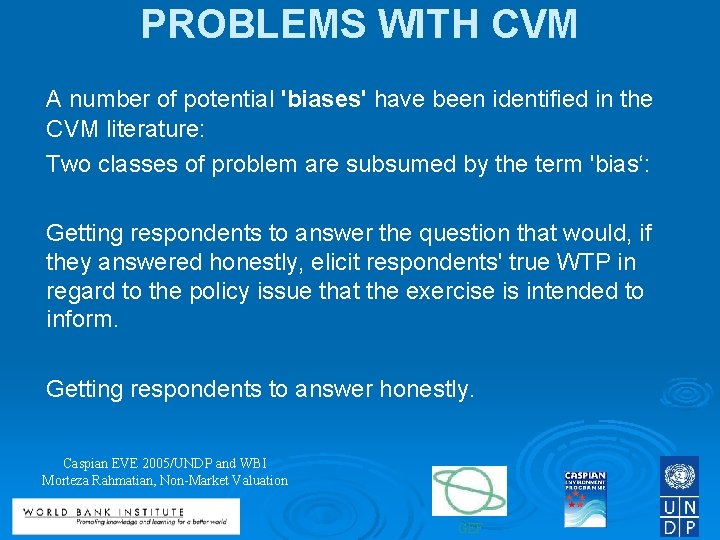
PROBLEMS WITH CVM A number of potential 'biases' have been identified in the CVM literature: Two classes of problem are subsumed by the term 'bias‘: Getting respondents to answer the question that would, if they answered honestly, elicit respondents' true WTP in regard to the policy issue that the exercise is intended to inform. Getting respondents to answer honestly. Caspian EVE 2005/UNDP and WBI Morteza Rahmatian, Non-Market Valuation GEF
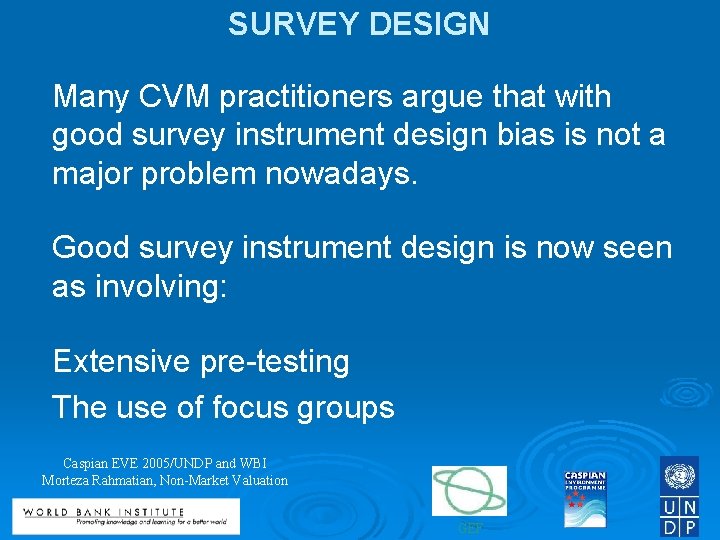
SURVEY DESIGN Many CVM practitioners argue that with good survey instrument design bias is not a major problem nowadays. Good survey instrument design is now seen as involving: Extensive pre-testing The use of focus groups Caspian EVE 2005/UNDP and WBI Morteza Rahmatian, Non-Market Valuation GEF
SOME OTHER DIFFICULTIES Averaging responses Use of mean or median (treatment of outliers)? Treatment of ‘no’ responses (to a question asking whether the individual would be WTP a particular sum). Is this a 'protest' or a ‘genuine’ response? . Are protest responses to be included in the average? Clearly, the treatment of outliers and protest responses can have significant implications for estimated median and, especially, mean WTP. Caspian EVE 2005/UNDP and WBI Morteza Rahmatian, Non-Market Valuation GEF
Obtaining total WTP Given average WTP, total WTP is just that average times the size of the relevant population. A question which arises is: what is the relevant population? At one level the question is answered by the conduct of the CVM exercise in regard to sample selection. At another level, the question may be open and unresolved. If it is the existence value associated with the Amazon rainforest, say, what is the relevant population (and how does that relate to the sample? ) Caspian EVE 2005/UNDP and WBI Morteza Rahmatian, Non-Market Valuation GEF
Hedonic Methods Approach Uses market price of a good to estimate the value of an environmental attribute which is embedded in the price of the marketed good Ø Example: house (size, construction, location, environmental and aesthetic attributes, e. g. clean air) Ø Application Ø l l Ø property prices and air pollution/aesthetic traits and access to water supply and rubbish collection Job markets and risks to life Limitations: l l requires survey, lots of data, economic theory/econometrics Relies on existence of properly functioning land/property and labour market Caspian EVE 2005/UNDP and WBI Morteza Rahmatian, Non-Market Valuation GEF
Hedonic Methods Approach An indirect method Widely used in context of environmental pollution Attempts to evaluate attributes of some traded good. Example: Traded good = housing Attribute = Air quality Uses multiple regression analysis to reveal relationship between house “rents” and levels of all relevant attributes … …and in doing so yields implied value of clean air. Caspian EVE 2005/UNDP and WBI Morteza Rahmatian, Non-Market Valuation GEF
THE HEDONIC PRICE METHOD The hedonic price method can be used to value an attribute, or a change in an attribute, whenever its value is capitalized into the price of an asset, such as houses or salaries. It consists of two steps. Suppose one wants to estimate the value of a scenic view. Caspian EVE 2005/UNDP and WBI Morteza Rahmatian, Non-Market Valuation GEF
THE HEDONIC PRICE METHOD The first step estimates the effect of a marginally better scenic view on the value (price) of lots (a slope parameter in a regression model), while controlling for other variables that affect lot prices. This results in hedonic price function or implicit price function. The change in the price of a lot that results from a unit change in a particular attribute (i. e. , the slope) is called the hedonic price, implicit price, or rent differential of the attribute. Caspian EVE 2005/UNDP and WBI Morteza Rahmatian, Non-Market Valuation GEF
THE HEDONIC PRICE METHOD The second step estimates the WTP for scenic views, after controlling for “tastes, ” which are proxied by income and other socioeconomic factors. To account for different incomes and tastes, analysts should estimate the following WTP function (inverse demand curve) for scenic views: Caspian EVE 2005/UNDP and WBI Morteza Rahmatian, Non-Market Valuation GEF
Revealed Preference Approaches- Hedonic Wage Studies The hedonic wage approach is based on the idea that an individual will choose the city in which he or she resides in order to maximize his/her utility. Ø The individual will consider wages and a host of other positive (educational or recreation opportunities) and negative (crime, pollution) factors. Ø Wages adjust to compensate people for different city characteristics. Ø Caspian EVE 2005/UNDP and WBI Morteza Rahmatian, Non-Market Valuation GEF
Revealed Preference Approaches- Hedonic Wage Studies Ø Ø Ø Suppose a person has two job offers, one in a cold weather city and the other in a warm weather city. Suppose each job offers the same salary. If the person chooses the warm weather job, and others do too, the labor pool will increase in the warm weather city and wages will fall. The reverse happens in the cold weather city. The difference between the wages in the warm weather city and the cold weather city compensates people for the disutility of living in the cold weather. This compensating differential can be used to look at value placed on environmental amenities or risk. Caspian EVE 2005/UNDP and WBI Morteza Rahmatian, Non-Market Valuation GEF