
Session 12 Selecting Team Members People Skills PS
Session 12 Selecting Team Members People Skills (PS 10 -01) Accredited By: Copyright © 2010 by The Association of Business Practitioners
Selecting Team Members • Often when employees join a company they are asked to work in a team. In the past not much thought was given to the mix of people in the team. Now however more thought is being given to the dynamics of a team in order for a team to be effective. • In a successfully working team, each member of the team has something specific to offer. • Researchers argue that there are two specific requirements in selecting team members. The first is that the team should include a range of the necessary technical and specialist skills. • Secondly there should be a variety of personal styles among the team members to fill the different roles that are involved in successful teamwork. Session 1: Customer Service (CS 10 -01) © BBPSD 2010, All Rights Reserved 2
Selecting Team Members The pioneering work on team roles or types was carried out by Dr Meredith Belbin in the 1970 s. • His team wanted to find out if and how team problems could be pre-empted and avoided. • The study revealed that the difference between success and failure for a team was not dependent on factors such as intellect, but more on behaviour. • He selected different types of people that would be required in a team if it was going to be successful. • The following slides explain Belbin’s lists of nine important team roles. Session 1: Customer Service (CS 10 -01) © BBPSD 2010, All Rights Reserved 3
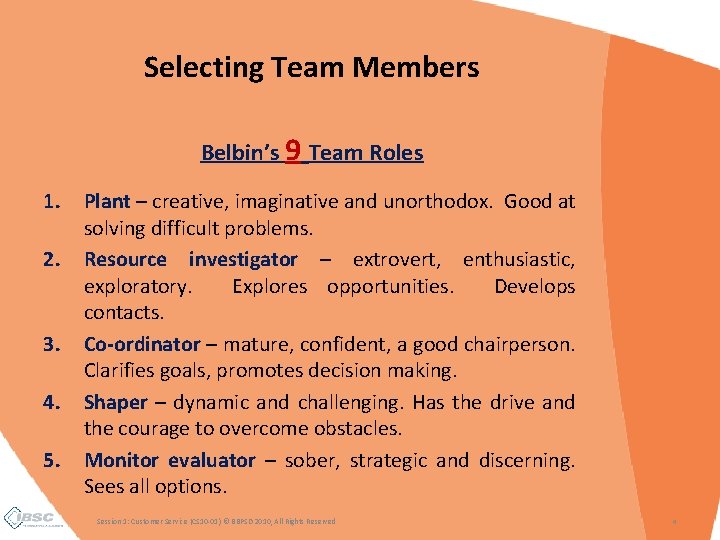
Selecting Team Members Belbin’s 9 Team Roles 1. 2. 3. 4. 5. Plant – creative, imaginative and unorthodox. Good at solving difficult problems. Resource investigator – extrovert, enthusiastic, exploratory. Explores opportunities. Develops contacts. Co-ordinator – mature, confident, a good chairperson. Clarifies goals, promotes decision making. Shaper – dynamic and challenging. Has the drive and the courage to overcome obstacles. Monitor evaluator – sober, strategic and discerning. Sees all options. Session 1: Customer Service (CS 10 -01) © BBPSD 2010, All Rights Reserved 4

Selecting Team Members Belbin’s 9 Team Roles Continued 6. Team worker – co-operative, mild, perceptive, diplomatic. Listens, builds, averts friction. 7. Implementer – disciplined, reliable, conservative. Turns ideas into practical action. 8. Completer – painstaking, conscientious, anxious. Searches out errors and omissions, delivers on time. 9. Specialist – single-minded, self-starting, dedicated. Provides knowledge and skill in rare supply [Examination Hint] Session 1: Customer Service (CS 10 -01) © BBPSD 2010, All Rights Reserved 5

Selecting Team Members • • Some commentators criticise Belbin’s work on the grounds that individuals rarely fit neatly into these categories in a straightforward manner and most of us generally fit into more than one category. Arguably, the best team workers will adapt their behaviour to fill different roles as circumstances require. It is however very useful for knowing what the mix of people should be in a team if you want a team to be most effective. But knowing that one tends to fit a certain profile has value in understanding one’s own and others’ strengths and weaknesses. Session 1: Customer Service (CS 10 -01) © BBPSD 2010, All Rights Reserved 6
Selecting Team Members Activity 1. Which one of the 9 roles do you think you fit best from Belbin’s team roles. 2. Can you identify people you know that are similar to those in Belbin’s team roles? 3. Imagine that you wanted to start up your own business and that your role profile was that of a specialist. If you could only afford to employ 4 more people, which of the 4 Belbin roles would you look to recruit, and why? Session 1: Customer Service (CS 10 -01) © BBPSD 2010, All Rights Reserved 7
Selecting Team Members • The degree of cohesiveness in a team is affected by the manner in which groups progress through the various stages of development and maturity before getting down to the real tasks in hand. • The main concern of a manager is that members of a work group co-operate in order to achieve the results expected from them. • It is suggested that between five and eight people (although Belbin has 9) is the ideal size for teams. A bigger group or a very small team will not generally be able to produce desired outcomes. • Teams need to be large enough to incorporate the appropriate range of expertise and representation of interests, but not too large to limit people’s participation and interest. Session 1: Customer Service (CS 10 -01) © BBPSD 2010, All Rights Reserved 8
Selecting Team Members • • Leadership is of course vital for successful teams and as you have seen in the earlier section, there is no one recipe for success. Strong and cohesive teams can, therefore, have beneficial effects for the organisation. Test yourself now by selecting the correct option to the following question. Which of the following is NOT one of the roles identified by Belbin? • • Coordinator Completer Team worker Compromiser Session 1: Customer Service (CS 10 -01) © BBPSD 2010, All Rights Reserved 9
Summary • In this session we have highlighted the importance of getting the right selection of team members. • You have also been exposed to a very widely used tool (Belbin) that is useful in selecting members for team roles. • Creating meaningful involvement for each of the team members is an important first step in creating a successful team. • We have noted that Belbin’s model is also open to criticism for presenting the nine team roles as fixed positions of people in the team. • However belbin’s model is a good practical aid to team selection. Session 1: Customer Service (CS 10 -01) © BBPSD 2010, All Rights Reserved 10
- Slides: 10