
Session 12 Overview of Record Keeping Objectives At
Session 12 Overview of Record Keeping
Objectives: At the end of this session, participants will be able to: discussed the importance of keeping records; enumerate the different types of records needed.
What is record? A written proof of what happened, what is happening, or what is anticipated to happen. a written proof of what was said, and who said it. examples : minutes of a meeting, a report on the number of group members who worked in the group project, a record of the names of members who have brought in their membership contribution.
Why keep records? Record keeping is important because you cannot keep everything in your head. People are forgetful by nature.
Advantages of record keeping: You will know. . . how much money you have received, how much money you have spent and how you have spent it. how much are the amount of inputs and materials used to grow the enterprise. the price of produce sold and cost of inputs. You can calculate whether you are making a profit or a loss.
Advantages of record keeping: You will be able to. . . to make better decisions on what to buy and sell. keep records of buying and selling on credit, so that people cannot cheat you. Know how much volume you produce
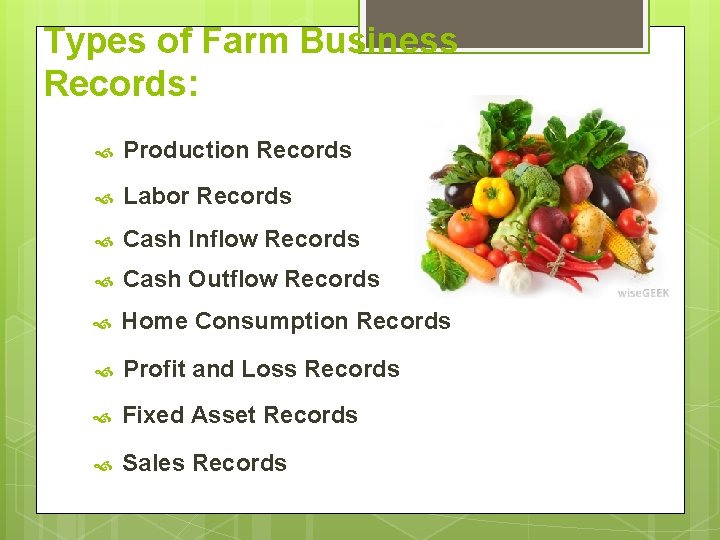
Types of Farm Business Records: Production Records Labor Records Cash Inflow Records Cash Outflow Records Home Consumption Records Profit and Loss Records Fixed Asset Records Sales Records
Session 13 Practice of keeping farm business records
Objectives: At the end of this session, participants shall have: Enumerated the kind of records needed; Described how to maintain them on a regular basis; Identified the kind of records needed; Discussed basis. the ways to maintain them on a regular
Production Record �It provides information on production output. �Helps the farmer to understand how well his production programme is performing. �It can be used to compare the performance of one farm with another farm. �It is necessary for assessing the farm business plans prepared previously.
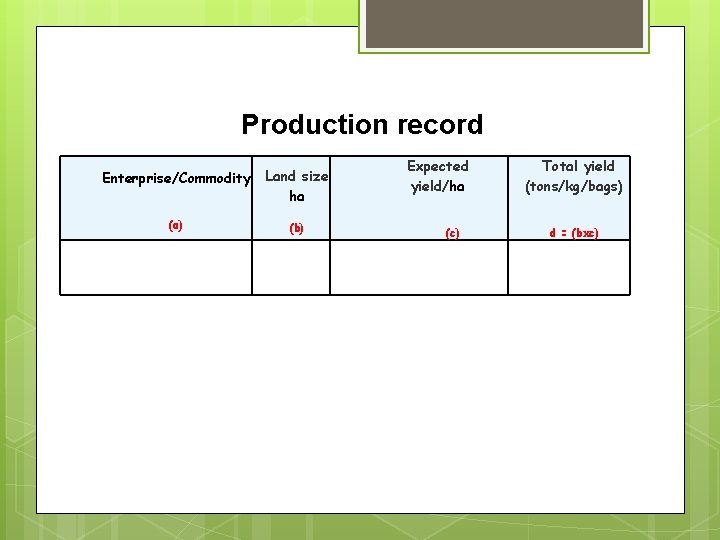
Production record Enterprise/Commodity Land size ha (a) (b) Expected yield/ha (c) Total yield (tons/kg/bags) d = (bxc)
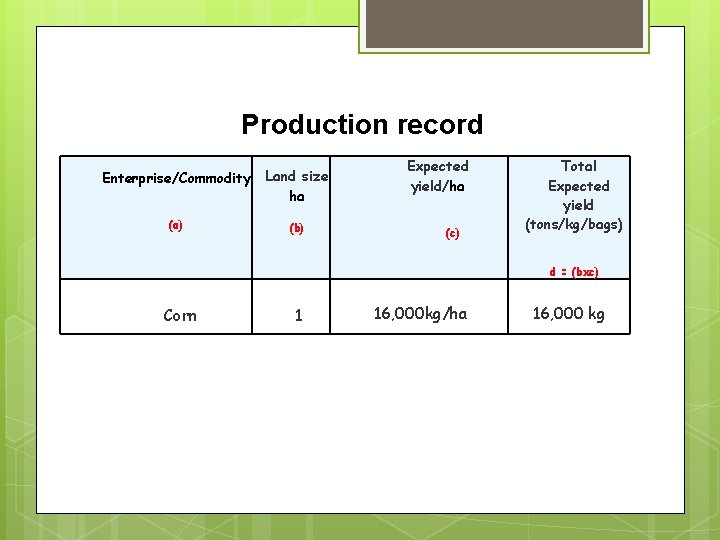
Production record Enterprise/Commodity Land size ha (a) (b) Expected yield/ha (c) Total Expected yield (tons/kg/bags) d = (bxc) Corn 1 16, 000 kg/ha 16, 000 kg
Labor Record �It provides information on the number of people required for each activity and the number of hours they will take each day. �It will assists the farmer in understanding the labor requirements for each activity.
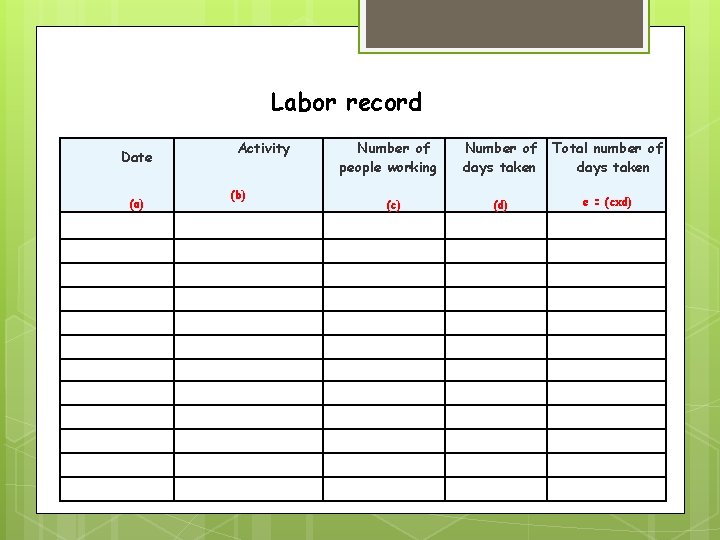
Labor record Date (a) Activity (b) Number of people working (c) Number of days taken Total number of days taken (d) e = (cxd)
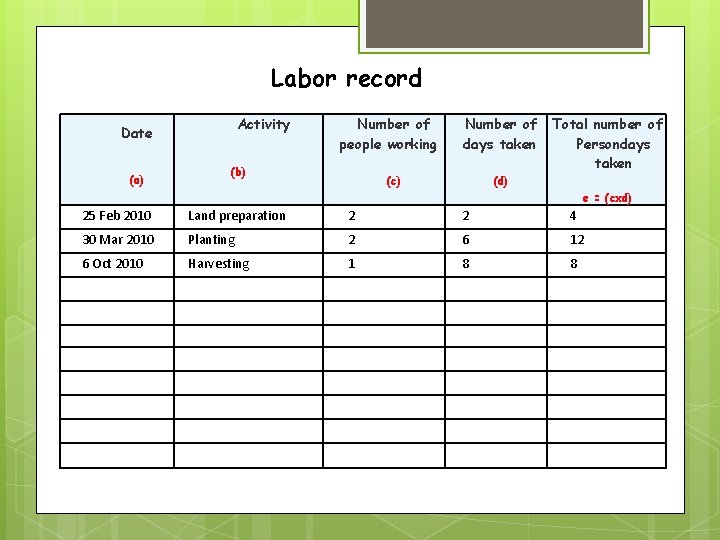
Labor record Activity Date (a) Number of people working (b) Number of days taken (c) Total number of Persondays taken (d) e = (cxd) 25 Feb 2010 Land preparation 2 2 4 30 Mar 2010 Planting 2 6 12 6 Oct 2010 Harvesting 1 8 8
Cash Inflow Record �help farmers to prepare enterprise budgets for the next round of planning. �helps farmers to construct farm. cash flows for the
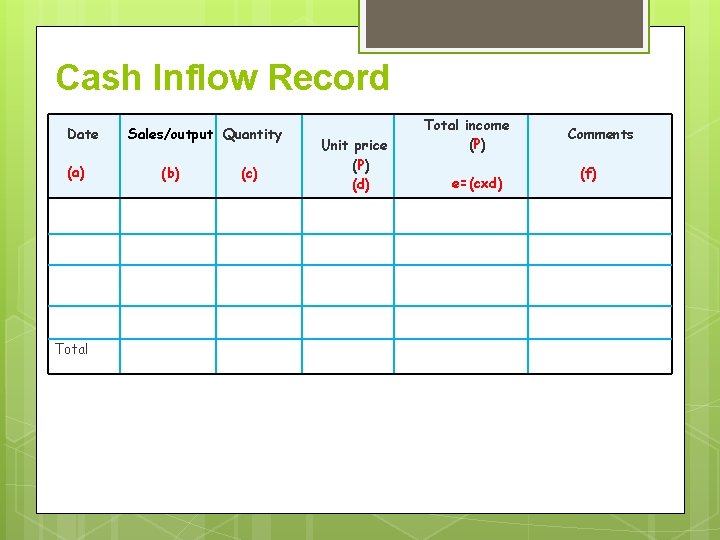
Cash Inflow Record Date (a) Total Sales/output Quantity (b) (c) Unit price (P) (d) Total income (P) e=(cxd) Comments (f)
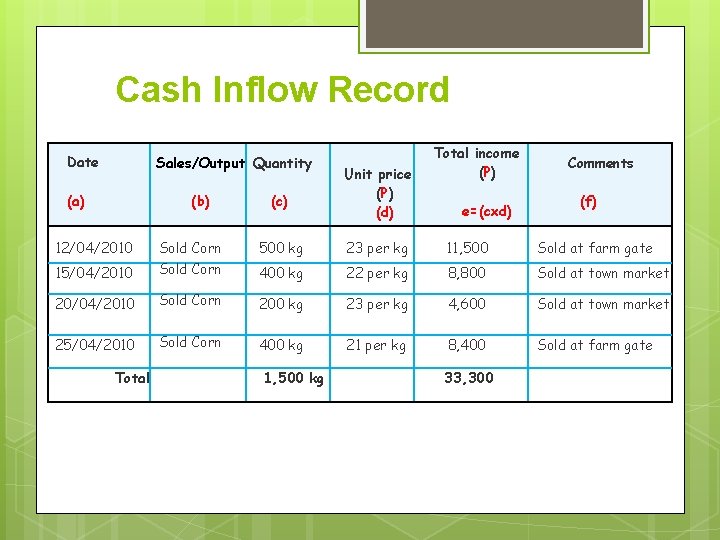
Cash Inflow Record Date Sales/Output Quantity (a) (b) (c) Unit price (P) (d) Total income (P) e=(cxd) Comments (f) 12/04/2010 Sold Corn 500 kg 23 per kg 11, 500 Sold at farm gate 15/04/2010 Sold Corn 400 kg 22 per kg 8, 800 Sold at town market 20/04/2010 Sold Corn 200 kg 23 per kg 4, 600 Sold at town market 25/04/2010 Sold Corn 400 kg 21 per kg 8, 400 Sold at farm gate Total 1, 500 kg 33, 300
Cash Outflow Record �help farmers when they need to set up enterprise budgets for the next round of planning. �help the farmer when he needs to calculate the cash flow for the whole farm. �provides information of all the activities that require the farmer to spend money either to buy inputs or pay for services and operations.
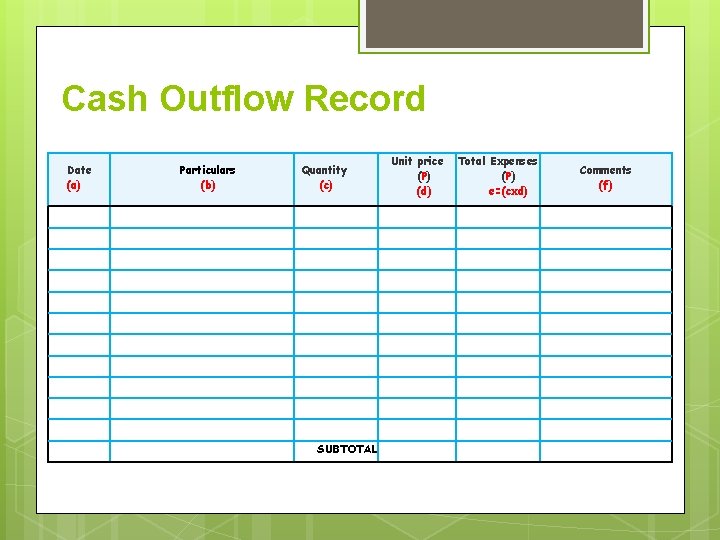
Cash Outflow Record Date (a) Particulars (b) Quantity (c) SUBTOTAL Unit price (P) (d) Total Expenses (P) e=(cxd) Comments (f)
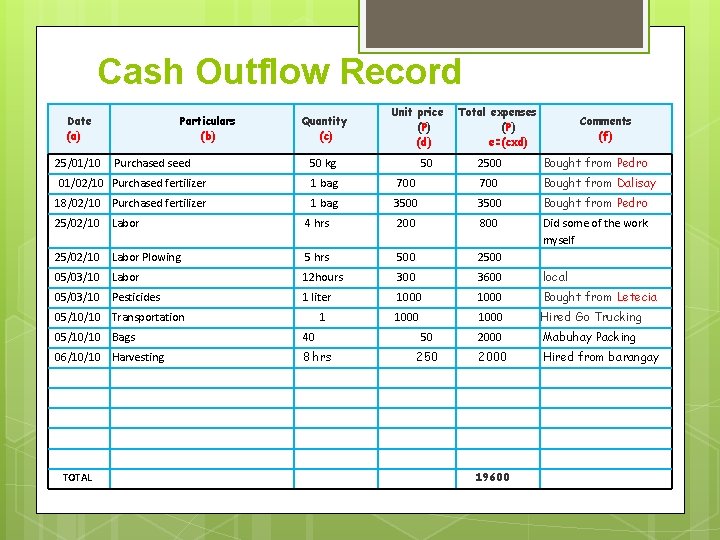
Cash Outflow Record Date (a) 25/01/10 Particulars (b) Purchased seed Quantity (c) Unit price (P) (d) 50 kg 50 Total expenses (P) e=(cxd) Comments (f) 2500 Bought from Pedro 01/02/10 Purchased fertilizer 1 bag 700 Bought from Dalisay 18/02/10 Purchased fertilizer 1 bag 3500 Bought from Pedro Did some of the work myself 25/02/10 Labor 4 hrs 200 800 25/02/10 Labor Plowing 5 hrs 500 2500 05/03/10 Labor 12 hours 300 3600 local 05/03/10 Pesticides 1 liter 1000 Bought from Letecia 1000 Hired Go Trucking 50 2000 Mabuhay Packing 250 2000 Hired from barangay 05/10/10 Transportation 1 05/10/10 Bags 40 06/10/10 Harvesting 8 hrs TOTAL 19600
Home consumption record assists farmers to know where some of the income from the farm enterprises is going; helps him make a business decision whether to sell all of his food crops to generate cash or to consume food as an alternative; records produce that have been stored, consumed, or given as gifts to relatives, friends and family members; o provide information on the amount and the value of what the family has consumed from the farm or has given away;
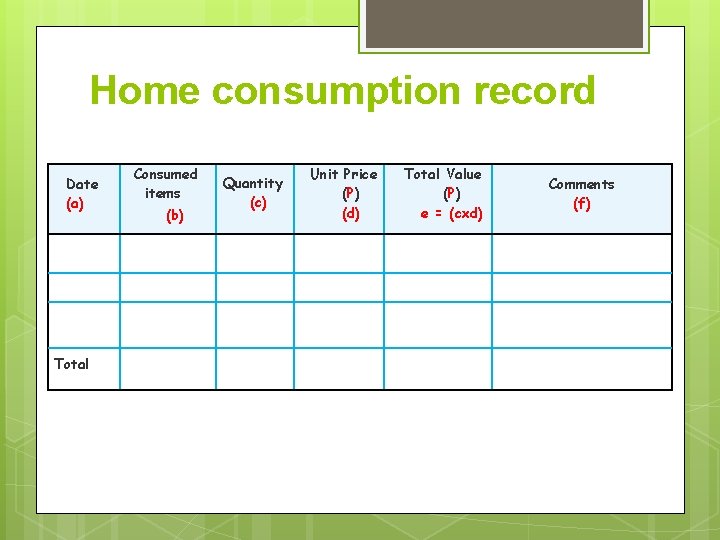
Home consumption record Date (a) Total Consumed items (b) Quantity (c) Unit Price (P) (d) Total Value (P) e = (cxd) Comments (f)
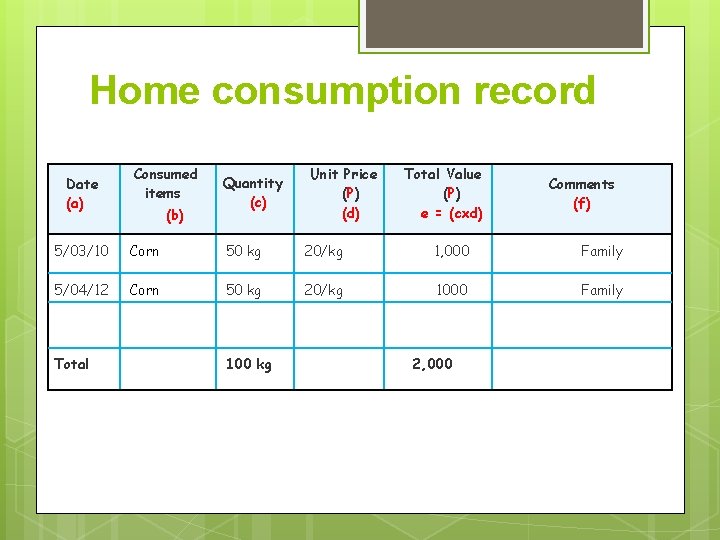
Home consumption record Date (a) Consumed items (b) Quantity (c) Unit Price (P) (d) Total Value (P) e = (cxd) Comments (f) 5/03/10 Corn 50 kg 20/kg 1, 000 Family 5/04/12 Corn 50 kg 20/kg 1000 Family Total 100 kg 2, 000
Profit and Loss Record �helps to keep track of profits and losses. �helps farmers to analyze his enterprise and to plan for the next cropping season
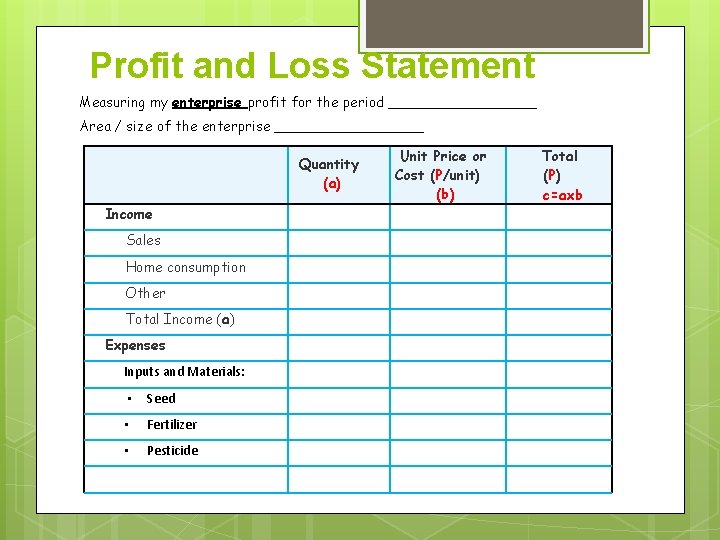
Profit and Loss Statement Measuring my enterprise profit for the period _________ Area / size of the enterprise _________ Quantity (a) Income Sales Home consumption Other Total Income (a) Expenses Inputs and Materials: • Seed • Fertilizer • Pesticide Unit Price or Cost (P/unit) (b) Total (P) c=axb
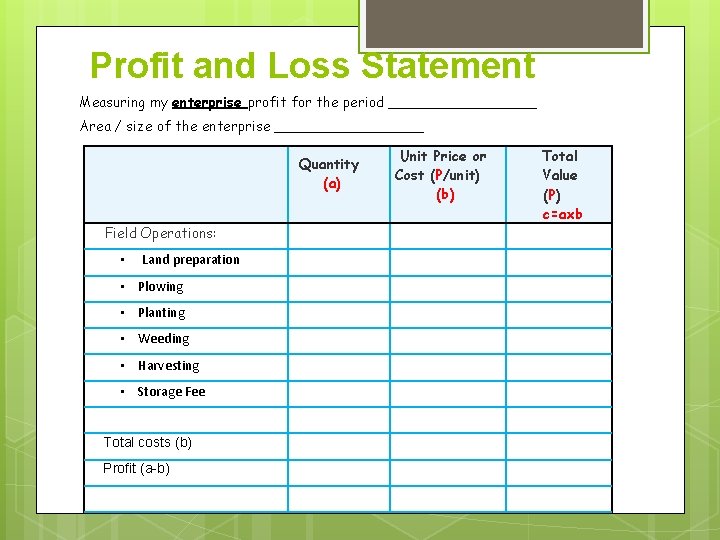
Profit and Loss Statement Measuring my enterprise profit for the period _________ Area / size of the enterprise _________ Quantity (a) Field Operations: • Land preparation • Plowing • Planting • Weeding • Harvesting • Storage Fee Total costs (b) Profit (a-b) Unit Price or Cost (P/unit) (b) Total Value (P) c=axb
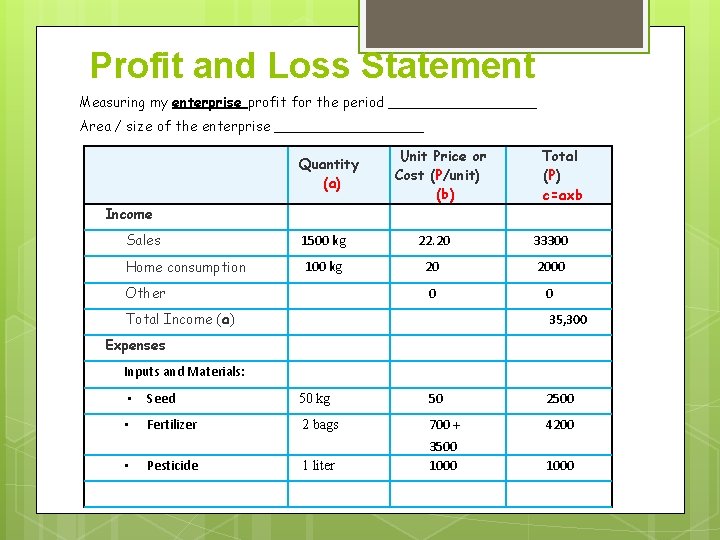
Profit and Loss Statement Measuring my enterprise profit for the period _________ Area / size of the enterprise _________ Quantity (a) Unit Price or Cost (P/unit) (b) Income Total (P) c=axb Sales 1500 kg 22. 20 33300 Home consumption 100 kg 20 2000 0 0 Other Total Income (a) 35, 300 Expenses Inputs and Materials: • Seed 50 kg 50 2500 • Fertilizer 2 bags 700 + 4200 1 liter 3500 1000 • Pesticide
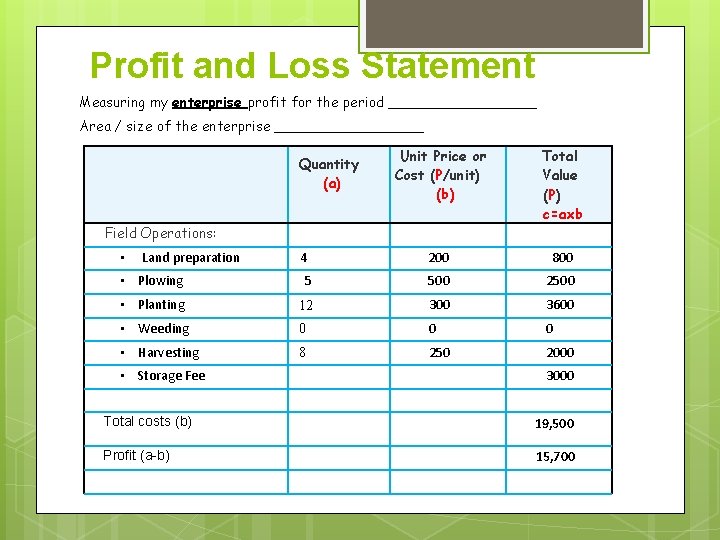
Profit and Loss Statement Measuring my enterprise profit for the period _________ Area / size of the enterprise _________ Unit Price or Cost (P/unit) (b) Total Value (P) c=axb 4 200 800 • Plowing 5 500 2500 • Planting 12 300 3600 • Weeding 0 0 0 • Harvesting 8 250 2000 Quantity (a) Field Operations: • Land preparation • Storage Fee 3000 Total costs (b) 19, 500 Profit (a-b) 15, 700
Fixed Asset Record �helps farmers remember when and for what price they bought the equipment �helps farmers remember when to repair or replace an item
Fixed Asset Record �helps farmers calculate the fixed costs for their farms when calculating the profit for the whole farm. �Includes farm equipments (e. g. tractor), implements and tools, packing shed, farm infrastructure (e. g. fencing)
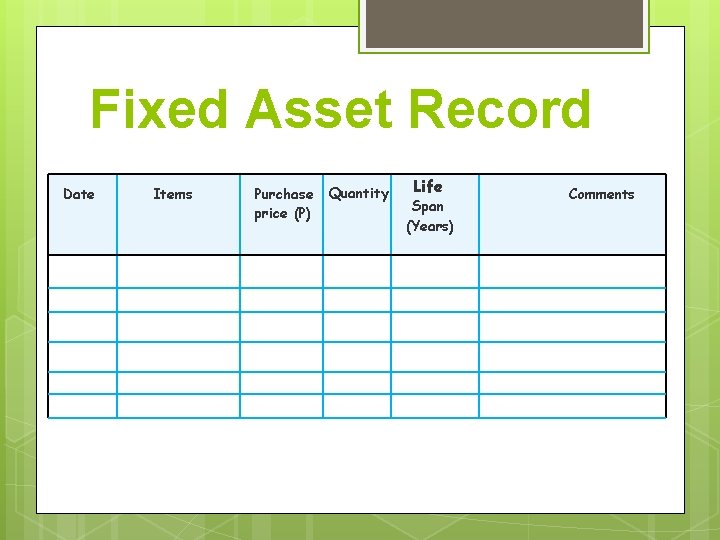
Fixed Asset Record Date Items Purchase price (P) Quantity Life Span (Years) Comments
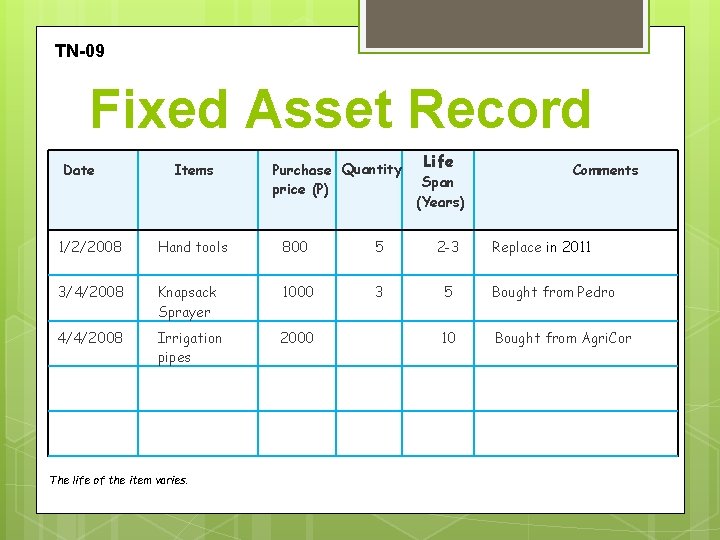
TN-09 Fixed Asset Record Date Items Purchase Quantity price (P) Life Span (Years) Comments 1/2/2008 Hand tools 800 5 2 -3 3/4/2008 Knapsack Sprayer 1000 3 5 Bought from Pedro 4/4/2008 Irrigation pipes 2000 10 Bought from Agri. Cor The life of the item varies. Replace in 2011
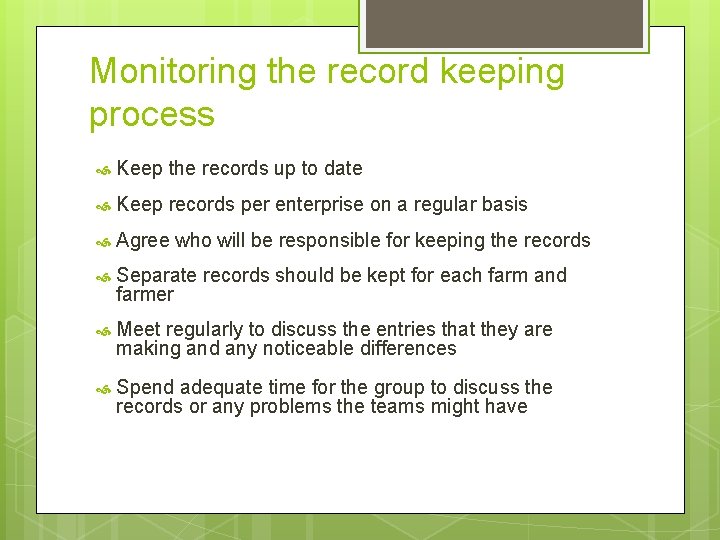
Monitoring the record keeping process Keep the records up to date Keep records per enterprise on a regular basis Agree who will be responsible for keeping the records Separate records should be kept for each farm and farmer Meet regularly to discuss the entries that they are making and any noticeable differences Spend adequate time for the group to discuss the records or any problems the teams might have

- Slides: 35