
Session 10 Indicators I Indicators baselines targets milestones
Session 10 Indicators (I) Indicators, baselines, targets & milestones 1
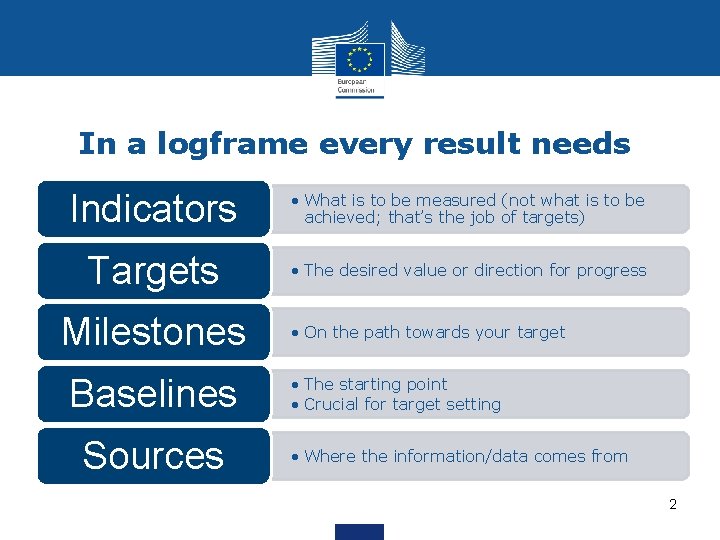
In a logframe every result needs Indicators • What is to be measured (not what is to be achieved; that’s the job of targets) Targets • The desired value or direction for progress Milestones Baselines Sources • On the path towards your target • The starting point • Crucial for target setting • Where the information/data comes from 2

Indicators and Objectives 3
Linking indicators to development objectives § More than one indicator is sometimes needed (or required) to cover the scope of development objectives. § Nevertheless: It is necessary to clearly link indicators with each related objective to assess the relevance of the indicators chosen § (cf chap 2. 1 guide on « Performance measurement… » ) 4

Defining indicators – Focus on what will be measured not by how much Impact • Long term goal to which the project contributes • e. g. MDG/SDG indicators, EURF level one, health improvement, poverty reduction, economic development Outcome • What will change for the beneficiaries/target groups – behaviour/ perceptions/ systems • e. g. # of people using improved water sources Output • The services or facilities delivered to the target groups • e. g. # of water points constructed 5
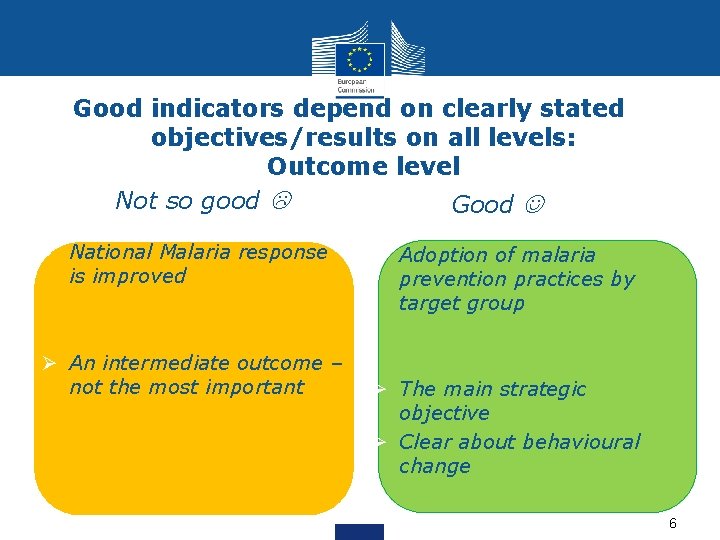
Good indicators depend on clearly stated objectives/results on all levels: Outcome level Not so good Good • National Malaria response is improved Ø An intermediate outcome – not the most important • Adoption of malaria prevention practices by target group Ø The main strategic objective Ø Clear about behavioural change 6
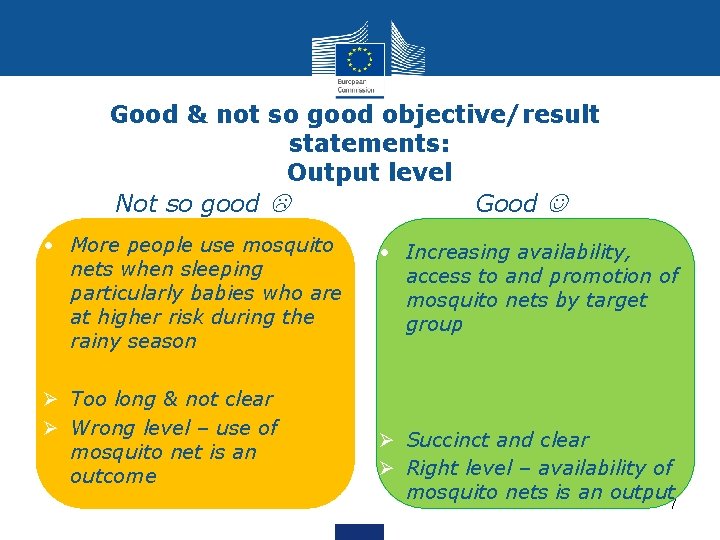
Good & not so good objective/result statements: Output level Not so good Good • More people use mosquito nets when sleeping particularly babies who are at higher risk during the rainy season Ø Too long & not clear Ø Wrong level – use of mosquito net is an outcome • Increasing availability, access to and promotion of mosquito nets by target group Ø Succinct and clear Ø Right level – availability of mosquito nets is an output 7
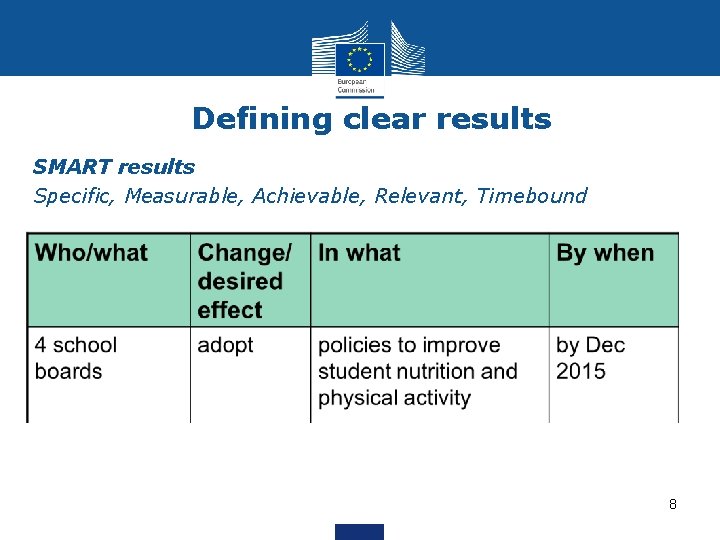
Defining clear results SMART results Specific, Measurable, Achievable, Relevant, Timebound 8

What makes a good indicator? • Specific – what will be measured? • Measurable - data can be collected • Relevant - to the results chain • Useful – for management decision making • Can be disaggregated if necessary • Good mix of qualitative and quantitative • Already defined e. g. MDGs or other internationally agreed indicators 9

Examples of good & not so good indicators Objectives or indicators? Better Not so good • Increased primary enrolment • Court systems providing effective access to citizens • Strengthened capacity of parliament • Net primary enrolment rate per annum • Percentage of citizens who say that they have access to court systems to resolve disputes • Public perception of parliamentary effectiveness 10

The use of proxy-indicators Keeping the most theorycompliant indicators §difficult to deal with (target setting, data collection) §but help to keep in mind what the ultimate goal of the operation is Using only existing or easy to collect indicators (among which proxies) §easier to manage §but do not always reflect the exact objective of the operation Between these two options, an indicator should at least be: §Relevant (linked unambiguously to a policy/strategy/action/objective) §Accepted (by all stakeholders) §Credible §Easy (to monitor and measure regularly) 11 §Robust (using a stable methodology)
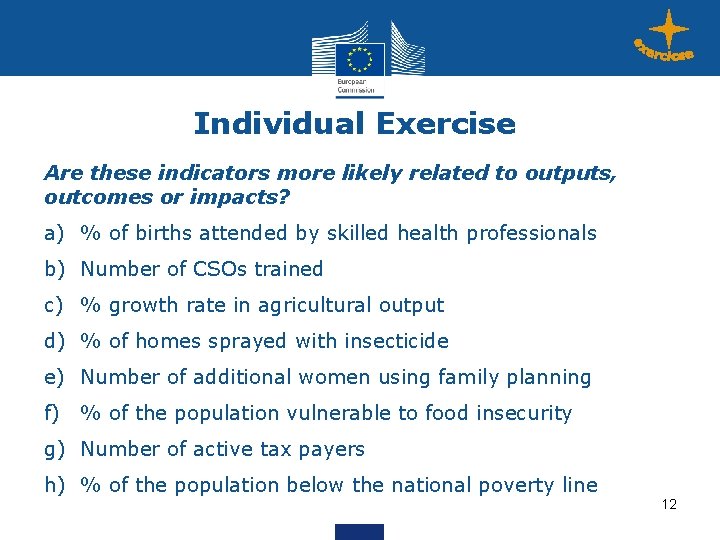
Individual Exercise Are these indicators more likely related to outputs, outcomes or impacts? a) % of births attended by skilled health professionals b) Number of CSOs trained c) % growth rate in agricultural output d) % of homes sprayed with insecticide e) Number of additional women using family planning f) % of the population vulnerable to food insecurity g) Number of active tax payers h) % of the population below the national poverty line 12

Top tips for indicators § The selection of each indicator should be based on the availability of data and its relevance to the objective/result § Don’t pick too many indicators for each result – choose the most important or strategic ones § Choose & develop indicators with partners – agree data collection responsibilities, including frequency § Involve (final) beneficiaries in choice of relevant indicators § Be clear on whether they are annual, cumulative etc. 13

Baselines, targets and milestones 14
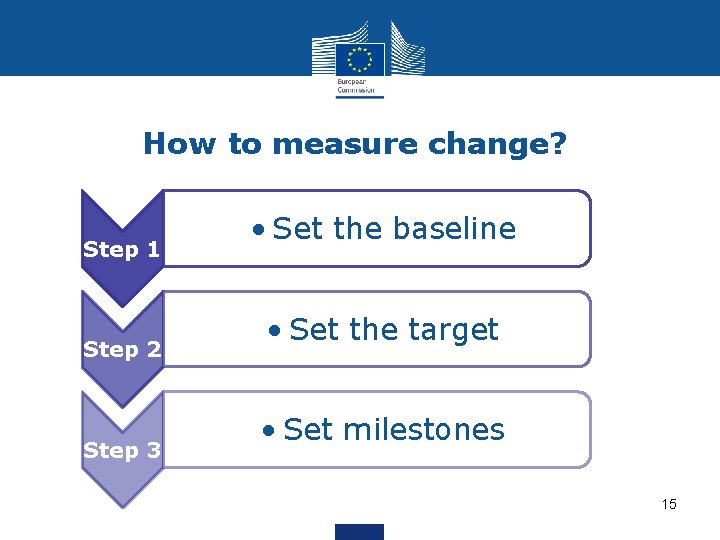
How to measure change? Step 1 Step 2 Step 3 • Set the baseline • Set the target • Set milestones 15
What is a baseline? § A baseline is a measure of the situation before the action starts (could be zero if a new action) § It is used to measure change and monitor progress § All indicators must have a baseline before the start of the action (or should state when it will become available) § Use existing data where possible, but check reliability § If you need to collect your own data; collect baseline data early i. e. as soon as beneficiaries have been identified 16
Top tips with baselines § Good in theory – often weak in practice § Requires a minimum level of information (can imply complexity & costs) § Look to existing sources first § Costs/benefits of different options for collecting information § Inception phase often the most appropriate time to complete or refine baselines (budget/resources required) A lot of difficulties that arise in the course of a project/programme are not foreseen because there is: o No baseline and no estimation of past and present trends o No real preparation of the monitoring and evaluation system 17
What is a target? § A target is the desired end point for each indicator. It is often planned to be achieved in the last year of a project § Must be included where baseline data is available § Disaggregated where relevant e. g. by sex/ geography/ income § Should be time specific (i. e. clear when the target is expected to be met) 18
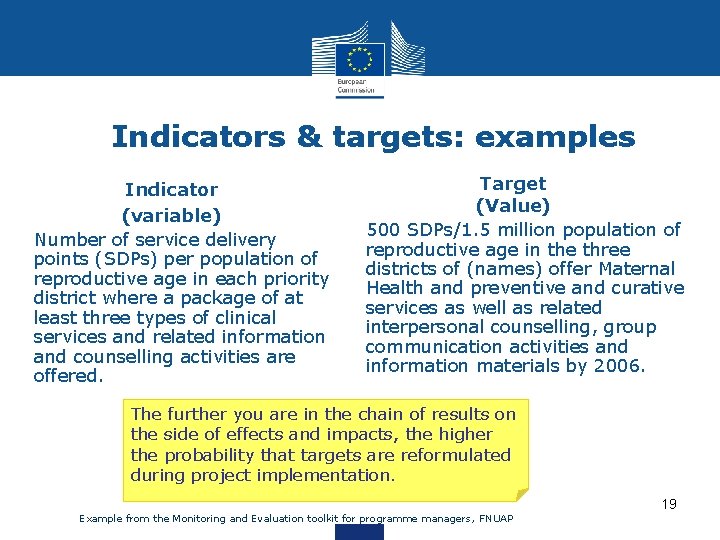
Indicators & targets: examples Indicator (variable) Number of service delivery points (SDPs) per population of reproductive age in each priority district where a package of at least three types of clinical services and related information and counselling activities are offered. Target (Value) 500 SDPs/1. 5 million population of reproductive age in the three districts of (names) offer Maternal Health and preventive and curative services as well as related interpersonal counselling, group communication activities and information materials by 2006. The further you are in the chain of results on the side of effects and impacts, the higher the probability that targets are reformulated during project implementation. 19 Example from the Monitoring and Evaluation toolkit for programme managers, FNUAP
How to set a target? To set a target, one should: § Have a reference value (baseline) § Assume a rhythm of progression § Give an exit value (target) in consequence of the two previous points Be careful! § The baseline value must be sound: reflecting previous situations/progressions if relevant § Rhythms of progression are often calculated starting from target level (ex MDGs), that are often more a declaration of a political ambition (Cf chap 2. 6 guide on « Performance measurement… » ) 20
Top tips for targets Can be a powerful tool (what gets measured gets managed) - but need to be treated with some caution § SMART approach remains valid for setting good targets § Where possible – specify quantity, quality, time (QQT) § Be realistic § Involve the right people in their selection (don’t impose) § Review targets on a regular basis § Provide incentives to report honestly (don’t shoot the messenger!) 21
What are milestones? Milestones… § are points along the desired trajectory from baseline to target; § will help to track progress and make timely changes to address under-performing areas; § should be annual at the output level (at the outcome level data may not be available annually). 22
Top tips for milestones § Be REALISTIC when setting milestones (given resources and capacity). § Go back to your intervention logic to look at the pathway of change and the many steps necessary to achieve the project/programme outcomes. In these ministeps you will find the milestones. § Milestones can be identified from the intermediary outcomes of your intervention logic. The graphic representation of the intervention logic and the objective tree can help you. § To quantify your milestone values, adopt the same attitude as for target setting: make projections using a realistic rythm of progression (see further exercise on methods of comparisons). 23
Targets & baselines - Key messages § Be realistic with targets. Expected levels of performance should be quantified and documented against reality and experience of what is feasible. § If baseline information is weak in formulation phase, baseline assessment and target setting should be planned in the inception phase of the project/programme. 24
- Slides: 24