
Session 1 Unfair Trade Practice Conceptualization Significance and
- Slides: 11
Session 1: Unfair Trade Practice: Conceptualization, Significance and Regional Perspective CUTS Conference on “Gathering Evidence on Unfair Trade Practice in ASEAN: Challenges and Impacts March 11 2011 Hanoi, Vietnam Deunden Nikomborirak Thailand Development Research Institute
Outline of the Presentation 1. What constitutes “unfair trade practice”? How is it 2. 3. 4. 5. different from anti-competitive practices? Why some countries have “unfair trade practice” provision while others do not? How is the “unfair trade practice” provision implemented? Does enforcement of unfair trade practice impose negative impact on consumers? Do ASEAN countries need an “unfair trade practice” provision?
1. What constitutes “unfair trade practice”? How is it different from anti-competitive practices? Unfair trade practice usually concerns the discrepancy in the “bargaining power” of two parties, often in a vertical supply chain. Different bargaining power leads to difference allocation of “rents” with larger portion of rents going to the party with greater bargaining power. Should the state get involved in how rents are distributed between two businesses? For example, if large retailers the like of Tesco squeezes the margin of small suppliers down to zero, should the government intervene? Theoretically, the answer is no. But the reality of having an unfair trade practice is not so simple.
2. Why some countries have “unfair trade practice” provision while others do not? 1. 2. 3. 4. The role of competition law is not limited to protect “fair competition” in the market, but also ensure “fair competition” between two undertakings. Certain trade practices are simply “undesirable” (bordering fraud/bad governance) and should be banned altogether. (fidelity rebates, reciprocal dealings, discriminatory treatment, etc) Competition Authority wants to maintain some “flexibility” in enforcing competition law. Unfair trade practice requires no proof of market dominance, which can be technically complicated. (Japan) Unfair trade practice can be seen as a “catch all” provision that will allow competition authority to deal with unanticipated forms of restrictive or unfair trade practices or those beyond the reach of conventional competition provisions. (Many countries)
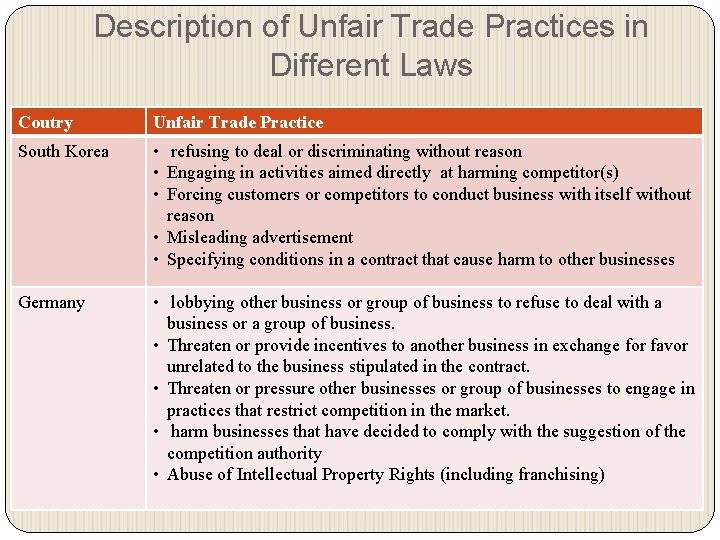
Description of Unfair Trade Practices in Different Laws Coutry Unfair Trade Practice South Korea • refusing to deal or discriminating without reason • Engaging in activities aimed directly at harming competitor(s) • Forcing customers or competitors to conduct business with itself without reason • Misleading advertisement • Specifying conditions in a contract that cause harm to other businesses Germany • lobbying other business or group of business to refuse to deal with a business or a group of business. • Threaten or provide incentives to another business in exchange for favor unrelated to the business stipulated in the contract. • Threaten or pressure other businesses or group of businesses to engage in practices that restrict competition in the market. • harm businesses that have decided to comply with the suggestion of the competition authority • Abuse of Intellectual Property Rights (including franchising)
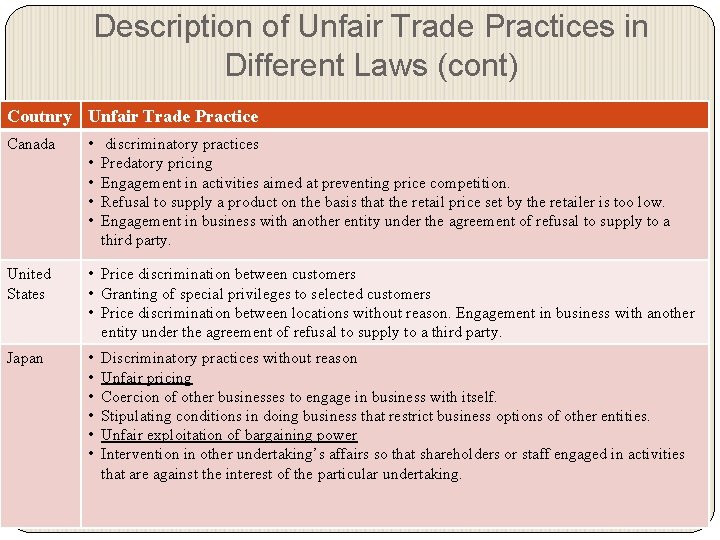
Description of Unfair Trade Practices in Different Laws (cont) Coutnry Unfair Trade Practice Canada • • • United States • Price discrimination between customers • Granting of special privileges to selected customers • Price discrimination between locations without reason. Engagement in business with another entity under the agreement of refusal to supply to a third party. Japan • • • discriminatory practices Predatory pricing Engagement in activities aimed at preventing price competition. Refusal to supply a product on the basis that the retail price set by the retailer is too low. Engagement in business with another entity under the agreement of refusal to supply to a third party. Discriminatory practices without reason Unfair pricing Coercion of other businesses to engage in business with itself. Stipulating conditions in doing business that restrict business options of other entities. Unfair exploitation of bargaining power Intervention in other undertaking’s affairs so that shareholders or staff engaged in activities that are against the interest of the particular undertaking.
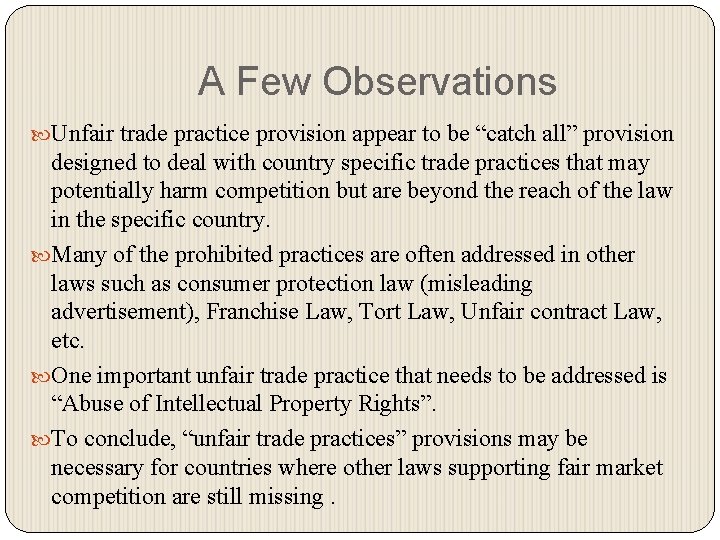
A Few Observations Unfair trade practice provision appear to be “catch all” provision designed to deal with country specific trade practices that may potentially harm competition but are beyond the reach of the law in the specific country. Many of the prohibited practices are often addressed in other laws such as consumer protection law (misleading advertisement), Franchise Law, Tort Law, Unfair contract Law, etc. One important unfair trade practice that needs to be addressed is “Abuse of Intellectual Property Rights”. To conclude, “unfair trade practices” provisions may be necessary for countries where other laws supporting fair market competition are still missing.
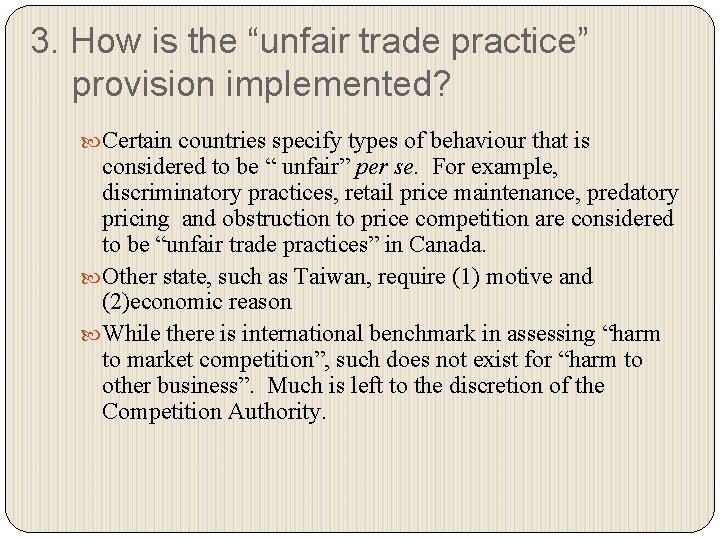
3. How is the “unfair trade practice” provision implemented? Certain countries specify types of behaviour that is considered to be “ unfair” per se. For example, discriminatory practices, retail price maintenance, predatory pricing and obstruction to price competition are considered to be “unfair trade practices” in Canada. Other state, such as Taiwan, require (1) motive and (2)economic reason While there is international benchmark in assessing “harm to market competition”, such does not exist for “harm to other business”. Much is left to the discretion of the Competition Authority.
4. Does enforcement of unfair trade practice impose negative impact on consumers? Depends on the nature of the practice and the nature of the remedy. For example, in the case of large retail stores, if the problem is considered to be “predatory pricing” such that daily discount of selected product is prohibited, then consumers will need to pay higher prices. But if the problem is considered to be “discriminatory treatment” between house-brand other products, then fair competition (benefitting consumers’ choice) can be had.
5. Do ASEAN countries need an “unfair trade practice” provision? Reasons that may support a need for such a provision Small enterprises in developing countries are less informed about their rights that do their counterparts in developed countries and so are easily taken advantage of. Supporting laws and regulations to ensure fair dealing are still missing (fair contract law, franchise law, anti-bribery law, etc. ) Large companies in developing countries tend to be not only large but powerful, exacerbating the imbalanced bargaining power, and expanding the scope of potentially unfair trade practices beyond the conventional horizon. So, there is a need for a provision that is flexible to deal with all sorts of undesirable trade practices. However, clear implementing regulations will be necessary to ensure the transparency and predictability of the enforcement.
Thank You