
Session 1 Overview of Child Rights in Development
- Slides: 27
Session 1: Overview of Child Rights in Development Cooperation
Session map § Regional priorities § Key facts § Definitions, international legal framework § General Measures of Implementation § Translating international commitments into practice § Child-rights based Country Context Analysis
What is meant by child rights? Child rights refers to: § A set of legally binding norms and standards for the care and protection of children – that apply to all children at all times in all situations Key treaties: § § § CRC CEDAW CRPD African Charter on Human and Peoples’ Rights African Charter on the Rights and Welfare of the Child
Definition of a ‘Child’ § According to the CRC: § Children are defined in the CRC as all those below the age of 18 years. § Childhood § Is recognized in the Universal Declaration of Human Rights as a period “entitled to special care and assistance. ”
CRC four guiding principles § Non-discrimination § Best interests of the child § Life, survival, and development § Participation
Rights under the CRC § Survival and development rights § Rights to the resources, skills and contributions necessary for survival and full development § Protection rights § Protection from all forms of child abuse, neglect, exploitation and violence § Participation rights § Entitled to express their opinions and to have a say in all matters that affect them
African Charter on the Rights and Welfare of the Child § Specific provisions of the Charter relative to the CRC § Emerging priorities based on review of country reports and consultations on the African Common Position on Post-2015 § Opportunities for international cooperation in Africa
Why take a CR approach? § It is an Obligation § Legal and political moral/ethical obligation by national governments § Obligation of international cooperation actors as well (EU commitments, UNICEF mandate, etc) § It is an Opportunity § Necessary for the achievement of development outcomes
Measures of implementation Translating the CRC commitments into practice 1. Legislation must be compatible with the CRC 2. Develop process of assessing impact of laws/policies 3. Developing a national strategy for children 4. Ensuring adequate resources allocations 5. Permanent mechanisms in gov’t for M&E 6. Training, education & capacity building 7. Cooperation/coordination with civil society 8. Appropriate indicators and sufficient data collection 9. Statutory independent children’s rights institutions
Questions & comments
CR-based Country Context Analysis An essential first step to integrating child rights commitments into development cooperation Ø Accurately identify trends, patterns, incidence and causes of key deprivations Ø Identify and analyse barriers and bottlenecks Ø Ensure that the most marginalized and excluded populations are prioritized Ø Analyse whether evidence-based interventions and services are prioritized in national policies, laws, strategies, plans and budgets
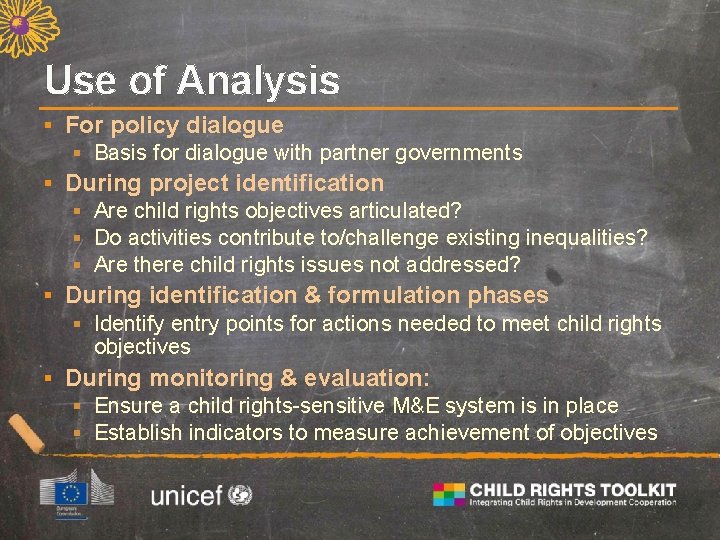
Use of Analysis § For policy dialogue § Basis for dialogue with partner governments § During project identification § Are child rights objectives articulated? § Do activities contribute to/challenge existing inequalities? § Are there child rights issues not addressed? § During identification & formulation phases § Identify entry points for actions needed to meet child rights objectives § During monitoring & evaluation: § Ensure a child rights-sensitive M&E system is in place § Establish indicators to measure achievement of objectives
Steps in undertaking CR-based Country Context Analysis Step 1: § Review critical resources § CRC Committee’s concluding observations § UNICEF situation analysis § Reports & analyses from child rights organizations such as Save the Children § Other sources of data § Assess whether additional data is needed § Identify data gaps
Steps in undertaking CR-based Country Context Analysis § Step 2: Analyse patterns of social exclusion and identify underlying factors 1. Causality analysis 2. Role-pattern analysis 3. Capacity-gap analysis 4. Analysis of the enabling environment
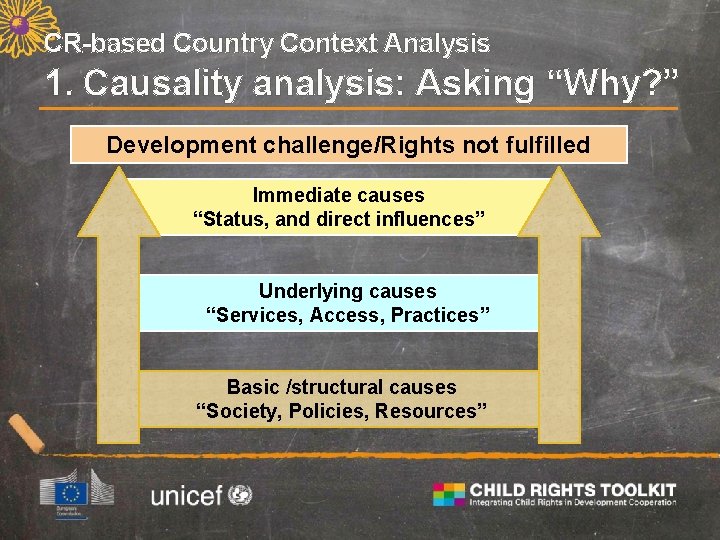
CR-based Country Context Analysis 1. Causality analysis: Asking “Why? ” Development challenge/Rights not fulfilled Immediate causes “Status, and direct influences” Underlying causes “Services, Access, Practices” Basic /structural causes “Society, Policies, Resources”
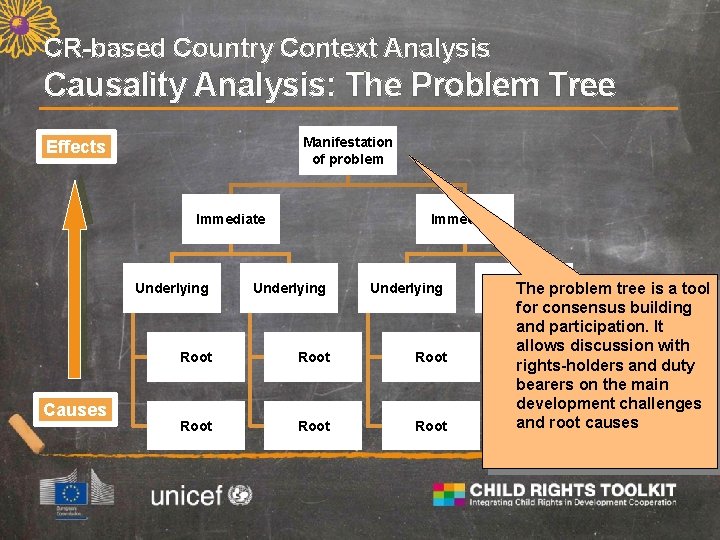
CR-based Country Context Analysis Causality Analysis: The Problem Tree Manifestation of problem Effects Immediate Underlying Causes Immediate Underlying Root Root Underlying The problem tree is a tool for consensus building and participation. It allows discussion with Root rights-holders and duty bearers on the main development challenges and root causes Root
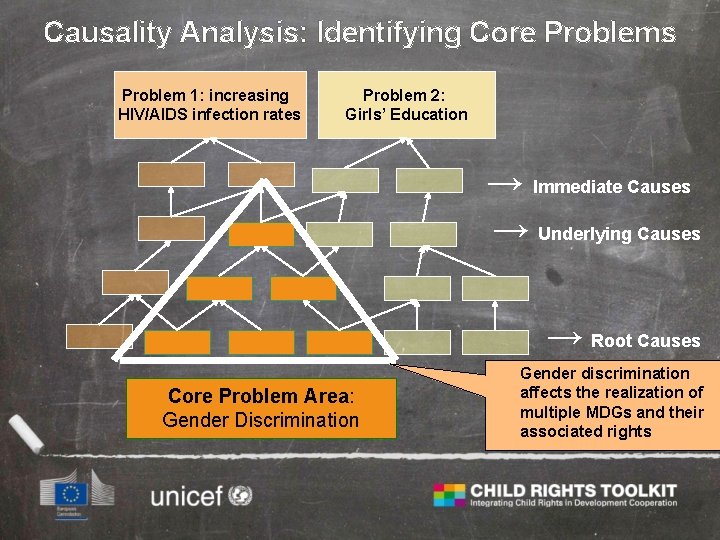
Causality Analysis: Identifying Core Problems Problem 1: increasing HIV/AIDS infection rates Problem 2: Girls’ Education → Immediate Causes → Underlying Causes → Root Causes Core Problem Area: Gender Discrimination Gender discrimination affects the realization of multiple MDGs and their associated rights
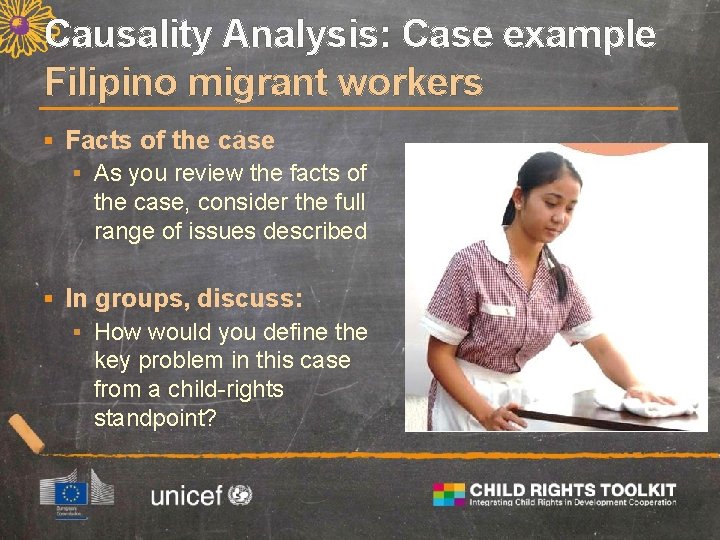
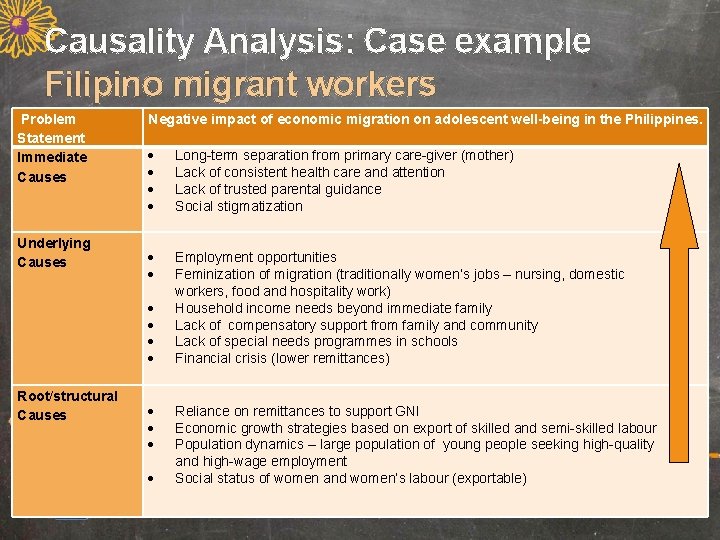
Causality Analysis: Case example Filipino migrant workers § Facts of the case § As you review the facts of the case, consider the full range of issues described § In groups, discuss: § How would you define the key problem in this case from a child-rights standpoint?
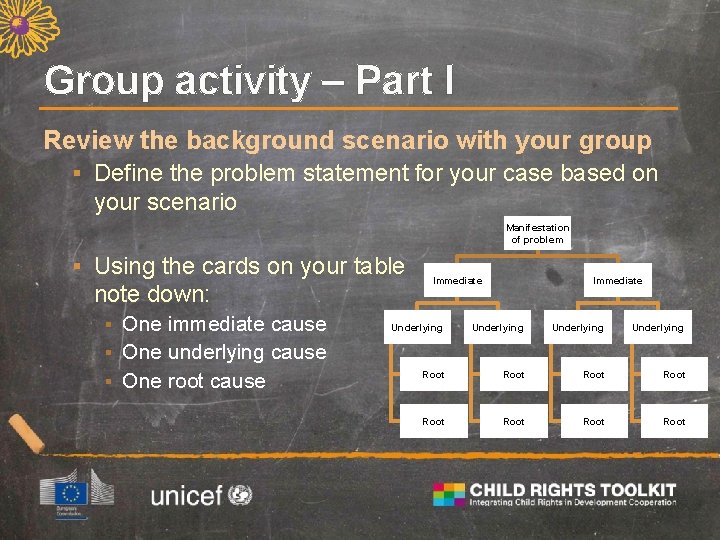
Group activity – Part I Review the background scenario with your group § Define the problem statement for your case based on your scenario Manifestation of problem § Using the cards on your table note down: § One immediate cause Immediate Underlying Root Root § One underlying cause § One root cause
Causality Analysis: Case example Filipino migrant workers Problem Statement Immediate Causes Underlying Causes Negative impact of economic migration on adolescent well-being in the Philippines. Long-term separation from primary care-giver (mother) Lack of consistent health care and attention Lack of trusted parental guidance Social stigmatization Employment opportunities Feminization of migration (traditionally women’s jobs – nursing, domestic workers, food and hospitality work) Household income needs beyond immediate family Lack of compensatory support from family and community Lack of special needs programmes in schools Financial crisis (lower remittances) Root/structural Causes Reliance on remittances to support GNI Economic growth strategies based on export of skilled and semi-skilled labour Population dynamics – large population of young people seeking high-quality and high-wage employment Social status of women and women’s labour (exportable)
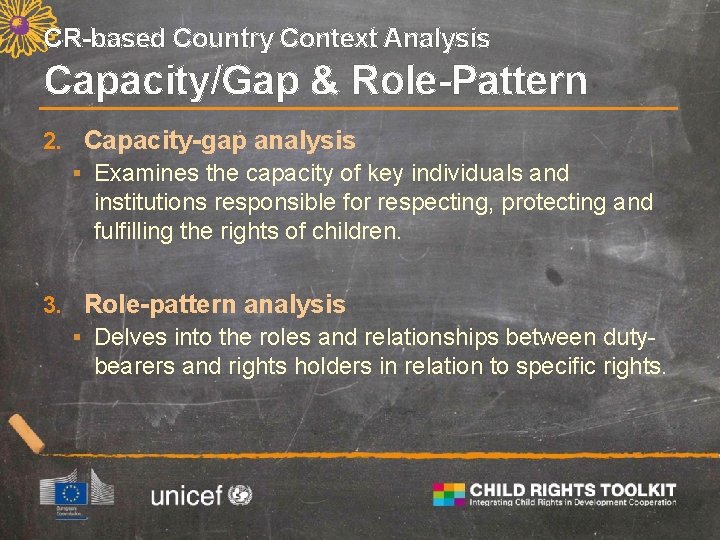
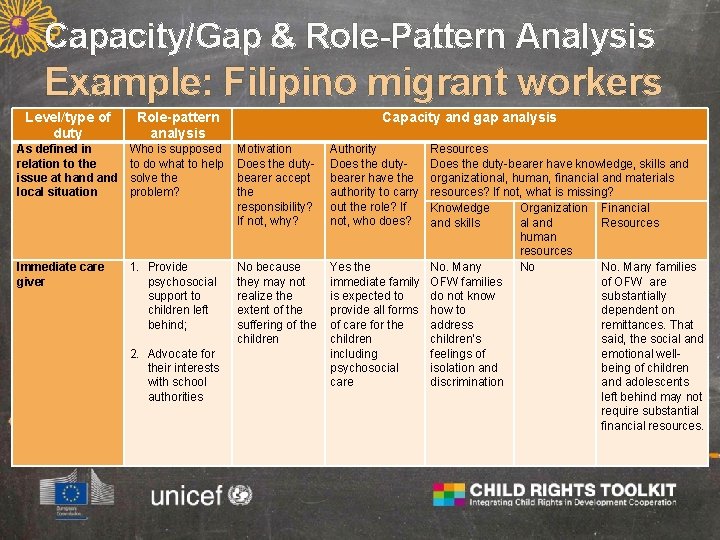
CR-based Country Context Analysis Capacity/Gap & Role-Pattern 2. Capacity-gap analysis § Examines the capacity of key individuals and institutions responsible for respecting, protecting and fulfilling the rights of children. 3. Role-pattern analysis § Delves into the roles and relationships between duty- bearers and rights holders in relation to specific rights.
Capacity/Gap & Role-Pattern Analysis Example: Filipino migrant workers Level/type of duty Role-pattern analysis As defined in relation to the issue at hand local situation Who is supposed to do what to help solve the problem? Motivation Does the dutybearer accept the responsibility? If not, why? Immediate care giver 1. Provide psychosocial support to children left behind; No because they may not realize the extent of the suffering of the children 2. Advocate for their interests with school authorities Capacity and gap analysis Authority Does the dutybearer have the authority to carry out the role? If not, who does? Resources Does the duty-bearer have knowledge, skills and organizational, human, financial and materials resources? If not, what is missing? Knowledge Organization Financial and skills al and Resources human resources Yes the No. Many No No. Many families immediate family OFW families of OFW are is expected to do not know substantially provide all forms how to dependent on of care for the address remittances. That children’s said, the social and including feelings of emotional wellpsychosocial isolation and being of children care discrimination and adolescents left behind may not require substantial financial resources.
CR-based Country Context Analysis 4. Enabling Environment Analysis § Examines broader policy, legal, administrative and budgetary issues and social norms that influence the realization of the human rights of children and women and the reduction of inequalities.
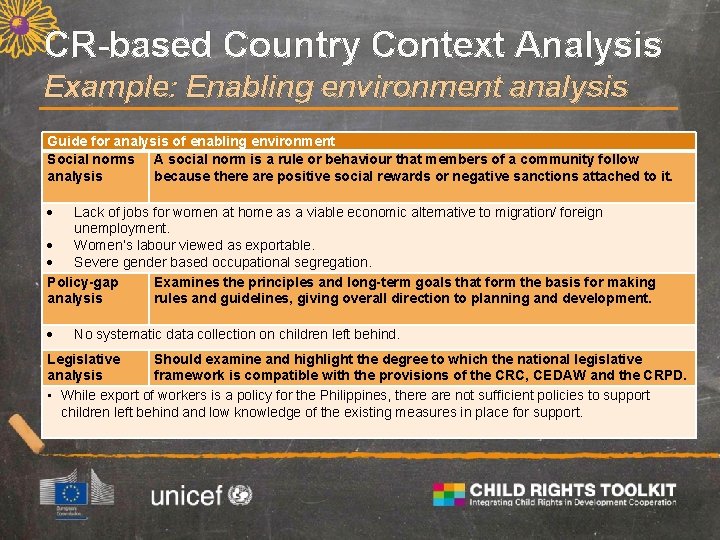
CR-based Country Context Analysis Example: Enabling environment analysis Guide for analysis of enabling environment Social norms A social norm is a rule or behaviour that members of a community follow analysis because there are positive social rewards or negative sanctions attached to it. Lack of jobs for women at home as a viable economic alternative to migration/ foreign unemployment. Women’s labour viewed as exportable. Severe gender based occupational segregation. Policy-gap Examines the principles and long-term goals that form the basis for making analysis rules and guidelines, giving overall direction to planning and development. No systematic data collection on children left behind. Legislative Should examine and highlight the degree to which the national legislative analysis framework is compatible with the provisions of the CRC, CEDAW and the CRPD. • While export of workers is a policy for the Philippines, there are not sufficient policies to support children left behind and low knowledge of the existing measures in place for support.
Group Activity
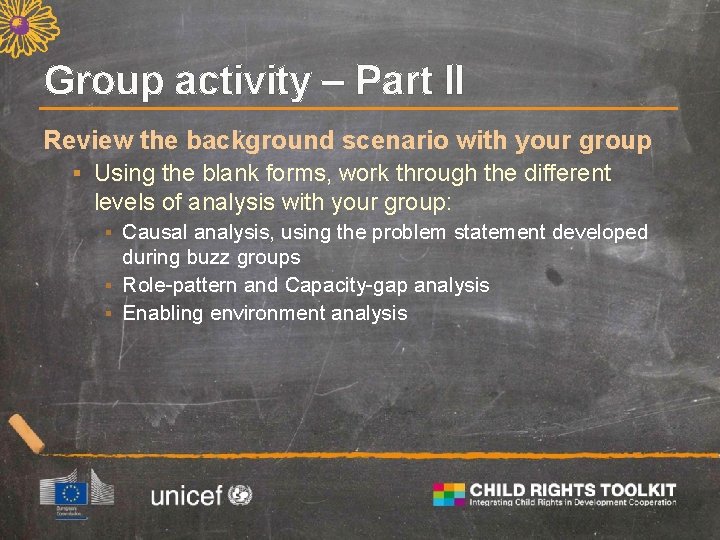
Group activity – Part II Review the background scenario with your group § Using the blank forms, work through the different levels of analysis with your group: § Causal analysis, using the problem statement developed during buzz groups § Role-pattern and Capacity-gap analysis § Enabling environment analysis