
SESSION 1 HOW TO HAVE AN EFFECTIVE MEETING

- Slides: 25
SESSION 1: HOW TO HAVE AN EFFECTIVE MEETING Laying the Foundation for Facilitation Date:
Agenda l l l Welcome & Check-In Training Group Agreements / Ground Rules Review Training Goals Active Learning & Practice Training Reflections Evaluation & Closing
TRAINING AGREEMENTS l l l l l Be open Show respect Listen to each other One person speaks at a time Silence Cell Phones Participate Share experiences Keep discussion confidential Give feedback in writing where possible
Training Goals l l Learn the purpose of meetings Learn the basics of meeting planning (and practice) Learn the major parts of a results based agenda (and practice) Learn why there is a need for a Facilitator and what a Facilitator does
Why Do We Have Meetings?
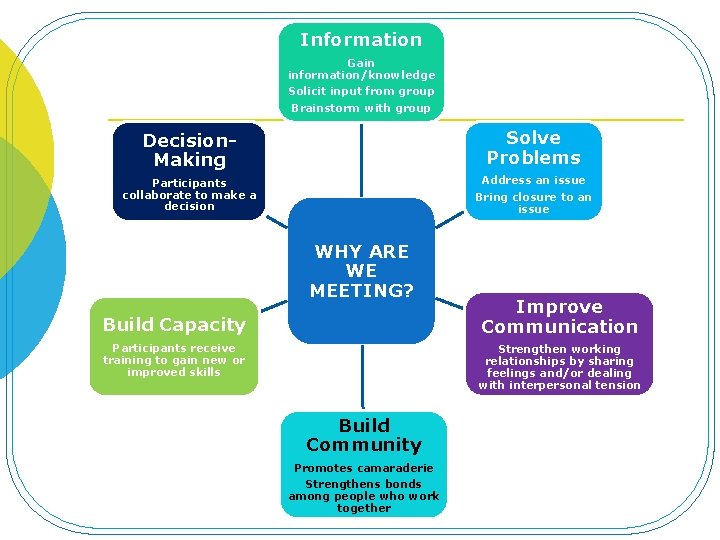
Information Gain information/knowledge Solicit input from group Brainstorm with group Decision. Making Solve Problems Participants collaborate to make a decision Address an issue Bring closure to an issue WHY ARE WE MEETING? Build Capacity Participants receive training to gain new or improved skills Improve Communication Strengthen working relationships by sharing feelings and/or dealing with interpersonal tension Build Community Promotes camaraderie Strengthens bonds among people who work together
Meeting Case Studies Meeting 1: l https: //youtu. be/32 Wj. O 7 Ii. Hp. I
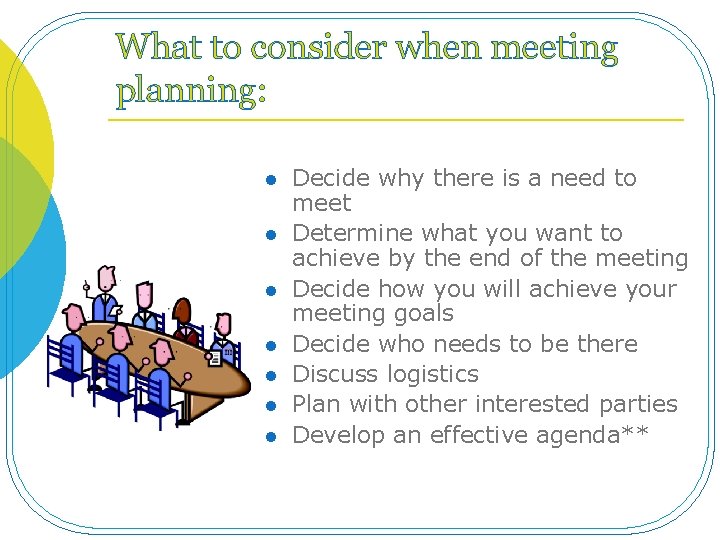
What to consider when meeting planning: l l l l Decide why there is a need to meet Determine what you want to achieve by the end of the meeting Decide how you will achieve your meeting goals Decide who needs to be there Discuss logistics Plan with other interested parties Develop an effective agenda**
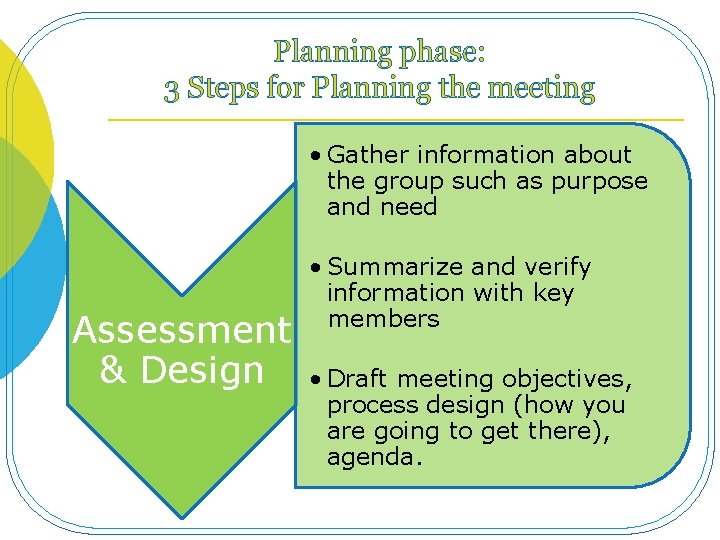
Planning phase: 3 Steps for Planning the meeting • Gather information about the group such as purpose and need Assessment & Design • Summarize and verify information with key members • Draft meeting objectives, process design (how you are going to get there), agenda.
Establishing Meeting Objectives l l l l Do you want a decision? Do you want an agreement? Do you want to generate ideas? Are you getting status reports? Are you communicating something? Are you raising awareness? Are you making plans? Are you coordinating something?
PLANNING PHASE: 3 STEPS FOR PLANNING THE MEETING • Ask for group leadership/member feedback and approval on design plans, including objectives. Feedback & Refinement • Listen and identify gaps in what members/leadership wants and needs. • Develop final objectives, process design and annotated agenda (facilitation guide).
PLANNING PHASE: 3 STEPS FOR PLANNING THE MEETING • Clarify all roles and responsibilities. • Check suitability of the meeting location. Final Preparation • Provide feedback on logistics, member communication, etc. • Identify all materials and supplies needed. • Develop and prepare all materials and handouts.
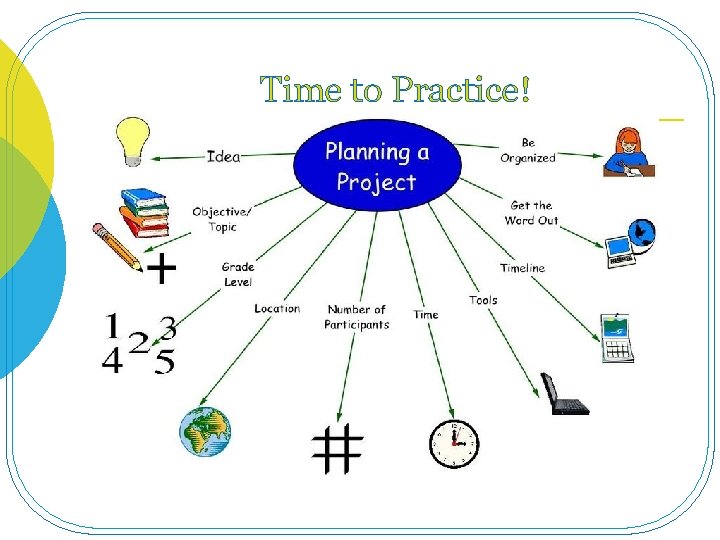
Time to Practice!
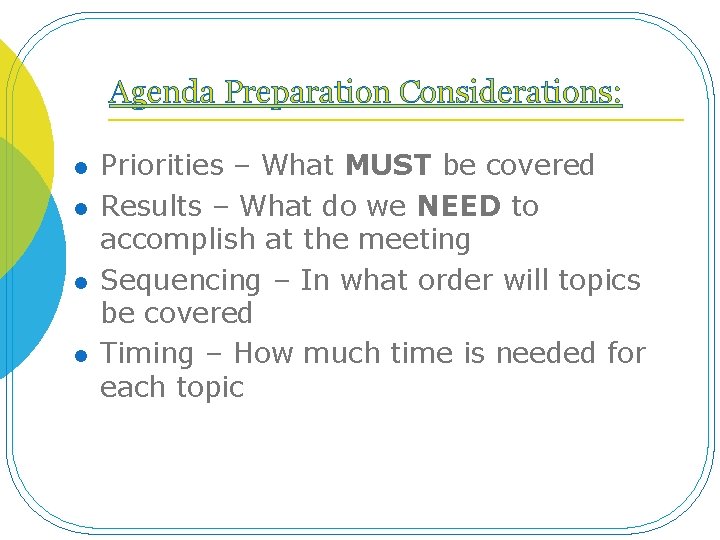
Agenda Preparation Considerations: l l Priorities – What MUST be covered Results – What do we NEED to accomplish at the meeting Sequencing – In what order will topics be covered Timing – How much time is needed for each topic
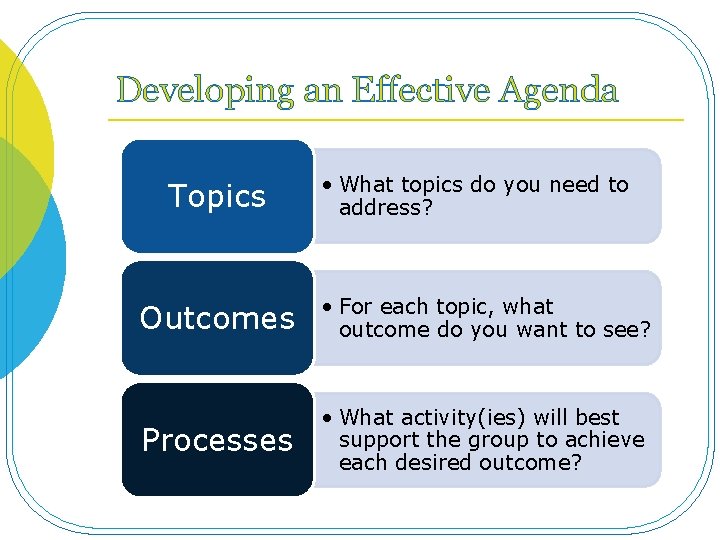
Developing an Effective Agenda Topics • What topics do you need to address? Outcomes • For each topic, what outcome do you want to see? Processes • What activity(ies) will best support the group to achieve each desired outcome?
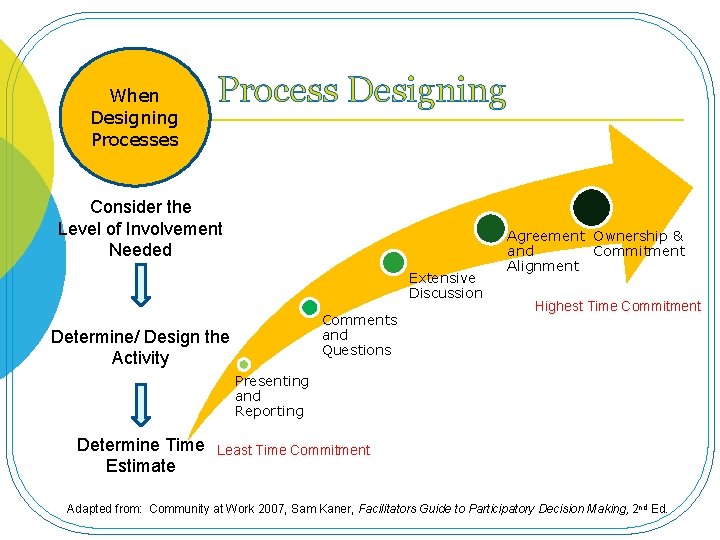
When Designing Processes Process Designing Consider the Level of Involvement Needed Extensive Discussion Comments and Questions Determine/ Design the Activity Agreement Ownership & Commitment and Alignment Highest Time Commitment Presenting and Reporting Determine Time Estimate Least Time Commitment Adapted from: Community at Work 2007, Sam Kaner, Facilitators Guide to Participatory Decision Making, 2 nd Ed.
Meeting Case Studies Meeting 2: l https: //youtu. be/6 w. CNO-BLCdk
Results Based Agendas include: l l l Meeting goals/objectives Welcome & Introductions Work items: q q q l l Set time limits for agenda items Assign meeting roles and responsibilities q l l Identify the meeting topics Identify the result of each agenda topic Identify the processes for each agenda topic Facilitator, note taker, time keeper, etc. Meeting Evaluation Closing & Next Steps
Time to PRACTICE
Facilitators…
Remember a Facilitator… • Helps a group to do it’s best thinking, and creates a space where everyone can participate. • Guides and monitors the process of the meeting (Is the meeting running well? ) • Monitors time or uses a timekeeper • Brings team back on-track when needed • Helps to clarify ideas • Provides feedback where appropriate *Session 2 will cover Facilitation techniques*
Training Reflections 1. Questions? 2. Please share 3 things you learned today
Training Evaluations l Please complete the evaluation form on your table
Resources l l l Facilitators Guide to Participatory Decision-Making, 2 nd Edition, Sam Kaner, 2007. Agency, Systems & Community Health Improvement Training, Laurie Call The Skilled Facilitator New and Revised, Roger Schwarz, 2002.
THE END! THANK YOU FOR PARTICIPATING!