
Session 1 Aisling Enright Speech and Language Therapist




- Slides: 48
Session 1 Aisling Enright Speech and Language Therapist Southill Health Centre 061 410988
Overview of training sessions
Week 1 o o o o General overview of Speech and Language Therapy How to spot a child with S&L difficulties How to refer a child SLT assessments-what we use and why How to read a SLT report Interpreting a SLT report Overview of terminology Question time
Week 2 o o o Speech and Phonological Awareness Terminology How to work on it Importance of P. A. and future literacy Reading Question Time
Week 3 o Areas of language i. e. morphology, semantics, syntax, pragmatics o Differentiation between the areas o How to tell which area is being affected o Vocabulary/Word Finding o Tips for working on all areas of language from Juniors to 6 TH Class o Question time
Week 4 o o o Receptive Language Auditory processing Narrative Social skills/pragmatics Practical tips for all age groups Question time-specific cases where possible
Week 5 o o o Deciding what to work on Choosing goals Writing suitable IEP goals Materials/resources available Question time
Workshop o o What are you currently doing in resource time How are you picking goals What resources/materials do you use What changes would you like to see in the current system i. e. links between SLT and teachers o How do you think we can achieve these changes
Identifying an ‘at risk’ child
Early Identification • Children identified at age 5 or later have a poorer prognosis with remediation than those identified earlier • Speech and Language delay may affect long term literacy, socialisation, behaviour and educational attainment • A child may be referred at any age from 0 -18 years
Risk Factors Family history of speech or language difficulties Any history of hearing difficulties Concerns about Parent-child interaction Associated difficulties with behaviour/attention Any of the above increase risk of speech and language difficulties and therefore should be monitored closely.
Prevalence • Estimates vary: • 10% of children will have some difficulty: ranging from mild to severe • Little data available on culturally and linguistically diverse groups e. g. bilingualism, traveling community • Association with socioeconomic status is also unclear
How do I know if my pupil has a difficulty with their language development?
Identify the Childs Needs • Does the child have trouble understanding? Give examples. • Does the child have trouble expressing him/herself? Give examples. • What impact does this difficulty have at home/school/with friends/other? Give examples.
Expressive Language To establish a child’s expressive language ability, first obtain a language sample e. g. news time/retelling of a familiar story or fairy tale/discussion. It is useful to get these in both oral and written form. Consider where the child’s main difficulties lie. Is it in vocabulary (content) or sentence construction (grammar) or use (social communication)?
Receptive Language • Can they follow 2, 3 and 4 step directions • Are they able to follow classroom directions • Do they have difficulty understanding concepts of time, space or location • Are they able to understand ‘wh’ qts and respond to them appropriately
Other things to look out for… • Play skills under-developed • Lack of social understanding i. e. turn-taking, poor eye contact, difficulty making friends • Learning difficulties in the classroom • Emotional and behavioural problems • Difficulties with word games e. g. ‘I Spy’ • Speaking out of turn, straying off topic, giving inappropriate answers
How to refer
Benefits of Early Referral • Early assessment and accurate identification of speech and language difficulties and early intervention and provision of appropriate support to parents helps to: – reduce parents’ anxiety – enables the provision of advice and guidelines to families, schools and other agencies
Referral Criteria o Open referral system-parents or any professional with parental permission may refer o All referrals to be sent directly to SLT Dept. HSE Western Area, Ballycummin Ave. , Raheen Business Park, Limerick.
Referral cont…. • A child who has already been referred to or in receipt of services from the Regional Child Development Centre (RCDC) or Early Intervention Teams (EIT) is not eligible for community care Speech and Language Therapy services. • Once referral is made the child is wait listed for initial assessment. • Following initial assessment the child is given a priority rating based on needs then may be wait listed for therapy, review or an onward referral is made.
Types of referrals we see q Speech Delay q Speech Disorder q Language Delay q Language Disorder q Stammering q Voice disorder q Hearing Impairment q Cleft lip and palate q Bilingual q Feeding difficulties q Selective mutism
Stammering • If you are concerned about a child ‘stammering’ they should ALWAYS be referred to Speech and Language Therapy for assessment • Things to look out for: repetitions of words, phrases, syllables, blocking, physical concomitant behaviours
Feeding Difficulties • Symptoms in school age children may include poor appetite, fussy eater, limited diet, poor range of consistencies and textures, gagging/choking while eating, refusal to eat, excessive drooling
Voice • Any child presenting with a voice disorder should be referred to SLT • Look out for children who are persistently hoarse or ‘nasal’ • ENT assessment is often indicated and can be made through GPs/AMOs.
Bilingualism • Screening of S & L skills at health checks will be heavily reliant on parental report. • A child should meet the general S & L guidelines in their first language and in subsequent languages only if they are exposed to them on an equal basis. • A limited proficency in English may arise from limited exposure to English and would not be indicative of a language disorder/delay.
Bilingualism contd. • Bilingual children often experience a mild delay in one/both languages and this usually resolves without any intervention. • All languages used at home should be encouraged • 2 years immersion = social/functional competency • 5 years immersion = academic competency
Selective Mutism • Relatively rare but can often be mistaken for shyness or obstinacy • Usually reported between ages 3 and 5 • Can be triggered by a dramatic event in the child’s life such as starting school • Psychological problem where a child seems to ‘freeze’ and becomes unable to speak • Fear/anxiety driven with an excessive sensitivity to the reactions of others
Assessment
SLT assessments • Clinical Evaluation of Language Fundamentals Preschool 2 (CELF Preschool 2) • Children aged 3 -6 years • Assessment of receptive and expressive language • Standardised • Clinical Evaluation of Language Fundamentals 4 (CELF 4) • Diagnostic Evaluation of Articulation and Phonology (DEAP) • Children aged 5 -16 years • Assessment of receptive and expressive language • Standardised • Children of all ages • Assessment of speech • Standardised
Other Assessments Used
Narrative • Assessments: Bus Story/ Peter and the cat • Receptive narrative – Basic story grammar qts – Critical thinking qts • Expressive Narrative – Content – Grammar – Use-social aspects of narrative
Vocabulary • Expressive vocabulary-Renfrew Word Finding Vocabulary Test • Receptive Vocabulary-British Picture Vocabulary Scales (BPVS) • Germann Test of Word Finding (both expressive and receptive)
Assessment Scoring • • • Subtest Standard/Scaled Scores Receptive and Expressive Average score: 7 -13 Above average score: 13 -17 Below Average score: 3 -7
Assessment Scoring contd. • Core Language core • Receptive Language Score • Expressive Language Score – On a scale of 100 and a standard deviation of 15 – average range for this score is 85 to 115
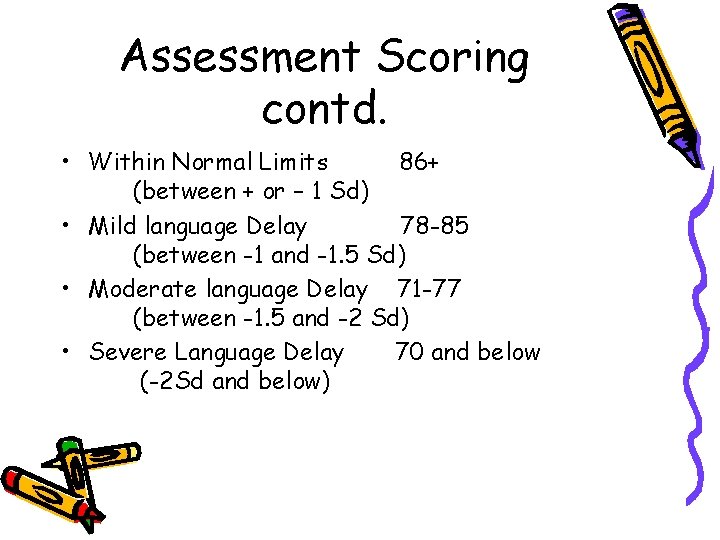
Assessment Scoring contd. • Within Normal Limits 86+ (between + or – 1 Sd) • Mild language Delay 78 -85 (between -1 and -1. 5 Sd) • Moderate language Delay 71 -77 (between -1. 5 and -2 Sd) • Severe Language Delay 70 and below (-2 Sd and below)
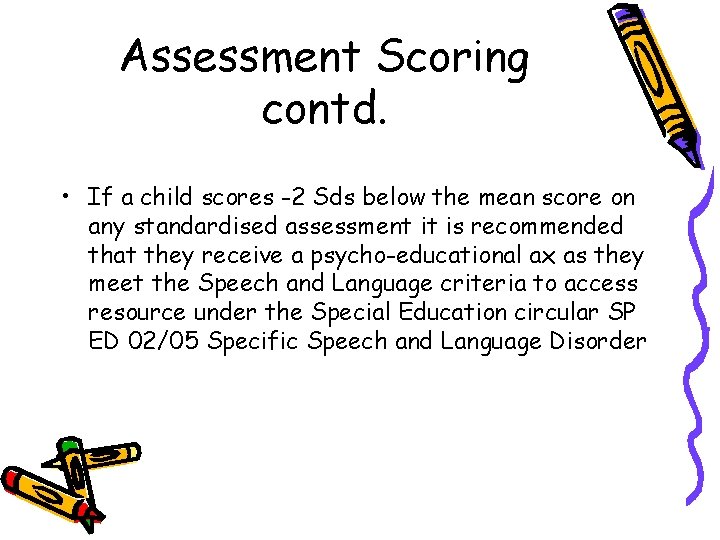
Assessment Scoring contd. • If a child scores -2 Sds below the mean score on any standardised assessment it is recommended that they receive a psycho-educational ax as they meet the Speech and Language criteria to access resource under the Special Education circular SP ED 02/05 Specific Speech and Language Disorder
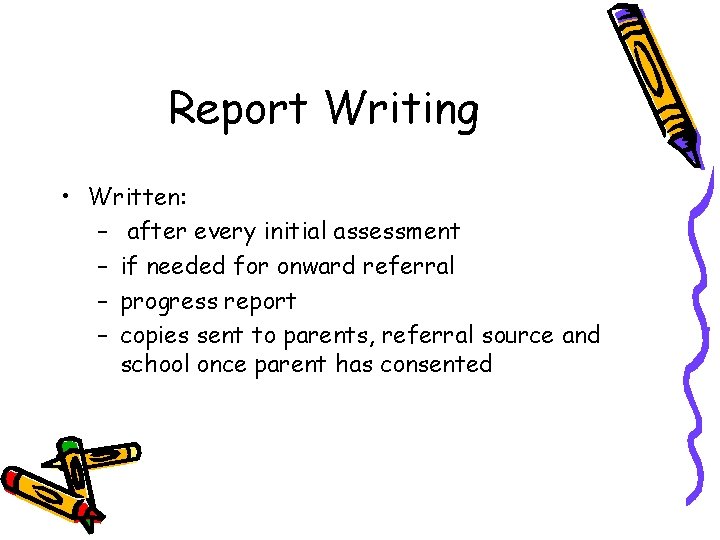
Report Writing • Written: – after every initial assessment – if needed for onward referral – progress report – copies sent to parents, referral source and school once parent has consented
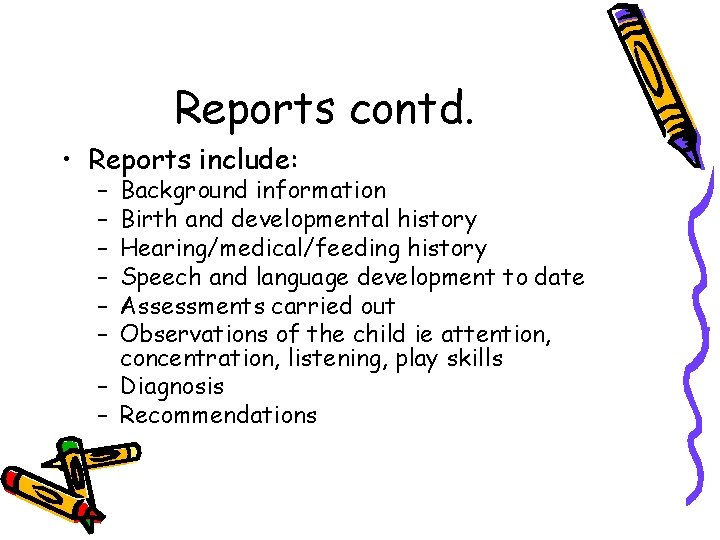
Reports contd. • Reports include: – – – Background information Birth and developmental history Hearing/medical/feeding history Speech and language development to date Assessments carried out Observations of the child ie attention, concentration, listening, play skills – Diagnosis – Recommendations
Interpreting a report • Results section: – determining what scores the child got – diagnosis i. e. receptive vs. expressive, phonological vs. articulation – areas of weakness – areas of strength – subtest analysis (see appendices)
Interpreting results • Delay vs. disorder • Receptive vs. expressive • Articulation vs. phonological
Delay vs. Disorder • A delay means that the child is following the normal pattern of language development but that they are not at the level they should be for their age. • A disorder means that the child is following an atypical pattern of language development. • A delay is generally easier to treat and the child may even “grow out of it” themselves or with minimal input. • A disorder will not resolve by itself and the child will need additional help.
Receptive vs. Expressive Language • Receptive: understanding what is being said by others be it spoken, written or signed • Expressive: Use or production of language be it spoken, written or signed • Children need to understand language before they an use it effectively
Articulation vs. Phonological • Articulation: Child can’t pronounce the sound and needs to be taught how to do so e. g. interdental /s/ • Phonology: Child can pronounce sound but doesn’t always do so correctly e. g. child can say /k/ but still says “tat” for “cat”
Subtest analysis • Look at appendices provided for subtest breakdown • Report should outline which areas of the subtest were delayed • Goals for therapy/resource can be picked from these (session 5)
Workshop • Read results section of reports provided and note: – Diagnosis – Scores – Areas of weakness – Areas of strength – Recommendations made
Next session o o o Speech and Phonological Awareness Terminology How to work on it Importance of P. A. and future literacy Fluency
Question Time ? ? ?