
SERVSAFE CHAPTER 6 Preparation GENERAL PREP PRACTICES Equipment
- Slides: 32
SERVSAFE CHAPTER 6 Preparation
GENERAL PREP PRACTICES Equipment: clean and sanitized Quantity: only take out what you need and return the rest to cooler Additives: Only use additives approved by local regulatory authority Presentation: you cannot mislead or misinform customers �True colors, appearance, quality
CORRECTIVE ACTIONS Food that is unsafe must be thrown out unless it can be safely reconditioned Must be thrown out: �When it is handled by staff who have been restricted or excluded due to illness (6 reportable) �When it is contaminated by hands or bodily fluids from nose or mouth �When it has exceeded time and temp requirements
RECONDITIONING Food can be restored if it has been in the danger zone for less than two hours �Ex: soup can be reheated to 165˚F if it’s been out under two hours.
THAWING Never thaw food at room temperature! It is acceptable to thaw food the following ways: �Refrigeration (at 41˚F or lower) �Running Water (70˚F or lower) Never let the temp of food go above 41˚F for longer than 4 hrs. �Microwave �Cooking
THAWING ROP FISH Frozen fish in reduced-oxygen packaging (ROP) should remain frozen until ready to use. �Fish must be removed from packaging before thawing it under refrigeration before or immediately after thawing it under running water
PREPPING SPECIFIC FOOD Produce �Make sure fruits and veggies do not touch surfaces that touch raw meat �Wash produce thoroughly under running water. Water should be a little warmer than the produce Remove outer leaves of lettuce and spinach and pull completely apart to rinse thoroughly Certain chemicals may be used to wash fruits and veggies or by washing it in water containing ozone to control pathogens.
PREPPING SPECIFIC FOOD Produce �Soaking or storing- in standing water or an ice-water slurry Do not mix different items or multiple batches of the same item �Fresh-cut product- refrigerate and hold sliced melons, cut tomatoes, and cut leafy greens at 41˚F or lower. �Raw seed sprouts- If your operation primarily serves high-risk populations do NOT serve seed sprouts.
EGGS AND EGG MIXTURES Pooled eggs (eggs that are cracked open and combined in a container): handle pooled eggs (if allowed by local reg. authority) carefully. �Cook promptly after mixing or store at 41 F or lower. �Clean and sanitize containers used to hold them before making a new batch Pasteurized eggs- consider using pasteurized shell eggs or egg products when prepping egg dishes that need little or no cooking �Ex: Caesar salad dressing or hollandaise sauce
EGGS AND EGG MIXTURES High-risk populations- if you mainly serve high-risk populations like hospitals/nursing homes use pasteurized eggs or egg products when serving raw or undercooked dishes �Shelled eggs that are pooled must also be pasteurized �Ex: eggs over easy
SALADS CONTAINING TCS FOODS Chicken, tuna, egg, pasta, are all salads to be aware of for FBI outbreaks Only use leftover TCS food, such as pasta, chicken, and potatoes, if it was cooked, held, cooled, and stored correctly Do NOT use leftover TCS food that has been held for more than seven days. Check the use-by date of the stored TCS food before using it.
ICE Consumption: make ice from water that is safe to drink Cooling Food: NEVER use ice as an ingredient if it was used to keep food cold. � Ex: if ice is used to cool food on a salad bar, it cannot then be used in drinks. Containers and scoops: use clean and sanitized containers and ice scoops to transfer ice from an ice machine to other containers. � Store scoops outside of ice machine in a clean, protected location � NEVER hold or carry ice in containers that have held raw meat, seafood, or poultry; or chemicals � NEVER touch ice with the hands or use a glass to scoop ice.
PREPARATION PRACTICES THAT HAVE SPECIAL REQUIREMENTS Variance: a document issued by your regulatory authority that allows a regulatory requirement to be waived or changed �Ex: handling raw fish/shellfish used for sushi without gloves �You may have to submit HACCP plan to account for food safety risks
VARIANCES REQUIRED Variances are required for the following: �Packaging fresh juice on-site for sale at a later time, unless the juice has a warning label that complies with local regs. �Smoking food as a way to preserve it �Using food additives or adding components such as vinegar to preserve or alter the food so that I not longer needs TCS �Curing food
VARIANCE REQUIRED Custom-processing animals for personal use � Hunter brings a deer to a restaurant for dressing and takes the meat home for later use Packaging food using a reduced-oxygen packaging (ROP) method. This includes MAP, vacuum-packed, and sous vide food Sprouting seeds and beans Offering live shellfish from a display tank.
COOKING FOOD The only way to reduce pathogens in food to safe levels is to cook it to its correct minimum internal temperature for the correct amount of time. Cooking reduces pathogens but does not destroy spores or toxins
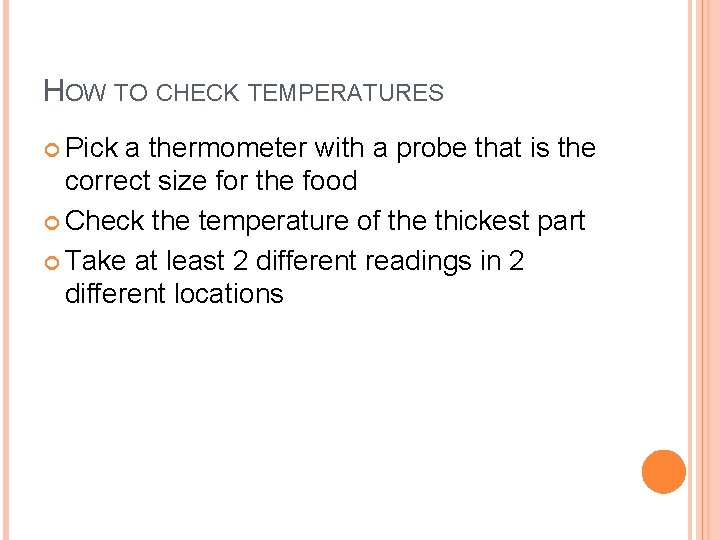
HOW TO CHECK TEMPERATURES Pick a thermometer with a probe that is the correct size for the food Check the temperature of the thickest part Take at least 2 different readings in 2 different locations
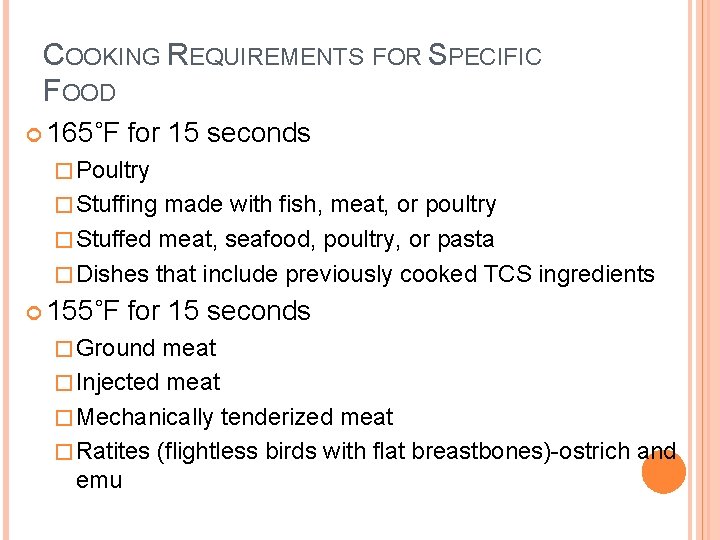
COOKING REQUIREMENTS FOR SPECIFIC FOOD 165˚F for 15 seconds � Poultry � Stuffing made with fish, meat, or poultry � Stuffed meat, seafood, poultry, or pasta � Dishes that include previously cooked TCS ingredients 155˚F for 15 seconds � Ground meat � Injected meat � Mechanically tenderized meat � Ratites (flightless birds with flat breastbones)-ostrich and emu
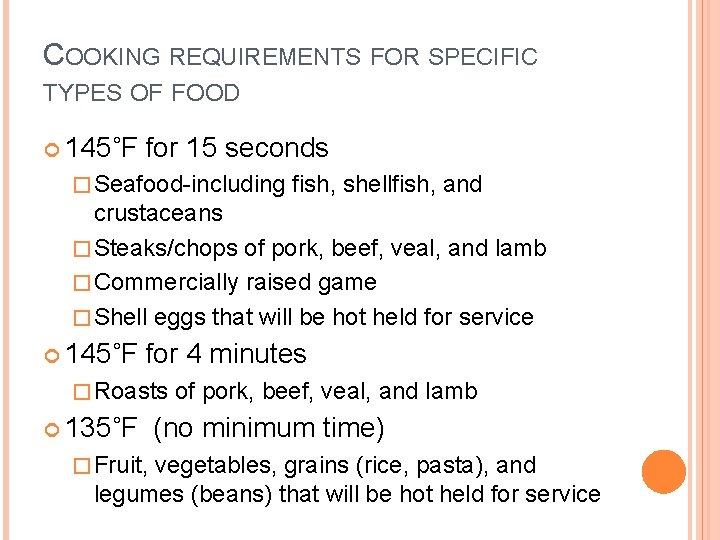
COOKING REQUIREMENTS FOR SPECIFIC TYPES OF FOOD 145˚F for 15 seconds � Seafood-including fish, shellfish, and crustaceans � Steaks/chops of pork, beef, veal, and lamb � Commercially raised game � Shell eggs that will be hot held for service 145˚F for 4 minutes � Roasts 135˚F � Fruit, of pork, beef, veal, and lamb (no minimum time) vegetables, grains (rice, pasta), and legumes (beans) that will be hot held for service
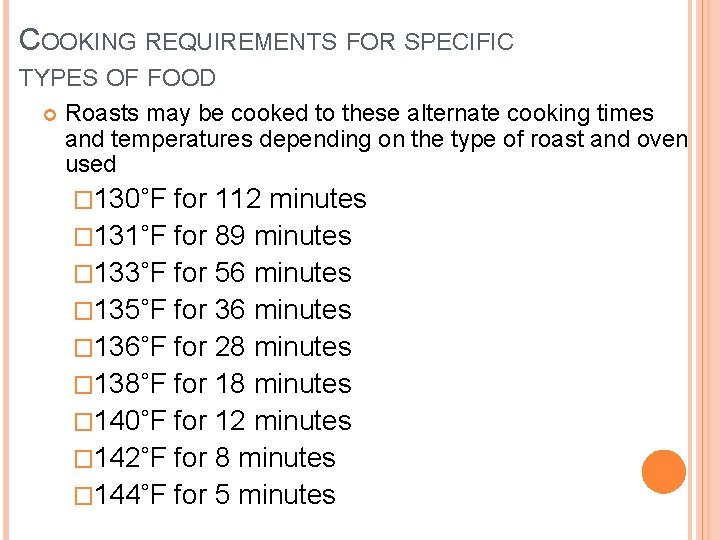
COOKING REQUIREMENTS FOR SPECIFIC TYPES OF FOOD Roasts may be cooked to these alternate cooking times and temperatures depending on the type of roast and oven used � 130˚F for 112 minutes � 131˚F for 89 minutes � 133˚F for 56 minutes � 135˚F for 36 minutes � 136˚F for 28 minutes � 138˚F for 18 minutes � 140˚F for 12 minutes � 142˚F for 8 minutes � 144˚F for 5 minutes
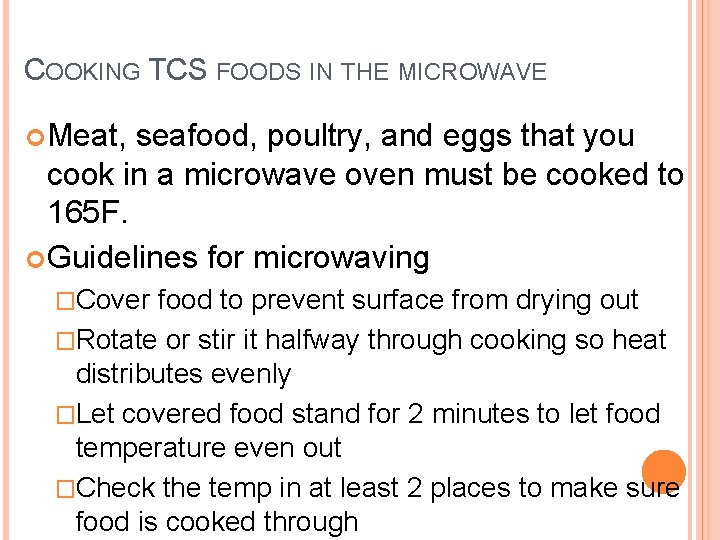
COOKING TCS FOODS IN THE MICROWAVE Meat, seafood, poultry, and eggs that you cook in a microwave oven must be cooked to 165 F. Guidelines for microwaving �Cover food to prevent surface from drying out �Rotate or stir it halfway through cooking so heat distributes evenly �Let covered food stand for 2 minutes to let food temperature even out �Check the temp in at least 2 places to make sure food is cooked through
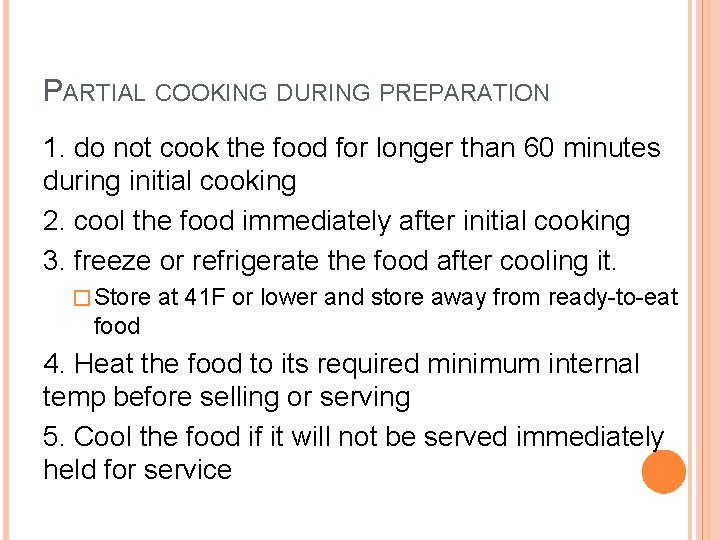
PARTIAL COOKING DURING PREPARATION 1. do not cook the food for longer than 60 minutes during initial cooking 2. cool the food immediately after initial cooking 3. freeze or refrigerate the food after cooling it. � Store at 41 F or lower and store away from ready-to-eat food 4. Heat the food to its required minimum internal temp before selling or serving 5. Cool the food if it will not be served immediately held for service
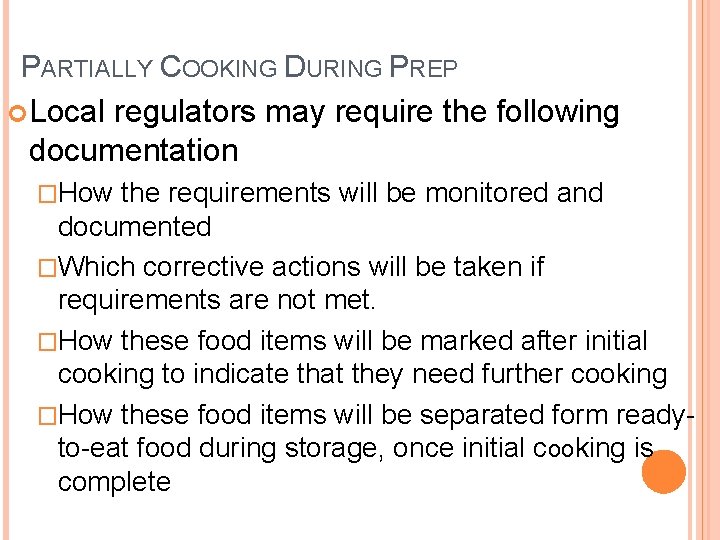
PARTIALLY COOKING DURING PREP Local regulators may require the following documentation �How the requirements will be monitored and documented �Which corrective actions will be taken if requirements are not met. �How these food items will be marked after initial cooking to indicate that they need further cooking �How these food items will be separated form readyto-eat food during storage, once initial cooking is complete
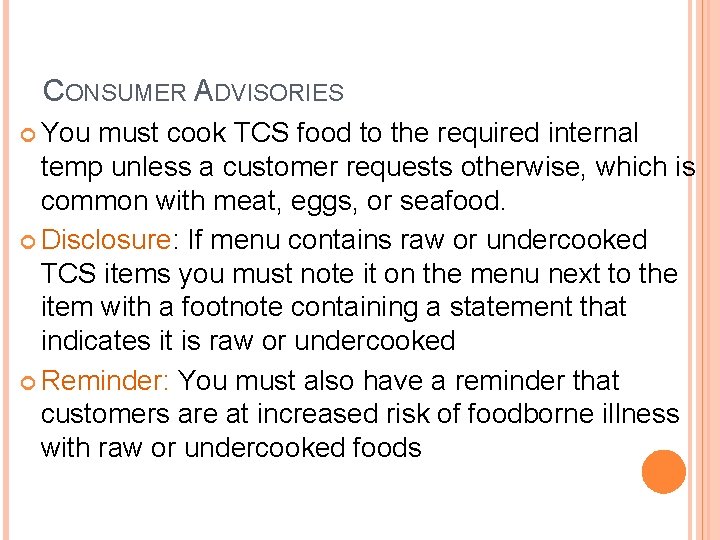
CONSUMER ADVISORIES You must cook TCS food to the required internal temp unless a customer requests otherwise, which is common with meat, eggs, or seafood. Disclosure: If menu contains raw or undercooked TCS items you must note it on the menu next to the item with a footnote containing a statement that indicates it is raw or undercooked Reminder: You must also have a reminder that customers are at increased risk of foodborne illness with raw or undercooked foods
CHILDREN’S MENUS The FDA advises against offering raw or undercooked meat, poultry, seafood, or eggs on a children’s menu. Especially undercooked ground beef
OPERATIONS THAT MAINLY SERVE HIGH-RISK POPULATIONS Never �Raw serve these items seed sprouts �Raw or undercooked eggs, meat or seafood �Unpasteurized milk or juice
COOLING AND REHEATING FOOD Cool TCS food from 135˚F to 41˚F or lower within 6 hours � Must cool form 135˚F to 70˚F within 2 hours � Then must cool from 70˚F to 41˚F or lower in four hours If food has not cooled in 70˚F within 2 hours, it must be reheated and then cooled again. If you cool food from 135˚F to 70˚F in less than 2 hours, you can use the remaining time to cool it to 41˚F or lower without going over six total hours
COOLING FOOD: FACTORS THAT AFFECT Thickness or density- dense food takes longer Size of the food- large food items cool more slowly � Reduce size of item � Reduce size of container Storage container- stainless steel transfers heat away from food faster than plastic � Shallow pans let the heat form the food disperse faster than deep pans
METHODS FOR COOLING FOOD NEVER cool large amounts of hot food in a cooler. Most coolers are not designed to cool large amounts of hot food quickly. �Placing hot food in a cooler may not move the food through the TDZ quick enough Ice-water bath-Divide food into smaller containers, place them in a clean prep sink or large pot filled with ice water. Stir frequently to cool faster and evenly.
METHODS OF COOLING Blast Chiller Ice Paddle Ice or cold water as ingredient- when cooling soups or stews, the recipe is made with less water than required. �Cold water or ice is then added to cool food and provide remaining water
STORING FOOD FOR FURTHER COOLING Loosely cover food containers before storing them Food can be left uncovered if stored in a way that prevents contaminants from getting into it Store above raw food
REHEATING FOOD Food reheated for immediate service: can be reheated to any temp if served immediately Food reheated for hot holding: you must heat TCS food for hot holding to 165 F for 15 seconds. �Make sure food reaches this temp within 2 hours from start to finish �Reheat commercially processed and packaged ready-to-eat food to an internal temp of at least