
Services Marketing Chapter 14 Improving Service Quality and


- Slides: 42
Services Marketing Chapter 14: Improving Service Quality and Productivity Slide © 2010 by Lovelock & Wirtz Services Marketing 7/e Chapter 14 – Page 1
Overview of Chapter 14 Services Marketing = Integrating Service Quality and Productivity Strategies = What is Service Quality? = The Gaps Model = Measuring and improving service quality = Learning from Customer Feedback = Hard Measures of Service Quality = Tools to Analyze and Address Service Quality Problems = Defining and Measuring Quality = Improving Service Productivity Slide © 2010 by Lovelock & Wirtz Services Marketing 7/e Chapter 14 – Page 2
Services Marketing Integrating Service Quality and Productivity Strategies Slide © 2010 by Lovelock & Wirtz Services Marketing 7/e Chapter 14 – Page 3
Integrating Service Quality and Productivity Strategies Services Marketing = Quality and productivity create value for customers and companies = Quality focuses on the benefits created for customers; productivity addresses financial costs incurred by firm = Importance of productivity: è Keep costs down to improve profits and/or reduce prices è Enable firms to spend more on improving customer service and supplementary services è Secure firm’s future through increased spending on R&D è May impact service experience Slide © 2010 by Lovelock & Wirtz Services Marketing 7/e Chapter 14 – Page 4
Services Marketing What is Service Quality? Slide © 2010 by Lovelock & Wirtz Services Marketing 7/e Chapter 14 – Page 5
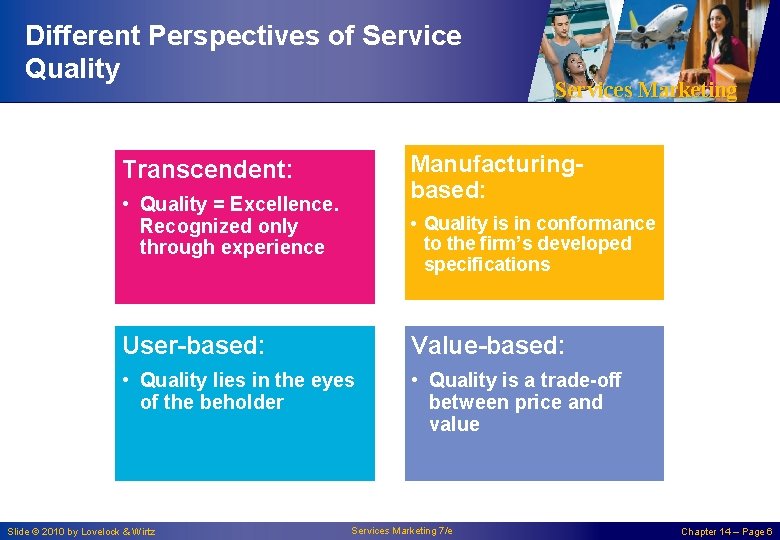
Different Perspectives of Service Quality Services Marketing Manufacturingbased: Transcendent: • Quality = Excellence. Recognized only through experience • Quality is in conformance to the firm’s developed specifications User-based: Value-based: • Quality lies in the eyes of the beholder • Quality is a trade-off between price and value Slide © 2010 by Lovelock & Wirtz Services Marketing 7/e Chapter 14 – Page 6
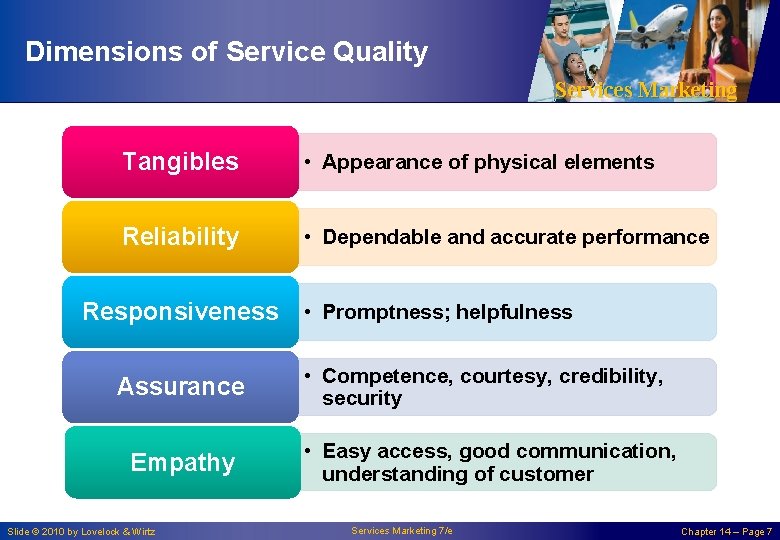
Dimensions of Service Quality Services Marketing Tangibles • Appearance of physical elements Reliability • Dependable and accurate performance Responsiveness • Promptness; helpfulness Assurance • Competence, courtesy, credibility, security Empathy • Easy access, good communication, understanding of customer Slide © 2010 by Lovelock & Wirtz Services Marketing 7/e Chapter 14 – Page 7
Services Marketing The Gaps Model Slide © 2010 by Lovelock & Wirtz Services Marketing 7/e Chapter 14 – Page 8
Six Service Quality Gaps Services Marketing Slide © 2010 by Lovelock & Wirtz Services Marketing 7/e Chapter 14 – Page 9
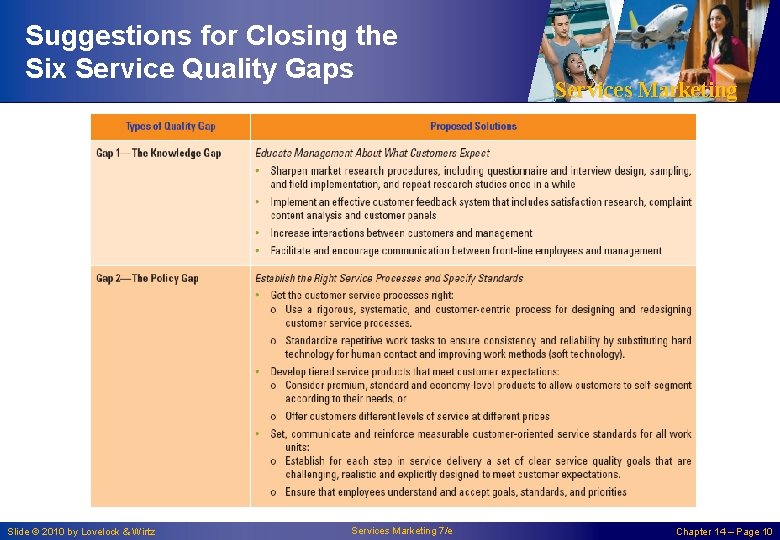
Suggestions for Closing the Six Service Quality Gaps Slide © 2010 by Lovelock & Wirtz Services Marketing 7/e Services Marketing Chapter 14 – Page 10
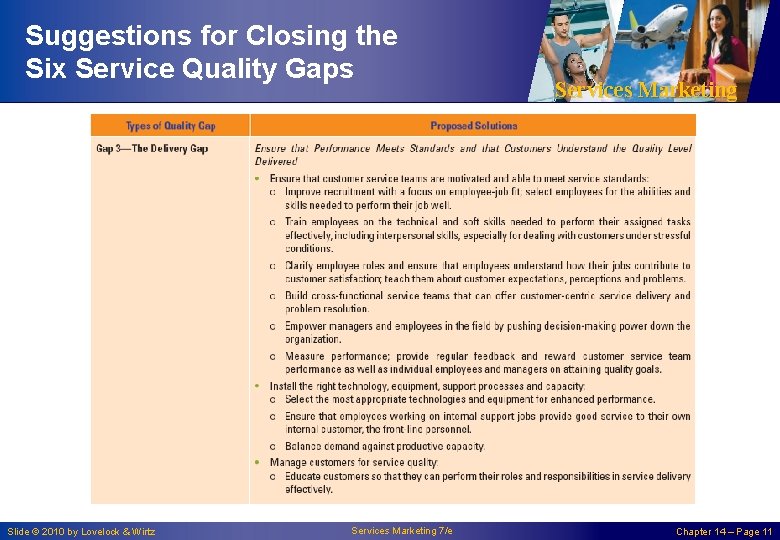
Suggestions for Closing the Six Service Quality Gaps Slide © 2010 by Lovelock & Wirtz Services Marketing 7/e Services Marketing Chapter 14 – Page 11
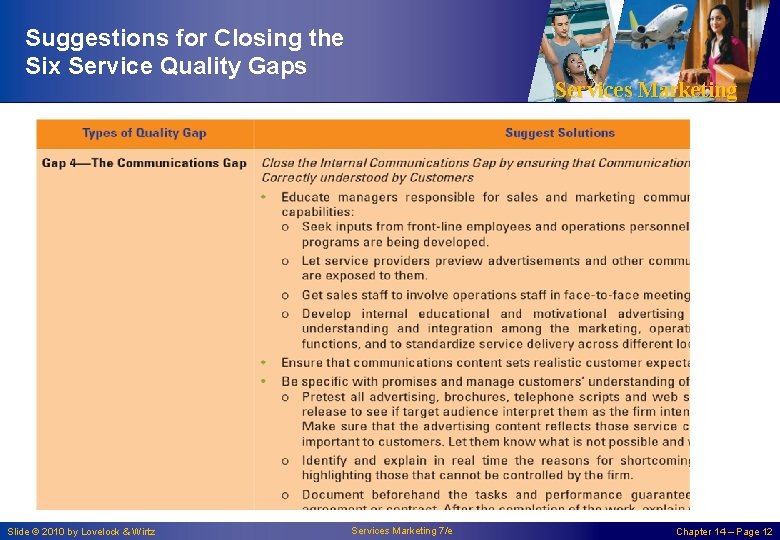
Suggestions for Closing the Six Service Quality Gaps Slide © 2010 by Lovelock & Wirtz Services Marketing 7/e Chapter 14 – Page 12
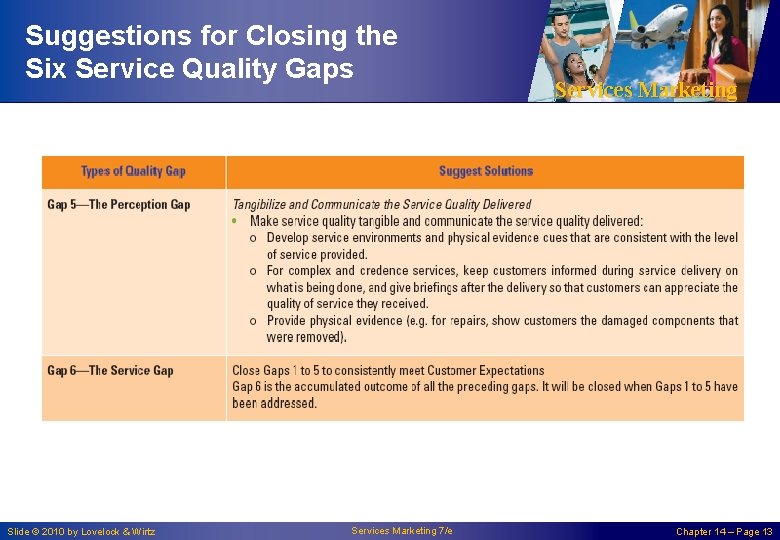
Suggestions for Closing the Six Service Quality Gaps Slide © 2010 by Lovelock & Wirtz Services Marketing 7/e Services Marketing Chapter 14 – Page 13
Services Marketing Measuring and Improving Service Quality Slide © 2010 by Lovelock & Wirtz Services Marketing 7/e Chapter 14 – Page 14
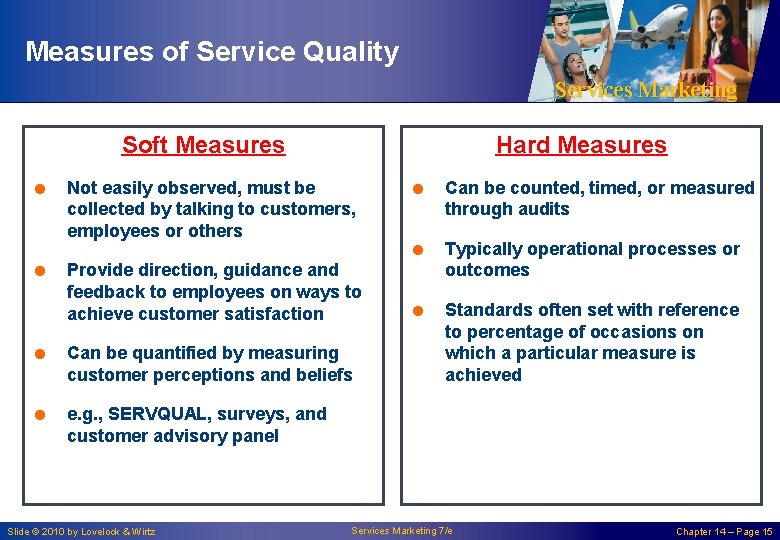
Measures of Service Quality Services Marketing Soft Measures Hard Measures = Not easily observed, must be collected by talking to customers, employees or others = Provide direction, guidance and feedback to employees on ways to achieve customer satisfaction = Can be quantified by measuring customer perceptions and beliefs = Can be counted, timed, or measured through audits = Typically operational processes or outcomes = Standards often set with reference to percentage of occasions on which a particular measure is achieved = e. g. , SERVQUAL, surveys, and customer advisory panel Slide © 2010 by Lovelock & Wirtz Services Marketing 7/e Chapter 14 – Page 15
Services Marketing Learning from Customer Feedback Slide © 2010 by Lovelock & Wirtz Services Marketing 7/e Chapter 14 – Page 16
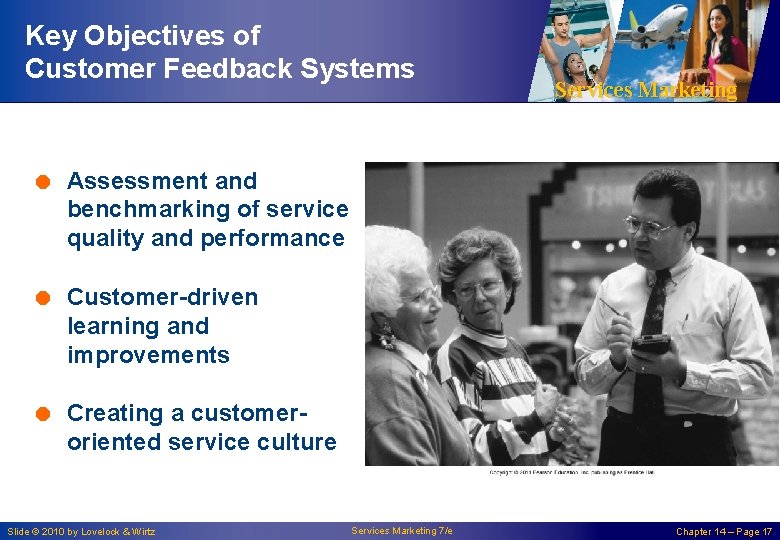
Key Objectives of Customer Feedback Systems Services Marketing = Assessment and benchmarking of service quality and performance = Customer-driven learning and improvements = Creating a customeroriented service culture Slide © 2010 by Lovelock & Wirtz Services Marketing 7/e Chapter 14 – Page 17
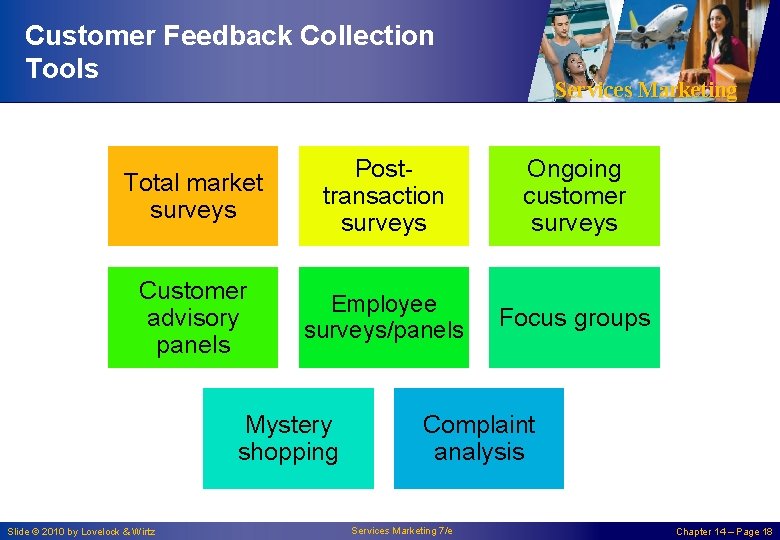
Customer Feedback Collection Tools Services Marketing Total market surveys Posttransaction surveys Ongoing customer surveys Customer advisory panels Employee surveys/panels Focus groups Mystery shopping Slide © 2010 by Lovelock & Wirtz Complaint analysis Services Marketing 7/e Chapter 14 – Page 18
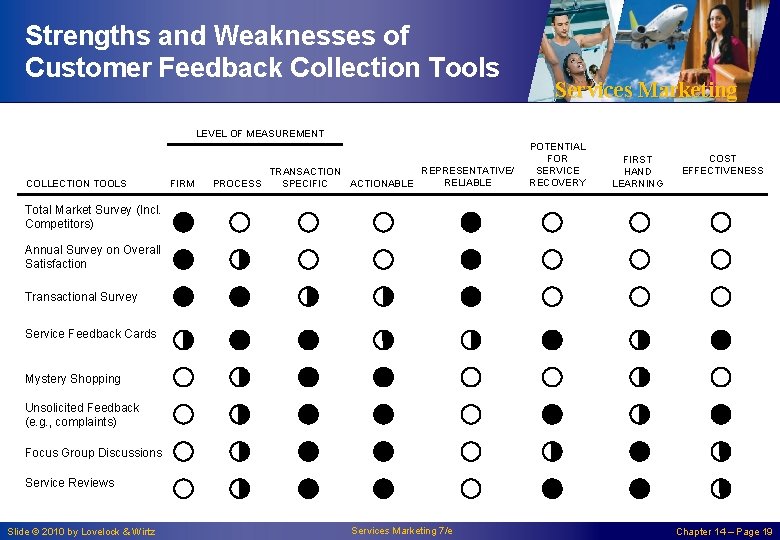
Strengths and Weaknesses of Customer Feedback Collection Tools Services Marketing LEVEL OF MEASUREMENT COLLECTION TOOLS FIRM REPRESENTATIVE/ TRANSACTION RELIABLE PROCESS ACTIONABLE SPECIFIC POTENTIAL FOR SERVICE RECOVERY FIRST HAND LEARNING COST EFFECTIVENESS Total Market Survey (Incl. Competitors) Annual Survey on Overall Satisfaction Transactional Survey Service Feedback Cards Mystery Shopping Unsolicited Feedback (e. g. , complaints) Focus Group Discussions Service Reviews Slide © 2010 by Lovelock & Wirtz Services Marketing 7/e Chapter 14 – Page 19
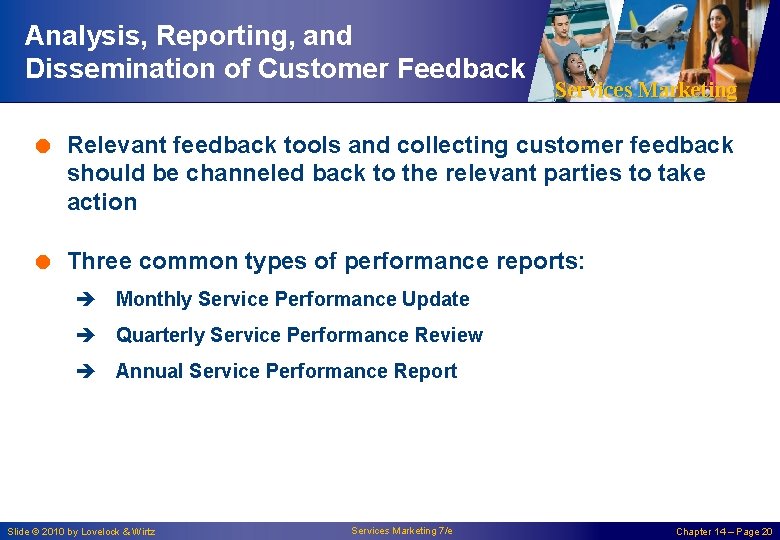
Analysis, Reporting, and Dissemination of Customer Feedback Services Marketing = Relevant feedback tools and collecting customer feedback should be channeled back to the relevant parties to take action = Three common types of performance reports: è Monthly Service Performance Update è Quarterly Service Performance Review è Annual Service Performance Report Slide © 2010 by Lovelock & Wirtz Services Marketing 7/e Chapter 14 – Page 20
Services Marketing Hard Measures of Service Quality Slide © 2010 by Lovelock & Wirtz Services Marketing 7/e Chapter 14 – Page 21
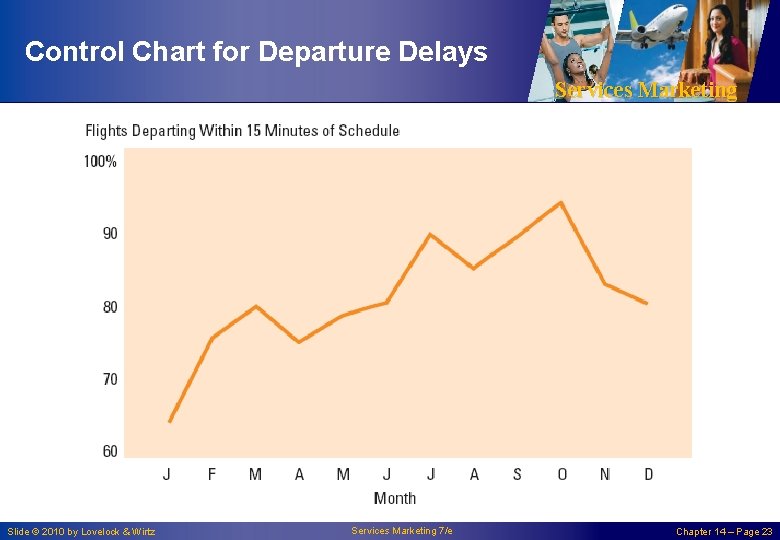
Hard Measures of Service Quality Services Marketing = Service quality indexes è Embrace key activities that have an impact on customers = Control charts to monitor a single variable è Offer a simple method of displaying performance over time against specific quality standards è Enable easy identification of trends è Are only good if data on which they are based are accurate = Fed. Ex: One of the first service companies to understand the need for an index of service quality that embraced all the key activities that affect customers Slide © 2010 by Lovelock & Wirtz Services Marketing 7/e Chapter 14 – Page 22
Control Chart for Departure Delays Services Marketing Slide © 2010 by Lovelock & Wirtz Services Marketing 7/e Chapter 14 – Page 23
Services Marketing Tools to Analyze and Address Service Quality Problems Slide © 2010 by Lovelock & Wirtz Services Marketing 7/e Chapter 14 – Page 24
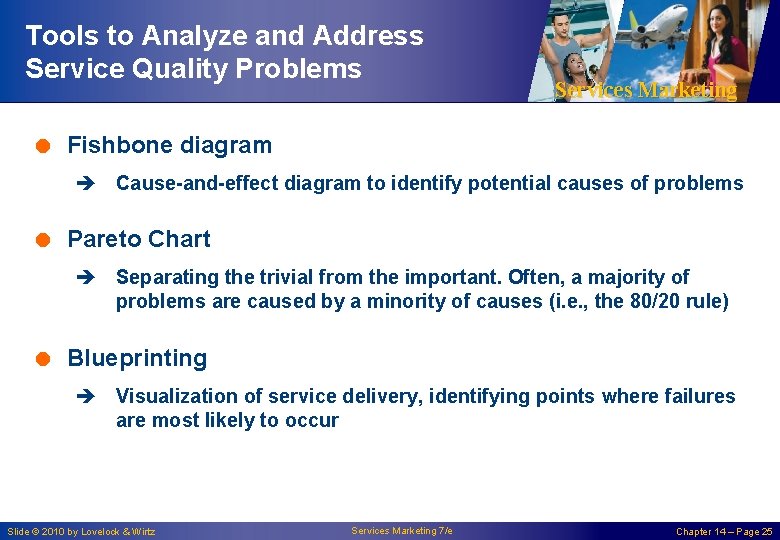
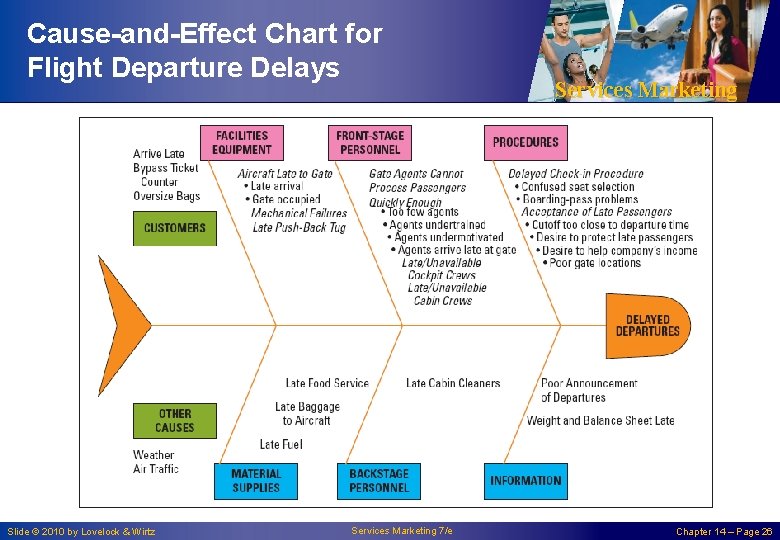
Tools to Analyze and Address Service Quality Problems Services Marketing = Fishbone diagram è Cause-and-effect diagram to identify potential causes of problems = Pareto Chart è Separating the trivial from the important. Often, a majority of problems are caused by a minority of causes (i. e. , the 80/20 rule) = Blueprinting è Visualization of service delivery, identifying points where failures are most likely to occur Slide © 2010 by Lovelock & Wirtz Services Marketing 7/e Chapter 14 – Page 25
Cause-and-Effect Chart for Flight Departure Delays Slide © 2010 by Lovelock & Wirtz Services Marketing 7/e Services Marketing Chapter 14 – Page 26
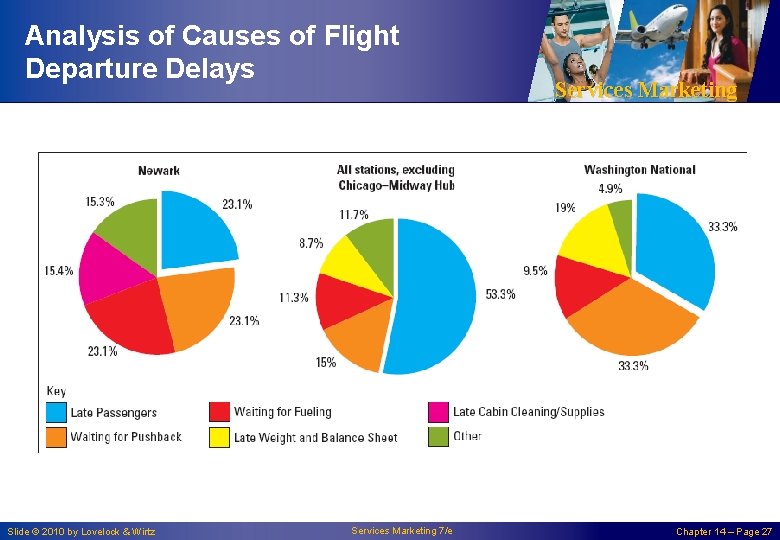
Analysis of Causes of Flight Departure Delays Slide © 2010 by Lovelock & Wirtz Services Marketing 7/e Services Marketing Chapter 14 – Page 27
Blueprinting Services Marketing = Depicts sequence of front-stage interactions experienced by customers plus supporting backstage activities = Used to identify potential fail points è where failures are most likely to appear = Shows how failures at one point can have a ripple effect = Managers can identify points which need urgent attention è Important first step in preventing service quality problems Slide © 2010 by Lovelock & Wirtz Services Marketing 7/e Chapter 14 – Page 28
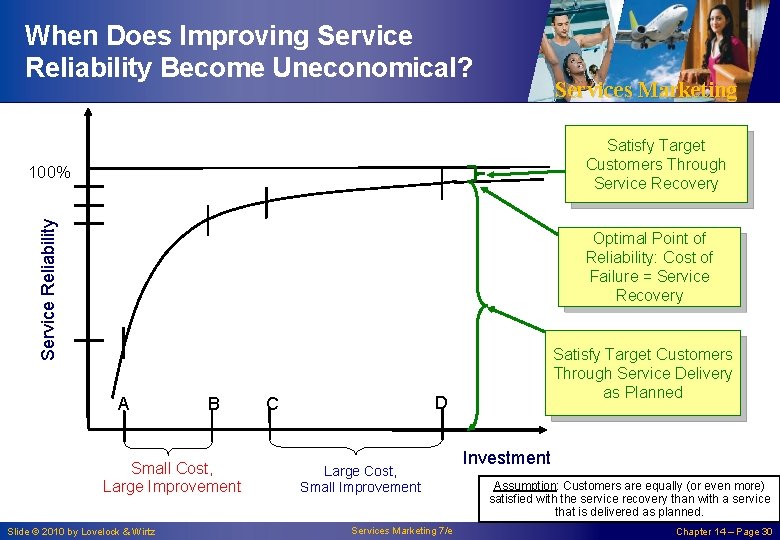
Return On Quality (ROQ) Services Marketing = Assess costs and benefits of quality initiatives è ROQ approach is based on four assumptions: - quality is an investment - quality efforts must be financially accountable - it’s possible to spend too much on quality - not all quality expenditures are equally valid è Implication: Quality improvement efforts may benefit from being related to productivity improvement programs è To determine feasibility of new quality improvement efforts, determine costs and then relate to anticipated customer response = Determine optimal level of reliability è Diminishing returns set in as improvements require higher investments è Know when improving service reliability becomes uneconomical Slide © 2010 by Lovelock & Wirtz Services Marketing 7/e Chapter 14 – Page 29
When Does Improving Service Reliability Become Uneconomical? Services Marketing Satisfy Target Customers Through Service Recovery Service Reliability 100% Optimal Point of Reliability: Cost of Failure = Service Recovery A B Small Cost, Large Improvement Slide © 2010 by Lovelock & Wirtz Satisfy Target Customers Through Service Delivery as Planned D C Large Cost, Small Improvement Services Marketing 7/e Investment Assumption: Customers are equally (or even more) satisfied with the service recovery than with a service that is delivered as planned. Chapter 14 – Page 30
Productivity in a Service Context Services Marketing = Productivity: amount of output produced relative to amount of inputs è Improvement in productivity means an improvement in the ratio of outputs to inputs. = Intangible nature of service makes it hard to measure productivity of service firms, especially for information-based services è Both input and output are hard to define è Relatively simpler in possession-processing services, as compared to information- and people-processing services Slide © 2010 by Lovelock & Wirtz Services Marketing 7/e Chapter 14 – Page 31
Service Efficiency, Productivity, and Effectiveness Services Marketing = Efficiency: involves comparison to a standard, usually time-based (e. g. , how long employee takes to perform specific task) è Focus on inputs rather than outcomes and may ignore variations in service quality/value = Productivity: involves financial valuation of outputs to inputs è Consistent delivery of outcomes desired by customers should command higher prices = Effectiveness: degree to which firm meets goals è Cannot divorce productivity from quality and customer satisfaction Slide © 2010 by Lovelock & Wirtz Services Marketing 7/e Chapter 14 – Page 32
Services Marketing Improving Service Productivity Slide © 2010 by Lovelock & Wirtz Services Marketing 7/e Chapter 14 – Page 33
Generic Productivity Improvement Strategies Services Marketing = Typical strategies to improve service productivity: è Careful control of costs è è Efforts to reduce wasteful use of materials or labor Teaching employees how to work more productively è Matching productive capacity to average demand levels Broadening variety of tasks that service worker can perform è Installing expert systems that allow paraprofessionals to take on work previously performed by professionals è è Replacing workers by automated machines or selfservice technologies = Although improving productivity can be approached incrementally, major gains often require redesigning entire processes Slide © 2010 by Lovelock & Wirtz Services Marketing 7/e Chapter 14 – Page 34
Customer-Driven Strategies to Improve Productivity Services Marketing = Change timing of customer demand è By shifting demand away from peaks, managers can make better use of firm’s productive assets and provide better service = Involve customers more in production è Get customers to self-serve è Encourage customers to obtain information and buy from firm’s corporate websites = Ask customers to use third parties è Delegate delivery of supplementary service elements to intermediary organizations Slide © 2010 by Lovelock & Wirtz Services Marketing 7/e Chapter 14 – Page 35
Implications of Backstage and Front. Stage Changes for Customers Services Marketing = Backstage changes may impact customers è Keep track of proposed backstage changes, and prepare customers for them - e. g. , new printing peripherals may affect appearance of bank statements = Front-stage productivity enhancements are especially visible in high contact services è Some improvements only require passive acceptance, while others require customers to change behavior è Must consider impact on customers and address customer resistance to changes Slide © 2010 by Lovelock & Wirtz Services Marketing 7/e Chapter 14 – Page 36
A Note of Caution on Mere Cost Reduction Strategies Services Marketing = Without new technology, firms improve service productivity by eliminating waste and reducing labor costs = Multitasking can reduce productivity = Excessive pressure breeds discontent and frustration among customer contact personnel = It is often better to search for service process redesign opportunities that lead to quantum leaps in improvements in productivity and service quality at the same time Slide © 2010 by Lovelock & Wirtz Services Marketing 7/e Chapter 14 – Page 37
Summary Services Marketing = Service quality has five key dimensions: Tangibles, Reliability, Responsiveness, Competence, Courtesy = GAPS model can be used to diagnose and address service quality problems: è è è Gap 1: The Knowledge Gap 2: The Policy Gap 3: The Delivery Gap 4: The Communications Gap 5: The Perceptions Gap 6: The Service Quality Gap = Customer feedback systems are used to: è è è Assess and benchmark service quality and performance Institutionalize customer-driven learning and improvements Create a customer-oriented service culture Slide © 2010 by Lovelock & Wirtz Services Marketing 7/e Chapter 14 – Page 38
Summary Services Marketing = Efficiency, productivity, and effectiveness need to be distinguished when measuring service quality = Customer-driven approaches to improving productivity include è è Changing timing of customer demand Involving customers more in production Asking customers to use third parties Use cost-reduction strategies with caution if they are not driven by new technology or process redesign - they may reduce service quality! Slide © 2010 by Lovelock & Wirtz Services Marketing 7/e Chapter 14 – Page 39
Services Marketing Appendix Slide © 2010 by Lovelock & Wirtz Services Marketing 7/e Chapter 14 – Page 40
SERVQUAL Services Marketing = Survey research instrument based on premise that customers evaluate firm’s service quality by comparing: è è their perceptions of service quality actually received with their prior expectations of companies in a particular industry Poor Quality: Perceived performance ratings < expectations Good Quality: Perceived performance ratings > expectations = Developed primarily in context of face-to-face service encounters = Scale contains 22 items reflecting five dimensions of service quality = Scale may have to be customized to the research context as recent research suggests that it is not generalizable Slide © 2010 by Lovelock & Wirtz Services Marketing 7/e Chapter 14 – Page 41
Tools to Analyze and Address Service Quality Problems Services Marketing = Total Quality Management (TQM) = ISO 9000 è Comprises requirements, definitions, guidelines, and related standards to provide an independent assessment and certification of a firm’s quality management system = Malcolm Baldrige Model Applied to Services è To promote best practices in quality management, and recognizing, and publicizing quality achievements among U. S. firms è Many countries around the world have adapted the Malcolm Baldrige Model = Six Sigma & Lean Six Sigma è Statistically, only 3. 4 defects per million opportunities (1/294, 000) è Has evolved from defect-reduction approach to an overall business-improvement approach Slide © 2010 by Lovelock & Wirtz Services Marketing 7/e Chapter 14 – Page 42