
Services for ELL Students Presenters Dely Roberts ALSDE
Services for ELL Students Presenters: Dely Roberts, ALSDE Federal Programs Cindy Hunt, ALSDE Regional ELL Coach
Which students receive ESL services? �ELL students who qualify for services have completed Home Language Survey � indicated that a language other than English is spoken at home and/or by the student have been screened using W-APT � administrator should be WIDA certified � student scoring < 3. 9 must be identified for service � student scoring >4. 0 may be identified for placement
What’s required? • Lau v. Nichols – – Equal access does not equal appropriate instruction. Must consider students’ linguistic needs. • Casteñada v Pickard – – – Selected program must be research-based. Implemented with necessary resources and personnel. Evaluated and adjusted. • No Child Left Behind – – Equal access to complete educational program. Regular and special education, as appropriate. Curricular and extracurricular opportunities. Federal funds are supplemental.
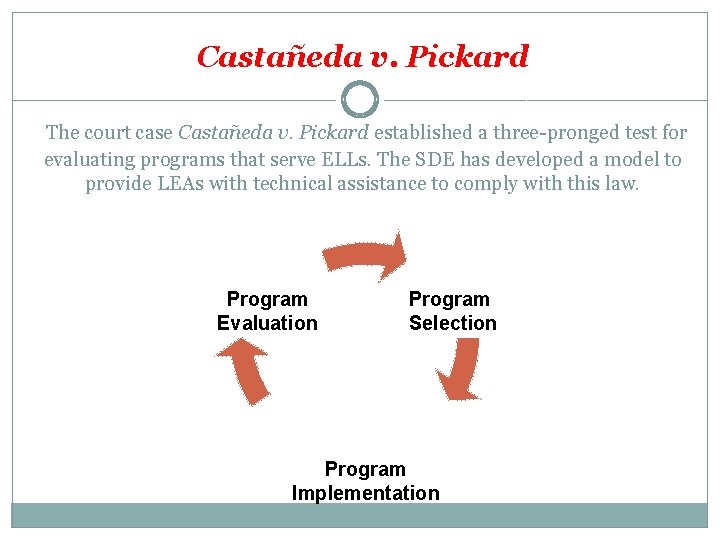
Castañeda v. Pickard The court case Castañeda v. Pickard established a three-pronged test for evaluating programs that serve ELLs. The SDE has developed a model to provide LEAs with technical assistance to comply with this law. Program Evaluation Program Selection Program Implementation
English as a Second Language Program Implementation An ESL leadership committee should convene to develop a strategic plan. The AMAO LEA Improvement Plan can be used to accomplish this activity. • Needs Assessment • Goals/Strategies/Action steps • Implementation • Evaluation
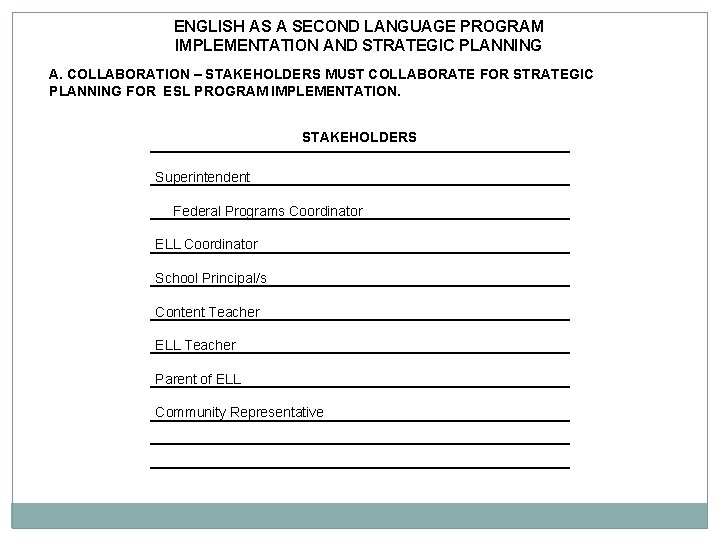
ENGLISH AS A SECOND LANGUAGE PROGRAM IMPLEMENTATION AND STRATEGIC PLANNING A. COLLABORATION – STAKEHOLDERS MUST COLLABORATE FOR STRATEGIC PLANNING FOR ESL PROGRAM IMPLEMENTATION. STAKEHOLDERS Superintendent Federal Programs Coordinator ELL Coordinator School Principal/s Content Teacher ELL Teacher Parent of ELL Community Representative
ELL/ ESL Program Selection and Curriculum Requirements
ESL Pull-out Generally used in elementary settings. Students spend a portion of the day with the ESL instructor. The majority of the day is spent in the regular classroom.
ESL Push-in The ESL instructor goes into the regular classroom. Collaboration between the ESL instructor and the regular education teacher is essential for success.
Newcomer Program Addresses specific needs of recent immigrant students (usually students that enroll in middle school or high school). Goals for Newcomers - Acquire beginning English language skills along with core academic skills. - Acculturate the students to the school system. Generally, students stay in the newcomer program for one year.
ESL Class Period Students receive ESL instruction during a regular class period. Students can receive course credit. Students can be grouped according to their level of proficiency.
ESL Resource Center The ESL Resource Center is a variation of the pull- out design. Students from several classrooms or schools come together where ESL materials and staff are concentrated in one location. Usually, there is at least one full time ESL instructor.
Sheltered English or Content-based Programs Language minority students from different language backgrounds are given instruction with English as the medium of instruction. Instruction is focused on content rather than language. Gestures and visual aids can be used to help students understand.
How are ESL services delivered? • LEA has an ELL plan detailing the service delivery model. • ELL Committee determines the best methods of meeting individual student language acquisition needs – – – ELL coordinator ELL teacher Content-area or grade-level teachers Special needs teacher as needed Guidance Counselor
English as a Second Language Program Evaluation The LEA conducts a program evaluation after the each year of implementation to determine the effectiveness of the program. Evaluation of the program involves the collection and analysis of data to determine if goals were met. The data analysis should include a summary of the status of the ESL program and future goals and plans to improve the program the following school year.
English as a Second Language Program Evaluation continued LEAs are encouraged to complete a self-assessment to determine program compliance. - See appendix K in the English Language Learners (ELL) Policies and Procedures Manual for a sample ESL Evaluation Template. - See Appendix L in the English Language Learners (ELL) Policies and Procedures Manual for a sample ESL Program District Assessment Survey.
Curriculum Requirements: Alabama Courses of Study and Wi. DA ELP Standards
Collaborate Alabama Courses of Study (Content) Wi. DA ELP Standards (Academic Language)

Wi. DA ELP World-Class Instructional Design and Assessment English Language Proficiency
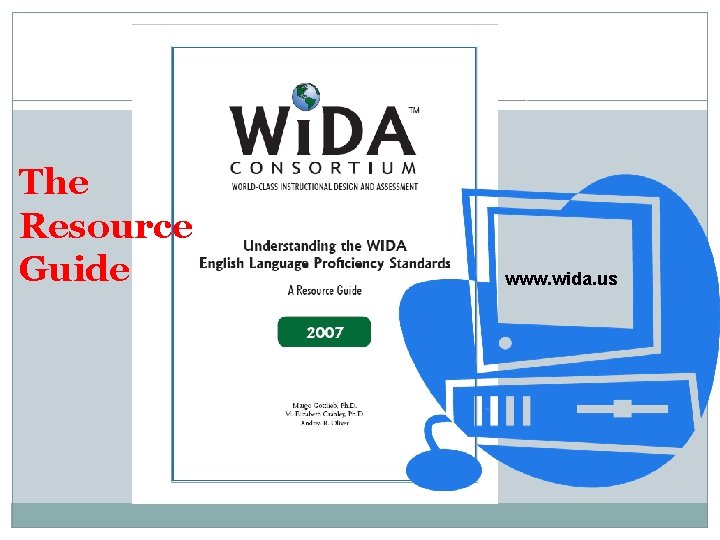
The Resource Guide www. wida. us
What are Wi. DA ELP standards? The WIDA ELP standards facilitate the design of language development objectives that support, guide and develop content knowledge and skills at the appropriate level of English proficiency. “English as a Second Language Curriculum and Instruction. ”English Language Learners (ELL) Policy and Procedures Manual; Federal Programs Section Division of Instructional Services of AL Department of Education, 2008 ed, p. 25
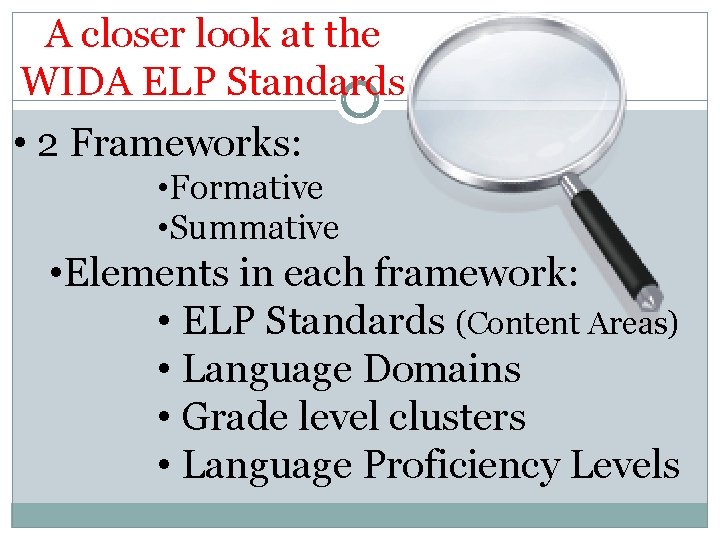
A closer look at the WIDA ELP Standards • 2 Frameworks: • Formative • Summative • Elements in each framework: • ELP Standards (Content Areas) • Language Domains • Grade level clusters • Language Proficiency Levels
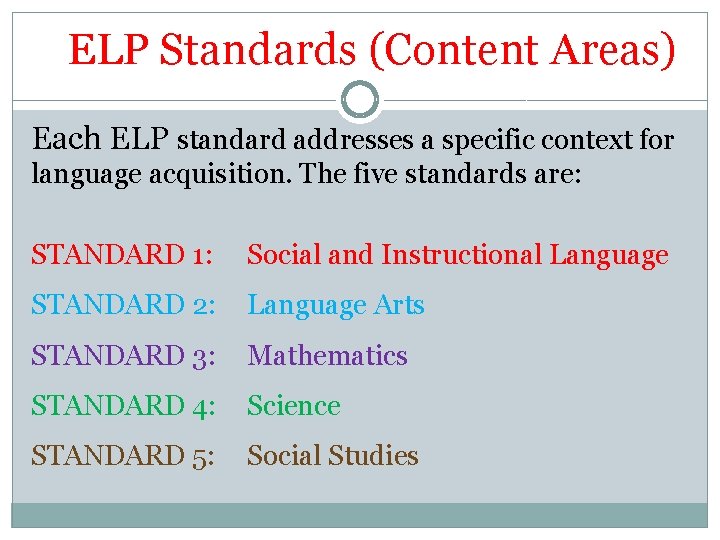
ELP Standards (Content Areas) Each ELP standard addresses a specific context for language acquisition. The five standards are: STANDARD 1: Social and Instructional Language STANDARD 2: Language Arts STANDARD 3: Mathematics STANDARD 4: Science STANDARD 5: Social Studies
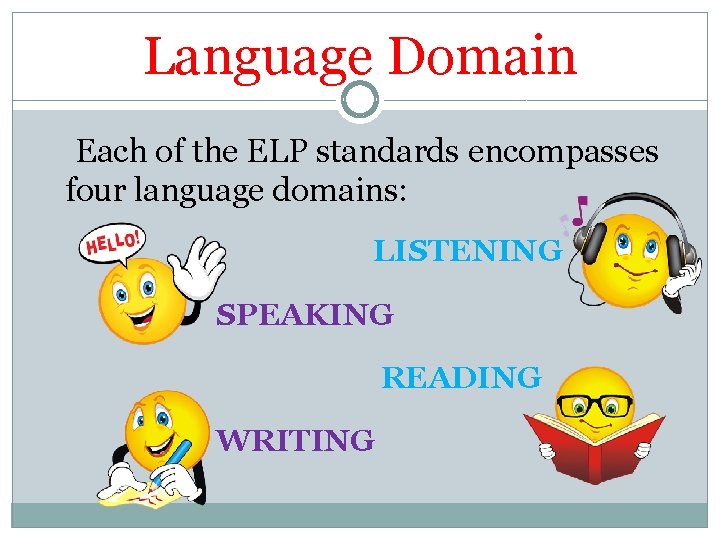
Language Domain Each of the ELP standards encompasses four language domains: LISTENING SPEAKING READING WRITING
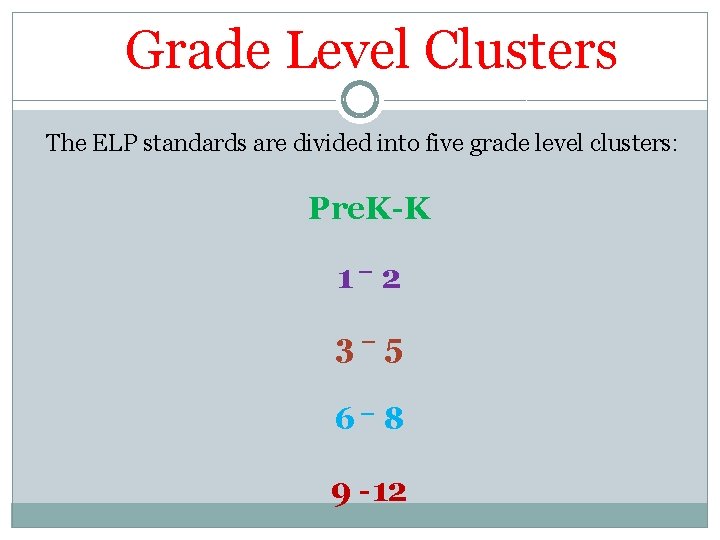
Grade Level Clusters The ELP standards are divided into five grade level clusters: Pre. K-K 1– 2 3– 5 6– 8 9 -12
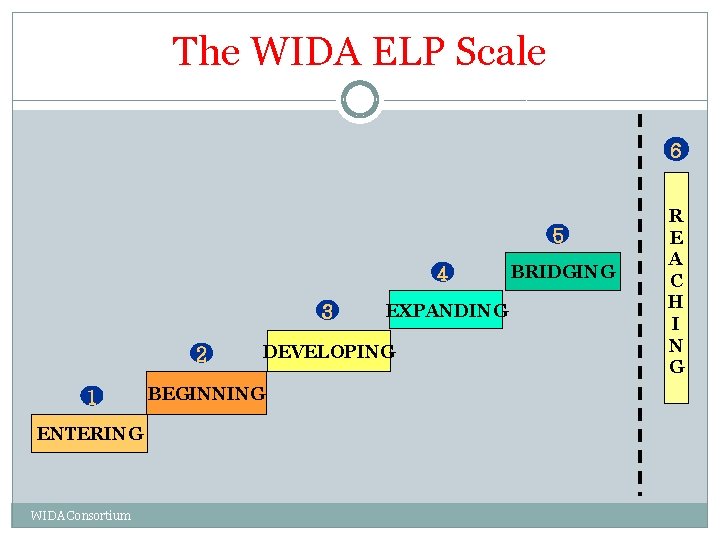
The WIDA ELP Scale 6 5 4 3 2 1 ENTERING WIDA Consortium EXPANDING DEVELOPING BEGINNING BRIDGING R E A C H I N G
Teacher-friendly Tools from WIDA Performance Definitions General descriptions of how ELLs understand, process, use and produce English. Aligned with ELP levels. “CAN DO Descriptors” General descriptions of what student “can do” in a specific language domain. Aligned with the specific ELP level for each language domain.
Review: How do you determine the student’s level? Screener Test: Annual Test: W-APT™ – ACCESS for ELLs®– WIDA ACCESS Placement Test Assessing Comprehension and Communication in English State-to-State for English Language Learners
SOURCES & RESOURCES: • The Alabama Department of Education ELL Policy and Procedures Manual (www. alex. state. al. us/ell/) • 2007 Edition of Wi. DA Consortium English Language Proficiency Standards and Resource Guide (see Wi. DA website for ordering a copy) • Wi. DA Consortium website (www. wida. us)
What do I do? They’re in my class? GRADING AND RETENTION
What instruction must ELLs receive? �English language development Driven by W-APT and WIDA ACCESS scores. BICS and CALP �Content learning Driven by content standards and objectives of Alabama State Course of Study. Required standardized testing objectives.
What do I do? They’re in my classroom! • Provide professional development for content-area and grade-level teachers! • ACCOMMODATIONS must be provided by the content-area or grade-level teacher. • Examples: – – Activation of background knowledge Scaffolded instruction Sheltering of instruction Use of authentic assessment tools
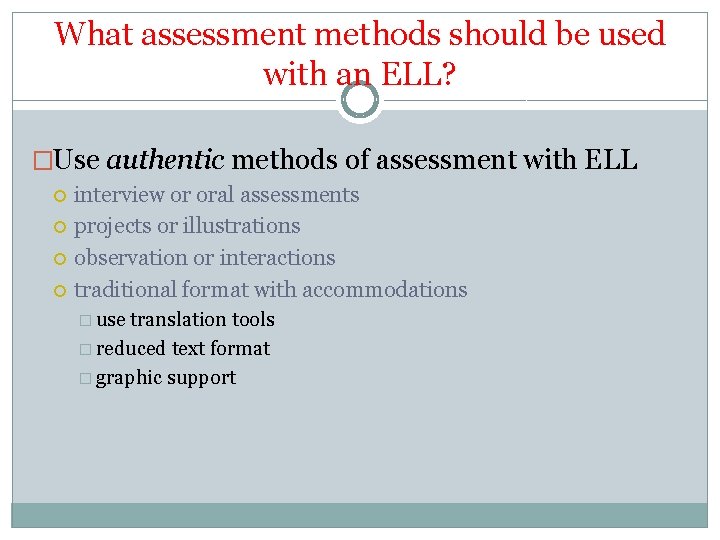
What assessment methods should be used with an ELL? �Use authentic methods of assessment with ELL interview or oral assessments projects or illustrations observation or interactions traditional format with accommodations � use translation tools � reduced text format � graphic support
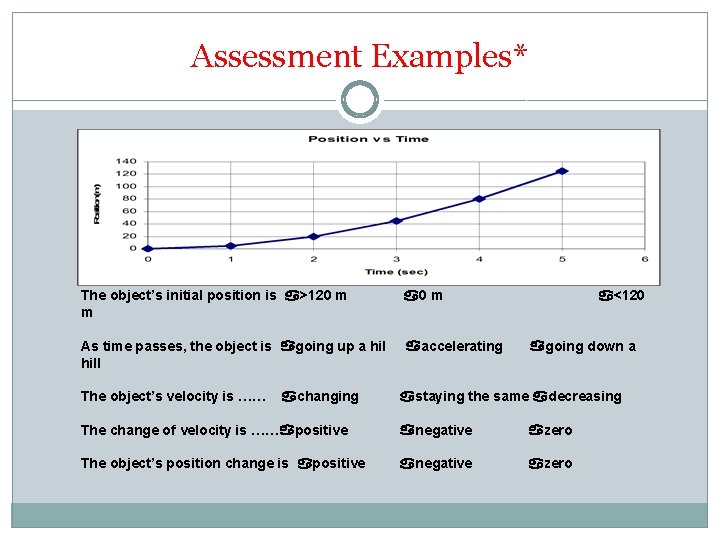
Assessment Examples* The object’s initial position is a>120 m m a 0 m As time passes, the object is agoing up a hill aaccelerating The object’s velocity is …… achanging a<120 agoing down a astaying the same adecreasing The change of velocity is ……apositive anegative azero The object’s position change is apositive anegative azero
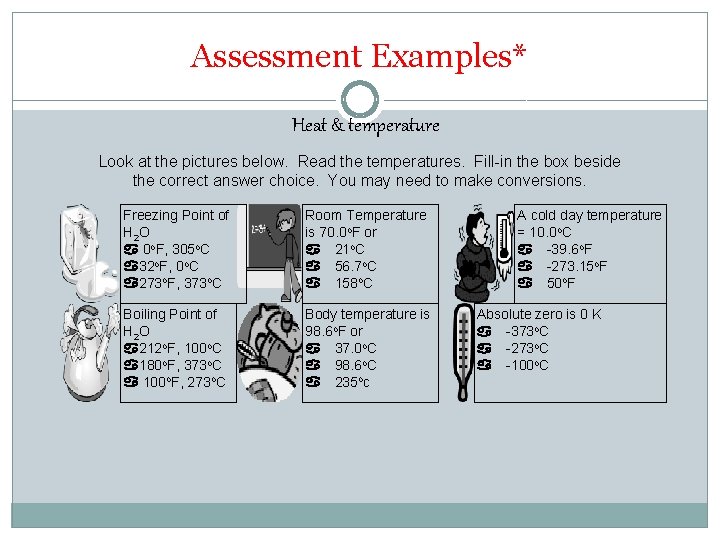
Assessment Examples* Heat & temperature Look at the pictures below. Read the temperatures. Fill-in the box beside the correct answer choice. You may need to make conversions. Freezing Point of H 2 O a 0 o. F, 305 o. C a 32 o. F, 0 o. C a 273 o. F, 373 o. C Room Temperature is 70. 0 o. F or a 21 o. C a 56. 7 o. C a 158 o. C Boiling Point of H 2 O a 212 o. F, 100 o. C a 180 o. F, 373 o. C a 100 o. F, 273 o. C Body temperature is 98. 6 o. F or a 37. 0 o. C a 98. 6 o. C a 235 oc A cold day temperature = 10. 0 o. C a -39. 6 o. F a -273. 15 o. F a 50 o. F Absolute zero is 0 K a -373 o. C a -273 o. C a -100 o. C
What considerations should be made when assigning grades for ELLs? • Is an I-ELP in place? • Were accommodations made to lower the language barrier? • Were authentic assessment methods used to evaluate ELL student learning of content? • Were all content objectives included in student’s instruction? • What level of mastery on content objectives did student demonstrate?
What considerations should be made regarding retention? • Is an I-ELP in place? • Were accommodations made to lower the language barrier? • Were authentic assessment methods used to evaluate ELL student learning of content? • Were all content objectives included in student’s instruction? • What level of mastery on content objectives did student demonstrate?
Failing Grades & Retention �Documentation to support action Develop a protocol Example components: � Samples of regular and accommodated documents � Samples of graded and/or accommodated student work � Brief narrative of teacher behaviors accommodations made teacher observations of student behavior contact with ELL specialist contact with parents
Failure and Retention �Failure and retention is determined through the support of evidence that: accommodations were provided consideration was made of student’s level of language proficiency progress monitoring and intervention strategies were implemented
Common Issues Title III vs. Core ESL program Waiving ESL services Evaluation of core ESL program Required activities for Title III funds ESL program exit requirements Barriers to enrollment Communication of ELL Plan to personnel other than ESL staff
- Slides: 41